
Activism
Finding the Right Doctor: Black Californians Weigh the Burden and Benefits
A California Health Care Foundation study published in May 2024 on heath disparities by race and ethnicity in the state found that Black Californians had the shortest life expectancy at 74.6 years. One in four Black respondents in the California Health Interview Survey (CHIS) felt they could have received better care if they were a different race/ethnicity.


By Edward Henderson, California Black Media
Living in California has been a dream come true for screenwriter Imani Quinn. She counts the Los Angeles-area weather, professional opportunities and proximity to close friends as some of the things that have made the experience especially rewarding for her.
However, when Quinn discovered she was pregnant, finding a good physician to help guide her along that journey became her number one priority – and greatest pain point.
Like many African Americans in California, Quinn said she found it difficult to find a physician who relates to her culturally, considers her lived experiences, and acknowledges the deep-seated racial biases that have been imbued in the health care delivery system historically in the United States.
“It was important because Black women have one of the highest mortality rates with childbirth, childbearing,” said Quinn. “I wanted to make sure that I was in the hands of somebody who knew how to prioritize my health as a Black woman — someone who knows the statistics and knows what to look for and makes me feel safe and comfortable.”

In 2021, the percentage of Black infants in California who were born preterm (12.7%) or who had low birthweight (12.4%) was higher than those of other races/ethnicities. Black mothers/birthing people experienced the highest maternal mortality rate among all races/ethnicities between 2018 and 2020.
A California Health Care Foundation study published in May 2024 on heath disparities by race and ethnicity in the state found that Black Californians had the shortest life expectancy at 74.6 years. One in four Black respondents in the California Health Interview Survey (CHIS) felt they could have received better care if they were a different race/ethnicity.
Given these staggering statistics, Dr. Glenda Newell-Harris, an internal physician and medical advocate based in Oakland, says it is urgent for Black physicians to provide the extra care and attention to improve these numbers.
A 2023 research study published by the Journal of the American Medical Association (JAMA) that evaluated all 1618 counties in the United States found that the life expectancy for Blacks was higher in areas where there were higher concentrations of Black doctors.
But how can Black Californians find them? California Black Media spoke with Newell-Harris about some strategies.
“The best recommendations come from patients, not doctors,” she said “At the end of the day, your physician has to be a professional that meets your needs. Somebody that’s willing to listen to you. Somebody that’s going to be available to see you. Somebody who works with you — whatever your situation is.”
Newell-Harris recommends consulting the National Medical Association in addition to seeking counsel from other Black organizations like churches, fraternities/sororities and local chapters of the NAACP to network and get doctor recommendations from other patients.
Another useful resource for Black Californians seeking the right doctor is myblacktelehealth.com, Newell says. For Black women, there is asktia.com.
Newell says the process may take a little more time, but it is a way to get access to a network of physicians of color and others who have a proven record of success working with Black patients.
In South L.A., where there is one of the highest concentrations of Black Californians in the state — 28% of a population of about 271,000 – the shortage of doctors is acute. Therefore, the chance of finding an available Black doctor or culturally competent one is even more challenging.
“It’s a starting point if you are completely at your wit’s end,” she added.
Quinn says her search for a Black physician in the Los Angeles area began online, consulting social media groups and women’s wellness spaces in Los Angeles.
“They referred me to some OB’s. But they were all White, majority of them were men. I was surprised at how much these institutions don’t have these resources to help people find the kind of OB that they want. So, I ended up doing a lot of my own research just by, like, Googling people.”
According to a 2020 study, only 3% of California’s physicians are Black.
According to Dr. Elaine Batchlor, CEO of the MLK Community Health Center hospital in South LA, the region needs more doctors.
“There are 39 physicians per 100,000 residents in South LA,” Batchlor said in a statement. “Compare that with 1,000 physicians for the same population in Los Angeles’s west side. The physician gap in this community is the next mountain we must move.”
An additional option, experts say, to work around the shortage of Black physicians in California is Telehealth. The medium, which gained popularity during the pandemic, has many benefits when it comes to consulting Black physicians across the state – or even the country — if one is not available in your city.
“Telehealth can be utilized for so many ways,” said Newell-Harris. “If you’re in a rural area and the specialist is far, then it helps to be able to get a telehealth visit. It can be a lifeline.”
However, Newell-Harris only recommends using telehealth for specialists and emphasizes that it is not a substitution for a primary care physician. She stressed the importance of seeing an in-person physician for important heath concerns that need to be diagnosed in person.
Some PCPs also offer telehealth visits for some routine checkups and other services.
For Quinn and many other Black Californians, sometimes finding the right doctor for you might be driving a little farther to another city or community in your region.
Luckily, Quinn said she saved a contact she made while hosting a podcast and was able to get a referral to a Black physician based in Los Angeles.
“I’ve gone to her for a visit so far and had communication with her. There’s an alignment just from a lifestyle place. And then just, yeah, her being a Black woman and being knowledgeable about, different genetic things that we can get that are more race specific, Quinn shared. “The experience was warm and welcoming.”
This article is supported by the California Black Health Journalism Project, a program created by California Black Media, that addresses the top health challenges African Americans in California face. It relies on the input of community and practitioners; an awareness of historical factors, social contexts and root causes; and a strong focus on solutions as determined by policymakers, advocates and patients.










Activism
Oakland Post: Week of September 30 – October 6, 2026
The printed Weekly Edition of the Oakland Post: Week of September 30 – October 6, 2026
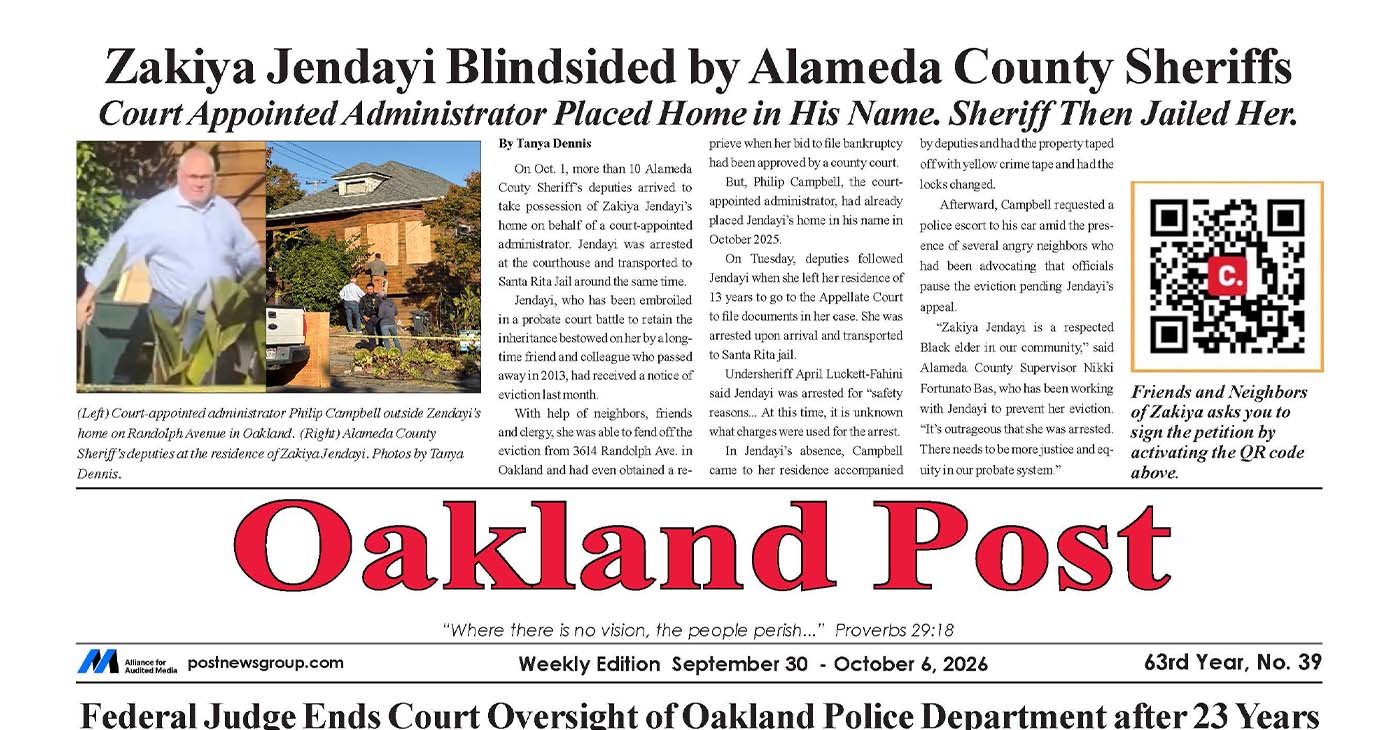
To enlarge your view of this issue, use the slider, magnifying glass icon or full page icon in the lower right corner of the browser window.
Activism
Oakland Post: Week of September 23 – 29, 2026
The printed Weekly Edition of the Oakland Post: Week of September 23 – 29, 2026

To enlarge your view of this issue, use the slider, magnifying glass icon or full page icon in the lower right corner of the browser window.
Activism
Oakland Post: Week of September 16 – 22, 2026
The printed Weekly Edition of the Oakland Post: Week of September 16 – 22, 2026

To enlarge your view of this issue, use the slider, magnifying glass icon or full page icon in the lower right corner of the browser window.


OP-ED: Proposition 44 Would Put a Price on Trust

OP-ED: Proposition 40: It’s Time to Play Chess, Not Checkers

Listening as a Lifeline: A Doula’s Witness to Black Maternal Health

New Protections for Ticket Buyers: Gov. Newsom Signs Assemblymember Isaac Bryan’s Bill

‘We Don’t Talk Trash — We Pick Up Trash!’

Zakiya Jendayi Arrested, Locked Out of Home by Sheriff’s Deputies

Oakland Post: Week of September 30 – October 6, 2026

Asm. Corey Jackson Announces Launch of 24-Hour Childcare in His District

IN MEMORIAM: The Rev. Leon “Sonny” Clark, Longtime Orange County Pastor and Community Leader, Dies at 72

Poll: Becerra Widens His Lead Over Hilton; Californians Split on Wealth Tax

From Historic Memories to New Possibilities: Oakland Celebrates Coliseum 60

County Office of Education Says OUSD Finances Are Getting Healthier, Materially Stronger

LIVE FREE Sunday Dinner Brings Faith, Fellowship and Civic Conversation to Oakland

Remembering Chauncey Bailey as Student Journalists Face Threats to Truth-Telling

BLACspace Cooperative Invites Bay Area to Experience Oakland’s Black Cultural Ecosystem Through a BLAC Map Tour + Party

Standoff for Justice: Our Homes Are Worth Fighting For

Oakland Post: Week of August 26 – September 1, 2026

Frontier Airlines’ Return to Oakland Airport Brings Flights, Jobs and Opportunity

Jackie Wright Champions Bay Area Stories, Filmmakers and Cultural Institutions

Gubernatorial Candidate Steve Hilton Blasts California New Tire Rules; Newsom Hits Back

Chef Sharon Lee Blends Culinary Excellence, Education and Empowerment

Misnamed ‘Parent’ PAC Seeks to Influence Oakland School Board Elections

Oakland Coliseum Project Opens Door for Small Businesses to Build Bigger

Big City Mayors Ask for “Yes” Vote on Housing Bond Measure; Conservatives Say “No”

Gov. Newsom’s Latest Appointees Include Sacramento Advocate for Formerly Incarcerated Students; State’s New Tech Chief

Oakland Post: Week of September 2 – 8, 2026

Longtime BWOPA Member Brendalyn Goodall Appointed to California Workforce Development Board

Gov. Newsom Signs Law Shielding Immigration Aid Workers From Doxing Threats

Secretary of State Shirley N. Weber Urges Californians to Vote Early as Voter ID Battle Intensifies

Oakland Post: Week of September 9 – 15, 2026

The Conversation With Al McFarlane 6/23/26

Media Monday 6/22/26

LIVE! ASK ALMA! — TUES. 6.23.26 7PM EST

Car Buying Secrets: 4 Hidden Checks Before You Sign!

Is This 550 HP Charger Worth YOUR Money? AutoNetwork Review

Celebrating Juneteenth – Frederick Douglass on education and resistance

LIVE! — ASK ALMA! — TUES. 6.19.26 7PM EST

Hyundai Ioniq 5 Parking, Safety, and 360 View #shorts

2025 Ioniq 5 New Wiper & Powerful Performance! #shorts

Electric SUV Range: Is 259 Miles Enough? #shorts

EV Charging: How Fast Can You Charge an Electric Vehicle? #shorts

Biometric Cooling… Messaging Seats…Come on! 2025 Infiniti QX80 Autograph 4WD

Charged Up: Witness the Magic of a Fully Electric Car! #shorts

Range Rover Sport PHEV Included…: See What’s Inside This Luxury SUV! #shorts

Invisible Hood View: Perfect Parking with X-Ray Vision! #shorts
-
 Community4 weeks ago
Misnamed ‘Parent’ PAC Seeks to Influence Oakland School Board Elections
-
 Activism4 weeks ago
Oakland Post: Week of September 9 – 15, 2026
-

 Community4 weeks ago
Richmond Tiny House Village Farm & Garden Set to Open Gates on Sept. 26
-

 Black History4 weeks ago
Latest Massacre in Haiti Reveals Cruelty U.S. Deportations
-

 Black History4 weeks ago
OPINION: Nolan Wells’ Death One of Several Signifying Racial Terror Lives on in U.S. South
-

 Business3 weeks ago
Mayor Lee Announces $1 Million Kaiser Permanente Grant for Pilot Program to Address Homelessness, Clean Up Public Spaces throughout Oakland
-

 Community4 weeks ago
Democratic Clubs Interview Candidates for Oakland School Board
-
 Economy2 weeks ago
Poll: Becerra Widens His Lead Over Hilton; Californians Split on Wealth Tax
