
Entertainment
Film Review: American Sniper


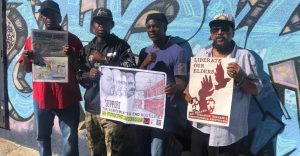
Luke Grimes and Cory Hardrict as play young G.I. s in the war drama American Sniper.
By Dwight Brown
NNPA Film Critic
This well-produced but flawed bio/war/drama follows the armed forces career and subsequent malaise of ex- Navy Seal Chris Kyle. He was a legendary sniper who did four tours of duty in Iraq. His steely, icy demeanor gave him a steady aim, but didn’t protect him from the fragile aftermath of war, particularly Post Traumatic Stress Disorder (PTSD). The film fluctuates between his achievements in battle and is ordeal back home.
Telling Kyle’s story is the purview of filmmaker Clint Eastwood, who directed Flags of Our Fathers and Letters From Iwo Jima and is well acquainted with the war film genre. As was the case with those aforementioned films, Eastwood’s style is never climactic. He prefers a moderate pace and a straightforward style that doesn’t add anything new to the game. Helicopters buzz over Iraq. Soldiers on both sides of the battle are killed. But nothing stands out and everything appears routine, considering it’s war. The proceedings lack the verve and staccato pacing that made Katherine Bigelow’s Zero Dark Thirty a jaw-dropping experience. His languishing, overly choreographed, and pat approach makes the footage feel flat and undistinguished.
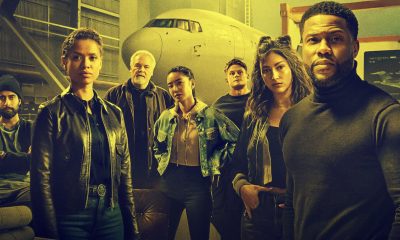
After a grueling training, Chris Kyle (Bradley Cooper) becomes a Navy Seal sniper. A sharp shooter as a kid, his skill peaks in Iraq where, he can protect platoons by accurately shooting a hostile target from as far away as a football field. Deadeye? The man kills 160 insurgents. When fellow soldiers praise him, Kyle is never less then humble. His subdued demeanor is the exact opposite of the anger and rage he incites from enemy forces who put a price on his head. No wonder they call him “Legend.”
Kyle’s Navy Seals, who’ve teamed up with brave Marines, find something to focus on in the helter skelter war. It’s the demonic Al Qaeda terrorist Abu Musab al-Zarqawi and his maniacal partner The Butcher (Mido Hamada); the latter tortures victims and snitches with power drills. As Kyle and his crew hone in on the new enemies, a sharpshooter, whose talents rival Kyle’s, scopes them out. Mustafa (Sammy Sheik), a Syrian sniper, has Kyle and his men in his crosshairs. First one to pull the trigger wins.
The script by Jason Hall, based on the bestselling autobiography by the real Chris Kyle with Scott McEwen and Jim DeFelice, has plenty of slow, forward motion. When things get too tense, the plotline throws in a flashback for relief. Kyle meeting his soon-to-be-wife Taya (Sienna Miller) in a bar, trips back home on leave, the birth of two sons, phone calls from the front lines; these mini scenes flesh out the imperfect human man behind the perfect aim – to varied affect.
You get a vague sense of the soul of this heroic soldier who tries to balance a dangerous existence with an infrequent family life. But it’s hard to feel compassion for him. He’s too strong a man. If the story followed a weaker person, perhaps a less successful marksman trying to prove himself with a save-the-day shot, he’d be a more compelling protagonist. As is, there’s an emotional shield around Kyle that is impenetrable, even as he descends into a living hell: “It’s not the people you saved that you remember. It’s the ones you couldn’t save. Those are the faces and situations that stay with you forever.”
Bradley Cooper’s performances are not known for their range. He lacks the emotional wallop and elasticity of a Christian Bale. He’s O.K. as the goof in the Hangover series. He stumbled across a golden opportunity with Silver Linings Playbook and turned that part, as an ex-mental patient with a bipolar disorder, into the role of a lifetime. However, he does nothing to get you under the skin of Chris Kyle. Nothing. He packed on weight for the role, but that girth isn’t a substitute for an intuitive or gifted character interpretation.
Sienna Miller, in only glimpses as the reluctant girlfriend turned into the concerned wife/mother, shows more depth and proves far more capable of cementing her dutiful and increasingly alarmed spouse persona. She is Kyle’s only beacon out of his darkness. She is believable. Ben Reed as Wayne Kyle, the weaker younger brother, acts the part; never as strong, smart or good as his sibling. Sammy Sheik (Lone Survivor and TV’s 24) as the stealth shooter Mustafa rarely speaks but powerfully commands the screen. Luke Grimes (Taken 2) and Cory Hardrict (Gran Torino) as play young buck soldiers with a very credible G.I. swagger
Tom Stern’s (Changeling) cinematography, Joel Cox (Unforgiven) and Gary Roach’s editing and the production design by Charisse Cardenas and James J. Murakami (Changeling) make the visuals impressionable. If the film has any air of realism, it’s because of their contributions. Clint Eastwood composed “Taya’s Theme,” the main theme music, which enhances the film in the right places. His taste in music is impeccable.
There will be better films that explore PSTD. They’ll be better if they focus on a sympathetic soldier and not a cold-blooded killer. They’ll be better if a filmmaker with more vigor and innovation directs them. Also, if you see this film and walk out the theater feeling like you just watched 134 minutes of pro-war propaganda, it means the film failed as a character study because it spent too much time on the battlefield.
Visit NNPA Film Critic Dwight Brown at DwightBrownInk.com.
###









Activism
Oakland Post: Week of September 9 – 15, 2026
The printed Weekly Edition of the Oakland Post: Week of September 9 – 15, 2026

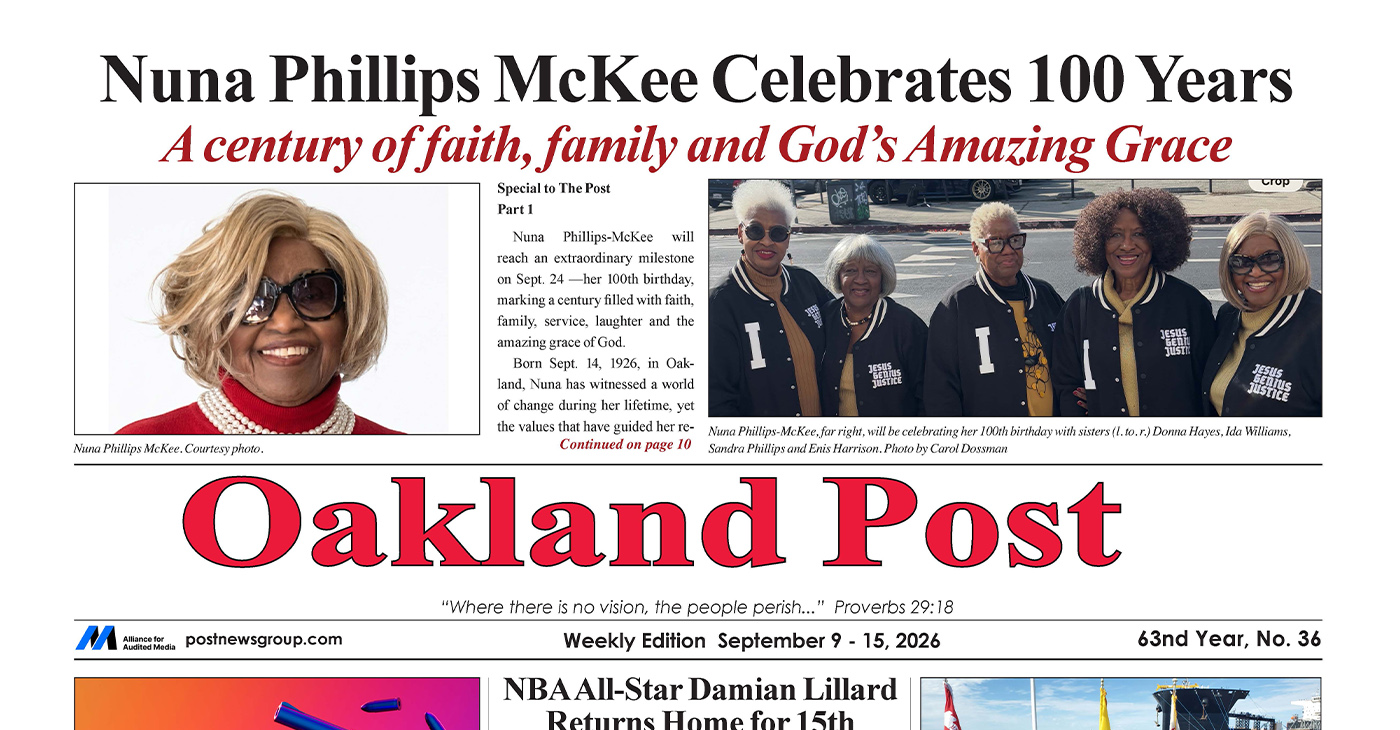
To enlarge your view of this issue, use the slider, magnifying glass icon or full page icon in the lower right corner of the browser window.

Activism
Oakland Post: Week of September 2 – 8, 2026
The printed Weekly Edition of the Oakland Post: Week of September 2 – 8, 2026
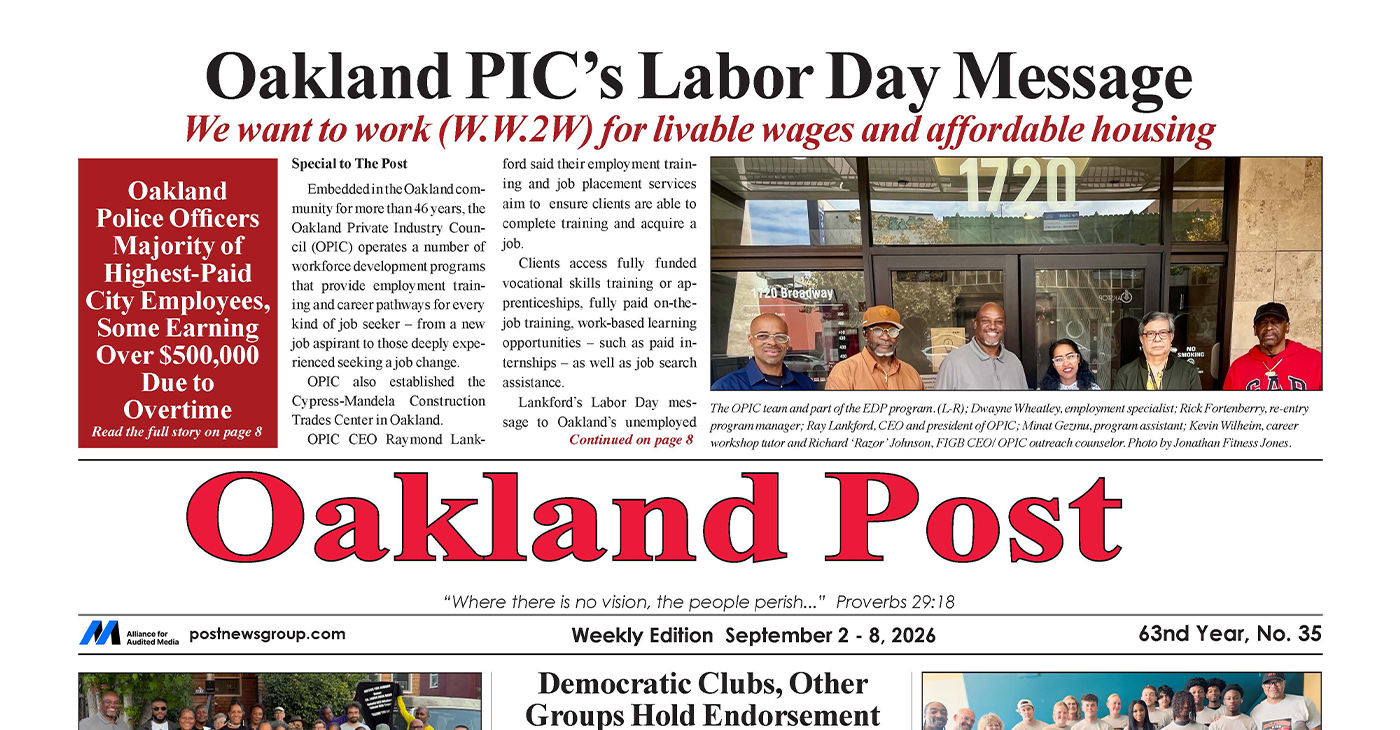
To enlarge your view of this issue, use the slider, magnifying glass icon or full page icon in the lower right corner of the browser window.
Black History
Jackie Wright Champions Bay Area Stories, Filmmakers and Cultural Institutions
As an award-winning communications professional, Wright has worked with corporations, nonprofits, government agencies, educational institutions, artists, and community organizations. In 2026, she expanded that work by launching an introductory public relations class for small businesses and nonprofits, offering practical tools for gaining visibility, shaping messages and building productive relationships with the media.


Jackie Wright has spent more than two decades helping people, organizations and communities understand the power of a well-told story.
As founder and president of Wright Enterprises, a San Francisco-based strategic communications and public affairs firm, Wright has built a career spanning journalism, public relations, media relations, crisis communications, community engagement and multimedia storytelling.
As an award-winning communications professional, Wright has worked with corporations, nonprofits, government agencies, educational institutions, artists, and community organizations. In 2026, she expanded that work by launching an introductory public relations class for small businesses and nonprofits, offering practical tools for gaining visibility, shaping messages and building productive relationships with the media.
Wright’s commitment to storytelling is also deeply personal. She wrote and co-directed the 15-minute documentary, “Love Separated in Life…Love Reunited in Honor,” which chronicles the story of her parents, Specialist Five (S5 Wyley Wright Jr. and Ouida Fay McClendon Wright. Her father, a U.S. Army helicopter crew chief, died in Vietnam in 1964 while serving as an honor guard during a visit by then-Secretary of Defense Robert McNamara. Decades later, Wright and her siblings had their father exhumed from a segregated cemetery in Jacksonville, Florida, and their mother moved from her burial place in Georgia so the couple could be reunited at Arlington National Cemetery in 2014.

The family journey later took Wright and her sister to Vietnam, where they discovered the former military compound that had been named in honor of their father and another fallen soldier. The documentary, centered on love, war, family, racial understanding, and remembrance, earned festival recognition at screenings.
“It was quite an honor to learn about my family’s history and share it on film,” said Wright.
That filmmaking experience complements Wright’s longstanding advocacy for independent cinema. She has served as a media partner and brand ambassador for Bay Area film festivals, including the San Francisco Black Film Festival, Oakland International Film Festival, and the Durban International Film Festival in South Africa.
“It’s important to help filmmakers and underrepresented stories reach broader audiences,” said Wright.
Whether promoting a neighborhood organization, championing an independent filmmaker or preserving her own family history, Wright has remained consistent. Through Wright Enterprises, she has turned communications into both a profession and a form of community service, telling stories that might otherwise go unheard.
“Our stories are an integral part of our history, and our history is not only American history, but worldwide,” she said.



Port of Oakland, Army Corps Sign Historic Harbor Design Agreement

Democratic Clubs Interview Candidates for Oakland School Board

Nuna Phillips-McKee Celebrates 100 Years: ‘A Century of Faith, Family and God’s Amazing Grace!’

D.A. Ursula Jones Dickson: Terminix to Pay $3.15 Million Over Illegal Disposal of Pesticides, Customer Records

REPORT: Community Level Policy Is Impacting Homelessness and Drug Abuse in California

OPINION: AI Needs to Know Who Is the Boss
Goldi-Locs and Two (or Three) Bears in the Forest in California Hills

Election Watch 2026: 85% of Eligible Voters in California Are Registered

Don’t Let scammers Crash Your School Year

BOOK REVIEW — Curved Air: A Biography of Sickle Cell Anemia and the Quest to Cure the First Molecular Disease

California’s Legal Cannabis Market Hits $8 Billion as State Touts Progress on Fighting Drugs, Crime

Blacks and Latinos Clash Over LA’s Barrio Run; Mayor Karen Bass Calls for Dialogue Across Racial, Neighborhood Lines

Asm. Smallwood-Cuevas’s Bill Repealing ‘Racist’ CalWORKs ‘Man-in-the-House’ Rule Clears Legislature

Asm. Smallwood-Cuevas’s Bill Repealing ‘Racist’ CalWORKs ‘Man-in-the-House’ Rule Clears Legislature

‘Ready to See These Bills Become Law’: Sen. Weber’s Package of 15 Bills Advance to Gov. Newsom’s Desk

Department of Homeland Security Demands California Secretary of State Shirley N. Weber Scrub Voter Rolls

“The Power to See Threats Sooner”: Gov. Newsom, Safety Officials Showcase California’s Investments in Hi-Tech Wildfire Prevention

Alpha Kappa Alpha Sorority, Inc. Celebrates New North Atlantic Regional Director

California Sen. Padilla Joins Colleagues to Introduce Bill Imposing Term Limits on Supreme Court Justices

Less Affluent School Districts, Including Sacramento City, Face Threat of State Takeover

Car Wash Workers Cope with Lingering Impacts of ICE Raids

ESSAY: California Can Close Its Colorectal Cancer Gap

Oakland Post: Week of August 5 – 11, 2026

As Part of Your Back-to- School Checklist, Vaccinate

Oakland ‘Port Serves as a Powerful Engine for Good Jobs and Economic Development

Gov. Newsom Signs New Affordable Housing Legislation

Gov. Newsom Announces $109.6 Million in Funding for 278 Supportive Homes in Bakersfield, Contra Costa, Sacramento and Fresno

California Hispanic Chambers of Commerce Unveils: ‘Powering the Future’ Theme for 47th Annual Statewide Convention

Closing the Gap: What the Data and Frontline Experiences Reveal About Cancer in Black California

Congresswoman Simon Demands Investigation into Trump’s Abuse of Emergency Powers for Coal Export Terminal in West Oakland

The Conversation With Al McFarlane 6/23/26

Media Monday 6/22/26

LIVE! ASK ALMA! — TUES. 6.23.26 7PM EST

Car Buying Secrets: 4 Hidden Checks Before You Sign!

Is This 550 HP Charger Worth YOUR Money? AutoNetwork Review

Celebrating Juneteenth – Frederick Douglass on education and resistance

LIVE! — ASK ALMA! — TUES. 6.19.26 7PM EST

Hyundai Ioniq 5 Parking, Safety, and 360 View #shorts

2025 Ioniq 5 New Wiper & Powerful Performance! #shorts

Electric SUV Range: Is 259 Miles Enough? #shorts

EV Charging: How Fast Can You Charge an Electric Vehicle? #shorts

Biometric Cooling… Messaging Seats…Come on! 2025 Infiniti QX80 Autograph 4WD

Charged Up: Witness the Magic of a Fully Electric Car! #shorts

Range Rover Sport PHEV Included…: See What’s Inside This Luxury SUV! #shorts

Invisible Hood View: Perfect Parking with X-Ray Vision! #shorts
-

 Commentary2 weeks ago
Standoff for Justice: Our Homes Are Worth Fighting For
-

 Business2 weeks ago
Gubernatorial Candidate Steve Hilton Blasts California New Tire Rules; Newsom Hits Back
-

 Activism2 weeks ago
Oakland Post: Week of August 26 – September 1, 2026
-

 Education2 weeks ago
Gov. Newsom’s Latest Appointees Include Sacramento Advocate for Formerly Incarcerated Students; State’s New Tech Chief
-

 Business2 weeks ago
Frontier Airlines’ Return to Oakland Airport Brings Flights, Jobs and Opportunity
-

 Business2 weeks ago
Oakland Coliseum Project Opens Door for Small Businesses to Build Bigger
-

 Business2 weeks ago
Chef Sharon Lee Blends Culinary Excellence, Education and Empowerment
-

 Community2 weeks ago
Big City Mayors Ask for “Yes” Vote on Housing Bond Measure; Conservatives Say “No”
