
Housing
Faith Leaders Move Ahead on Creative Homeless Solution; Schaaf reluctant to back tiny homes on church properties

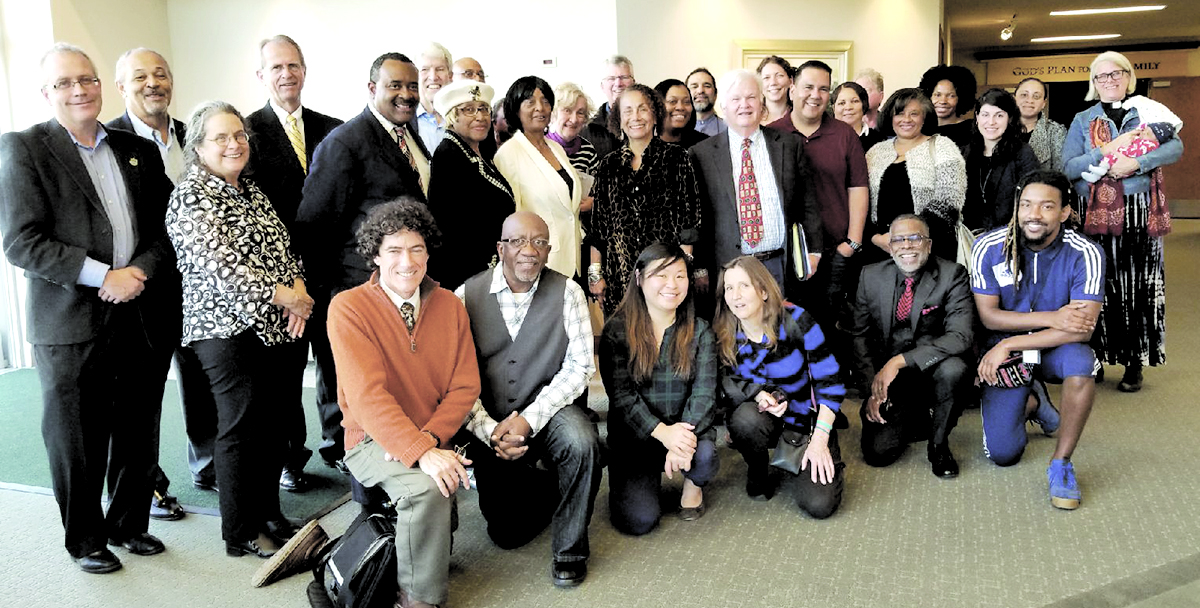
Members and supporters attend March 8 meeting of Interfaith Council of Alameda County (ICAC). Rev. Ken Chambers is shown at bottom, second from right.
The City of Oakland and Mayor Libby Schaaf have been reluctant to embrace a solution for homelessness that is being promoted by the Interfaith Council of Alameda County (ICAC). However, the project is moving ahead with the determination and creativity of faith leaders, community advocates, city council members and members of the Alameda County Board of Supervisors.
Under the plan backed by ICAC and others, local churches would lease their parking lots for temporary housing and safe car-parking areas, including bathrooms and garbage disposal, for homeless residents. Nonprofits, the county and other organizations would help cover the costs, and the city would provide the insurance coverage.
The churches, including as many as seven in West Oakland, would hire a coordinator who would work nightly to handle any issues that might come up at the encampments. One obstacle to the plan arose when the City Attorney Barbara Parker said money could not be spent for insurance.
ICAC members devised a work-around that would allow the project to continue.
Proposing an alternative, Mayor Schaaf has told ICAC members that she prefers to build permanent affordable housing on church property sites. Homeless advocates say long-term solutions are good, but action is needed now.

“ICAC supports affordable housing on church properties long term, but short term temporary small houses must happen immediately,” said West Oakland Pastor Ken Chambers, founder and president of ICAC.
“Churches have a vast amount of property in Oakland that is not being utilized during the week, especially at night hours,” he said. These are prime locations for homeless encampments for small houses and safe carparks.”
The churches also have facilities that can be used for classroom space for job and career training, as well as to provide county health and human services.
Pastor Chambers said he has visited homeless encampments, where he saw that many of the homeless were elderly.
“There are 3,000 unsheltered homeless living in Oakland, not counting those who are a step away from being out on the streets,” he said.
“This crisis did not happen overnight,” he continued. “It is a slow-moving disaster that has been growing for years.”
Pastor Chambers said ICAC has met with all the members of the City Council, and they are supporting the concept of the project. Especially helpful have been Councilmembers Rebecca Kaplan, Annie Campbell Washington, Abel Guillén and Noel Gallo and Alameda County Supervisors Nate Miley, Keith Carson and Wilma Chan.
Leaders of ICAC say it is crucial right now to let the homeless know that Oaklanders welcome them as part of the city and that residents demonstrate their humanity through actions that show they care about their neighbors in need.
On Good Friday, March 30, ICAC will meet at the Corinthian Baptist Church 920 Castro St. in Oakland, and march to downtown and West Oakland homeless encampment sites with care packages.
Among those participating in the march will be Rev. Chauncey Mathews of Corinthian Baptist; Rev. Jim Hopkin, pastor of Lakeshore Avenue Baptist Church; Rev. Thomas Harris, Pleasant Grove Baptist Church; Rev. Scott Denman, rector of St. John’s Oakland Episcopal Church; Blasé Bova, executive director St. Vincent de Paul; as well as Councilmembers Campbell Washington, Gallo and Kaplan.
“We will meet, have prayer and instructions, then march out to the homeless encampment sites with the care packages,” said Pastor Chambers.
Mayor Schaaf did not respond to a request for comment.
For more information call Rev. Ken Chambers, ICAC president, at 510-239-6969 kenchambers1@yahoo.com interfaithac.org













Business
COMMENTARY: Your California Living Trust Could Be Next: When Evidence Isn’t Enough
A recent California appellate ruling in the case of the Laura Dean Head Living Trust serves as a sobering warning for property owners relying on estate planning. Despite Dr. Head’s express written wishes to disinherit her estranged sisters and name a longtime friend as beneficiary, the court invalidated the trust based on undue influence. This decision highlights how documented intentions and supporting testimony from legal and medical professionals may still face successful legal challenges from disinherited relatives. Read more to see how this precedent impacts California homeowners.


You put your home in a living trust. You choose who inherits. You expressly disinherit relatives. An attorney prepares the documents. You expect your wishes to survive you.
Dr. Laura Dean Head’s trust did not.
California property owners should examine Laura Dean Head Living Trust, Alameda County Superior Court, Oakland, Case No. RP20061734, and Hamlin v. Jendayi, California Court of Appeal, First Appellate District, Division Three, Case No. A167695.
The case delivers a sobering warning: a living trust can face a successful challenge even when its chosen beneficiary presents evidence supporting the person’s stated wishes.
Head, a San Francisco State University professor, named Zakiya Jendayi as successor trustee and primary beneficiary. They had known each other for 28 years. Seven years after Dr. Head’s death, her estranged sisters contested the trust. Jendayi alleges that they consulted various probate attorneys while forum shopping before pursuing the challenge. Judge Sandra K. Bean in Dept. 103 invalidated the trust based on undue influence.
Jendayi’s compilation, “The Truth Is in the Transcriptions,” places disputed findings beside testimony and medical records. She argues that the evidence tells a different story.
Estate planning attorney Elaine Lee testified that she reviewed the trust privately with Head, behind a closed door. Lee’s testimony, reproduced in the compilation, attributes the beneficiary choices to Head and describes her insistence that her sisters receive nothing.
Hospice social worker Jenna Noe confirmed that Head told her she wanted to leave her belongings to Jendayi. Noe also testified that Head made her own decisions in their conversations.
The court described complete dependence on Jendayi. The compilation points to paid caregivers, hospice professionals and frequent visits from friends. When the judge asked nurse Dolly Woodson whether she had witnessed Jendayi abusing Head, Woodson answered no.
Jendayi also challenges the court’s treatment of her conditional power of attorney and alleges omissions and unequal treatment of evidence.
Yet the appellate court affirmed the judgment. It found substantial evidence supporting undue influence, rejected the judicial-bias claims and deemed any deficiencies in the statement of decision harmless. The published portion held that disinherited potential intestate heirs had standing to contest the trust.
That ruling endangers Californians who have properties held in a trust. Disinheritance did not prevent this challenge, and evidence supporting Head’s intentions did not secure the outcome Jendayi sought.
For homeowners relying on a living trust, the question is urgent: how well will your documented choices withstand a contested courtroom narrative?
Read the decision at https://law.justia.com/cases/california/court-of-appeal/2024/a167695m.html
Examine the testimony. Consider what happened when a woman’s written wishes and the evidence offered to defend them were still not enough.
Sources: Hamlin v. Jendayi (2024) 105 Cal.App.5th 1064, opinion filed Oct. 17, 2024, modified Nov. 12, 2024; Jendayi’s supplied compilation of transcript excerpts and exhibits. Claims of error reflect Jendayi’s position.

Commentary
Oakland Probate Dispute Raises Questions About Court-Ordered Property Transfer and Missing Notice
A legal dispute over an Oakland property has intensified following a tentative ruling that favored occupant Zakiya Jendayi, who claimed she was not properly notified before a judge ordered the property transferred into an estate. After the ruling, the estate’s administrator successfully challenged the presiding judge and requested the case be returned to the judge who signed the original transfer order. The First District Court of Appeal has now intervened to review the disqualification process and recent changes to the court docket. Read more.

Opinion and documentary analysis | Part 2 of 2
A tentative ruling found that Oakland property occupant Zakiya Jendayi had not received notice before a judge ordered its transfer into an estate.
The ruling was not final. Attention shifted to the assigned judge.
The estate’s special administrator, Phillip Campbell, invoked California Code of Civil Procedure Section 170.6 to disqualify Judge Stephanie Sato. The trial court granted the challenge Sept. 9, 2026.

Five days later, Campbell requested reassignment specifically to Judge Sandra Bean, who had signed the property order Jendayi sought to overturn.
The sequence raises questions about procedural fairness.
A Challenge After an Unfavorable Ruling
Sato’s Sept. 8 tentative ruling concluded that California’s notice requirement protected Jendayi as an occupant, regardless of whether Jendayi held a valid ownership interest.
Her proposed decision would have vacated Bean’s Oct. 8, 2025, order.
Section 170.6 permits challenges under certain circumstances. Whether Campbell’s challenge was timely was disputed.
On Sept. 14, Campbell sought Bean’s reassignment, citing her familiarity with related trust litigation, judicial economy and consistency. Jendayi opposed the request the following day.
The timing invites serious public scrutiny but does not establish misconduct.
The Appellate Court Intervenes
In Kaiser Foundation Hospitals v. Superior Court (1987), a California appellate court examined the danger of allowing litigants to learn a judge’s likely decision before seeking disqualification.
The decision also recognized that changed assignments and insufficient notice can affect when a challenge is permissible.
On Sept. 17, 2026, the First District Court of Appeal stayed the order granting Campbell’s challenge and requested briefing addressing Kaiser.
That intervention did not vacate Bean’s property order, restore the invalidated trust or conclusively decide whether Campbell’s challenge was improper.
It did place the reassignment dispute under appellate review.
Questions in the Docket
Two versions of the court docket present another unresolved issue.
A printout preserved through Sept. 15 lacked reassignment entries that appeared in a later version. The later docket listed reassignment to Bean and a clerk’s notice under Sept. 9.
The difference warrants an explanation of when the entries were created, entered and made publicly accessible.
It does not establish deliberate backdating.
Accountability Beyond an Order
Judges generally enjoy immunity from damages claims arising from judicial acts, even when serious error is alleged. That protection does not make their decisions immune from review.
Appellate courts can correct legal errors; California’s Commission on Judicial Performance can investigate misconduct but cannot reverse judgments.
For Jendayi, the central concern remains practical: How much litigation must an occupant undertake to enforce a notice requirement intended to protect participation before property rights are adjudicated?
The U.S. Supreme Court’s decision in Mullane v. Central Hanover Bank & Trust Co. underscores the importance of meaningful notice and an opportunity to object.
The record establishes contested filings, a tentative ruling and appellate intervention, not anyone’s private motives.
The public deserves a transparent, documented explanation of this consequential judicial process.
A judge’s signature should resolve a lawful dispute, not silence legitimate questions about how the decision was reached.
The case is Estate of Laura Dean Head, Alameda County Superior Court case RP20066047. Records are available through the court’s eCourt Public Portal.
Business
Veterans Housing Project Proposed for South Richmond
According to the development team’s presentation, the project has an estimated total cost of nearly $158 million. The presentation outlines five phases encompassing entitlement and construction documents, community outreach, soil remediation and utility work, podium and building construction, solar technology integration, and interior buildouts.

A proposed mixed-use development at 338 Carlson Blvd. could bring hundreds of homes and support services for military veterans to South Richmond.
Led by the Richmond-based Veterans Resource Program in partnership with Eagle Environmental Construction & Development, the proposal covers an approximately 2.3-acre property the nonprofit acquired in 2018.
The proposal features a multi-building residential development with various apartment sizes, though city documents and developer materials cite conflicting totals ranging from 226 to 268 units.
The proposal also includes approximately 40,000 square feet of commercial and retail space, about 200 parking spaces, and an entrepreneurial training and job-development component intended to connect veterans with economic and workforce opportunities.
According to the development team’s presentation, the project has an estimated total cost of nearly $158 million. The presentation outlines five phases encompassing entitlement and construction documents, community outreach, soil remediation and utility work, podium and building construction, solar technology integration, and interior buildouts.
Founded in 2011, the Veterans Resource Program provides housing assistance and other services to veterans, including those experiencing homelessness or transitioning from incarceration.

The proposal aims to advance Richmond’s affordable housing goals while connecting veterans with housing and supportive services. Details of affordability and veteran eligibility remain to be clarified.
The Richmond City Council was scheduled to receive an informational presentation on the project at its Oct. 6 meeting, following a continuance from Sept. 22. The item does not seek project approval or city funding. Any future request for city financial assistance or other public resources would require separate consideration and approval.



Oakland Post: Week of November 18 – 24, 2026

Oakland Post: Week of November 11 -17, 2026

Alameda County Supervisor Miley to Propose Illegal Dumping Ordinance

Oakland City Council Extends AI Data Center Moratorium for 10 Months.

On Veterans Day, U.S. Rep. Simon Demands Answers on Status of Veterans Affairs Clinic, Columbarium Project

OPINION: Mario Juarez’s Courtroom Admissions Raise Questions About Allegations That Fueled Recall of Pamela Price

Hutchinson Concedes: Ballots Still Being Counted in Oakland Board Elections

Mayor Lee and Schools’ Supt. Saddler Issue Joint Statement on Recent ICE Activity in Oakland

Mississippi Congressman Bennie Thompson Congratulates Scott Colom on Historic Victory

Farms to Grow, Inc. Hosts the 8th Annual Sweet Potato Pie Tasting Contest

Oakland Post: Week of November 4 – 10, 2026

How the Sandwich Generation Can Help Protect Aging Parents’ Finances

As Progressive Democrats Celebrate ‘Blue Tsunami,’ Oakland Counts Victories

Golden State Valkyries Become Bay Area Legends Winning WNBA Championship on Halloween Night

IN MEMORIAM: Marcia Ann Gillespie, Editor of Essence and Ms. Magazines, Dies at 82

COMMENTARY: Valarie Bachelor and Jennifer Brouhard are Excellent School Board Members and Deserve to Be Reelected

OUSD Receives State Review of District Finances; Outlines Progress Since January

HISTORY MADE: Keisha Lance Bottoms Becomes First Black Woman Elected Governor in American History

SEIU Local 1000 and State of California Will Continue to Negotiate New Labor Contract
Golden State Valkyries Become Bay Area Legends Winning WNBA Championship on Halloween Night

Fate of Bay Area Public Transit Hinges on Regional Transit Measure

COMMENTARY: Your California Living Trust Could Be Next: When Evidence Isn’t Enough

Chase Launches Fraud & Scam Prevention Month

Mayor Barbara Lee Holds Special State of the City Address in Deep East Oakland

Democrats, Community Groups Back Measure EE to Change How Oakland Is Governed

It’s Time to Lose Weight Before the Holidays

Post News Group Nov. 3 Election Endorsements

Richmond Neighbors Put Pantry Power on the Map

Oakland Awarded More than $14 Million in State Funding

Oakland Post: Week of October 7 – 13, 2026

The Conversation With Al McFarlane 6/23/26

Media Monday 6/22/26

LIVE! ASK ALMA! — TUES. 6.23.26 7PM EST

Car Buying Secrets: 4 Hidden Checks Before You Sign!

Is This 550 HP Charger Worth YOUR Money? AutoNetwork Review

Celebrating Juneteenth – Frederick Douglass on education and resistance

LIVE! — ASK ALMA! — TUES. 6.19.26 7PM EST

Hyundai Ioniq 5 Parking, Safety, and 360 View #shorts

2025 Ioniq 5 New Wiper & Powerful Performance! #shorts

Electric SUV Range: Is 259 Miles Enough? #shorts

EV Charging: How Fast Can You Charge an Electric Vehicle? #shorts

Biometric Cooling… Messaging Seats…Come on! 2025 Infiniti QX80 Autograph 4WD

Charged Up: Witness the Magic of a Fully Electric Car! #shorts

Range Rover Sport PHEV Included…: See What’s Inside This Luxury SUV! #shorts

Invisible Hood View: Perfect Parking with X-Ray Vision! #shorts
-
 Commentary3 weeks ago
COMMENTARY: Valarie Bachelor and Jennifer Brouhard are Excellent School Board Members and Deserve to Be Reelected
-
 Education3 weeks ago
OUSD Receives State Review of District Finances; Outlines Progress Since January
-
 Black History2 weeks ago
HISTORY MADE: Keisha Lance Bottoms Becomes First Black Woman Elected Governor in American History
-
 Business3 weeks ago
SEIU Local 1000 and State of California Will Continue to Negotiate New Labor Contract
-
 Community2 weeks ago
Golden State Valkyries Become Bay Area Legends Winning WNBA Championship on Halloween Night
-
 Business4 weeks ago
Fate of Bay Area Public Transit Hinges on Regional Transit Measure
-
 Business3 weeks ago
COMMENTARY: Your California Living Trust Could Be Next: When Evidence Isn’t Enough
-
 Business4 weeks ago
Chase Launches Fraud & Scam Prevention Month
