
Activism
‘Empathy and Curiosity:’ How queen jaks is Helping Haas Make Teaching More Inclusive
Over the past year, queen has been helping Haas faculty navigate the minefield of changing mores and heightened awareness around a range of topics often referred to as diversity, equity, inclusion, justice, and belonging (DEIJB).


By Laura Counts
UC Berkeley News
When Dr. queen jaks walks into a Berkeley Haas classroom and sits in the back scribbling notes, students wonder what’s going on.
“They think the professor is in trouble and I’m there to get the dirt,” says queen, who writes her name with lowercase letters.
But as the school’s first diversity instructional support consultant, queen is not an enforcer. She’s there as an invited guest of faculty members who want help in making their teaching more inclusive.
“It’s so important to make it clear that I’m not there to tell people they’re doing something wrong. I’m not there to hear both sides,” she says. “I’m there because the instructor wants support.”
Unique role
Over the past year, queen has been helping Haas faculty navigate the minefield of changing mores and heightened awareness around a range of topics often referred to as diversity, equity, inclusion, justice, and belonging (DEIJB). Her role is unique: Rather being called in to mediate when things heat up, she coaches instructors individually—by observing classes, offering suggestions on course content, or consulting on issues that come up in class. She also teaches best practices through brief workshops and exercises.
Holding both an MBA and a PhD in organizational behavior, queen is fluent in the language of academia, while also drawing on her own experiences of feeling like an outsider who broke into that world as a first-generation student from an impoverished community. She grew up in San Diego and earned a BS in business administration from UC Riverside, going on for her MBA from the University of Redlands and her doctorate from Case Western Reserve University.

She approaches the job with empathy, curiosity, and a natural sense of humor.
“We’re all learning, we’re all going to make mistakes, and that’s okay,” says queen, whose own research focuses on the contributions of marginalized communities. “Society is evolving, and people want change really badly, so everything that comes out of your mouth in the classroom is going to be scrutinized. I’m here to say ‘I feel you. Now let’s turn it around and see how that might be perceived.’”
Haas Chief DEI Officer Élida Bautista dreamed up the new role in response to growing demand from students for more diversity in course content and on the faculty. In addition to the work Haas is doing to hire more diverse faculty members and an effort led by the Center for Equity, Gender and Leadership to compile a library of business cases featuring diverse protagonists, Bautista wanted to find a way to directly support current faculty. Dean Ann Harrison greenlighted the pilot position.
“When I looked around for consultants and talked to my counterparts at other business schools and universities, no one was doing this—so we didn’t really have a model,” Bautista says. As a clinical psychologist, she designed the role so that all services would be confidential and voluntary.
“Anytime you force people to do something, there’s an inherent resistance and that decreases the efficacy,” she said. “Some people think that when you make something voluntary, you end up preaching to the choir. But even the choir needs tuning: People who are bought into these ideas still need skills to carry them out, and they’ll end up bringing others along.”
Sensitive content
That’s what has happened. Associate Professor Juliana Schroeder—who championed the new role along with associate deans Jennifer Chatman and Don Moore and served on the hiring committee—offered to be a guinea pig for queen to observe her leadership class.
Schroeder is a social psychologist who has thought carefully about diversity and psychological safety in her teaching and materials. Still, on the day of the observation, when she was referencing the 1986 Challenger Space Shuttle explosion to shed light on decision-making pitfalls for a case study about car racing, a student had a “PTSD-like” incident in her classroom.
“He was an Army veteran, and this was directly relevant to his experience,” Schroeder says. “I was so glad queen was there that day, and I was blown away by how great her feedback was. It really illustrated what a benefit it was to have someone well-trained in these topics right there in my classroom.”
After the session, queen gave Schroeder a detailed report with suggestions on adjusting her script and offering both a written and verbal alert for sensitive topics. It also included a list of things she was doing well, and some practices to add—such as repeating back answers that were lower in volume, acknowledging students who were waiting to speak, and using contrasting colors on slides—as well as including photos in her slides that would show diversity beyond race and gender.
Word of mouth
Schroeder thought it was so helpful she asked to share it with other faculty members, and soon queen had a full calendar.
“Every single person I’ve worked with has been so receptive,” queen says. “I’ve spent a lot of time at business schools, and it’s been jaw-dropping how much Haas has embraced this.”
Associate Professor Mathijs De Vaan invited her to sit in on a session focused on DEIJB in his MBA course Leading People. De Vaan, who grew up in The Netherlands, is mindful that his class includes international students who may be new to American culture, as well as students with backgrounds that have been marginalized in the U.S.
“It’s a challenge. There’s always a group of students who are very knowledgeable and very vocal, and others who know these are sensitive subjects and are afraid to speak at all,” says De Vaan. “I wanted students to be on the same page in understanding the scope of the problem that racism and discrimination represent in the U.S., so I gave them a number of examples of where companies fell short.”
That’s important, queen told him, but it can also be stressful for some students. “For minority students in the room, it might reinforce the idea that their group is marginalized,” he says. To address this, in the next iteration of the class he focused less on examples of problematic situations, and more on possible solutions to societal challenges.













Activism
Oakland Post: Week of September 16 – 22, 2026
The printed Weekly Edition of the Oakland Post: Week of September 16 – 22, 2026

To enlarge your view of this issue, use the slider, magnifying glass icon or full page icon in the lower right corner of the browser window.
Activism
Oakland Post: Week of September 9 – 15, 2026
The printed Weekly Edition of the Oakland Post: Week of September 9 – 15, 2026

To enlarge your view of this issue, use the slider, magnifying glass icon or full page icon in the lower right corner of the browser window.
Activism
Oakland Post: Week of September 2 – 8, 2026
The printed Weekly Edition of the Oakland Post: Week of September 2 – 8, 2026
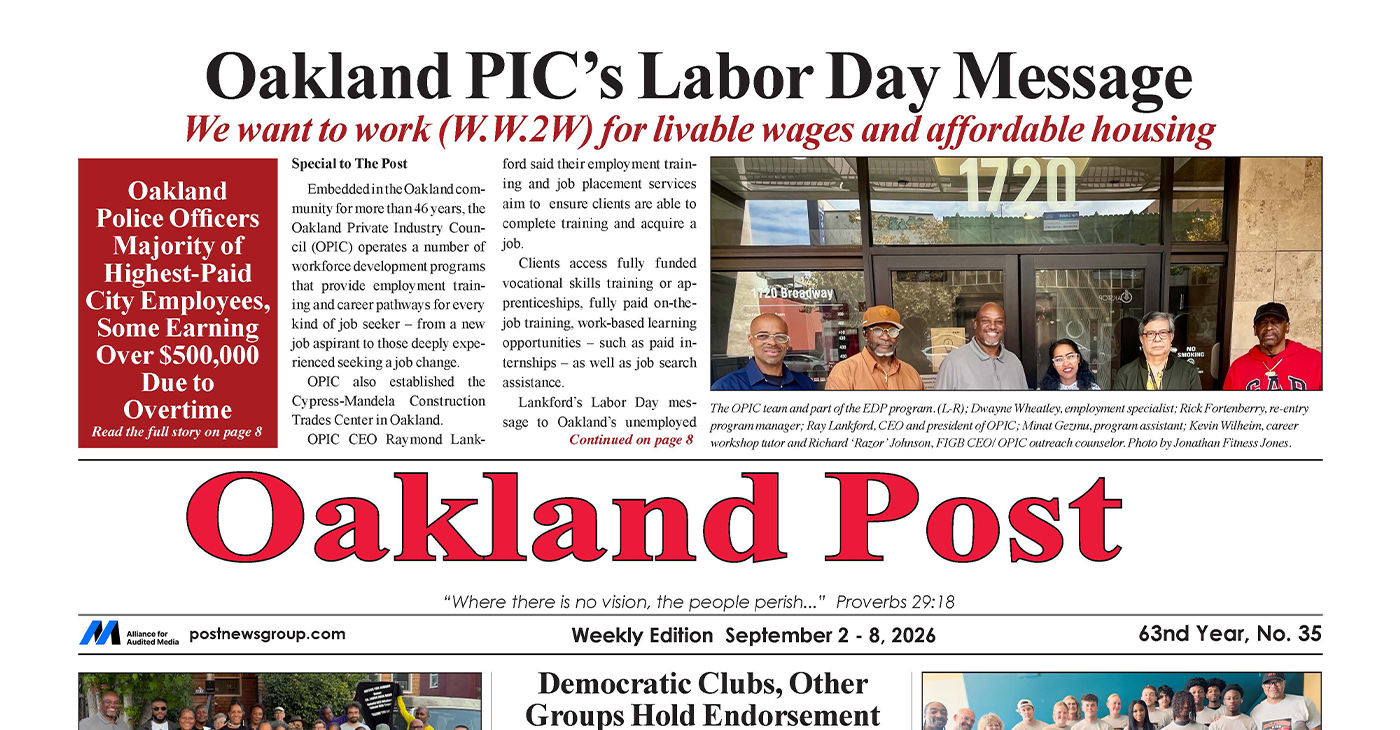
To enlarge your view of this issue, use the slider, magnifying glass icon or full page icon in the lower right corner of the browser window.



Doulas Are Helping Black California Moms Navigate Pregnancy–Even as High Mortality Rates Persist

Newsom Signs Addictive Social Media Law to Protect Kids

On Your November Ballot: Prop 38 Would Allocate $8.4 Billion to Immunology and Immunotherapy Funding

Ask California: Golden State Releases New AI Chatbot

Asm. Isaac Bryan’s Bill Banning California Police From ICE Side Jobs Reaches Newsom’s Desk

Assemblymember LaShae Sharp-Collins’s Bill Would Pause Law Enforcement’s Use of Shock Gloves Pending Study

BOOK REVIEW: ‘Laws of Solomon’ Reveals Tender Heart of Former Child Soldier

OPINION: The New American Fear – From 9-11 to AI

Passing for White, Fighting for Black America: The Courage of Walter White

Oakland People’s Arms Embargo Coalition Demands End to Military Shipments Thru Oakland

Barbara Lee Mourns Gloria Steinem, Remembers a Friendship Rooted in Equality

Event Preview: ‘Fashion v. Fascism’ – A Runway Revolution Is Coming to the Bay Area

Two Looming Threats Every Alameda County Elder Should Know About

Oakland Mayor Reads to Children at Bookout Block Party at Marcus Books Store

Tradition Comes to the Streets in 11th Annual Black-Eyed Pea Festival at the Freedom Farmers Market

Less Affluent School Districts, Including Sacramento City, Face Threat of State Takeover

ESSAY: California Can Close Its Colorectal Cancer Gap

California Hispanic Chambers of Commerce Unveils: ‘Powering the Future’ Theme for 47th Annual Statewide Convention

Four Candidates, Including Incumbent Barbara Lee, Qualify for Oakland Mayor’s Race

Oakland Post: Week of August 12 – 18, 2026

From Blueprint to Breakthrough: Tackling Affordable Housing in Oakland

Oakland Observes Black August with Block Parties, Film Showings, Workshops

COMMENTARY: Why Local School Tax Measure G1 Will Not Be on the November Ballot

Standoff for Justice: Our Homes Are Worth Fighting For

Returning to Its Roots, the Oakland Black-Eyed Pea Festival Partners with the Freedom Farmers Market Sept. 12

NPRC Scores First Advocacy Victory: David Shaw Finally Gets His Wish to ‘Go Home’

Oakland Post: Week of August 26 – September 1, 2026

Frontier Airlines’ Return to Oakland Airport Brings Flights, Jobs and Opportunity

Gubernatorial Candidate Steve Hilton Blasts California New Tire Rules; Newsom Hits Back

Chef Sharon Lee Blends Culinary Excellence, Education and Empowerment

The Conversation With Al McFarlane 6/23/26

Media Monday 6/22/26

LIVE! ASK ALMA! — TUES. 6.23.26 7PM EST

Car Buying Secrets: 4 Hidden Checks Before You Sign!

Is This 550 HP Charger Worth YOUR Money? AutoNetwork Review

Celebrating Juneteenth – Frederick Douglass on education and resistance

LIVE! — ASK ALMA! — TUES. 6.19.26 7PM EST

Hyundai Ioniq 5 Parking, Safety, and 360 View #shorts

2025 Ioniq 5 New Wiper & Powerful Performance! #shorts

Electric SUV Range: Is 259 Miles Enough? #shorts

EV Charging: How Fast Can You Charge an Electric Vehicle? #shorts

Biometric Cooling… Messaging Seats…Come on! 2025 Infiniti QX80 Autograph 4WD

Charged Up: Witness the Magic of a Fully Electric Car! #shorts

Range Rover Sport PHEV Included…: See What’s Inside This Luxury SUV! #shorts

Invisible Hood View: Perfect Parking with X-Ray Vision! #shorts
-
 Commentary4 weeks ago
Standoff for Justice: Our Homes Are Worth Fighting For
-
 Activism4 weeks ago
Oakland Post: Week of August 26 – September 1, 2026
-
 Business4 weeks ago
Frontier Airlines’ Return to Oakland Airport Brings Flights, Jobs and Opportunity
-
 Business4 weeks ago
Gubernatorial Candidate Steve Hilton Blasts California New Tire Rules; Newsom Hits Back
-
 Business4 weeks ago
Chef Sharon Lee Blends Culinary Excellence, Education and Empowerment
-

 Education4 weeks ago
Gov. Newsom’s Latest Appointees Include Sacramento Advocate for Formerly Incarcerated Students; State’s New Tech Chief
-

 Community4 weeks ago
Big City Mayors Ask for “Yes” Vote on Housing Bond Measure; Conservatives Say “No”
-

 Business4 weeks ago
Oakland Coliseum Project Opens Door for Small Businesses to Build Bigger
