
Entertainment
Diversity and Inclusion, First Report at Netflix
Inclusion according to Myers has been a “cultural value” at Netflix since 2017

Netflix is headquartered in Los Gatos, California and was founded in 1997 and began streaming programs in 2007. The company now has 203.7 million subscribers world-wide and 73 million in the United States.
Inclusion according to Myers has been a “cultural value” at Netflix since 2017.
“ . . . [W]hen you pair . . . culture with diversity and inclusion – it unlocks our ability to innovate, to be creative, to solve problems,” she said.
She adds that inclusion teams cannot do this alone: “[E]ach employee needs to look at every issue, decision, and meeting, inside and outside the company with inclusion in mind. We call this an “inclusion lens,” where employees ask questions like, whose voice is missing? Who is being excluded? Are we portraying this authentically?”
“When we get that right . . . magic is possible. We’re uplifting stories about Black British lives. We’re chronicling the life of a gay man with cerebral palsy on Tv, a first. We’re moving some of our cash into Black banks.”
The report goes on to talk specifically about representation “by the Numbers”:
A snapshot: women at 47.1% make up half the workforce with 47.8% of directors, 43.7% of vice presidents, and 47.6% of senior leadership.
Additionally, 46.4% of the company’s U.S. workforce and 42% of the leadership are from underrepresented racial or ethnic groups defined as Black, Latinx/Hispanic, Indigenous, Middle Eastern, Asian, and Pacific Islander.
Specifically, Black employees in the United States at Netflix make up 8% of the workforce and 9% of the leadership with 8,000 full time streaming employees as of October 2020.
Of course, Netflix is not only looking inward, but also at its content, realizing that the hires also impact the content and who gets access.
For example, the company’s employees have created access particularly addressing the lack of Black folks in the tech industry by launching a technical bootcamp with HBCU Norfolk University.
Netflix has also partnered with organizations like /dev/color/, techqueria, Ghetto Film School, and TalentoTotal.
During the pandemic events are virtual.
Netflix also commissioned USC Annenberg Inclusion Initiative to analyze the company’s content this year and every two years through 2026.
Key findings of the report, which analyzed 126 movies and 180 series, found that although white people still dominate both in front of and behind the camera, 15.2% of the original content on Netflix has Black leads or co-leads; 20% of the main cast members in movies were Black.
In terms of directors, 9.2% were Black (nine men and three women).
The report also showed that “Black creatives were much more likely to yield more Black leads and other characters.”
“When you have people of color in the room voicing their opinions, objecting, complaining and celebrating, it changes the texture of what you see,” said George C. Wolfe, director of “Ma Rainey’s Black Bottom.” “Diversity has to be a holistic assault. Without it, people are scared of making decisions because they don’t want to make wrong ones, so they end up making no decisions.”
The full report can be found at assets.ctfassets.net.
Wikipedia, CBS News, CNET, The Wall Street Journal, and Hollywood Reporter were sources for this article.





Activism
Oakland Post: Week of March 11 -17, 2026
The printed Weekly Edition of the Oakland Post: Week of March 11 – 17, 2026

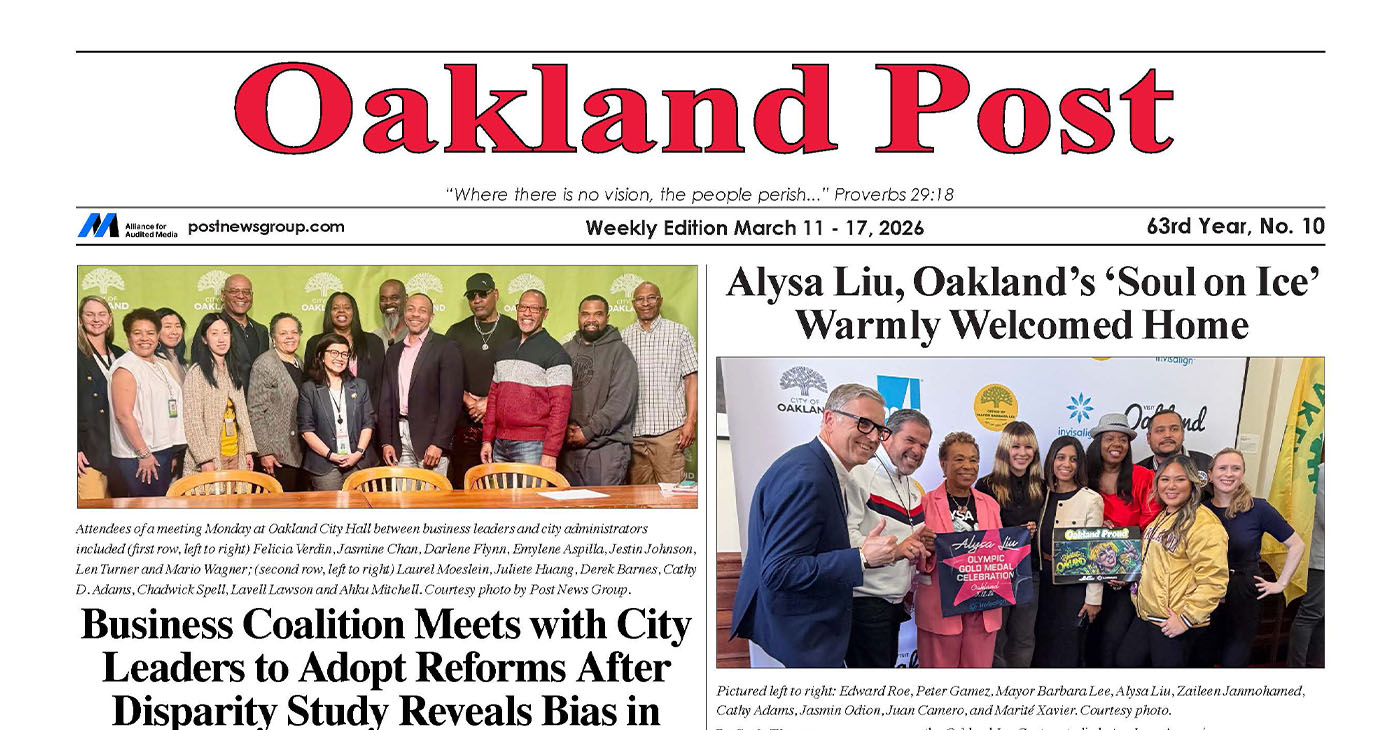
To enlarge your view of this issue, use the slider, magnifying glass icon or full page icon in the lower right corner of the browser window.

Activism
Oakland Post: Week of March 4 – 10, 2026
The printed Weekly Edition of the Oakland Post: Week of March 4 – 10, 2026

To enlarge your view of this issue, use the slider, magnifying glass icon or full page icon in the lower right corner of the browser window.
Activism
Oakland Post: Week of February 25 – March 3, 2026
The printed Weekly Edition of the Oakland Post: Week of – February 25 – March 3, 2026

To enlarge your view of this issue, use the slider, magnifying glass icon or full page icon in the lower right corner of the browser window.


WORK FROM HOME
Home-based business with potential monthly income of $10K+ per month. A proven training system and website provided to maximize business effectiveness. Perfect job to earn side and primary income. Contact Lynne for more details: Lynne4npusa@gmail.com 800-334-0540


Financial Wellness and Mental Health: Managing Money Stress in College

Oakland Post: Week of March 11 -17, 2026

Women & Wealth: Tips for Navigating Your Lifelong Financial Journey

COMMENTARY: Women of Color Shape Our Past and Future

Woman’s Search for Family’s Roots Leads to Ancestor John T. Ward – A Successful Entrepreneur and Conductor on the Underground Railroad

Advocates Raise Alarm Over ICE Operation, MOU and Detention Risks in Baltimore County

Pete Buttigieg to Join Mayor Randall Woodfin for Community Town Hall in Birmingham

WATCH: Week One – NNPA’s “Leadership Matters” Video Series

Oakland Post: Week of March 4 – 10, 2026

OP-ED: NNPA Launches 2026 “Leadership Matters” Video Series

PRESS ROOM: PMG and Cranbrook Horizons-Upward Bound Launch Journey Fellowship Cohort 2

Los Angeles Summit Brings Together Leaders to Tackle Poverty and Affordability

Civil Rights TV Launches 24/7 Network Focused on Black History, Education and Equity

REVIEW: The Ultimate Hot Girl Summer Getaway: Sunseeker Resort Florida

COMMENTARY: How You Stop a Prescription Medicine is as Important as How You Start

Book Review: Books on Black History and Black Life for Kids

Community Celebrates Turner Group Construction Company as Collins Drive Becomes Turner Group Drive

Discrimination in City Contracts

California Launches Study on Mileage Tax to Potentially Replace Gas Tax as Republicans Push Back

COMMENTARY: The Biases We Don’t See — Preventing AI-Driven Inequality in Health Care

Black History Events in the East Bay

Post Newspaper Invites NNPA to Join Nationwide Probate Reform Initiative

Art of the African Diaspora Celebrates Legacy and Community at Richmond Art Center

New Bill, the RIDER Safety Act, Would Support Transit Ambassadors and Safety on Public Transit

COMMENTARY: The National Protest Must Be Accompanied with Our Votes

Oakland Post: Week of February 4 – 10, 2026

Oakland Post: Week of February 11 – 17, 2026

Dorothy Lee Bolden: Uniting Domestic Workers

After Don Lemon’s Arrest, Black Officials Raise Concerns About Independent Black Media

Reflecting on Black History Milestones in Birmingham AL

Hyundai Ioniq 5 Parking, Safety, and 360 View #shorts

2025 Ioniq 5 New Wiper & Powerful Performance! #shorts

Electric SUV Range: Is 259 Miles Enough? #shorts

EV Charging: How Fast Can You Charge an Electric Vehicle? #shorts

Biometric Cooling… Messaging Seats…Come on! 2025 Infiniti QX80 Autograph 4WD

Charged Up: Witness the Magic of a Fully Electric Car! #shorts

Range Rover Sport PHEV Included…: See What’s Inside This Luxury SUV! #shorts

Invisible Hood View: Perfect Parking with X-Ray Vision! #shorts

AI Is Reshaping Black Healthcare: Promise, Peril, and the Push for Improved Results in California

ESSAY: Technology and Medicine, a Primary Care Point of View

Sanctuary Cities

The RESISTANCE – FREEDOM NOW

STATE OF THE PEOPLE: Freddie

ECONOMIC BOYCOTT DAY!!!!!

I told You So
-
 #NNPA BlackPress4 weeks ago
Reflecting on Black History Milestones in Birmingham AL
-
 #NNPA BlackPress4 weeks ago
PRESS ROOM: NBA Hall of Fame Nominee Terry Cummings Joins 100 Black Men of DeKalb County to Launch Victory & Values Initiative
-

 #NNPA BlackPress4 weeks ago
U.S. manufacturing rebounds – how foundry services are adapting to rising demand
-

 Activism3 weeks ago
Oakland Post: Week of February 25 – March 3, 2026
-

 #NNPA BlackPress4 weeks ago
OP-ED: One Hundred Years of Black Workers Telling the Truth
-

 #NNPA BlackPress4 weeks ago
Advancements in solar technology that are changing the way we power the world
-

 #NNPA BlackPress4 weeks ago
Trump’s MAGA Allies are Creating Executive Order Plan to Steal the 2026 Midterms
-

 #NNPA BlackPress4 weeks ago
PRESS ROOM: Civil Rights TV Launches in Selma as the World’s First 24/7 Civil Rights Television Network
