
Bay Area
Diversity Among Bay Area Elected Officials Improves, But Disparities Still Exist
Racial diversity among Bay Area elected officials increased during the 2020 election cycle, but new data shows wide disparities still exist across the region.


Racial diversity among Bay Area elected officials increased during the 2020 election cycle, but new data shows wide disparities still exist across the region.
The proportion of people of color holding top local offices increased from 26 percent in 2018 to about 34 percent after the 2020 elections, according to a report released this week by the Bay Area Equity Atlas.
Despite this increase, however, people of color remain highly underrepresented since they make up 60 percent of the total population, according to the report.
The same data shows white people are still overrepresented in the halls of power, accounting for 66 percent of officials elected to the region’s city councils, boards of supervisors and mayoral and district attorney’s offices, while making up just 40 percent of the population.
“A huge part of the reason why we put out the report is that representation matters, especially with all these difficulties we’ve seen arise over the past 17 months — the over-policing of BIPOC, violence against Asian elders, working class people and renters being left behind during the pandemic,” said Bay Area Equity Atlas associate Michelle Huang.
Huang, who co-authored the report with Bay Rising executive director Kimi Lee, said proportional representation doesn’t automatically lead to equitable policy making.
“But it is really important for local leadership to reflect the diversity of the community, especially communities that have been historically excluded from power,” she said.
In many cities and counties, however, the share of elected officials lags far behind population numbers.
For example, the share of Asian American elected officials has remained at about 10 percent for the past several years, but that’s far below the 26 percent of the Bay Area’s population who are Asian American.
Also, while Latinos now make up 13 percent of the region’s elected officials — up from 9 percent in 2018 — Latinos account for nearly 25 percent of the overall population, according to the report.
The report identifies 26 cities that still have zero people of color on their city councils and notes that while the proportion of Black elected officials increased from 6 percent to 8 percent across the region, 74 of 101 Bay Area municipalities still have no black city councilmembers.
“Across the region it seems like Black representation is on par with Black residents, but as we found, vast numbers of cities don’t have any Black representation and that’s astounding,” Huang said.
The report mentions several policy solutions that its authors believe would help people of color overcome racist, systemic barriers to voting and political participation, including publicly funding political campaigns and developing leadership programs for people of color, among other things.
One idea that’s already being implemented in several Bay Area cities involves switching from city-wide elections to district-based contests.
Out of the 20 cities from which sufficient data could be collected, 12 saw an increased presence of candidates of color after switching to district-based elections, which are typically less expensive and more easily accessible than city-wide elections.
For example, Livermore went from having no candidates of color before 2020 to having 50 percent in the 2020 election.
In Redwood City, where 18 percent of candidates were people of color in the 2015 and 2018 elections, 56 percent were people of color in the 2020 election and Half Moon Bay went from having no candidates of color to over a third of its candidates being people of color, according to the report.
“The early results are really promising,” Huang said.
To read the report, visit https://bayareaequityatlas.org/Electeds2021.
Also, on Sept. 9, the By Area Equity Atlas and Bay Rising will host a public webinar and panel discussion on the report’s findings. Panelists will include both authors as well as former Oakland Unified School District Board candidate Clarissa Doutherd, OUSD Board Director Shanthi Gonzales and Ellen Wu of Urban Habitat.
Register for the webinar at https://policylink.zoom.us/webinar/register/WN_mA9yAd2nQbuN3uvI5lq-ig.












Activism
Oakland Post: Week of September 16 – 22, 2026
The printed Weekly Edition of the Oakland Post: Week of September 16 – 22, 2026


To enlarge your view of this issue, use the slider, magnifying glass icon or full page icon in the lower right corner of the browser window.

Activism
Oakland Post: Week of September 9 – 15, 2026
The printed Weekly Edition of the Oakland Post: Week of September 9 – 15, 2026

To enlarge your view of this issue, use the slider, magnifying glass icon or full page icon in the lower right corner of the browser window.
Activism
Oakland Post: Week of September 2 – 8, 2026
The printed Weekly Edition of the Oakland Post: Week of September 2 – 8, 2026
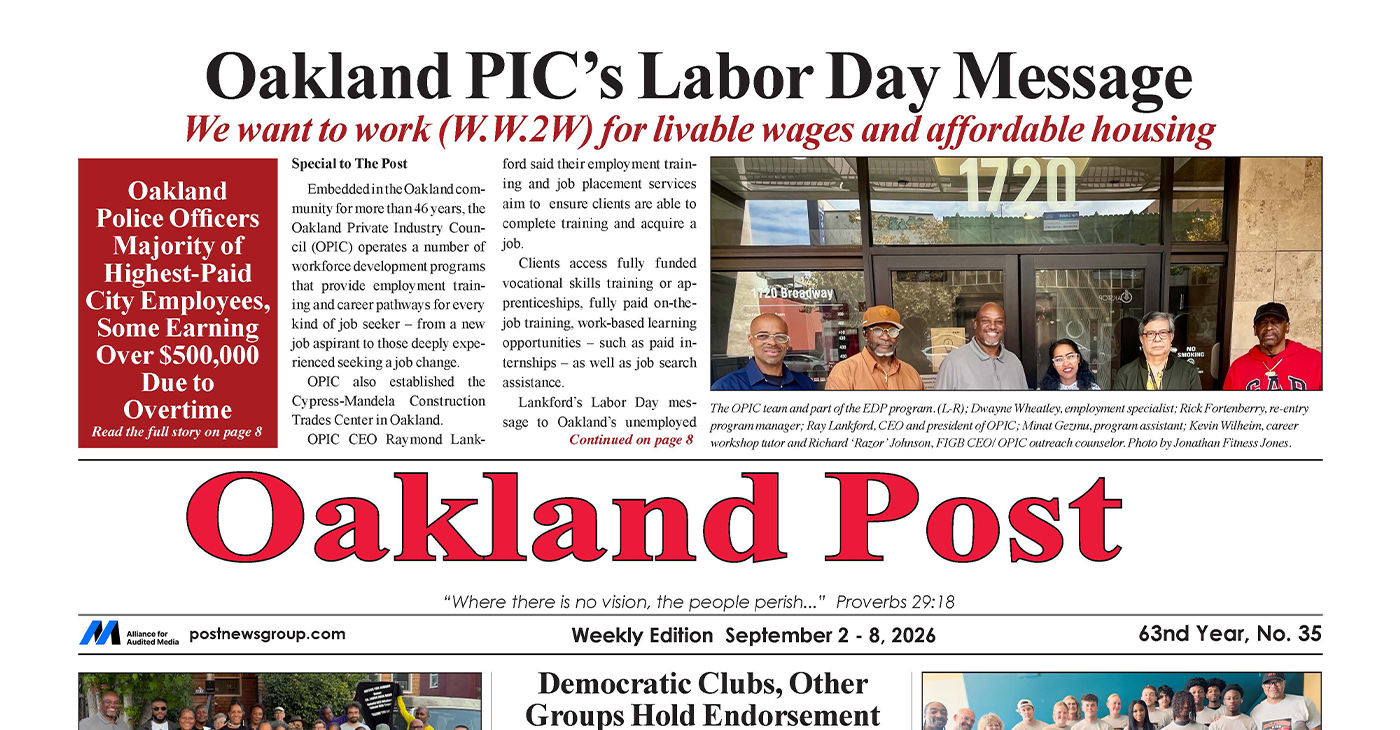
To enlarge your view of this issue, use the slider, magnifying glass icon or full page icon in the lower right corner of the browser window.



Oakland Mayor Reads to Children at Bookout Block Party at Marcus Books Store

Tradition Comes to the Streets in 11th Annual Black-Eyed Pea Festival at the Freedom Farmers Market

Attorney General Rob Bonta Continues Opposition to President Trump’s Tariff Regime

Neighborhood Empowerment Day in Deep East Oakland Brings Community Together After Recent Tragedy

Community Action Group ‘Friends of Zakiya’ Ask Sheriff for Time

Oakland Launches Aerbits Program to Identify, Report Abandoned Trash

Mayor Lee Announces $1 Million Kaiser Permanente Grant for Pilot Program to Address Homelessness, Clean Up Public Spaces throughout Oakland

Alameda County DA Ursula Jones Dickson Says Key to Optimal Use of DA’s Office Is Knowledge

Oakland Post: Week of September 16 – 22, 2026

NFL: Week Two Recap | Jalen Hurts did not fold; Caleb Williams exits game with injury

The Complete Negotiation Framework — Every Stage, Every Tactic, Every Win

Mazda CX-90 Luxury: Heated Seats & Premium Comfort! #shorts

Car Dashboard Glare: Avoid This Distraction! #shorts

Mazda CX-90 Safety: All Driver Assistance Features Explained #shorts

Subaru Outback: 19-Inch Wheels & 8.8″ Ground Clearance! #shorts

Department of Homeland Security Demands California Secretary of State Shirley N. Weber Scrub Voter Rolls

“The Power to See Threats Sooner”: Gov. Newsom, Safety Officials Showcase California’s Investments in Hi-Tech Wildfire Prevention

California Sen. Padilla Joins Colleagues to Introduce Bill Imposing Term Limits on Supreme Court Justices

Less Affluent School Districts, Including Sacramento City, Face Threat of State Takeover

Car Wash Workers Cope with Lingering Impacts of ICE Raids

ESSAY: California Can Close Its Colorectal Cancer Gap

As Part of Your Back-to- School Checklist, Vaccinate

Oakland ‘Port Serves as a Powerful Engine for Good Jobs and Economic Development

Gov. Newsom Announces $109.6 Million in Funding for 278 Supportive Homes in Bakersfield, Contra Costa, Sacramento and Fresno

California Hispanic Chambers of Commerce Unveils: ‘Powering the Future’ Theme for 47th Annual Statewide Convention

Congresswoman Simon Demands Investigation into Trump’s Abuse of Emergency Powers for Coal Export Terminal in West Oakland

Four Candidates, Including Incumbent Barbara Lee, Qualify for Oakland Mayor’s Race

Oakland Post: Week of August 12 – 18, 2026

From Blueprint to Breakthrough: Tackling Affordable Housing in Oakland

Oakland Observes Black August with Block Parties, Film Showings, Workshops

The Conversation With Al McFarlane 6/23/26

Media Monday 6/22/26

LIVE! ASK ALMA! — TUES. 6.23.26 7PM EST

Car Buying Secrets: 4 Hidden Checks Before You Sign!

Is This 550 HP Charger Worth YOUR Money? AutoNetwork Review

Celebrating Juneteenth – Frederick Douglass on education and resistance

LIVE! — ASK ALMA! — TUES. 6.19.26 7PM EST

Hyundai Ioniq 5 Parking, Safety, and 360 View #shorts

2025 Ioniq 5 New Wiper & Powerful Performance! #shorts

Electric SUV Range: Is 259 Miles Enough? #shorts

EV Charging: How Fast Can You Charge an Electric Vehicle? #shorts

Biometric Cooling… Messaging Seats…Come on! 2025 Infiniti QX80 Autograph 4WD

Charged Up: Witness the Magic of a Fully Electric Car! #shorts

Range Rover Sport PHEV Included…: See What’s Inside This Luxury SUV! #shorts

Invisible Hood View: Perfect Parking with X-Ray Vision! #shorts
-

 Commentary3 weeks ago
Standoff for Justice: Our Homes Are Worth Fighting For
-

 Activism3 weeks ago
Oakland Post: Week of August 26 – September 1, 2026
-

 Business3 weeks ago
Gubernatorial Candidate Steve Hilton Blasts California New Tire Rules; Newsom Hits Back
-

 Business3 weeks ago
Frontier Airlines’ Return to Oakland Airport Brings Flights, Jobs and Opportunity
-

 Business3 weeks ago
Chef Sharon Lee Blends Culinary Excellence, Education and Empowerment
-

 Education3 weeks ago
Gov. Newsom’s Latest Appointees Include Sacramento Advocate for Formerly Incarcerated Students; State’s New Tech Chief
-

 Business3 weeks ago
Oakland Coliseum Project Opens Door for Small Businesses to Build Bigger
-

 Community3 weeks ago
Big City Mayors Ask for “Yes” Vote on Housing Bond Measure; Conservatives Say “No”
