
Bay Area
Diversity Among Bay Area Elected Officials Improves, But Disparities Still Exist
Racial diversity among Bay Area elected officials increased during the 2020 election cycle, but new data shows wide disparities still exist across the region.


Racial diversity among Bay Area elected officials increased during the 2020 election cycle, but new data shows wide disparities still exist across the region.
The proportion of people of color holding top local offices increased from 26 percent in 2018 to about 34 percent after the 2020 elections, according to a report released this week by the Bay Area Equity Atlas.
Despite this increase, however, people of color remain highly underrepresented since they make up 60 percent of the total population, according to the report.
The same data shows white people are still overrepresented in the halls of power, accounting for 66 percent of officials elected to the region’s city councils, boards of supervisors and mayoral and district attorney’s offices, while making up just 40 percent of the population.
“A huge part of the reason why we put out the report is that representation matters, especially with all these difficulties we’ve seen arise over the past 17 months — the over-policing of BIPOC, violence against Asian elders, working class people and renters being left behind during the pandemic,” said Bay Area Equity Atlas associate Michelle Huang.
Huang, who co-authored the report with Bay Rising executive director Kimi Lee, said proportional representation doesn’t automatically lead to equitable policy making.
“But it is really important for local leadership to reflect the diversity of the community, especially communities that have been historically excluded from power,” she said.
In many cities and counties, however, the share of elected officials lags far behind population numbers.
For example, the share of Asian American elected officials has remained at about 10 percent for the past several years, but that’s far below the 26 percent of the Bay Area’s population who are Asian American.
Also, while Latinos now make up 13 percent of the region’s elected officials — up from 9 percent in 2018 — Latinos account for nearly 25 percent of the overall population, according to the report.
The report identifies 26 cities that still have zero people of color on their city councils and notes that while the proportion of Black elected officials increased from 6 percent to 8 percent across the region, 74 of 101 Bay Area municipalities still have no black city councilmembers.
“Across the region it seems like Black representation is on par with Black residents, but as we found, vast numbers of cities don’t have any Black representation and that’s astounding,” Huang said.
The report mentions several policy solutions that its authors believe would help people of color overcome racist, systemic barriers to voting and political participation, including publicly funding political campaigns and developing leadership programs for people of color, among other things.
One idea that’s already being implemented in several Bay Area cities involves switching from city-wide elections to district-based contests.
Out of the 20 cities from which sufficient data could be collected, 12 saw an increased presence of candidates of color after switching to district-based elections, which are typically less expensive and more easily accessible than city-wide elections.
For example, Livermore went from having no candidates of color before 2020 to having 50 percent in the 2020 election.
In Redwood City, where 18 percent of candidates were people of color in the 2015 and 2018 elections, 56 percent were people of color in the 2020 election and Half Moon Bay went from having no candidates of color to over a third of its candidates being people of color, according to the report.
“The early results are really promising,” Huang said.
To read the report, visit https://bayareaequityatlas.org/Electeds2021.
Also, on Sept. 9, the By Area Equity Atlas and Bay Rising will host a public webinar and panel discussion on the report’s findings. Panelists will include both authors as well as former Oakland Unified School District Board candidate Clarissa Doutherd, OUSD Board Director Shanthi Gonzales and Ellen Wu of Urban Habitat.
Register for the webinar at https://policylink.zoom.us/webinar/register/WN_mA9yAd2nQbuN3uvI5lq-ig.





Activism
Oakland Post: Week of March 11 -17, 2026
The printed Weekly Edition of the Oakland Post: Week of March 11 – 17, 2026

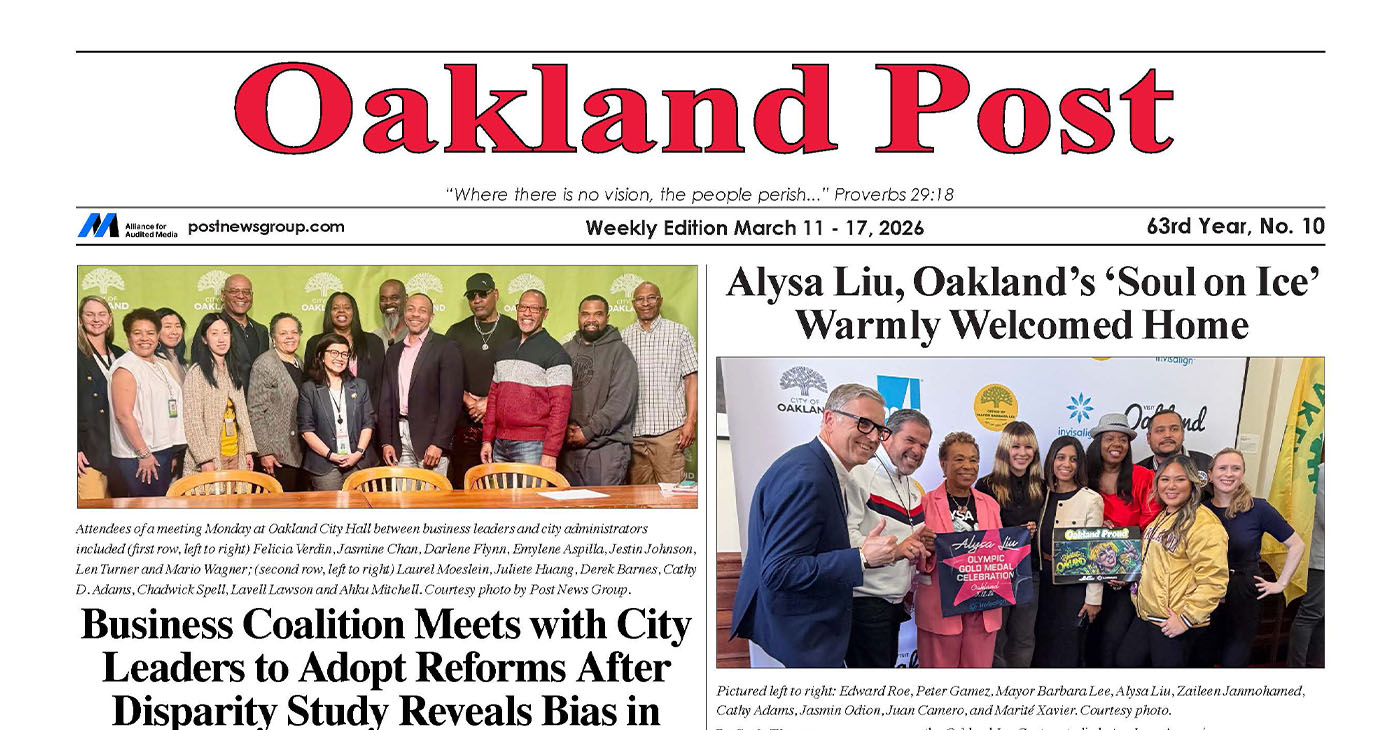
To enlarge your view of this issue, use the slider, magnifying glass icon or full page icon in the lower right corner of the browser window.

Activism
Oakland Post: Week of March 4 – 10, 2026
The printed Weekly Edition of the Oakland Post: Week of March 4 – 10, 2026

To enlarge your view of this issue, use the slider, magnifying glass icon or full page icon in the lower right corner of the browser window.
Activism
Oakland Post: Week of February 25 – March 3, 2026
The printed Weekly Edition of the Oakland Post: Week of – February 25 – March 3, 2026

To enlarge your view of this issue, use the slider, magnifying glass icon or full page icon in the lower right corner of the browser window.

WORK FROM HOME
Home-based business with potential monthly income of $10K+ per month. A proven training system and website provided to maximize business effectiveness. Perfect job to earn side and primary income. Contact Lynne for more details: Lynne4npusa@gmail.com 800-334-0540


Financial Wellness and Mental Health: Managing Money Stress in College

Oakland Post: Week of March 11 -17, 2026

Women & Wealth: Tips for Navigating Your Lifelong Financial Journey

COMMENTARY: Women of Color Shape Our Past and Future

Woman’s Search for Family’s Roots Leads to Ancestor John T. Ward – A Successful Entrepreneur and Conductor on the Underground Railroad

Advocates Raise Alarm Over ICE Operation, MOU and Detention Risks in Baltimore County

Pete Buttigieg to Join Mayor Randall Woodfin for Community Town Hall in Birmingham

WATCH: Week One – NNPA’s “Leadership Matters” Video Series

Oakland Post: Week of March 4 – 10, 2026

OP-ED: NNPA Launches 2026 “Leadership Matters” Video Series

PRESS ROOM: PMG and Cranbrook Horizons-Upward Bound Launch Journey Fellowship Cohort 2

Los Angeles Summit Brings Together Leaders to Tackle Poverty and Affordability

Civil Rights TV Launches 24/7 Network Focused on Black History, Education and Equity

REVIEW: The Ultimate Hot Girl Summer Getaway: Sunseeker Resort Florida

COMMENTARY: How You Stop a Prescription Medicine is as Important as How You Start

Book Review: Books on Black History and Black Life for Kids

Community Celebrates Turner Group Construction Company as Collins Drive Becomes Turner Group Drive

Discrimination in City Contracts

California Launches Study on Mileage Tax to Potentially Replace Gas Tax as Republicans Push Back

COMMENTARY: The Biases We Don’t See — Preventing AI-Driven Inequality in Health Care

Black History Events in the East Bay

Post Newspaper Invites NNPA to Join Nationwide Probate Reform Initiative

Art of the African Diaspora Celebrates Legacy and Community at Richmond Art Center

New Bill, the RIDER Safety Act, Would Support Transit Ambassadors and Safety on Public Transit

COMMENTARY: The National Protest Must Be Accompanied with Our Votes

Oakland Post: Week of February 4 – 10, 2026

Oakland Post: Week of February 11 – 17, 2026

Dorothy Lee Bolden: Uniting Domestic Workers

After Don Lemon’s Arrest, Black Officials Raise Concerns About Independent Black Media

Reflecting on Black History Milestones in Birmingham AL

Hyundai Ioniq 5 Parking, Safety, and 360 View #shorts

2025 Ioniq 5 New Wiper & Powerful Performance! #shorts

Electric SUV Range: Is 259 Miles Enough? #shorts

EV Charging: How Fast Can You Charge an Electric Vehicle? #shorts

Biometric Cooling… Messaging Seats…Come on! 2025 Infiniti QX80 Autograph 4WD

Charged Up: Witness the Magic of a Fully Electric Car! #shorts

Range Rover Sport PHEV Included…: See What’s Inside This Luxury SUV! #shorts

Invisible Hood View: Perfect Parking with X-Ray Vision! #shorts

AI Is Reshaping Black Healthcare: Promise, Peril, and the Push for Improved Results in California

ESSAY: Technology and Medicine, a Primary Care Point of View

Sanctuary Cities

The RESISTANCE – FREEDOM NOW

STATE OF THE PEOPLE: Freddie

ECONOMIC BOYCOTT DAY!!!!!

I told You So
-
 #NNPA BlackPress4 weeks ago
Reflecting on Black History Milestones in Birmingham AL
-
 #NNPA BlackPress4 weeks ago
PRESS ROOM: NBA Hall of Fame Nominee Terry Cummings Joins 100 Black Men of DeKalb County to Launch Victory & Values Initiative
-

 #NNPA BlackPress4 weeks ago
U.S. manufacturing rebounds – how foundry services are adapting to rising demand
-

 #NNPA BlackPress4 weeks ago
OP-ED: One Hundred Years of Black Workers Telling the Truth
-

 Activism3 weeks ago
Oakland Post: Week of February 25 – March 3, 2026
-

 #NNPA BlackPress4 weeks ago
Advancements in solar technology that are changing the way we power the world
-
 #NNPA BlackPress4 weeks ago
Trump’s MAGA Allies are Creating Executive Order Plan to Steal the 2026 Midterms
-
 #NNPA BlackPress4 weeks ago
PRESS ROOM: Civil Rights TV Launches in Selma as the World’s First 24/7 Civil Rights Television Network
