Connect with us

Black History

Cutting Through History: The Ingenious Invention of John Albert Burr

Born in Maryland in 1848, John Burr’s life began during the era of slavery. While many African Americans of his time were enslaved, John’s parents were fortunate to secure their freedom, ensuring that their son was born free. This freedom enabled him to pursue education and skills that would later fuel his inventive genius. Though details of his early education remain sparse, John’s knack for mechanics and engineering became apparent as he grew up. 

Published

on

By Tamara Shiloh

When discussing African American inventors, names like George Washington Carver or Granville T. Woods often take center stage. However, history is filled with unsung innovators whose contributions have remarkably shaped the modern world. Among these figures is John Albert Burr, a man whose ingenuity revolutionized the lawn care industry.

Born in Maryland in 1848, John Burr’s life began during the era of slavery. While many African Americans of his time were enslaved, John’s parents were fortunate to secure their freedom, ensuring that their son was born free. This freedom enabled him to pursue education and skills that would later fuel his inventive genius. Though details of his early education remain sparse, John’s knack for mechanics and engineering became apparent as he grew up. 

In the late 19th century, lawn care was labor-intensive and often relied on rudimentary tools. The available lawnmowers were cumbersome, inefficient, and prone to clogging, making manicuring lawns arduous. Enter John Albert Burr.

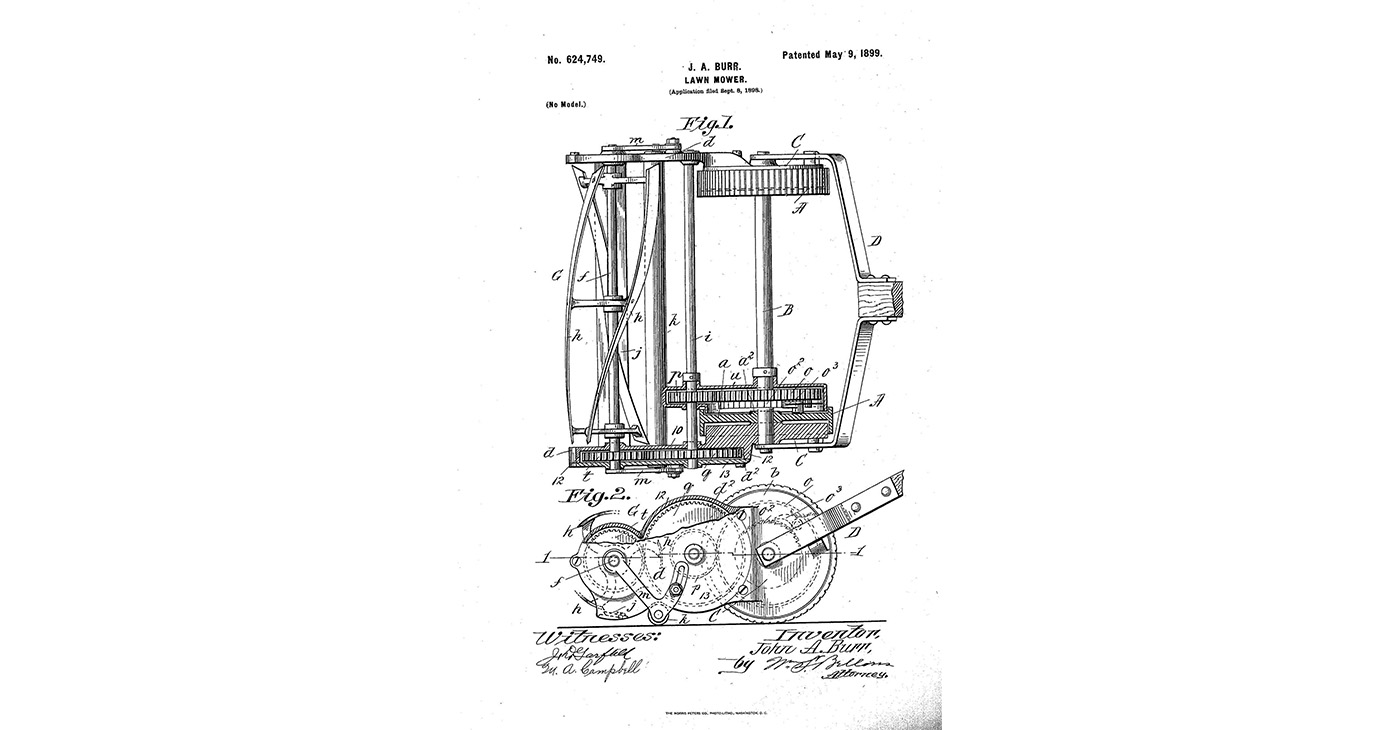
In 1899, John Burr patented his revolutionary rotary blade lawn mower. His design improved upon earlier models by preventing the mower’s blades from becoming clogged with grass. John’s mower featured a flexible and durable rotary blade mechanism that made cutting grass smoother and more effective. The design enhanced functionality and extended the mower’s life, reducing maintenance costs and increasing efficiency.

His innovation catered to the growing demand for well-manicured lawns among the middle and upper classes during the Victorian era, when lawns became a status symbol. His mower’s practicality and ease of use ensured its widespread acceptance.

While John’s patent was groundbreaking, Black inventors often struggled to gain recognition or fair compensation for their work, as systemic racism in patent law and business practices frequently robbed them of their rights.

Despite these obstacles, he used his skills and intellect to thrive. He worked as a mechanical engineer and continued to innovate throughout his career. Unlike many African American inventors, he retained control over his patent. He was able to reap financial rewards, ensuring that his contributions would not be lost to history or taken by others.

Although his name may not be as widely recognized as it deserves, his impact can still be felt whenever a modern rotary lawn mower hums to life. He represents the countless African American inventors whose brilliance has quietly revolutionized our lives and work.

Tamara Shiloh

Tamara Shiloh


About Tamara Shiloh


Tamara Shiloh has published the first two books in her historical fiction chapter book series, Just Imagine…What If There Were No Black People in the World is about African American inventors, scientists and other notable Black people in history. The two books are Jaxon’s Magical Adventure with Black Inventors and Scientists and Jaxon and Kevin’s Black History Trip Downtown. Tamara Shiloh has also written a book a picture book for Scholastic, Cameron Teaches Black History, that will be available in June, 2022.

Tamara Shiloh’s other writing experiences include: writing the Black History column for the Post Newspaper in the Bay area, Creator and Instruction of the black History Class for Educators a professional development class for teachers and her non-profit offers a free Black History literacy/STEM/Podcast class for kids 3d – 8th grade which also includes the Let’s Go Learn Reading and Essence and tutorial program.   She is also the owner of the Multicultural Bookstore and Gifts, in Richmond, California,

Previously in her early life she was the /Editor-in-Chief of Desert Diamonds Magazine, highlighting the accomplishments of minority women in Nevada; assisting with the creation, design and writing of a Los Angeles-based, herbal magazine entitled Herbal Essence; editorial contribution to Homes of Color; Editor-in-Chief of Black Insight Magazine, the first digital, interactive magazine for African Americans; profile creations for sports figures on the now defunct PublicFigure.com; newsletters for various businesses and organizations; and her own Las Vegas community newsletter, Tween Time News, a monthly publication highlighting music entertainment in the various venues of Las Vegas.

She is a member of:

  • Society of Children’s Book Writers and Illustrators (SCBWI)

  • Richmond Chamber of Commerce

  • Point Richmond Business Association

  • National Association of Professional Women (NAPW)

  • Independent Book Publishers Association (IPBA)

  • California Writers Club-Berkeley & Marin

  • Richmond CA Kiwanis

  • Richmond CA Rotary

  • Bay Area Girls Club


Tamara Shiloh, a native of Northern California, has two adult children, one grandson and four great-grand sons. She resides in Point Richmond, CA with her husband, Ernest.

www.multiculturalbookstore.com

About Tamara Shiloh

Tamara Shiloh has published the first two books in her historical fiction chapter book series, Just Imagine…What If There Were No Black People in the World is about African American inventors, scientists and other notable Black people in history. The two books are Jaxon’s Magical Adventure with Black Inventors and Scientists and Jaxon and Kevin’s Black History Trip Downtown. Tamara Shiloh has also written a book a picture book for Scholastic, Cameron Teaches Black History, that will be available in June, 2022. Tamara Shiloh’s other writing experiences include: writing the Black History column for the Post Newspaper in the Bay area, Creator and Instruction of the black History Class for Educators a professional development class for teachers and her non-profit offers a free Black History literacy/STEM/Podcast class for kids 3d – 8th grade which also includes the Let’s Go Learn Reading and Essence and tutorial program.   She is also the owner of the Multicultural Bookstore and Gifts, in Richmond, California, Previously in her early life she was the /Editor-in-Chief of Desert Diamonds Magazine, highlighting the accomplishments of minority women in Nevada; assisting with the creation, design and writing of a Los Angeles-based, herbal magazine entitled Herbal Essence; editorial contribution to Homes of Color; Editor-in-Chief of Black Insight Magazine, the first digital, interactive magazine for African Americans; profile creations for sports figures on the now defunct PublicFigure.com; newsletters for various businesses and organizations; and her own Las Vegas community newsletter, Tween Time News, a monthly publication highlighting music entertainment in the various venues of Las Vegas. She is a member of:
  • Society of Children’s Book Writers and Illustrators (SCBWI)
  • Richmond Chamber of Commerce
  • Point Richmond Business Association
  • National Association of Professional Women (NAPW)
  • Independent Book Publishers Association (IPBA)
  • California Writers Club-Berkeley & Marin
  • Richmond CA Kiwanis
  • Richmond CA Rotary
  • Bay Area Girls Club
Tamara Shiloh, a native of Northern California, has two adult children, one grandson and four great-grand sons. She resides in Point Richmond, CA with her husband, Ernest. www.multiculturalbookstore.com

Continue Reading
Click to comment

Leave a Reply

Your email address will not be published. Required fields are marked *

Activism

EBMUD Enshrines the Legacy of  its First Black Board Member William ‘Bill’ Patterson 

Patterson, who died in 2025 at the age of 94, was remembered as a tireless advocate, mentor, and public servant whose influence shaped generations across the East Bay.

Published

on

William “Bill” Patterson, Jr. Courtesy Peralta College District

By Carla Thomas

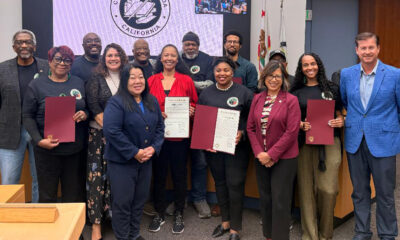
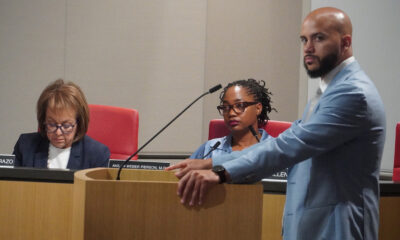
On Tuesday, May 12, Oakland honored a towering community figure, William “Bill” Patterson, with the unveiling of a bronze plaque and the renaming of the East Bay Municipal Utility District (EBMUD) boardroom in downtown Oakland.

Board members, family, colleagues, and mentees gathered to reflect on Patterson’s enduring legacy at the meeting.

Patterson, who died in 2025 at the age of 94, was remembered as a tireless advocate, mentor, and public servant whose influence shaped generations across the East Bay.

“This is well deserved,” said Patterson’s cousin, Maria Simon. “He was such a big part of the Oakland community. It’s heartwarming to know he was known by so many people.

“So many credit him with helping them get their first job. It was especially meaningful when he held the Bible for Mayor Barbara Lee’s swearing-in. He truly believed in the goodness of people, in possibilities, and in the power to bring things to fruition.”

Oakland NAACP President Cynthia Adams described Patterson as a father figure. “He took me under his wing,” she said. “This recognition is a very special moment.”

Fellow NAACP member Robert “Bob” Harris echoed that sentiment, recalling Patterson as “a great member of the NAACP and a proud Kappa Alpha Psi man.”

Patterson’s son, William Patterson Jr., reflected on his father’s professional life.

“My father loved his community, and he loved working with EBMUD and spoke highly of his colleagues,” he said, standing alongside cousin Rise Jones Pichon, a former Santa Clara County Superior Court judge.

EBMUD Board President Luz Gómez praised Patterson’s resilience and dedication.

“As his health declined, he would spend half the day in the hospital and still come to our meetings,” she said. “There will never be another like him.”

Activist Cheryl Sudduth highlighted Patterson’s commitment to workforce development and youth empowerment. “He had the vision to bring water careers to students and the next generation,” she said, noting that participants in one of his initiatives received $2,000 stipends.

Sudduth also summed up one of Patterson’s guiding philosophies: “He told me it’s not enough to have a seat at the table. You need to have access to quality resources, the tools to build the table, and the skills to ensure everyone there can contribute. We should be more than a representation; we should reflect determination.”

EBMUD Board Member Andy Katz emphasized the importance of remembrance.

“When you die, you die twice, physically, and then when people stop saying your name,” he said. “By honoring him this way, his name will continue to be spoken for years to come.”

Others in attendance reflected on Patterson’s broad impact.

“It was a joy to watch him accomplish so much,” said EBMUD Board Member Marguerite Young.

Business leader, Delane Sims added that Patterson became a trusted advisor to multiple Oakland mayors.

“We need young people to learn about him so they can become leaders capable of creating meaningful change,” Sims said.

Following public comments, attendees witnessed the unveiling of the bronze plaque in the boardroom foyer, along with signage officially renaming the space in Patterson’s honor.

Born in 1931, Patterson devoted more than seven decades to public service in Oakland and the broader East Bay. Appointed to the EBMUD Board in 1997, he served for 27 years and became its first African American board president. His leadership extended beyond water governance into civil rights, education, and community development.

A three-term president of the Oakland NAACP, Patterson also advised Oakland’s first Black mayor, Lionel Wilson, and played a key role in advancing equity, public health, and environmental justice. He served on the Urban Strategies Council and the Oakland Public Ethics Commission, further shaping public policy.

In 1971, Patterson was a founding director of the Peralta Colleges Foundation, which provides financial assistance and support to students across Berkeley City College, College of Alameda, Laney College, and Merritt College.

In addition, Patterson mentored countless young people through Oakland’s recreation programs, helping guide future leaders and even professional athletes. Though slight in stature, Patterson will always be remembered as a giant of a man.

Continue Reading

Arts and Culture

Against All Odds: Mary Jackson’s Journey to NASA Engineer

Jackson’s life took a significant turn when she was offered the opportunity to work in a wind tunnel, a facility used to test the effects of air moving over aircraft structures. It was here that her passion for engineering truly took flight. However, there was a challenge: to become an engineer, she needed to take advanced courses that were only offered at a segregated high school.

Published

on

Mary Jackson. Public domain.

By Tamara Shiloh  

When we talk about breaking barriers in science, technology, engineering, and mathematics, the name Mary Jackson deserves a place at the top of the list.

Jackson was born in 1921 in Hampton, Virginia, a place that would later become central to her groundbreaking work. From an early age, she showed a strong aptitude for math and science—subjects that, at the time, were not widely encouraged for African American women. But Jackson was not one to be limited by expectations. She earned degrees in mathematics and physical science from Hampton Institute (now Hampton University), setting the foundation for a career that would change history.

Before joining NASA, Jackson worked as a teacher and later as a research mathematician at the National Advisory Committee for Aeronautics (NACA), the agency that eventually became NASA. Like many African American women of her time, she began her career as a “human computer,” performing complex calculations by hand. It was in this environment that she worked alongside brilliant minds like Katherine Johnson, forming part of a powerful group of African American women whose calculations helped launch America into space.

Jackson’s life took a significant turn when she was offered the opportunity to work in a wind tunnel, a facility used to test the effects of air moving over aircraft structures. It was here that her passion for engineering truly took flight. However, there was a challenge: to become an engineer, she needed to take advanced courses that were only offered at a segregated high school.

Jackson did something truly remarkable. She petitioned the city of Hampton for permission to attend those classes. She didn’t accept “no” as an answer. And she won.

In 1958, Jackson became NASA’s first African American female engineer.

But Jackson’s impact didn’t stop there.

Later in her career, she chose to step away from her engineering position—not because she couldn’t continue, but because she wanted to make a difference. She moved into roles focused on equal opportunity, working to ensure that women and minorities had access to the same opportunities she fought so hard to get.

Jackson’s story gained wider recognition through the book and film Hidden Figures, which highlighted the contributions of African American women at NASA. But long before the spotlight found her, Jackson was doing the work—quietly, persistently, and brilliantly.

Jackson retired from Langley in 1985. Among her many honors were an Apollo Group Achievement Award and being named Langley’s Volunteer of the Year in 1976. She served as the chair of one of the center’s annual United Way campaigns and a member of the National Technical Association (the oldest African American technical organization in the United States).

She and her husband Levi had an open-door policy for young Langley recruits trying to gain their footing in a new town and a new career. A 1976 Langley Researcher profile might have done the best job capturing Mary’s spirit and character, calling her a “gentlelady, wife and mother, humanitarian and scientist.”

For Jackson, science and service went hand in hand.

She died on Feb. 11, 2005, at age 83, at a convalescent home in Hampton, Virginia.

Continue Reading

Activism

Supreme Court Voting Rights Ruling Reverberates From the South to California

The Supreme Court’s recent ruling weakening the Voting Rights Act is reshaping political battles, particularly in the South. While California’s protections may offer a buffer, the decision raises national concerns about Black political representation and redistricting.

Published

on

Researchers pointed out that the number amounts to 1 in every 50 adults, with 3 out of 4 disenfranchised living in their communities, having completed their sentences or remaining supervised while on probation or parole. (Photo: iStockphoto)
iStock.

By Brandon Patterson

A recent U.S. Supreme Court ruling weakening a key section of the federal Voting Rights Act is already reshaping political battles in parts of the South while raising broader questions about the future of Black political representation nationwide.

In Louisiana v. Callais, the Court’s conservative majority limited the use of Section 2 of the Voting Rights Act, the provision historically used to challenge electoral maps that dilute minority voting strength. Writing in dissent, Justice Elena Kagan warned that the ruling marked the “now-complete demolition of the Voting Rights Act.”

The immediate effects of the ruling are expected to be felt most sharply in Southern states, where litigation over majority-Black districts has shaped congressional maps for decades. Republican-led states including Louisiana, Alabama, and Texas have already moved to defend or revisit maps following the decision, according to reporting by Reuters and Politico.

California’s political landscape is different. The state uses an independent citizen’s commission to draw district lines and also has its own California Voting Rights Act, which in some cases provides broader protections than federal law. Because of those safeguards, the Supreme Court’s decision is not expected to immediately alter Black political representation in California.

Still, legal scholars and voting rights advocates say the ruling could shape future national debates over how race is considered in redistricting and voting rights enforcement.

“It changes the legal atmosphere around voting rights nationally,” UCLA law professor Rick Hasen told Axios. “Even states with stronger protections are paying attention to where the Court is headed.”

The decision also arrives amid renewed political fights over redistricting. In California, voters approved Proposition 50 in November 2025, a measure backed by Gov. Gavin Newsom that expanded the state’s ability to redraw congressional maps in response to mid-decade redistricting efforts in other states.

Supporters argued the measure was necessary to counter increasingly aggressive Republican-led redistricting nationally, while critics warned it could weaken California’s independent redistricting tradition.

For Black Californians, the ruling lands at a time when political representation remains significant even as demographic shifts have changed historically Black neighborhoods in cities like Oakland, Los Angeles and San Francisco.

Oakland Mayor Barbara Lee criticized the Court’s decision in comments to The Oaklandside, calling the Voting Rights Act one of the nation’s foundational civil rights protections.

“This decision weakens one of the most important civil rights tools our communities have had,” Lee said. “We know voting rights were never given freely. People fought and died for them.”

Rep. Lateefah Simon warned against complacency.

“This is part of a larger effort to erase the gains of the civil rights movement,” Simon told Oaklandside. “Black political power matters, and representation matters.”

The Voting Rights Act, passed in 1965 during the height of the Civil Rights Movement, helped expand Black political representation nationwide, including in California, where coalition politics among Black, Latino and Asian American voters helped elect candidates of color at the local, state and federal levels.

For many observers, the latest ruling serves less as an immediate threat to California districts and more as a reminder that voting rights protections long viewed as settled remain politically and legally contested.

Continue Reading

Subscribe to receive news and updates from the Oakland Post

* indicates required

CHECK OUT THE LATEST ISSUE OF THE OAKLAND POST

ADVERTISEMENT

WORK FROM HOME

Home-based business with potential monthly income of $10K+ per month. A proven training system and website provided to maximize business effectiveness. Perfect job to earn side and primary income. Contact Lynne for more details: Lynne4npusa@gmail.com 800-334-0540

Facebook

Trending

Copyright ©2021 Post News Group, Inc. All Rights Reserved.