
Bay Area
COVID-19’s Unequal Toll on Black Americans: A Q&A With Tina Sacks

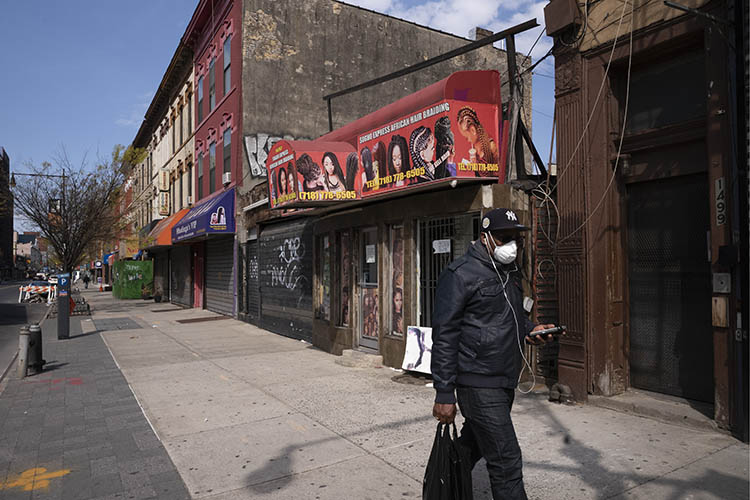
The recently-released data are shocking: COVID-19 is infecting and killing black people at an alarmingly high rate. An Associated Press analysis — one of the first attempts to examine the racial disparities of COVID-19 cases and deaths nationwide — has found that, of nearly 3,300 of the 13,000 deaths so far, about 42% of the deceased were African American. Black Americans account for about 21% of the total population in the areas covered by the AP analysis.
Other minority groups’ cases and deaths are fairly in line with their demographics, the analysis found, although among Hispanic individuals, there are some hot spots.
Black residents have been hardest hit in several U.S. cities, including New York City, Milwaukee and New Orleans. In another, Chicago, the city’s public health agency reported this week that African Americans accounted for 72% of deaths from COVID-19 complications and 52% of positive tests for the coronavirus, despite making up only 30% of the city’s population.
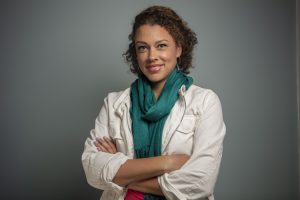
Tina Sacks
This week, Berkeley News spoke about this issue with Tina Sacks, an assistant professor in the School of Social Welfare and faculty chair of the Center for Research on Social Change at the campus’s Institute for the Study of Societal Issues. Her areas of expertise include racial disparities in health and health care; race, class and gender; and the social safety net.
Before her arrival at Berkeley, she worked for the Centers for Disease Control and Prevention for nearly 10 years as special assistant to the CDC director during the first coronavirus outbreak — SARS (severe acute respiratory syndrome).
Berkeley News: Data are beginning to surface that black Americans are suffering the brunt of the health and economic impacts of the coronavirus pandemic, especially in urban areas. What structural factors in our society are contributing to these alarming outcomes?
Tina Sacks: Unfortunately, the preliminary data that we are seeing is in keeping with what we might expect, given the underlying structural inequality in this country. First, black people have experienced decades of residential racial segregation, unlike any other ethno-racial group. This means that Black neighborhoods typically have fewer institutional anchors, such as grocery stores, good schools and safe places to walk outside and exercise. There is even a relationship, for example, between residential segregation and living in neighborhoods with fewer trees, which leads to poorer air quality.
Black people are disproportionately exposed to indoor and outdoor environmental toxins in their homes and neighborhoods. Black people are more likely to grow up in poverty, live in substandard housing, attend under-resourced schools and are more likely to end up in the carceral system. All of these things exact a terrible toll on black people’s health through the life course, making them more likely to have the chronic conditions — like diabetes, asthma and hypertension — that make them more vulnerable to COVID.
Black people are also more likely to be uninsured, making their access to care spotty. Plus, we know from my work and that of others scholars who research bias during the health care encounter that Black people’s health complaints are less likely to be taken seriously.
So, if someone does present in the emergency room, they may be turned away. Black people face challenges when they need to interface with the health care system, particularly when it is already taxed in the manner it is currently.
Lastly, Black people are concentrated in parts of the labor market where workers cannot stay home to shelter in place, which presumably brings them into contact with more people and ultimately increases their risk of acquiring COVID. This is true for other minorities in the U.S., as well. For example, Black people may be working retail jobs in the ‘essential services’ sector, like the Black woman I encountered at the CVS in downtown Berkeley. She told me she had traveled by bus for three hours to make it to her shift as a checkout clerk. The bus lines have been cut, so it took her even longer to make it to work. People are calling off work because they are afraid to come in. She said she was terrified to come in, but felt it was her responsibility, so she woke up at 5:30 a.m. to go to work wearing her mask and gloves. Black people are also concentrated in industries that do not have paid sick leave. All of these policy level issues disproportionately affect Black people and other people of color.
In addition to all this, Black people live in a society that chronically undervalues their lives and humanity. This really cannot be overstated as another determinant of human health and well-being. Living in a society like that takes a toll.
Why are urban living conditions especially dangerous for the transmission of COVID-19?
Although I haven’t seen data on this, I would speculate that living in densely-populated areas like New York City can speed transmission. We know certainly that in overcrowded institutional settings where Black people are over-represented, like jails and prisons, there is no possibility of social distancing. This is something that really needs to be discussed more. The NYT is reporting that Cook County Jail in Chicago has the largest number of cases with a known source in the U.S., 353.
What is access to COVID-19 testing and treatment like, for low-income African Americans and other low-income people of color?
Because Black people are less likely to be insured (as well as Latinx and poor people), their access to testing is necessarily going to be spotty. We’ve seen that famous people — who, of course, can be black or people of color — have had easier access to testing. In general, I would say that we know that everyone has had a hard time getting tested, but what is happening to Black people during the COVID crisis is akin to a saying in the Black community, ‘When white folks catch a cold, Black people get pneumonia.’ Crises affect the Black community much more profoundly. This is definitely the case for other communities of color. For example, Native people also bear a disproportionate disease burden and are deeply affected by COVID.
Is the nation, and are any cities across America, addressing these issues in a helpful way?
I have heard that some cities are making statements about (the situation), and acknowledging the issue is an important first step. But because the causes are so deeply embedded in the social system and in social policy, I think the solutions also need to be rooted there, but that will take a lot of time and political will.
In the meantime, cities like Chicago are taking steps to try to address the issue, including;
1) Mandating the reporting of the number of cases and deaths by race and ethnicity.
2) Setting up a public health rapid response team comprised of activists and public health experts to talk to people in the black, Latinx and immigrant communities.
3) Re-routing buses to the south and west sides to better enable social distancing on bus lines.
Addressing this will require short- and long-term interventions, and some of the most major ones are to finally address structural inequality — to provide reparations and to work toward a fully-developed safety net that includes health insurance and paid sick leave.








Activism
Oakland Post: Week of August 12 – 18, 2026
The printed Weekly Edition of the Oakland Post: Week of August 12 – 18, 2026


To enlarge your view of this issue, use the slider, magnifying glass icon or full page icon in the lower right corner of the browser window.

Activism
Oakland Post: Week of August 5 – 11, 2026
The printed Weekly Edition of the Oakland Post: Week of August 5 – 11, 2026
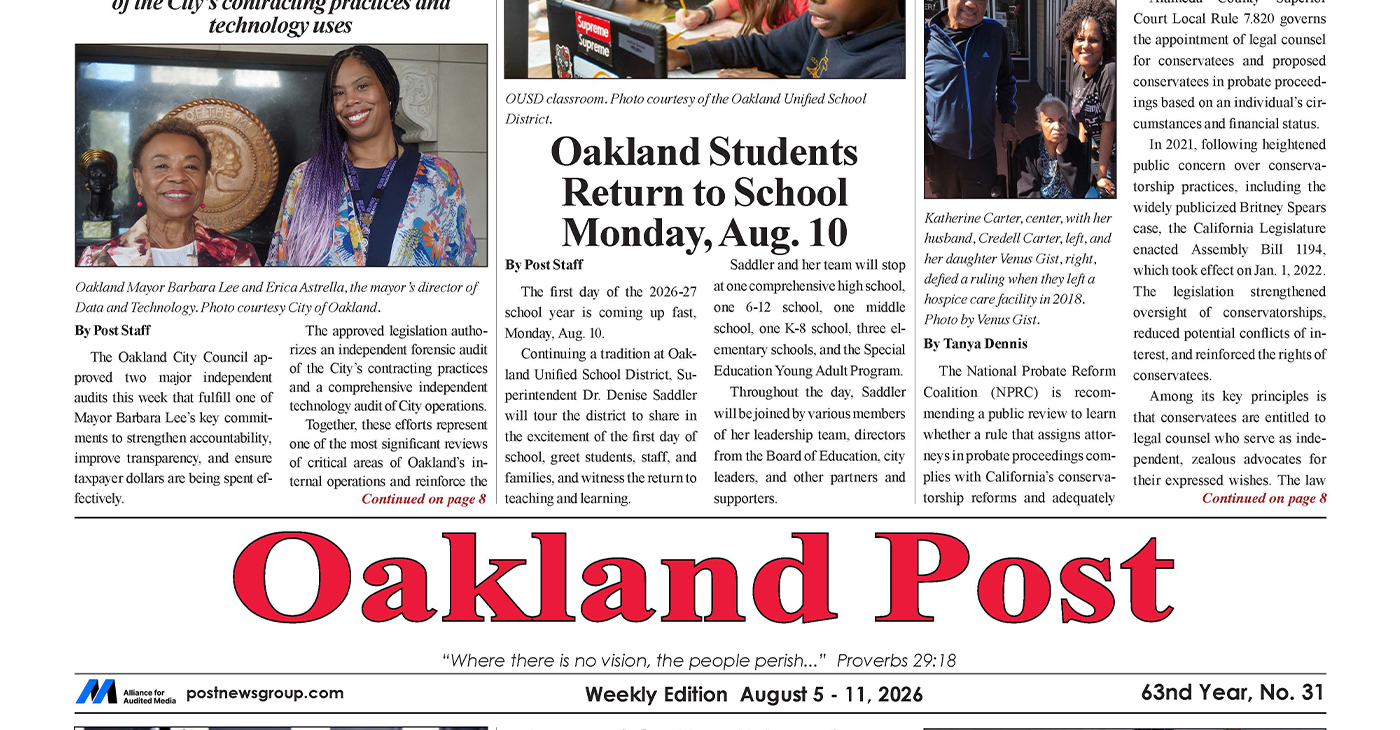
To enlarge your view of this issue, use the slider, magnifying glass icon or full page icon in the lower right corner of the browser window.
Activism
Oakland Post: Week of July 29 – August 4, 2026
The printed Weekly Edition of the Oakland Post: Week of July 29 – August 4, 2026
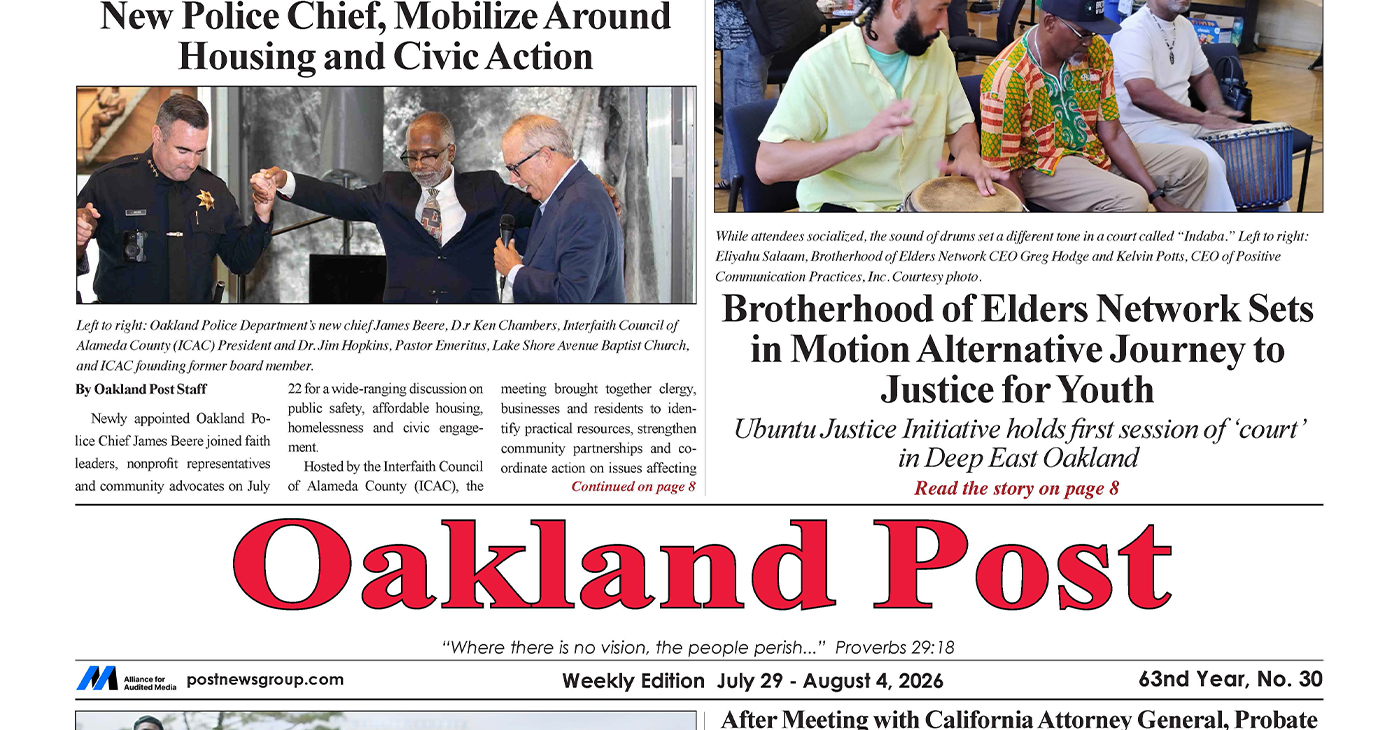
To enlarge your view of this issue, use the slider, magnifying glass icon or full page icon in the lower right corner of the browser window.

WORK FROM HOME
Home-based business with potential monthly income of $10K+ per month. A proven training system and website provided to maximize business effectiveness. Perfect job to earn side and primary income. Contact Lynne for more details: Lynne4npusa@gmail.com 800-334-0540


IN MEMORIAM: Dolly Parton Dead at 80 — How She Built a Legacy of Love and Earned Her Place in Black Culture

OPINION: 57,000 Empty Apartments and Not a Word of Apology – City Limits

Oakland Protesters Rally to Defend Haitian Immigrants and TPS

First 5 Alameda County Celebrates First Year of Measure C’s Implementation

From Palestine to Oakland: Seeds for Liberation Examines Shared Struggles for Freedom

NABJ Convention Brings Black Journalists, Civic Leaders Together in Atlanta

At Sacramento Summit, Becerra Discusses Policy; Uses “Family” Metaphor to Frame Case for National Political Unity

$5 Billion Coliseum Vision Puts Oakland Jobs, Businesses at Center

Gov. Newsom Nominates 3 Black Women Judges to Serve on State Courts of Appeal

Oakland Observes Black August with Block Parties, Film Showings, Workshops

NPRC Elder Justice Symposium Invites Community to Join Effort to Protect Alameda County Elders
Episode 4: Grow Stronger After 50
Episode 4: Grow Stronger After 50

Four Candidates, Including Incumbent Barbara Lee, Qualify for Oakland Mayor’s Race

Oakland Observes Black August with Block Parties, Film Showings, Workshops

Department of Homeland Security Demands California Secretary of State Shirley N. Weber Scrub Voter Rolls

New Judge Could Decide if Karmelo Anthony Gets a New Trial

Oakland Children’s Hospital Workers and Patients Rally for Pediatric Medical Care

“The Power to See Threats Sooner”: Gov. Newsom, Safety Officials Showcase California’s Investments in Hi-Tech Wildfire Prevention

Alpha Kappa Alpha Sorority, Inc. Celebrates New North Atlantic Regional Director

Surveillance Pricing Fight: State Senate Debates Bill Banning Retailers from Using AI to Set Prices Based on a Buyer’s Profile

Mount Zion MBC, Church of Jesus Christ of Latter-day Saints Partner to Bring 29,000 Meals to Alameda County

California Sen. Padilla Joins Colleagues to Introduce Bill Imposing Term Limits on Supreme Court Justices

Less Affluent School Districts, Including Sacramento City, Face Threat of State Takeover

Car Wash Workers Cope with Lingering Impacts of ICE Raids

Starting This Summer, California Car Buyers Can Get an Instant $3500 Off the Cost of Electric Vehicles

COMMENTARY: You Are Already Paying for the AI Boom

California Bill Would Let Abuse Victims Use Trauma as Legal Defense for Violent Crime

Fed Court to Decide Landmark First Amendment Case

Gov. Gavin Newsom Signs Law Streamlining Affordable Housing Rules

The Conversation With Al McFarlane 6/23/26

Media Monday 6/22/26

LIVE! ASK ALMA! — TUES. 6.23.26 7PM EST

Car Buying Secrets: 4 Hidden Checks Before You Sign!

Is This 550 HP Charger Worth YOUR Money? AutoNetwork Review

Celebrating Juneteenth – Frederick Douglass on education and resistance

LIVE! — ASK ALMA! — TUES. 6.19.26 7PM EST

Hyundai Ioniq 5 Parking, Safety, and 360 View #shorts

2025 Ioniq 5 New Wiper & Powerful Performance! #shorts

Electric SUV Range: Is 259 Miles Enough? #shorts

EV Charging: How Fast Can You Charge an Electric Vehicle? #shorts

Biometric Cooling… Messaging Seats…Come on! 2025 Infiniti QX80 Autograph 4WD

Charged Up: Witness the Magic of a Fully Electric Car! #shorts

Range Rover Sport PHEV Included…: See What’s Inside This Luxury SUV! #shorts

Invisible Hood View: Perfect Parking with X-Ray Vision! #shorts
-
 Featured3 weeks ago
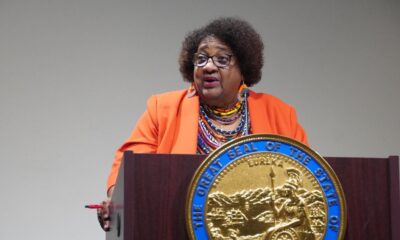
Department of Homeland Security Demands California Secretary of State Shirley N. Weber Scrub Voter Rolls
-
 #NNPA BlackPress4 weeks ago
New Judge Could Decide if Karmelo Anthony Gets a New Trial
-
 Environment3 weeks ago
“The Power to See Threats Sooner”: Gov. Newsom, Safety Officials Showcase California’s Investments in Hi-Tech Wildfire Prevention
-
 Black History3 weeks ago
Alpha Kappa Alpha Sorority, Inc. Celebrates New North Atlantic Regional Director
-
 Featured3 weeks ago
California Sen. Padilla Joins Colleagues to Introduce Bill Imposing Term Limits on Supreme Court Justices
-
 Community2 weeks ago
Less Affluent School Districts, Including Sacramento City, Face Threat of State Takeover
-
 Business2 weeks ago
Car Wash Workers Cope with Lingering Impacts of ICE Raids
-
 #NNPA BlackPress4 weeks ago
COMMENTARY: You Are Already Paying for the AI Boom
