
Activism
Community Celebrates Historic Oakland Billboard Agreements
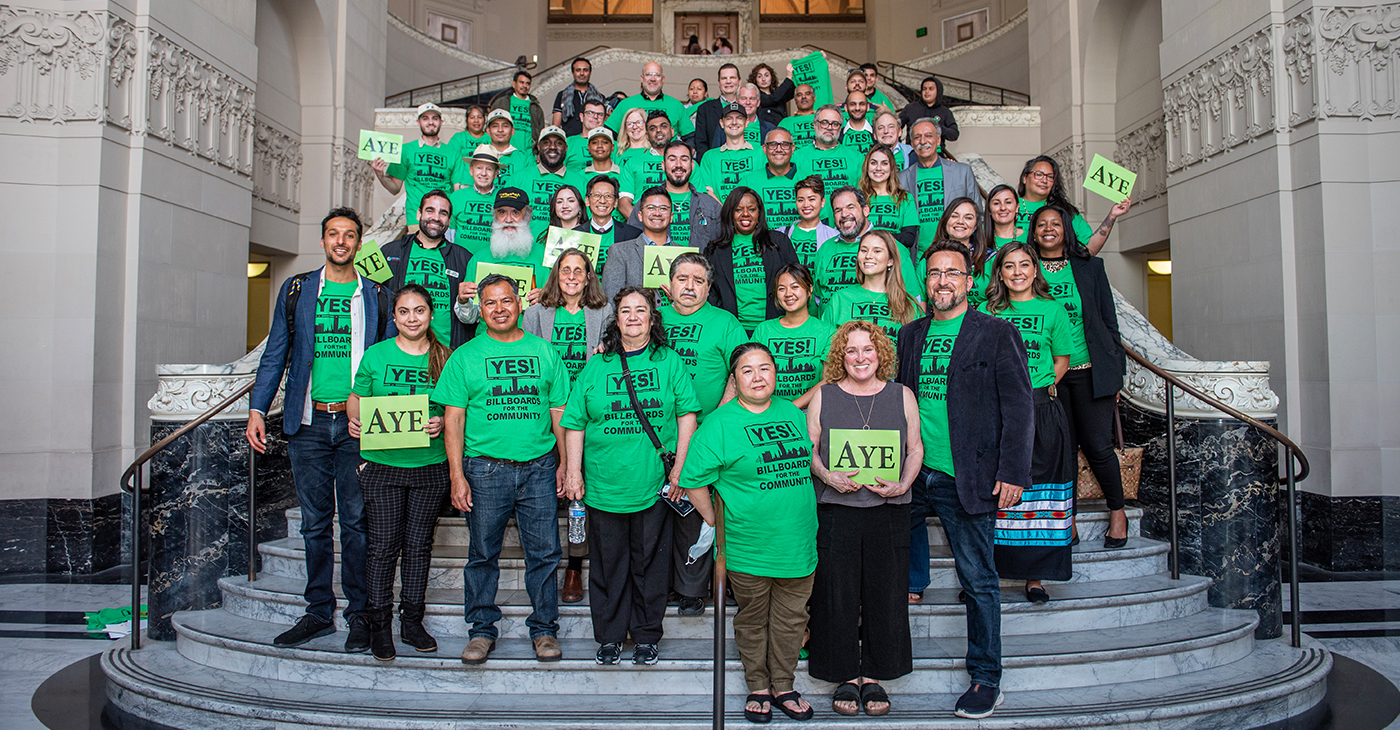
We, the Oakland Billboard Economic Development Coalition, which includes Oakland’s six leading community health clinics, all ethnic chambers of commerce, and top community-based economic development organizations – celebrate the historic billboard agreements approved last year by the Oakland City Council. We have fought for this opportunity against the billboard monopoly, against Clear Channel, for five years. The agreements approved by Council set the bar for community benefits – nearly $70 Million over their lifetime, more than 23 times the total paid by all previous Clear Channel relocation agreements in Oakland combined.

Grand Jury Report Incorrect – Council & Community Benefit
We, the Oakland Billboard Economic Development Coalition, which includes Oakland’s six leading community health clinics, all ethnic chambers of commerce, and top community-based economic development organizations – celebrate the historic billboard agreements approved last year by the Oakland City Council. We have fought for this opportunity against the billboard monopoly, against Clear Channel, for five years. The agreements approved by Council set the bar for community benefits – nearly $70 Million over their lifetime, more than 23 times the total paid by all previous Clear Channel relocation agreements in Oakland combined.
Unfortunately, a recent flawed Grand Jury report got it wrong, so we feel compelled to correct the record:
- Regarding the claim that the decision was made hastily, the report itself belies that claim. The process was five years in the making, with two and a half years from the first City Council hearing to the final vote. Along the way, as the report describes, there were multiple Planning Commission hearings, public stakeholder outreach meetings, a Council Committee meeting, and then a vote by the full Council. Not only was this not hasty, it had far more scrutiny than any of the previous relocation agreements approved by the City with Clear Channel, all of which provide 1/23 of the benefits of the Becker/OFI agreements approved by the Council.
- More importantly, the agreements will actually bring millions to the City and community, nearly $70M to be exact, 23 times the previous Clear Channel relocation agreements combined. They certainly will not cost the city money, especially since nothing would have been on the table at all if our Coalition had not been fighting for it. Right before the decisive City Council Committee hearing, in the final weeks before the full Council vote, there was a hastily submitted last-minute “proposal” by Clear Channel that was debunked as based on non-legal and non-economically viable sites, and relying entirely on the endorsement of a consultant that boasts Clear Channel as their biggest client and whose decisions map to Clear Channel’s monopolistic interests all over the country. Some City staff believed these unrealistic numbers based on false premises, and, since they only interviewed City staff, the Grand Jury report reiterated this misinformation, but it was just part of Clear Channel’s tried and true monopolistic practices of seeking to derail agreements that actually set the new standard for billboard community benefits. Furthermore, our proposals are not mutually exclusive – if Clear Channel’s proposal was real, why had they not brought it forward previously? Why have they not brought it forward since? Because it was not a real proposal – it was nothing but smoke and mirrors, as the Clear Channel’s former Vice President stated publicly at Council.
Speaking on behalf of the community health clinics that are the primary beneficiaries of the billboard funding, La Clinica de la Raza CEO Jane Garcia, states: “In this case, the City Council did the right thing – listening to the community that fought for five years to create this opportunity that is offering the City and community more than twenty times what previous billboard relocation agreements have offered.”
Oakland Billboard Economic Development Coalition
| Native American Health Center | La Clínica de la Raza | West Oakland Health Center |
| Asian Health Services | Oakland LGBTQ Center | Roots Community Health Center |
| The Unity Council | Black Cultural Zone | Visit Oakland |
| Oakland African American Chamber of Commerce | Oakland Chinatown Chamber of Commerce | Oakland Vietnamese Chamber of Commerce |
| Oakland Latino Chamber of Commerce | Building Trades of Alameda County | (partial list) |







Activism
Oakland Post: Week of March 18 – 24, 2026
The printed Weekly Edition of the Oakland Post: Week of March 18 – 24, 2026
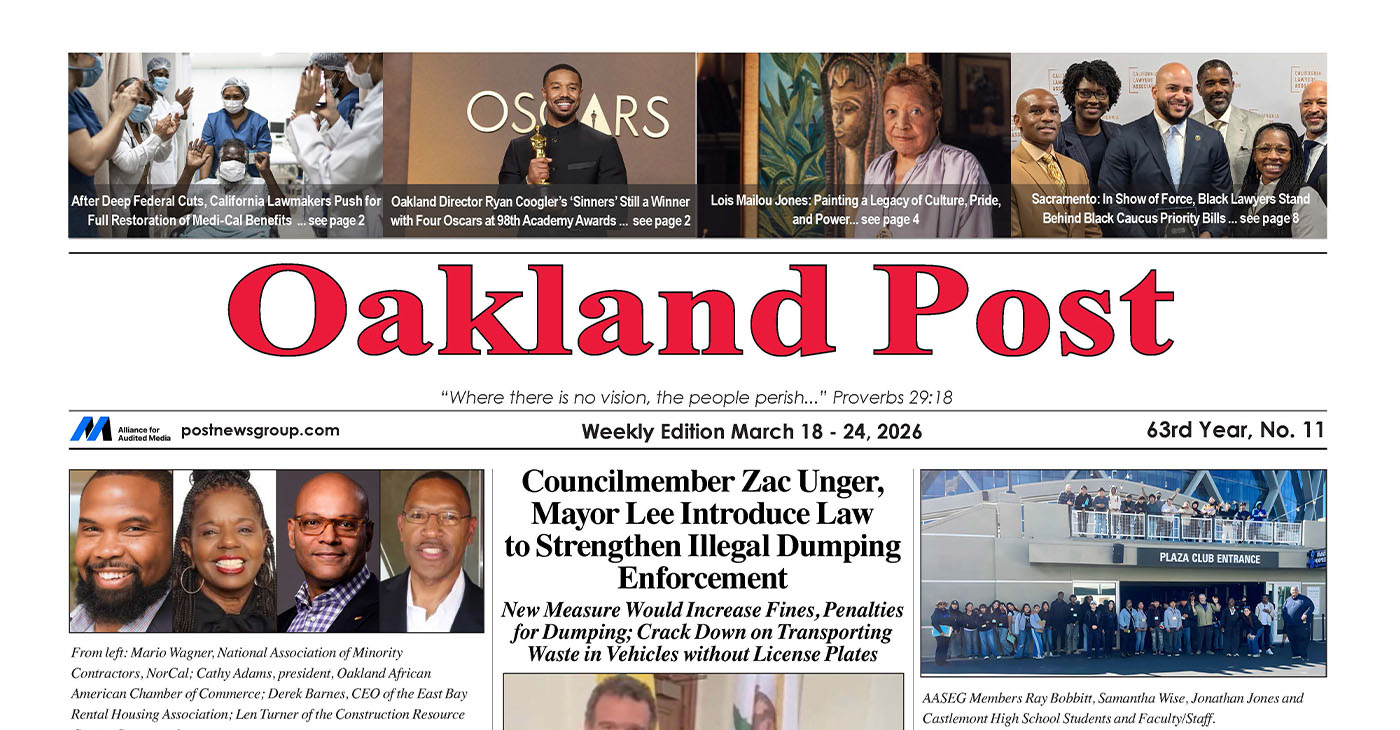
To enlarge your view of this issue, use the slider, magnifying glass icon or full page icon in the lower right corner of the browser window.
Activism
Oakland Post: Week of March 11 -17, 2026
The printed Weekly Edition of the Oakland Post: Week of March 11 – 17, 2026
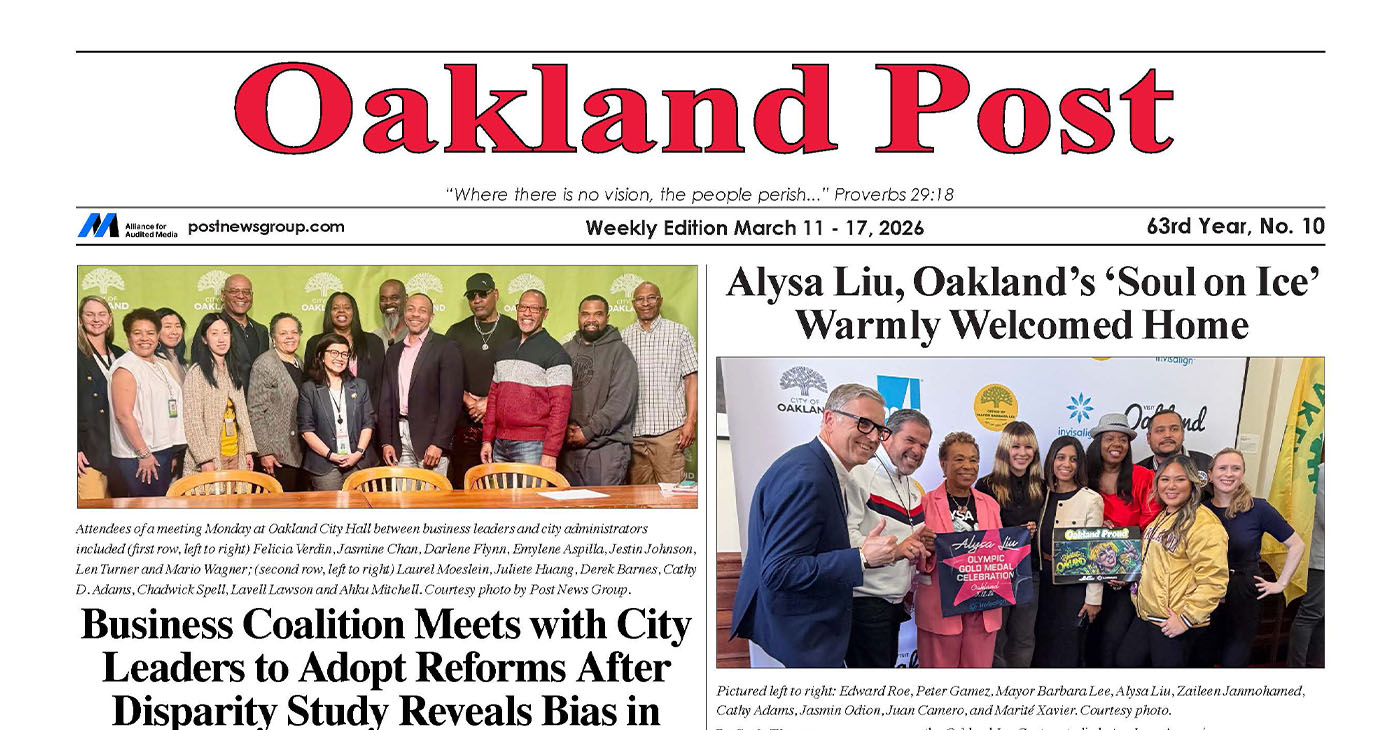
To enlarge your view of this issue, use the slider, magnifying glass icon or full page icon in the lower right corner of the browser window.
Activism
Oakland Post: Week of March 4 – 10, 2026
The printed Weekly Edition of the Oakland Post: Week of March 4 – 10, 2026
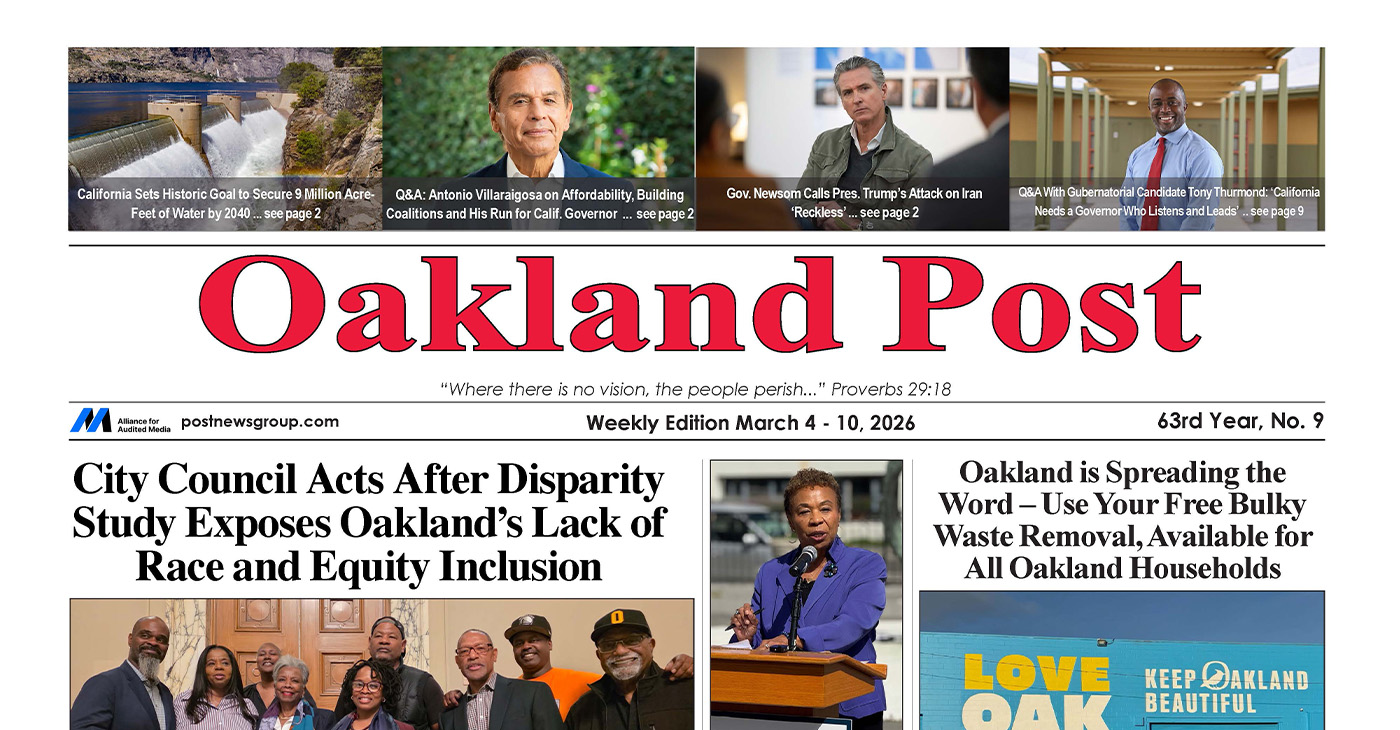
To enlarge your view of this issue, use the slider, magnifying glass icon or full page icon in the lower right corner of the browser window.


WORK FROM HOME
Home-based business with potential monthly income of $10K+ per month. A proven training system and website provided to maximize business effectiveness. Perfect job to earn side and primary income. Contact Lynne for more details: Lynne4npusa@gmail.com 800-334-0540


Black Artists in America, Installation Three Wraps at the Dixon Gallery and Gardens

Grief, Advocacy, and Education: A Counselor Reflects on Black Maternal Health

Future of Florida’s Black History Museum in Limbo

New Research Shows the Many Benefits of Early Learning

South Hampton K-8 Students Among Top 10 Finalists for Samsung’s ‘Solve for Tomorrow’ Competition

Cuba: No Negotiation with US on the President or Political System

Brooklyn Academy of Music Names Jamaican-Born Tamara McCaw as President

Trinidad & Tobego – U.S. Launches WhatsApp Channel for American Citizens in the Country

Oakland Post: Week of March 18 – 24, 2026

AI Innovation vs. Ethics and Environmental Impact

AI, Web3, and Digital Reparations

What If You Owned Your AI Agent?

Season 7, Episode 3 – January Reporter’s Roundtable 📱

Season 7, Episode 3 – January Reporter’s Roundtable

AI, Media, and Power | Part 2, Real-World Impacts and Tradeoffs

Oakland Post: Week of February 11 – 17, 2026

Reflecting on Black History Milestones in Birmingham AL

CITY OF SAN LEANDRO STATE OF CALIFORNIA PUBLIC WORKS DEPARTMENT ENGINEERING DIVISION NOTICE TO BIDDERS FOR ANNUAL STREET OVERLAY/REHABILITATION 2019-21 – PHASE III

Oakland Post: Week of February 18 – 24, 2026

PRESS ROOM: NBA Hall of Fame Nominee Terry Cummings Joins 100 Black Men of DeKalb County to Launch Victory & Values Initiative

Oakland Post: Week of February 25 – March 3, 2026

Trump’s MAGA Allies are Creating Executive Order Plan to Steal the 2026 Midterms

U.S. manufacturing rebounds – how foundry services are adapting to rising demand

OP-ED: One Hundred Years of Black Workers Telling the Truth

Advancements in solar technology that are changing the way we power the world

Chase Oakland Community Center Hosts Alley-Oop Accelerator Building Community and Opportunity for Bay Area Entrepreneurs

Poll Shows Support for Policies That Help Families Afford Child Care

Oakland Post: Week of March 4 – 10, 2026

PRESS ROOM: Civil Rights TV Launches in Selma as the World’s First 24/7 Civil Rights Television Network

Woman’s Search for Family’s Roots Leads to Ancestor John T. Ward – A Successful Entrepreneur and Conductor on the Underground Railroad

Hyundai Ioniq 5 Parking, Safety, and 360 View #shorts

2025 Ioniq 5 New Wiper & Powerful Performance! #shorts

Electric SUV Range: Is 259 Miles Enough? #shorts

EV Charging: How Fast Can You Charge an Electric Vehicle? #shorts

Biometric Cooling… Messaging Seats…Come on! 2025 Infiniti QX80 Autograph 4WD

Charged Up: Witness the Magic of a Fully Electric Car! #shorts

Range Rover Sport PHEV Included…: See What’s Inside This Luxury SUV! #shorts

Invisible Hood View: Perfect Parking with X-Ray Vision! #shorts

AI Is Reshaping Black Healthcare: Promise, Peril, and the Push for Improved Results in California

ESSAY: Technology and Medicine, a Primary Care Point of View

Sanctuary Cities

The RESISTANCE – FREEDOM NOW

STATE OF THE PEOPLE: Freddie

ECONOMIC BOYCOTT DAY!!!!!

I told You So
-
 #NNPA BlackPress4 weeks ago
Poll Shows Support for Policies That Help Families Afford Child Care
-
 Activism4 weeks ago
Oakland Post: Week of March 4 – 10, 2026
-
 #NNPA BlackPress3 weeks ago
Woman’s Search for Family’s Roots Leads to Ancestor John T. Ward – A Successful Entrepreneur and Conductor on the Underground Railroad
-

 #NNPA BlackPress4 weeks ago
OP-ED: NNPA Launches 2026 “Leadership Matters” Video Series
-

 #NNPA BlackPress3 weeks ago
Advocates Raise Alarm Over ICE Operation, MOU and Detention Risks in Baltimore County
-

 #NNPA BlackPress3 weeks ago
COMMENTARY: Women of Color Shape Our Past and Future
-

 #NNPA BlackPress3 weeks ago
Pete Buttigieg to Join Mayor Randall Woodfin for Community Town Hall in Birmingham
-

 Activism2 weeks ago
Oakland Post: Week of March 11 -17, 2026
