
Activism
COMMENTARY: Will Progressive Victories Mean a More Democratic, Inclusive Oakland?
The results were a significant defeat for the moderate, pro-big-business regime of outgoing Mayor Libby Schaaf, her corporate backers and the candidates she groomed and promoted as her legacy. The failure of Schaaf-backed candidates may have had a lot to do with the starkness of that legacy.


By Ken Epstein
The sweep of progressive-leaning local candidates in November’s elections potentially means a seismic shift toward democratic and egalitarian policies in Oakland as the city seeks to grapple with ballooning homelessness, garbage-filled streets, violent crime, a police department still unable to emerge from federal court oversight, and lack of commitment to building housing that most Oaklanders can afford.
At the same time, the results were a significant defeat for the moderate, pro-big-business regime of outgoing Mayor Libby Schaaf, her corporate backers and the candidates she groomed and promoted as her legacy.
In part, the failure of Schaaf-backed candidates may have had a lot to do with the starkness of that legacy.
While failing to address city needs, Schaaf served as a prominent cheerleader for Oakland A’s owner John Fisher’s exclusive residential development at Howard Terminal alongside a new baseball stadium.
In opposition to many residents, she also backed the closing of many more neighborhood schools, the growth of charter schools, and blocked efforts for greater racial equity in construction in the awarding of city contracts.
Schaaf did not intervene to help stop the closure of Mills College, the historic Oakland-based women’s institution, which would have benefitted from some of the energy she spent leading the charge for the A’s real estate project.
The national political showdown between Republicans and Democrats may also have impacted the results, as progressives and mainstream Democrats across the country joined forces to slow down the so-called Red Wave to a trickle.
While this national energy likely helped fuel Oakland’s progressive tide, the results for city races and the closely watched Alameda County District Attorney’s race may count as among the most important local progressive victories in the country.
According to civil rights attorney Walter Riley, who worked with other local leaders and activists during the election to mobilize progressive voters, that work of mobilizing the community will continue.
“This election was about a vision for Oakland, affordable housing, housing the unhoused, stopping closure of predominately Black and Brown schools, cleaning up the city, crime, and criminal justice,” he said. “The entrenched opposition will be divisive, (and) we will build unity.”
The final results of the election were apparently posted on Monday by the Alameda County Registrar of Voters. However, before the election is official, the results must still be audited by the registrar and certified by the Oakland City Council.
Election results:
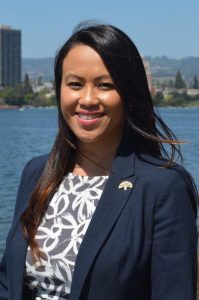
Sheng Thao, Mayor of Oakland
Sheng Thao Is Oakland’s Next Mayor
City Councilmember Sheng Thao on Nov. 8 squeaked out a victory in her race with Councilmember Loren Taylor, who was backed by Mayor Schaaf. The race was widely seen as a referendum on Schaaf’s eight years as mayor.
Thao won 50.30% of the final vote, compared with Taylor’s 49.70%, beating him by 682 votes out of a total of 113,636 ballots cast.
In a statement released Monday, Mayor-elect Thao said, “I’m also very humbled to be here. Fifteen years ago, I was living in my car with my baby. I’ve been through a lot to get to this moment.”
One of her top priorities is public safety. “That involves doubling down on the violence prevention programs that we know reduce violent crime, addressing root causes of crime by working to create more jobs and educational opportunities, filling vacancies in our police department with experienced and diverse officers, providing real support for victims, and redoubling our efforts to get guns off our streets,” she said.
Thao also pledged to “make Oakland the most proactive city in California on housing and homelessness. We’re going to have an aggressive housing policy that protects renters, fights displacement, and treats our unhoused with the dignity they deserve.”

Pamela Price, Alameda County District Attorney
Pamela Price Will Be Alameda County District Attorney
The election of civil rights attorney Pamela Price as the first Black District Attorney broke the chain of succession of hand-picked white district attorneys who maintained the inequitable criminal justice system that has become increasingly out of touch with county residents in the last decade.
Price’s victory, which will have an impact on the push for criminal justice reform nationwide, will be closely watched by both reform advocates and well-funded supporters of the status quo.
In an email to supporters after the election, Price wrote, “We knew this election was going to be an exclamation point in history for Alameda County. The DA’s office has been an untouched tower of legacy appointed and unchallenged District Attorneys.”
“For the last 10 years, the DA’s office has stood in the way of the progressive reforms ushered in by our California Legislature and endorsed by Alameda County voters,” wrote Price, who was described by the S.F. Chronicle as a “staunch reform advocate.”
Price was behind early in the race but ultimately won 53.14% of the vote, to Chief Assistant District Attorney Terry Wiley’s 46.86%.
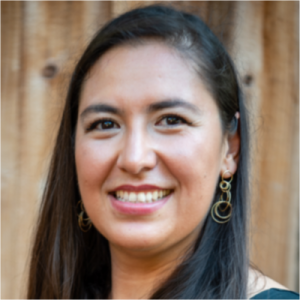
Valarie Bachelor, District 6 Oakland Board of Education
Progressive Majority Flips School Board
For the first time in almost two decades Oakland will have a school board that is opposed to charter school expansion and willing to stand up to state pressure to close neighborhood schools.
The two progressive winners of the Oakland Board of Education elections, educator Jennifer Brouhard and union organizer Valarie Bachelor, will join Boardmembers Mike Hutchinson and VanCedric Williams to form a majority on the seven-member board against closings schools.
Brouhard, District 2 board member, won 63.89% of the vote. She is joined by Bachelor, District 6 board member, who received 54.23% of the vote.
In the District 4 school board, two progressive candidates split the vote, losing to Nick Resnick, who received 51.25% of the vote.
Progressive-Leaning Candidates Win City Council Races
With victories in three races, the City Council’s progressive alliance is likely to absorb fresh energy and new ideas and may be even stronger than it was in the past four years, according to several observers.
Nikki Fortunato Bas, Oakland City Councilmember for District 2, won reelection with 67.79% of the vote. Attorney Janani Ramachandran won in District 4 with 68.47% of the vote, and Kevin Jenkins won in District 6 with 84.22% of the vote.
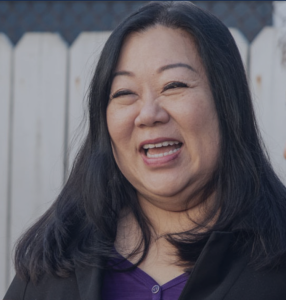
Lena Tam, Elected New Supervisor of District 3
Lena Tam Elected New Supervisor of District 3
Lena Tam, former vice mayor for the City of Alameda, was elected to the Alameda County Board of Supervisors to serve District 3. She garnered 52.10% of the vote to Kaplan’s 47.90%. Tam had the backing of all three mayors of the cities in the district — San Leandro’s Pauline Cutter, City of Alameda’s Marilyn Ezzy Ashcraft and Oakland Mayor Libby Schaaf — as well as the sitting members of the board.
She is replacing Wilma Chan who died last year after she was hit by a car while walking her dog in Alameda.








Activism
Oakland Post: Week of March 18 – 24, 2026
The printed Weekly Edition of the Oakland Post: Week of March 18 – 24, 2026


To enlarge your view of this issue, use the slider, magnifying glass icon or full page icon in the lower right corner of the browser window.

Activism
Oakland Post: Week of March 11 -17, 2026
The printed Weekly Edition of the Oakland Post: Week of March 11 – 17, 2026
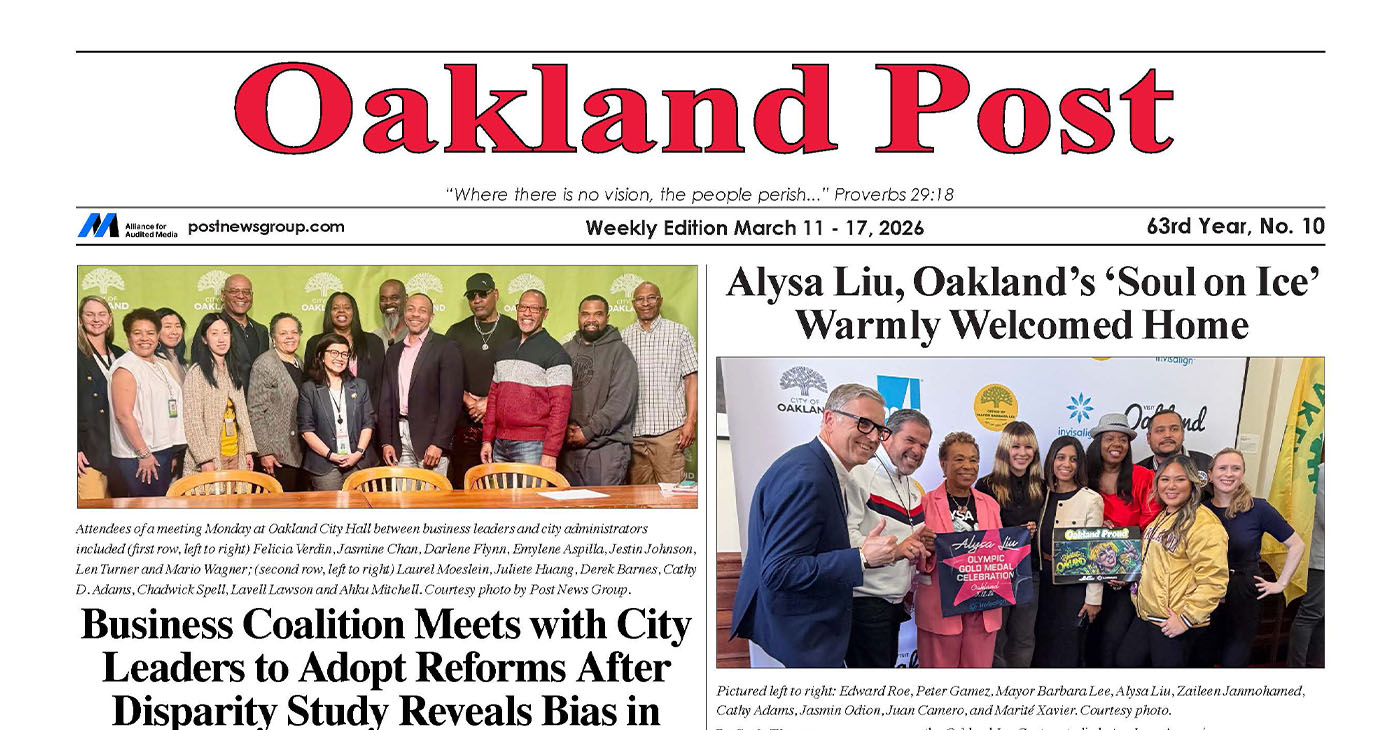
To enlarge your view of this issue, use the slider, magnifying glass icon or full page icon in the lower right corner of the browser window.
Activism
Oakland Post: Week of March 4 – 10, 2026
The printed Weekly Edition of the Oakland Post: Week of March 4 – 10, 2026

To enlarge your view of this issue, use the slider, magnifying glass icon or full page icon in the lower right corner of the browser window.

WORK FROM HOME
Home-based business with potential monthly income of $10K+ per month. A proven training system and website provided to maximize business effectiveness. Perfect job to earn side and primary income. Contact Lynne for more details: Lynne4npusa@gmail.com 800-334-0540


Black Artists in America, Installation Three Wraps at the Dixon Gallery and Gardens

Grief, Advocacy, and Education: A Counselor Reflects on Black Maternal Health

Future of Florida’s Black History Museum in Limbo

New Research Shows the Many Benefits of Early Learning

South Hampton K-8 Students Among Top 10 Finalists for Samsung’s ‘Solve for Tomorrow’ Competition

Cuba: No Negotiation with US on the President or Political System

Brooklyn Academy of Music Names Jamaican-Born Tamara McCaw as President

Trinidad & Tobego – U.S. Launches WhatsApp Channel for American Citizens in the Country

Oakland Post: Week of March 18 – 24, 2026

AI Innovation vs. Ethics and Environmental Impact

AI, Web3, and Digital Reparations

What If You Owned Your AI Agent?

Season 7, Episode 3 – January Reporter’s Roundtable 📱

Season 7, Episode 3 – January Reporter’s Roundtable

AI, Media, and Power | Part 2, Real-World Impacts and Tradeoffs

Oakland Post: Week of February 11 – 17, 2026

Reflecting on Black History Milestones in Birmingham AL

CITY OF SAN LEANDRO STATE OF CALIFORNIA PUBLIC WORKS DEPARTMENT ENGINEERING DIVISION NOTICE TO BIDDERS FOR ANNUAL STREET OVERLAY/REHABILITATION 2019-21 – PHASE III

Oakland Post: Week of February 18 – 24, 2026

PRESS ROOM: NBA Hall of Fame Nominee Terry Cummings Joins 100 Black Men of DeKalb County to Launch Victory & Values Initiative

Oakland Post: Week of February 25 – March 3, 2026

Trump’s MAGA Allies are Creating Executive Order Plan to Steal the 2026 Midterms

U.S. manufacturing rebounds – how foundry services are adapting to rising demand

OP-ED: One Hundred Years of Black Workers Telling the Truth

Chase Oakland Community Center Hosts Alley-Oop Accelerator Building Community and Opportunity for Bay Area Entrepreneurs

Poll Shows Support for Policies That Help Families Afford Child Care

Oakland Post: Week of March 4 – 10, 2026

Advancements in solar technology that are changing the way we power the world

PRESS ROOM: Civil Rights TV Launches in Selma as the World’s First 24/7 Civil Rights Television Network

Woman’s Search for Family’s Roots Leads to Ancestor John T. Ward – A Successful Entrepreneur and Conductor on the Underground Railroad

Hyundai Ioniq 5 Parking, Safety, and 360 View #shorts

2025 Ioniq 5 New Wiper & Powerful Performance! #shorts

Electric SUV Range: Is 259 Miles Enough? #shorts

EV Charging: How Fast Can You Charge an Electric Vehicle? #shorts

Biometric Cooling… Messaging Seats…Come on! 2025 Infiniti QX80 Autograph 4WD

Charged Up: Witness the Magic of a Fully Electric Car! #shorts

Range Rover Sport PHEV Included…: See What’s Inside This Luxury SUV! #shorts

Invisible Hood View: Perfect Parking with X-Ray Vision! #shorts

AI Is Reshaping Black Healthcare: Promise, Peril, and the Push for Improved Results in California

ESSAY: Technology and Medicine, a Primary Care Point of View

Sanctuary Cities

The RESISTANCE – FREEDOM NOW

STATE OF THE PEOPLE: Freddie

ECONOMIC BOYCOTT DAY!!!!!

I told You So
-
 Activism4 weeks ago
Oakland Post: Week of March 4 – 10, 2026
-
 #NNPA BlackPress3 weeks ago
Woman’s Search for Family’s Roots Leads to Ancestor John T. Ward – A Successful Entrepreneur and Conductor on the Underground Railroad
-

 #NNPA BlackPress4 weeks ago
OP-ED: NNPA Launches 2026 “Leadership Matters” Video Series
-

 #NNPA BlackPress3 weeks ago
Advocates Raise Alarm Over ICE Operation, MOU and Detention Risks in Baltimore County
-

 #NNPA BlackPress3 weeks ago
COMMENTARY: Women of Color Shape Our Past and Future
-

 #NNPA BlackPress3 weeks ago
Pete Buttigieg to Join Mayor Randall Woodfin for Community Town Hall in Birmingham
-

 Activism2 weeks ago
Oakland Post: Week of March 11 -17, 2026
-

 #NNPA BlackPress4 weeks ago
PRESS ROOM: PMG and Cranbrook Horizons-Upward Bound Launch Journey Fellowship Cohort 2
