
Activism
COMMENTARY: Schools and streets have been named after Martin Luther King Jr.
Those who misrepresent King and Critical Race Theory are illogical, and they only reveal their fear of him. There is no need to fear this American Black preacher who preached nonviolence and love. King was a peaceful warrior who was radically obedient to Jesus, who taught us to love even our enemies.

By Dr. J. Alfred Smith Sr. | Baptist News Global
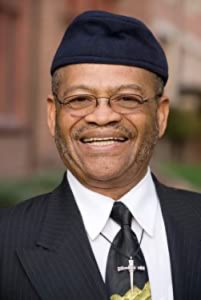
J. Alfred Smith Sr.
Churches and libraries are named after him. He is the only African American and the only American clergy honored with a national holiday. In many countries around the world, he is numbered with global heroes like Mother Teresa and Nelson Mandela.
Some discredited him by calling him a communist, a detractor and troublemaker. Sophisticated ideological historians are deconstructing his history in order to distort the powerful truth of his ministry. Those who pass laws against teaching Critical Race Theory are making sure that present and coming generations will not learn as Professor Cornel West said, that King’s universal religious commitments led him to internationalize the American ideals of democracy, freedom and equality.
Those who misrepresent King and Critical Race Theory are illogical, and they only reveal their fear of him. There is no need to fear this American Black preacher who preached nonviolence and love. King was a peaceful warrior who was radically obedient to Jesus, who taught us to love even our enemies.
“There is no need to fear this American Black preacher who preached non-violence and love.”

Forgive us, Lord, for our ignorance
Forgive us, Lord, for reducing Martin Luther King to being only a civil rights leader. Forgive us, Lord, for our ignorance. All many people know about him is that he had a dream. He was more than a dreamer. Forgive us for ignoring your calling of Martin Luther King as a minister with good news for a bad news world.
In keeping with Luke 4:18-19, King — like Jesus — had a deep commitment to the poor, pushed down, left out, disrespected Black sanitation workers of Memphis. He addressed, to the displeasure of the white power structure, the basic constitutionally guaranteed rights of the Black population — equitable education, decent housing, jobs that paid living wages, and equal justice in the courts. The sanitation workers had lost their lives working long hours for dirt-poor pay with unsafe trucks that had taken the lives of several workers.
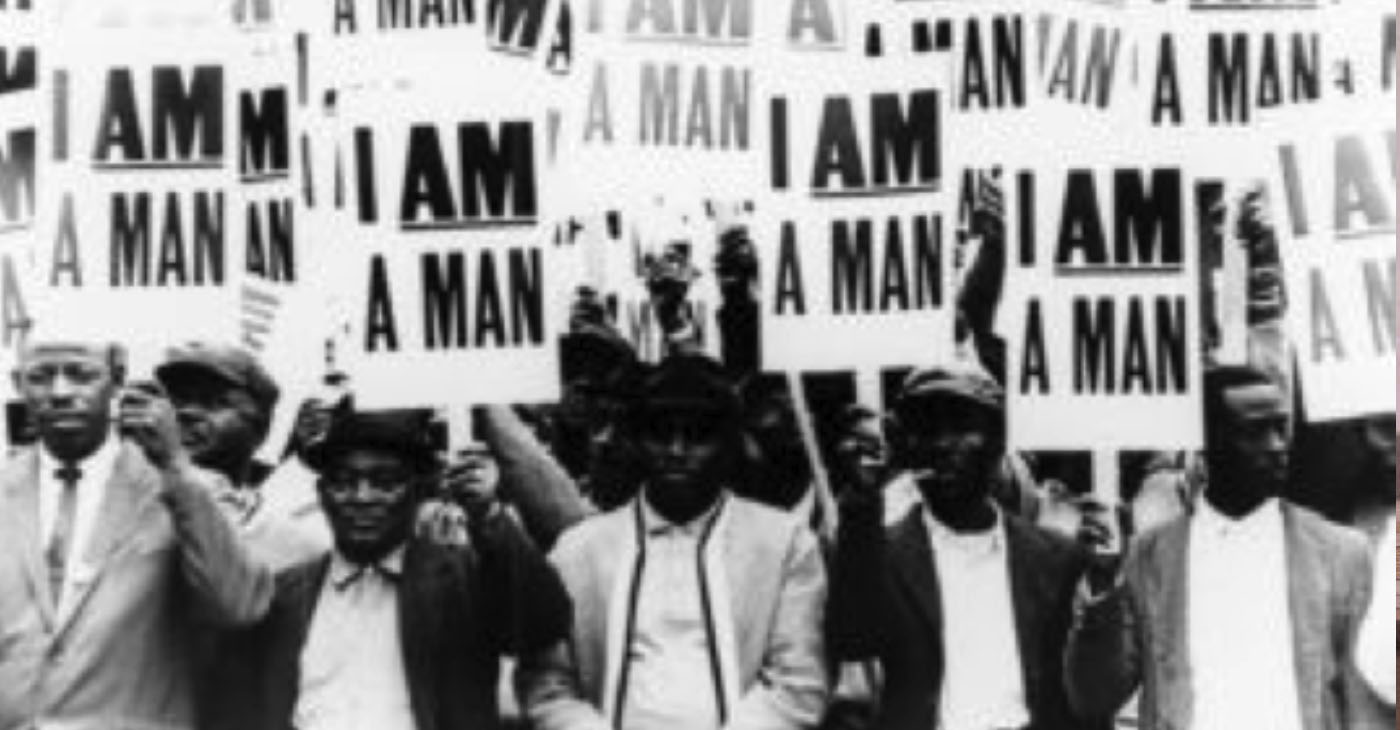
The workers had a strike with the support of many in the community. They carried signs that said, “I AM A MAN!” Some critics of King did not understand his identification with the cause of sanitation workers.
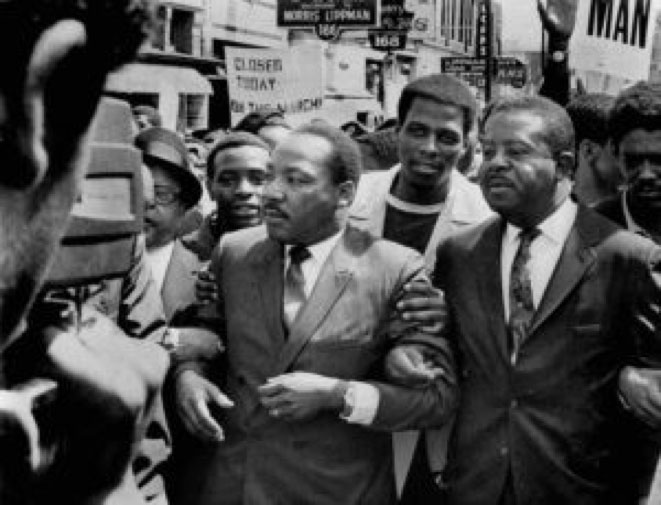
On March 28, 1968, Martin Luther King Jr. and Ralph Abernathy, right, lead a march on behalf of striking Memphis sanitation workers. (AP Photo/The Commercial Appeal, Sam Melhorn)
Professor Luther D. Ivory states in Toward a Theology of Radical Involvement that King used the teaching of Imago Dei to counter the notion of Black inferiority. Everyone irrespective of race, gender, education or economic status is to be valued and treated with respect and dignity. Blacks needed this message to overcome feelings of shame, inferiority and self-hatred caused by the absurdities of racism.
With this understanding, the foundation is built for Blacks and whites to live together in the beloved community. Living in the beloved community calls for Blacks and whites to work together to transform existing injustices in institutions and public life.
Forgive us, Lord, for our distorted gospel
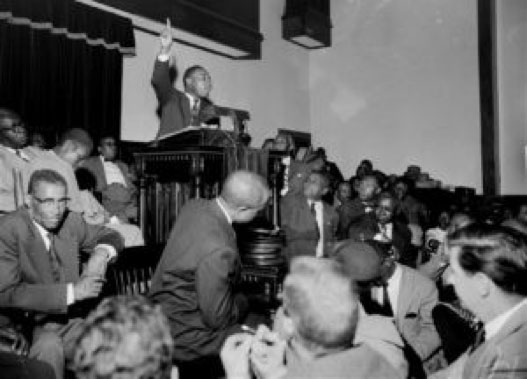
Martin Luther King speaks to an overflow crowd at a mass meeting at Holt Street Baptist Church in Memphis. (AP Photo/Gene Herrick)
Lord, forgive American Christians — Black and white — for their middle-class captivity with a distorted view of the gospel. This understanding of the gospel was concerned about life after death and not life after birth, addressing only the sweet by and by while ignoring the nasty now and now. This gospel condemns the personal sins of the individuals while ignoring corporate and institutional evils. This gospel refused to oppose chemical and nuclear waste dumps that are built on the edge of communities where the poor and politically powerless live.
In his book Stride Toward Freedom, King corrects the distorted view of the gospel saying: “The gospel deals with the whole man, not only his soul, but his body; not only his spiritual well-being, but his material well-being. … Any religion which professes to be concerned about the souls of men and is not concerned about the conditions that scar the soul is a spiritually moribund religion only waiting for the day to be buried.”
Forgive us, Lord, for our white nationalism
Forgive America, Lord, for her ethnocentrism and white nationalism that justifies her behavior whether it is right or wrong. American arrogance has been promoted by persons who have held the highest leadership positions in the nation. America has promoted herself as being No. 1 among the wealthy nations of the world.
In “A Lament for Humanity” on Humans Rights Day 2021, pastor, author and judge Wendell Griffen wrote, “The world’s richest 1% have more than twice as much wealth as 6.9 billion people. Nearly half the world’s population of 3.4 billion people lives on less than $5.50 per day. Every year, 100 million people are pushed into poverty because they must pay out-of-pocket for health care. Currently 258 million children (one out of five) will not be allowed to attend school.”
Pastor Griffen adds: “And it came to pass that humanity appears to have cursed itself and the world by that greed, lust for power, inequality and bigotry that make community seem like a global fantasy instead of a human imperative.”
The inequality is not accidental; it is deliberative, calculated and purposeful.
Forgive us, Lord, for we were warned by King in his last book, Where Do We Go from Here? He wrote, “We have inherited a large house, a great world house in which we have to learn to live together, Black and white, Easterner and Westerner, Gentile and Jew, Catholic and Protestant, Muslim and Hindu. A family unduly separated in ideas, culture and interest, who because we can never live apart, must somehow learn to live with each other in peace.”
Forgive us, Lord, for our violence
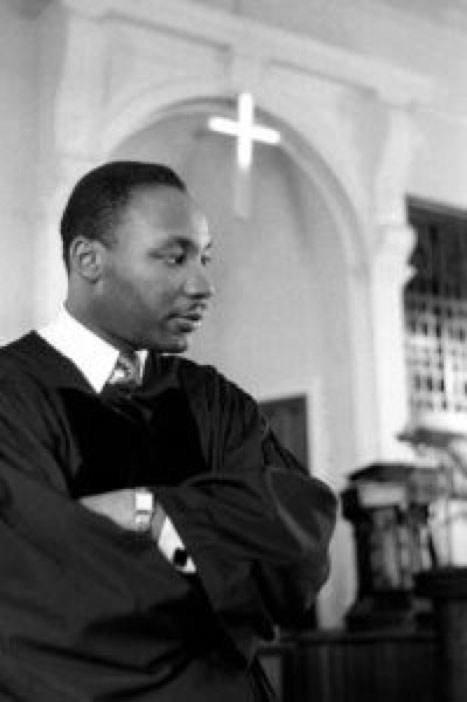
Martin Luther King delivers a sermon on May 13, 1956, in Montgomery, Ala. (Photo by Michael Ochs Archives/Getty Images)
Forgive us, Lord, for our worship of guns. There are more guns in America than people. Our money says “In God We Trust” but there are 121 firearms for every 100 residents. And 75% of homicides are related to guns. America leads all other nations in gun deaths. Our children have fears of being killed in school by a student. Black Christians in churches and Jews in synagogues have been killed while worshipping. Our shopping centers have had mass killings.
On Jan. 6, 2021, the U.S. Capitol was invaded by persons with guns attempting to stop the counting of the Electoral College votes. The reports say the lives of the vice president and the Speaker of the House were marked for death.
Guns are used to settle differences. The United States is the No. 1 seller of arms to the countries of the world. Forgive us, Lord, for giving deaf ears to the apostle of nonviolence. He preached against what he called the triplets of evil: war, poverty and racism. It was he who said, “Darkness cannot drive out darkness, only light can do that. Hate cannot drive out hate, only love can do that.”
A prayer for hope
May those of us who have become discouraged because racism seems to be on the increase find hope. May those of us who have become discouraged because white supremacy and white nationalism are boldly obtaining a stronger foothold in state and national governments find hope. May those of us who have become discouraged because voting rights for which people shed their blood so we could vote are now being stolen, placing democracy in jeopardy find hope.
Forgive us, Lord, if we forget how Martin Luther King told us in his very last speech that we would face difficult days. Those days are here.
Two months before his assassination on April 4, 1968, he spoke powerful words of hope. We must not forget them. He said, “We must accept finite disappointment but never lose infinite hope.”
Yes, the immediate future may not look promising. Negative news about climate change may haunt us. Young college graduates are uncertain about career opportunities. The COVID-19 virus and its mutations trouble us. These finite disappointments multiply geometrically, but we must not lose infinite hope.
I am not speaking of blind hope but an infinite hope that presses forward believing that if we do our part, our way-maker God, who brought us through the Middle Passage, the horror of runaway slaves chased by bloodhounds and beaten with many stripes if caught, the sexual abuse of the slave woman bearing a mulatto child for the slave owner, and the way-maker God of liberation who helped us survive the terrorism of the Ku Klux Klan and inspired our preachers to preach on after their churches were burned and to rebuild them back bigger — that this God will inspire us and create in us the power to keep the dream alive.
Not the God of the slave master’s preacher who told us not to steal the master’s chickens when our babies were crying from hunger, but the God of infinite hope, the God who creates ex nihilo, who makes a way out of no way. The way-maker God inspires us and creates in us the power to keep the dream of Martin Luther King alive.
Dante Stewart reminds us how Pastor James Bevel spoke about infinite hope: “There is a false rumor around our leader’s death. Martin Luther King is not our leader. Our leader is the man who led Moses out of Egypt. Our leader is the one who went with Daniel in the lion’s den. Our leader is the man who walked out of the grave on Easter morning. Our leader never sleeps nor slumbers. He cannot be put in jail. Our leader is still on the case. Our leader is not dead. One of the prophets died. We will not stop because of that.”
Alfred Smith served four decades as pastor of Allen Temple Baptist Church in Oakland, Calif. Now pastor emeritus, he is a member of the American Baptist Churches in the USA and dually aligned with the Progressive National Baptist Convention, where he served as the organization’s 12th president.










Activism
Oakland Post: Week of September 16 – 22, 2026
The printed Weekly Edition of the Oakland Post: Week of September 16 – 22, 2026

To enlarge your view of this issue, use the slider, magnifying glass icon or full page icon in the lower right corner of the browser window.
Activism
Oakland Post: Week of September 9 – 15, 2026
The printed Weekly Edition of the Oakland Post: Week of September 9 – 15, 2026
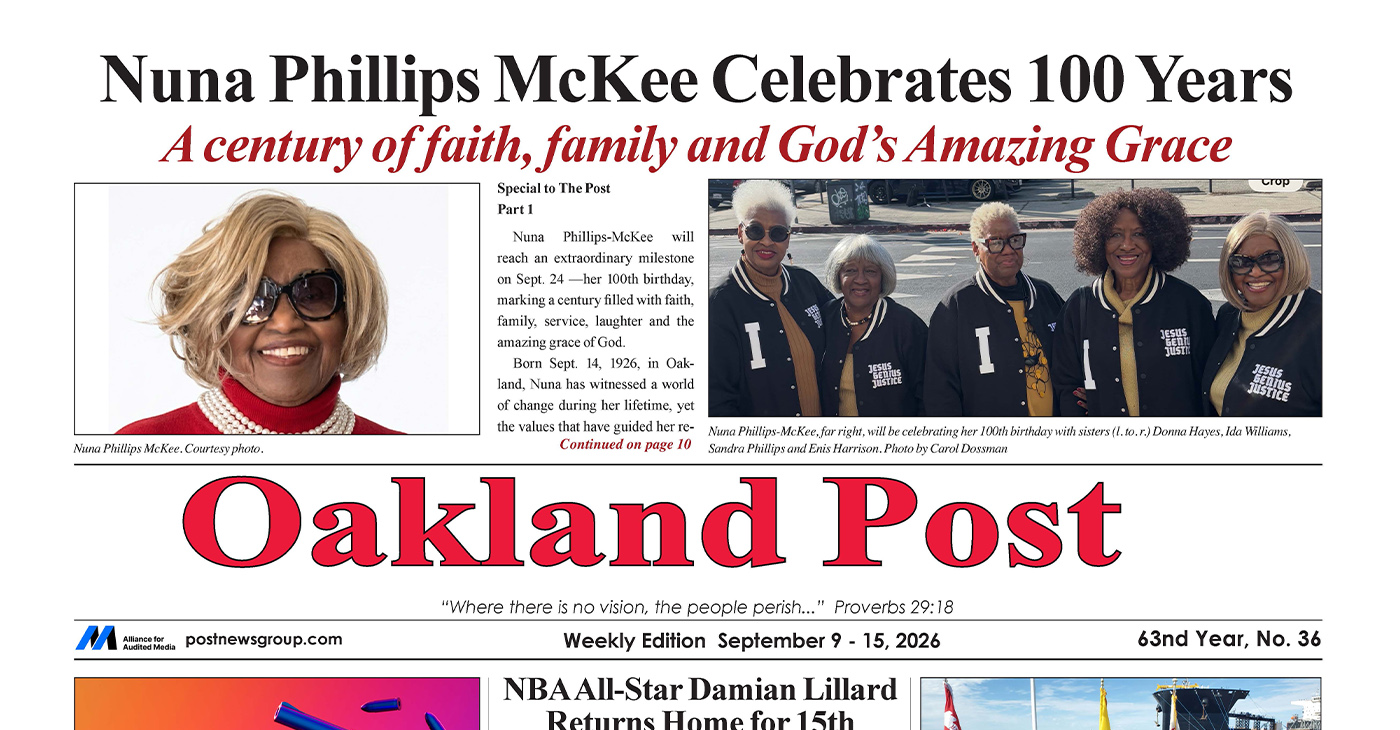
To enlarge your view of this issue, use the slider, magnifying glass icon or full page icon in the lower right corner of the browser window.
Activism
Oakland Post: Week of September 2 – 8, 2026
The printed Weekly Edition of the Oakland Post: Week of September 2 – 8, 2026
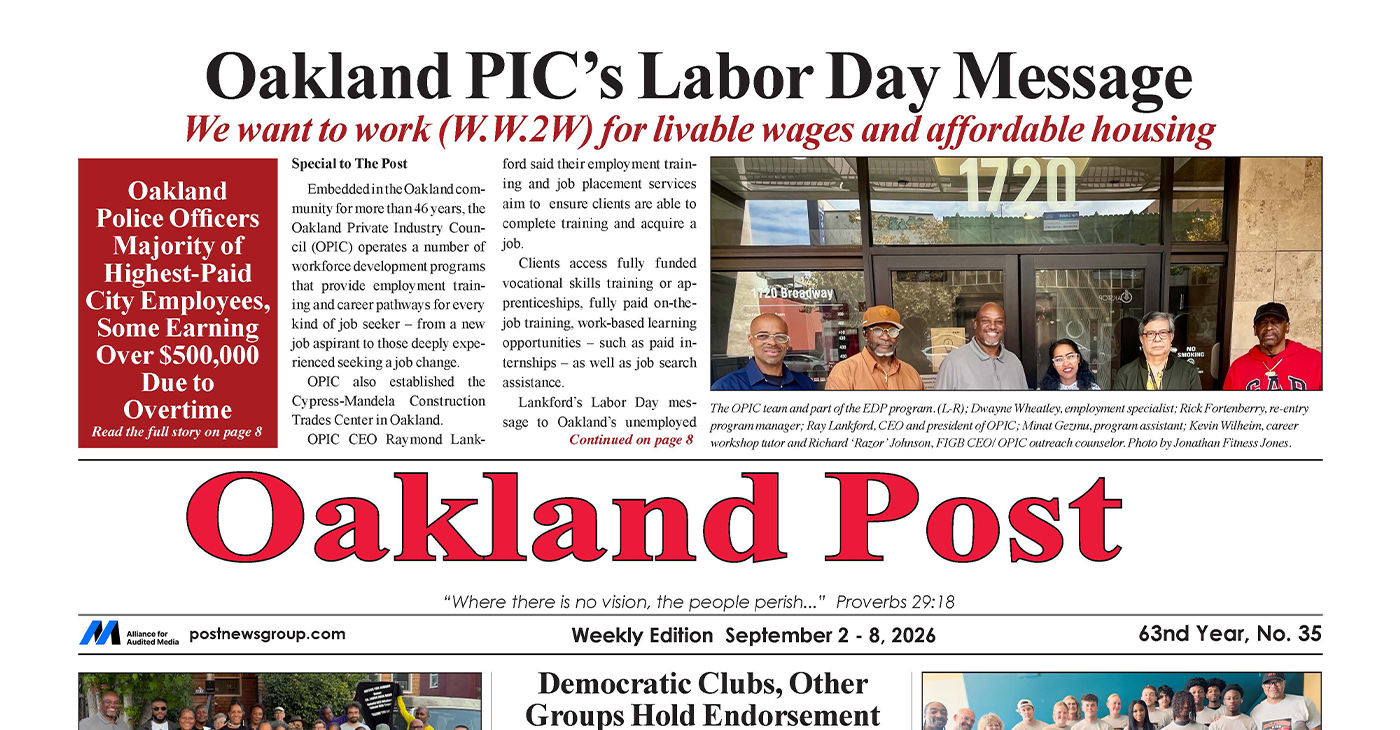
To enlarge your view of this issue, use the slider, magnifying glass icon or full page icon in the lower right corner of the browser window.



Doulas Are Helping Black California Moms Navigate Pregnancy–Even as High Mortality Rates Persist

Newsom Signs Addictive Social Media Law to Protect Kids

On Your November Ballot: Prop 38 Would Allocate $8.4 Billion to Immunology and Immunotherapy Funding

Ask California: Golden State Releases New AI Chatbot

Asm. Isaac Bryan’s Bill Banning California Police From ICE Side Jobs Reaches Newsom’s Desk

Assemblymember LaShae Sharp-Collins’s Bill Would Pause Law Enforcement’s Use of Shock Gloves Pending Study

BOOK REVIEW: ‘Laws of Solomon’ Reveals Tender Heart of Former Child Soldier

OPINION: The New American Fear – From 9-11 to AI

Passing for White, Fighting for Black America: The Courage of Walter White

Oakland People’s Arms Embargo Coalition Demands End to Military Shipments Thru Oakland

Barbara Lee Mourns Gloria Steinem, Remembers a Friendship Rooted in Equality

Event Preview: ‘Fashion v. Fascism’ – A Runway Revolution Is Coming to the Bay Area

Two Looming Threats Every Alameda County Elder Should Know About

Oakland Mayor Reads to Children at Bookout Block Party at Marcus Books Store

Tradition Comes to the Streets in 11th Annual Black-Eyed Pea Festival at the Freedom Farmers Market

Less Affluent School Districts, Including Sacramento City, Face Threat of State Takeover

ESSAY: California Can Close Its Colorectal Cancer Gap

California Hispanic Chambers of Commerce Unveils: ‘Powering the Future’ Theme for 47th Annual Statewide Convention

Four Candidates, Including Incumbent Barbara Lee, Qualify for Oakland Mayor’s Race

Oakland Post: Week of August 12 – 18, 2026

From Blueprint to Breakthrough: Tackling Affordable Housing in Oakland

Oakland Observes Black August with Block Parties, Film Showings, Workshops

COMMENTARY: Why Local School Tax Measure G1 Will Not Be on the November Ballot

Standoff for Justice: Our Homes Are Worth Fighting For

Returning to Its Roots, the Oakland Black-Eyed Pea Festival Partners with the Freedom Farmers Market Sept. 12

NPRC Scores First Advocacy Victory: David Shaw Finally Gets His Wish to ‘Go Home’

Oakland Post: Week of August 26 – September 1, 2026

Frontier Airlines’ Return to Oakland Airport Brings Flights, Jobs and Opportunity

Gubernatorial Candidate Steve Hilton Blasts California New Tire Rules; Newsom Hits Back

Chef Sharon Lee Blends Culinary Excellence, Education and Empowerment

The Conversation With Al McFarlane 6/23/26

Media Monday 6/22/26

LIVE! ASK ALMA! — TUES. 6.23.26 7PM EST

Car Buying Secrets: 4 Hidden Checks Before You Sign!

Is This 550 HP Charger Worth YOUR Money? AutoNetwork Review

Celebrating Juneteenth – Frederick Douglass on education and resistance

LIVE! — ASK ALMA! — TUES. 6.19.26 7PM EST

Hyundai Ioniq 5 Parking, Safety, and 360 View #shorts

2025 Ioniq 5 New Wiper & Powerful Performance! #shorts

Electric SUV Range: Is 259 Miles Enough? #shorts

EV Charging: How Fast Can You Charge an Electric Vehicle? #shorts

Biometric Cooling… Messaging Seats…Come on! 2025 Infiniti QX80 Autograph 4WD

Charged Up: Witness the Magic of a Fully Electric Car! #shorts

Range Rover Sport PHEV Included…: See What’s Inside This Luxury SUV! #shorts

Invisible Hood View: Perfect Parking with X-Ray Vision! #shorts
-
 Commentary4 weeks ago
Standoff for Justice: Our Homes Are Worth Fighting For
-
 Activism4 weeks ago
Oakland Post: Week of August 26 – September 1, 2026
-
 Business4 weeks ago
Frontier Airlines’ Return to Oakland Airport Brings Flights, Jobs and Opportunity
-
 Business4 weeks ago
Gubernatorial Candidate Steve Hilton Blasts California New Tire Rules; Newsom Hits Back
-
 Business4 weeks ago
Chef Sharon Lee Blends Culinary Excellence, Education and Empowerment
-

 Education4 weeks ago
Gov. Newsom’s Latest Appointees Include Sacramento Advocate for Formerly Incarcerated Students; State’s New Tech Chief
-

 Community4 weeks ago
Big City Mayors Ask for “Yes” Vote on Housing Bond Measure; Conservatives Say “No”
-

 Business4 weeks ago
Oakland Coliseum Project Opens Door for Small Businesses to Build Bigger
