
California Black Media
Commentary: Finding the Right Balance — Addressing Organized Retail Theft While Upholding Civil Liberties
Organized retail theft is a significant issue that impacts both consumers and businesses. While it is crucial to address theft and protect businesses from losses, we should also be mindful of safeguarding individuals’ constitutional rights, particularly the right to due process. AB 1990 by Assemblymember Wendy Carrillo, also known as the STOP Act, raises concerns about the balance between addressing theft effectively and ensuring civil liberties are upheld.


By Assemblymember Tina McKinnor | Special to California Black Media Partners
Organized retail theft is a significant issue that impacts both consumers and businesses. While it is crucial to address theft and protect businesses from losses, we should also be mindful of safeguarding individuals’ constitutional rights, particularly the right to due process.
AB 1990 by Assemblymember Wendy Carrillo, also known as the STOP Act, raises concerns about the balance between addressing theft effectively and ensuring civil liberties are upheld. This bill allows law enforcement officers to make warrantless arrests for shoplifting offenses not witnessed by the officer, as long as there is reasonable cause to believe the individual committed the crime. This bill has a dangerous potential for overreach and infringes on civil liberties, particularly the right to due process.
While the stated intention behind the STOP Act is to combat organized retail theft and protect businesses, there are valid concerns that this bill is an overreach and that existing law works, if properly enforced by our partners in law enforcement. A petty theft involving property stolen valued at $950 or less may be charged as a felony or misdemeanor (called a wobbler) if the offender has the following prior convictions: 1) at least on prior petty or theft-related conviction for which a term of imprisonment was served, and 2) a prior conviction for a serious or violent offense, for any registerable sex offense, or for embezzlement from a dependent adult or anyone over the age of 65. A misdemeanor can result in a sentence of up to one year in jail, whereas a felon can mean incarceration for 16 months, two years or three years. Let’s look at shoplifting in California. It occurs when a suspect enters a store, while that establishment is open, intending to steal property worth less than $950. The crime is considered a misdemeanor, punishable by up to six months in the county jail.

Granting officers the authority to arrest individuals based on reasonable cause, without witnessing the crime firsthand, can lead to negative consequences and possible violations of individual rights. Probable cause is the legal standard by which police authorities have reason to obtain a warrant for the arrest of a suspected criminal and for the courts to issue a search warrant. A grand jury uses the probable cause standard to determine whether or not to issue a criminal indictment. The principle behind the probable cause standard is to limit the power of authorities to conduct unlawful search and seizure of a person or its property, and to promote formal, forensic procedures for gathering lawful evidence for the prosecution of the arrested criminal. Reasonable cause does not require any of this due process and only requires that an officer reasonably believes that a crime has been committed. It is essential to find a middle ground that effectively addresses organized retail theft without compromising the fundamental rights of individuals.
California’s current laws, including the use of witness statements and surveillance evidence are sufficient for addressing suspected shoplifting and organized retail theft. California Attorney General Rob Bonta recently prosecuted Michelle Mack, a suspected organized smash and grab ringleader who paid twelve women to travel around California and commit over $8 million in retail theft at 21 different stores. AG Bonta used California’s current laws to have the suspect arrested and brought to justice.
The State of California is also making significant investments to address retail theft. Just this past year California invested an additional $267 million to combat organized retail theft. It has been less than a year and our law enforcement partners should have the opportunity to address this recent spike in retail theft crime.
Los Angeles County recently applied for and received a grant for the State of California for $15.6 million dollars to address retail theft enforcement. LA District Attorney George Gascon also recently formed an organized retail task force that partners with LA County Sheriff’s Department, Glendale, Beverly Hills, Burbank, Torrance and Santa Monica Police Departments to integrate their response to retail theft across the region. These collaborative efforts, such as those seen in initiatives like the organized retail task force in LA County, demonstrate the importance of a united approach to tackling theft while maintaining a balance between enforcement and civil liberties.
As we move forward, it is essential for policymakers, law enforcement agencies, businesses and communities to work together in finding solutions that effectively address organized retail theft without encroaching on individual rights. Ongoing evaluation and a commitment to thoughtful consideration will be crucial in navigating this challenge and fostering a safe and prosperous environment for all. Balancing the scales of justice to protect businesses while upholding civil liberties demands a comprehensive and conscientious approach from all stakeholders involved.
I am confident we can find that balance.
About the Author
Assemblymember Tina McKinnor (D-Inglewood) represents the 61st District in Los Angeles County, which includes parts of the South Bay, Inglewood, Hawthorne and Lawndale.








Activism
Oakland Post: Week of August 12 – 18, 2026
The printed Weekly Edition of the Oakland Post: Week of August 12 – 18, 2026

To enlarge your view of this issue, use the slider, magnifying glass icon or full page icon in the lower right corner of the browser window.
Activism
Oakland Post: Week of August 5 – 11, 2026
The printed Weekly Edition of the Oakland Post: Week of August 5 – 11, 2026
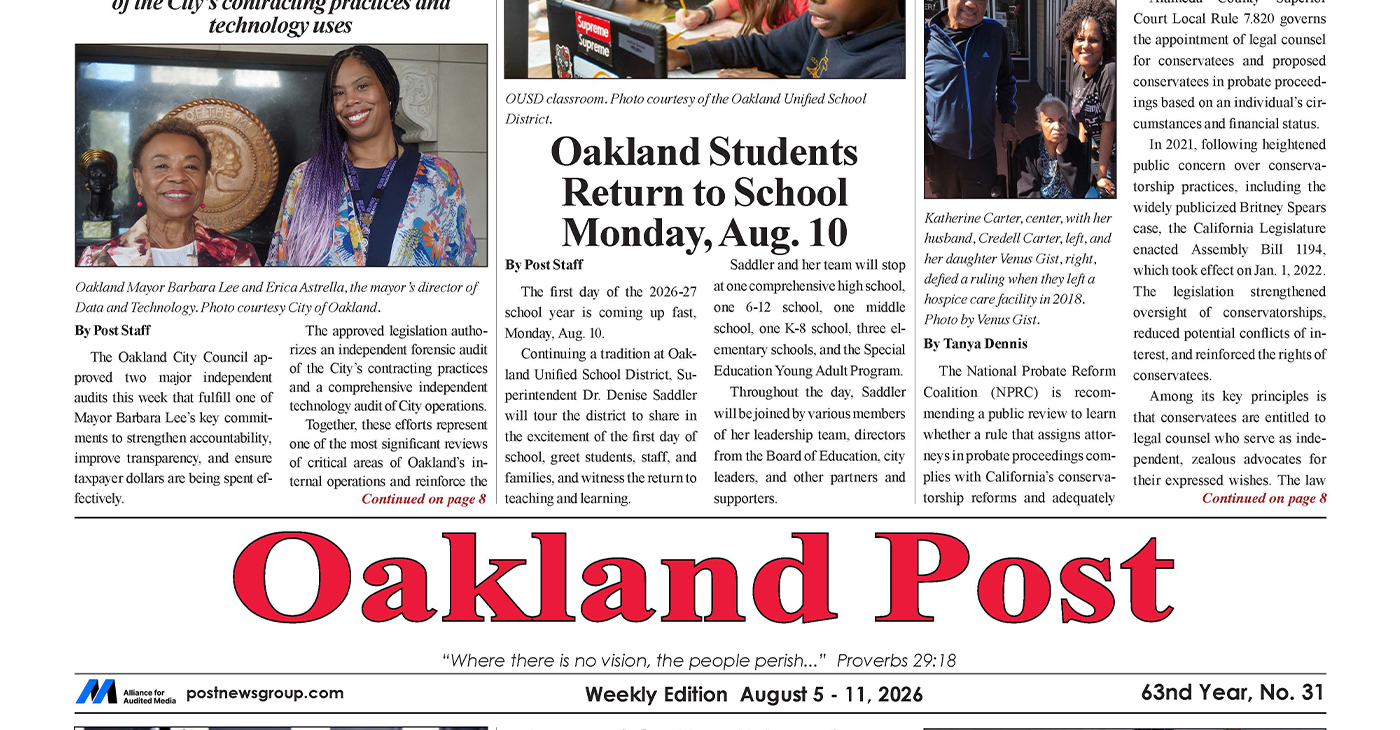
To enlarge your view of this issue, use the slider, magnifying glass icon or full page icon in the lower right corner of the browser window.
Activism
Oakland Post: Week of July 29 – August 4, 2026
The printed Weekly Edition of the Oakland Post: Week of July 29 – August 4, 2026

To enlarge your view of this issue, use the slider, magnifying glass icon or full page icon in the lower right corner of the browser window.

WORK FROM HOME
Home-based business with potential monthly income of $10K+ per month. A proven training system and website provided to maximize business effectiveness. Perfect job to earn side and primary income. Contact Lynne for more details: Lynne4npusa@gmail.com 800-334-0540


Four Candidates, Including Incumbent Barbara Lee, Qualify for Oakland Mayor’s Race

Oakland Observes Black August with Block Parties, Film Showings, Workshops

Oakland Post: Week of August 12 – 18, 2026

COMMENTARY: Why Local School Tax Measure G1 Will Not Be on the November Ballot

California Hispanic Chambers of Commerce Unveils: ‘Powering the Future’ Theme for 47th Annual Statewide Convention

Returning to Its Roots, the Oakland Black-Eyed Pea Festival Partners with the Freedom Farmers Market Sept. 12

Less Affluent School Districts, Including Sacramento City, Face Threat of State Takeover

From Blueprint to Breakthrough: Tackling Affordable Housing in Oakland

NPRC Scores First Advocacy Victory: David Shaw Finally Gets His Wish to ‘Go Home’

ESSAY: California Can Close Its Colorectal Cancer Gap

Car Wash Workers Cope with Lingering Impacts of ICE Raids

Misty Copeland Shapes Ballet’s Tomorrow

As Part of Your Back-to- School Checklist, Vaccinate

As Part of Your Back-to- School Checklist, Vaccinate

Congresswoman Simon Demands Investigation into Trump’s Abuse of Emergency Powers for Coal Export Terminal in West Oakland

Department of Homeland Security Demands California Secretary of State Shirley N. Weber Scrub Voter Rolls

Oakland Children’s Hospital Workers and Patients Rally for Pediatric Medical Care

New Judge Could Decide if Karmelo Anthony Gets a New Trial

“The Power to See Threats Sooner”: Gov. Newsom, Safety Officials Showcase California’s Investments in Hi-Tech Wildfire Prevention

Alpha Kappa Alpha Sorority, Inc. Celebrates New North Atlantic Regional Director

Surveillance Pricing Fight: State Senate Debates Bill Banning Retailers from Using AI to Set Prices Based on a Buyer’s Profile

Mount Zion MBC, Church of Jesus Christ of Latter-day Saints Partner to Bring 29,000 Meals to Alameda County

California Sen. Padilla Joins Colleagues to Introduce Bill Imposing Term Limits on Supreme Court Justices

Starting This Summer, California Car Buyers Can Get an Instant $3500 Off the Cost of Electric Vehicles

COMMENTARY: You Are Already Paying for the AI Boom
Less Affluent School Districts, Including Sacramento City, Face Threat of State Takeover

California Bill Would Let Abuse Victims Use Trauma as Legal Defense for Violent Crime
Car Wash Workers Cope with Lingering Impacts of ICE Raids

Fed Court to Decide Landmark First Amendment Case

Gov. Gavin Newsom Signs Law Streamlining Affordable Housing Rules

The Conversation With Al McFarlane 6/23/26

Media Monday 6/22/26

LIVE! ASK ALMA! — TUES. 6.23.26 7PM EST

Car Buying Secrets: 4 Hidden Checks Before You Sign!

Is This 550 HP Charger Worth YOUR Money? AutoNetwork Review

Celebrating Juneteenth – Frederick Douglass on education and resistance

LIVE! — ASK ALMA! — TUES. 6.19.26 7PM EST

Hyundai Ioniq 5 Parking, Safety, and 360 View #shorts

2025 Ioniq 5 New Wiper & Powerful Performance! #shorts

Electric SUV Range: Is 259 Miles Enough? #shorts

EV Charging: How Fast Can You Charge an Electric Vehicle? #shorts

Biometric Cooling… Messaging Seats…Come on! 2025 Infiniti QX80 Autograph 4WD

Charged Up: Witness the Magic of a Fully Electric Car! #shorts

Range Rover Sport PHEV Included…: See What’s Inside This Luxury SUV! #shorts

Invisible Hood View: Perfect Parking with X-Ray Vision! #shorts
-
 Featured1 week ago
Department of Homeland Security Demands California Secretary of State Shirley N. Weber Scrub Voter Rolls
-
 Business3 weeks ago
Oakland Children’s Hospital Workers and Patients Rally for Pediatric Medical Care
-
 #NNPA BlackPress2 weeks ago
New Judge Could Decide if Karmelo Anthony Gets a New Trial
-
 Environment1 week ago
“The Power to See Threats Sooner”: Gov. Newsom, Safety Officials Showcase California’s Investments in Hi-Tech Wildfire Prevention
-
 Black History2 weeks ago
Alpha Kappa Alpha Sorority, Inc. Celebrates New North Atlantic Regional Director
-
 Business3 weeks ago
Surveillance Pricing Fight: State Senate Debates Bill Banning Retailers from Using AI to Set Prices Based on a Buyer’s Profile
-
 Business3 weeks ago
Mount Zion MBC, Church of Jesus Christ of Latter-day Saints Partner to Bring 29,000 Meals to Alameda County
-
 Featured1 week ago
California Sen. Padilla Joins Colleagues to Introduce Bill Imposing Term Limits on Supreme Court Justices
