
#NNPA BlackPress
COMMENTARY: D.C. Crime Bill Fails to Address Root Causes of Violence and Incarceration
WASHINGTON INFORMER — The D.C. crime bill and so many others like it are reminiscent of the ‘94 crime bill, which produced new and harsher criminal sentences, helped deploy thousands of police and surveilling methods in Black and brown communities, and incentivized more states to build prisons through a massive infusion of federal funding. While it is not at the root of mass incarceration, it significantly accelerated it, forcing a generation of Black and brown families into a never-ending cycle of state-sanctioned violence and incarceration.
The post COMMENTARY: D.C. Crime Bill Fails to Address Root Causes of Violence and Incarceration first appeared on BlackPressUSA.

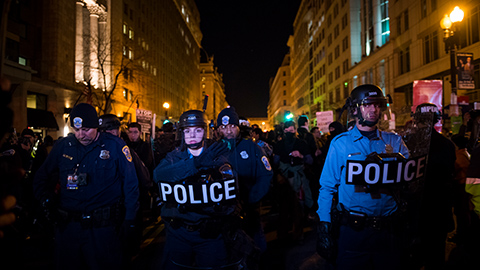
By Kaili Moss and Jillian Burford | Washington Informer
Mayor Bowser has signed the “Secure DC” omnibus bill passed by the D.C. Council last month. But we already know that this bill will be disastrous for all of D.C., especially for Black and brown residents.
While proponents claim that this legislation “will make D.C. residents safer and more secure,” it actually does nothing to address the root of the harm in the first place and instead maintains a cycle of violence, poverty, and broken community ties. The omnibus bill calls for increased surveillance, drug-free zones, and will expand pre-trial detention that will incarcerate people at a significantly higher rate and for an indeterminate amount of time before they are even tried. This bill will roll back decades of nationwide policy reform efforts and initiatives to keep our communities safe and whole, which is completely contradictory to what the “Secure” D.C. bill claims it will do.
What is unfolding in Washington, D.C., is part of a dangerous national trend. We have seen a resurrection of bad crime bills in several jurisdictions across the country — a phenomenon policy experts have named “zombie laws,” which are ineffective, costly, dangerous for communities of color and, most importantly, will not create public safety. Throwing more money into policing while failing to fund preventative measures does not keep us safe.

The D.C. crime bill and so many others like it are reminiscent of the ‘94 crime bill, which produced new and harsher criminal sentences, helped deploy thousands of police and surveilling methods in Black and brown communities, and incentivized more states to build prisons through a massive infusion of federal funding. While it is not at the root of mass incarceration, it significantly accelerated it, forcing a generation of Black and brown families into a never-ending cycle of state-sanctioned violence and incarceration. Thirty years later, despite spending billions each year to enforce these policies with many of these provisions remaining in effect, it has done very little to create long-term preventative solutions. Instead, it placed a permanent moving target on the backs of Black people, and the D.C. crime bill will do the same.
The bill calls for more pretrial detention. When our loved ones are held on pretrial detention, they are held on the presumption of guilt for an indeterminate amount of time before ever seeing a judge, which can destabilize people and their families. According to experts at the Malcolm Weimer Center for Social Policy at Harvard University, just one day in jail can have “devastating consequences.” On any given day, approximately 750,000 people are held in jails across the nation — a number that beats our nation’s capital population by about 100,000. Once detained, people run the risk of losing wages, jobs, housing, mental and health treatments, and time with their families. Studies show that pretrial detention of even a couple of days makes it more likely for that person to be rearrested.
The bill also endangers people by continuing a misguided and dangerous War on Drugs, which will not get drugs off the street, nor will it deter drug use and subsequent substance use disorders (SUDs). Drug policies are a matter of public health and should be treated as such. Many states such as Alabama, Iowa and Wisconsin are treating the current fentanyl crisis as “Crack 2.0,” reintroducing a litany of failed policies that have sent millions to jails and prisons instead of prioritizing harm reduction. Instead, we propose a simple solution: listen to members of the affected communities. Through the Decrim Poverty D.C. Coalition, community members, policy experts and other stakeholders formed a campaign to decriminalize drugs and propose comprehensive legislation to do so.
While there are many concerning provisions within the omnibus bill, car chases pose a direct physical threat to our community members. In July 2023, NBC4 reported that the D.C. Council approved emergency legislation that gave MPD officers the ability to engage in vehicular pursuits with so-called “limited circumstances.” Sgt. Val Barnes, the head of MPD’s carjacking task force, even expressed concern months before the decision, saying, “The department has a pretty strict no-chase policy, and obviously for an urban setting and a major metropolitan city, that’s understandable.” If our law enforcement officers themselves are operating with more concern than our elected officials, what does it say about the omnibus bill’s purported intention to keep us safe?
And what does it mean when the risk of bodily harm is posed by the pursuit itself? On Saturday, Feb. 10, an Eckington resident had a near-miss as a stolen car barreled towards her and her dog on the sidewalk with an MPD officer in pursuit. What responsibility does the city hold if this bystander was hit? What does restitution look like? Why are our elected officials pushing for MPD officers to contradict their own policies?
Just a few summers ago during the uprisings of 2020, we saw a shift in public perspectives on policing and led to legislation aimed at limiting police power after the highly-publicized murders of loved ones Breonna Taylor and George Floyd — both victims of War on Drugs policing and the powers gained from the ’94 crime bill. And yet here we are. These measures do not keep us safe and further endanger the health of our communities. Studies show that communities that focus on harm reduction and improving material conditions have a greater impact on public safety and community health. What’s missing in mainstream conversations about violent crime is the violence that stems from state institutions and structures that perpetuate racial and class inequality. The people of D.C. deserve to feel safe, and that includes feeling safe from the harms enacted by the police.
Kaili Moss is a staff attorney at Advancement Project, a national racial justice and legal organization, and Jillian Burford is a policy organizer at Harriet’s Wildest Dreams.
The post COMMENTARY: D.C. Crime Bill Fails to Address Root Causes of Violence and Incarceration first appeared on BlackPressUSA.












#NNPA BlackPress
NFL: Week Two Recap | Jalen Hurts did not fold; Caleb Williams exits game with injury
Philadelphia Eagles quarterback Jalen Hurts found Darius Cooper with nine seconds left for the game winning touchdown as his team beat the Tennessee Titans 24-20 in Nashville. Hurts finished the day 26/37 for 264 yards. He threw for two touchdowns and two interceptions. Prior to the final drive, the Eagles ran 25 plays for 45 […]
The post NFL: Week Two Recap | Jalen Hurts did not fold; Caleb Williams exits game with injury appeared first on BlackPressUSA.

Philadelphia Eagles quarterback Jalen Hurts found Darius Cooper with nine seconds left for the game winning touchdown as his team beat the Tennessee Titans 24-20 in Nashville. Hurts finished the day 26/37 for 264 yards. He threw for two touchdowns and two interceptions.
Prior to the final drive, the Eagles ran 25 plays for 45 yards. During the final drive Hurts went 6-8 with 61 passing yards and the touchdown. Titans defensive tackle — and team captain — Jeffery Simmons said this week that the way to defend Jalen Hurts is to make him “play quarterback.”
Hurts said to Simmons after today’s game: “You started that sh**. I had to finish it.”
Running back Saquon Barkley suffered a stinger in the first half but he ultimately finished the game. He had four carries and nine yards and one catch for eleven yards. He will get an MRI for his injury, but admitted to Cameron Wolfe of the NFL Network he was fine.
Caleb Williams leaves game against Vikings with apparent lower-body injury
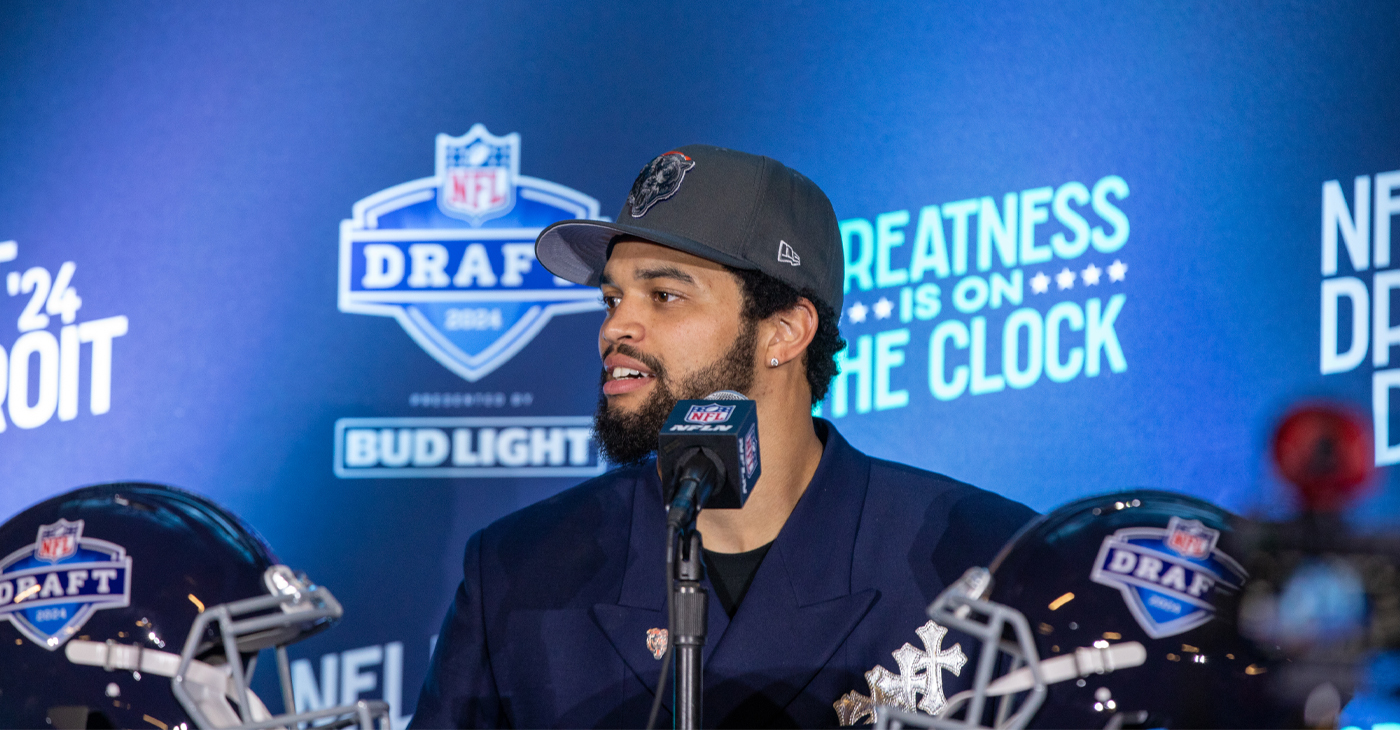
Chicago Bears quarterback Caleb Williams was helped off the field with a right leg injury with 7:42 remaining in the fourth quarter. Williams was down, writhing in pain after scrambling to his left. After departing the injury tent, Williams raised his right fist, acknowledging the crowd while expressing his frustration. Testing will commence on Monday to find out more details about his injury.
“We’ll know tomorrow,” Johnson admitted regarding Williams’ injury. “He’s in good spirits. He’s a team player.”
Williams finished the day with 138 passing yards and one interception.
“I’m actually happy it’s nothing with the knee — that was my first inclination,” Johnson said. “But, a hamstring could be pretty damaging as well. So, we’ll see. We’ll see how bad it is tomorrow and we’ll go from there.”
Bryce Young once again dominated the Falcons
Carolina Panthers quarterback Bryce Young is 5-1 against the Atlanta Falcons and is undefeated at Mercedes-Benz Stadium. Today, Young threw for 287 yards and three touchdowns as he led the Panthers to a 34-3 dismembering of the Atlanta Falcons. Georgia Tech alumnus Darren Waller caught two touchdowns and linebacker Devin Lloyd returned one of his two interceptions for a touchdown.
Cooper Rush started his second straight game for the Falcons and it did not go well. The partisan crowd voiced their displeasure after Rush completed 10/17 passes for 86 yards and two interceptions. Jack Strand entered the game for Rush prompting cheers from the Falcons fans. The rookie threw a pick-six on his first career pass attempt. Strand was the first QB to accomplish that feat since Sam Darnold in 2018 and is the first Falcons player to do that since Brett Favre in 1991. Strand finished the day with 59 passing yards and 16 rushing yards.
According to reports, quarterback Michael Penix, Jr. is expected to make his season debut this Thursday at the Green Bay Packers. His return should help the Falcons. They are the first team since the 2008 Rams to not run any plays in the red zone after the first two games to open a season.
The bright spots for the Falcons today were the Spelman College Jaguarettes performing with the Falcons cheerleaders and Florida A&M’s marching band, The Marching 100, also performed during halftime!
Jayden Daniels gets carted off after apparent arm injury
Washington Commanders quarterback Jayden Daniels appeared to injure his left elbow on the final play of the first half in his game against the Dallas Cowboys. During the play, Daniels got stepped on, braced himself for the fall, and his elbow bent the wrong way. Daniels draped a towel over his head as he exited the field on the cart.
He was later ruled out.
Daniels suffered a dislocated elbow to the same arm during week nine of last season against the Washington Commanders, which led to him being shut down for the remainder of the season.
The post NFL: Week Two Recap | Jalen Hurts did not fold; Caleb Williams exits game with injury appeared first on BlackPressUSA.

#NNPA BlackPress
The Complete Negotiation Framework — Every Stage, Every Tactic, Every Win
Master the complete vehicle-purchase negotiation framework with Roosevelt Gist and Roosevelt. Learn every stage, tactic, and win!
The post The Complete Negotiation Framework — Every Stage, Every Tactic, Every Win appeared first on BlackPressUSA.

Roosevelt Gist and Roosevelt deliver the complete vehicle-purchase negotiation framework in Episode 8 of The Color of Our Money Is Green. This episode covers the three foundations of every effective negotiation, the full seven-stage negotiation sequence with exact language for every stage, and five of the most common dealership tactics with the specific response each one requires.
What You Learn in This Episode:
The three foundations that make every negotiation tactic work
The complete seven-stage car-buying negotiation sequence
Exact language for every stage of the dealership conversation
Five common dealership tactics — the turnover, the four-square, the packed payment, spot delivery, and forced add-ons — and how to counter each one
Why signing preliminary paperwork isn’t the same as signing the final contract
___________________________________________________________________
“The Color of Our Money Is Green: A Buyer’s Guide to What Cars Actually Cost” — stan.store/RGist
____________________________________________________________________
AutoNetwork helps serious car shoppers inspect any new vehicle online before walking into a dealership. I’m Roosevelt — I’ve been reviewing cars and shaping digital car buying and credit union auto leasing since before YouTube car reviews existed.
You’ll find detailed walkaround reviews, POV test drives, and buyer-focused breakdowns covering comfort, space, features, and real-world value.
How to use the channel:
Watch the walkaround of the car you’re considering
Visit AutoNetwork.com for the full review
Check CouponsOffersAndDeals.com for current dealer specials
Walk in already knowing what you want — and what it should cost
 AutoNetwork.com
 CouponsOffersAndDeals.com
Affiliate disclosure: some links earn a small commission at no cost to you and help support the channel. Insta360 is one of those partners.
The post The Complete Negotiation Framework — Every Stage, Every Tactic, Every Win appeared first on BlackPressUSA.
#NNPA BlackPress
Mazda CX-90 Luxury: Heated Seats & Premium Comfort! #shorts
Stay toasty in the CX-90! Plush Nappa leather, heated/ventilated seats, and a memory-equipped heated steering wheel deliver ultimate luxury.
The post Mazda CX-90 Luxury: Heated Seats & Premium Comfort! #shorts appeared first on BlackPressUSA.

Experience ultimate comfort in the CX-90. Nappa leather, heated/ventilated seats, 8-way power adjustments, and memory settings for both front passengers. The heated steering wheel with memory tilt/telescope adds premium convenience.
 Watch the full video: https://youtu.be/EH5A4eQ4ipY
#AutoNetwork
The post Mazda CX-90 Luxury: Heated Seats & Premium Comfort! #shorts appeared first on BlackPressUSA.



Doulas Are Helping Black California Moms Navigate Pregnancy–Even as High Mortality Rates Persist

Newsom Signs Addictive Social Media Law to Protect Kids

On Your November Ballot: Prop 38 Would Allocate $8.4 Billion to Immunology and Immunotherapy Funding

Ask California: Golden State Releases New AI Chatbot

Asm. Isaac Bryan’s Bill Banning California Police From ICE Side Jobs Reaches Newsom’s Desk

Assemblymember LaShae Sharp-Collins’s Bill Would Pause Law Enforcement’s Use of Shock Gloves Pending Study

BOOK REVIEW: ‘Laws of Solomon’ Reveals Tender Heart of Former Child Soldier

OPINION: The New American Fear – From 9-11 to AI

Passing for White, Fighting for Black America: The Courage of Walter White

Oakland People’s Arms Embargo Coalition Demands End to Military Shipments Thru Oakland

Barbara Lee Mourns Gloria Steinem, Remembers a Friendship Rooted in Equality

Event Preview: ‘Fashion v. Fascism’ – A Runway Revolution Is Coming to the Bay Area

Two Looming Threats Every Alameda County Elder Should Know About

Oakland Mayor Reads to Children at Bookout Block Party at Marcus Books Store

Tradition Comes to the Streets in 11th Annual Black-Eyed Pea Festival at the Freedom Farmers Market

Less Affluent School Districts, Including Sacramento City, Face Threat of State Takeover

ESSAY: California Can Close Its Colorectal Cancer Gap

California Hispanic Chambers of Commerce Unveils: ‘Powering the Future’ Theme for 47th Annual Statewide Convention

Four Candidates, Including Incumbent Barbara Lee, Qualify for Oakland Mayor’s Race

Oakland Post: Week of August 12 – 18, 2026

From Blueprint to Breakthrough: Tackling Affordable Housing in Oakland

Oakland Observes Black August with Block Parties, Film Showings, Workshops

COMMENTARY: Why Local School Tax Measure G1 Will Not Be on the November Ballot

Standoff for Justice: Our Homes Are Worth Fighting For

Returning to Its Roots, the Oakland Black-Eyed Pea Festival Partners with the Freedom Farmers Market Sept. 12

NPRC Scores First Advocacy Victory: David Shaw Finally Gets His Wish to ‘Go Home’

Oakland Post: Week of August 26 – September 1, 2026

Frontier Airlines’ Return to Oakland Airport Brings Flights, Jobs and Opportunity

Gubernatorial Candidate Steve Hilton Blasts California New Tire Rules; Newsom Hits Back

Chef Sharon Lee Blends Culinary Excellence, Education and Empowerment

The Conversation With Al McFarlane 6/23/26

Media Monday 6/22/26

LIVE! ASK ALMA! — TUES. 6.23.26 7PM EST

Car Buying Secrets: 4 Hidden Checks Before You Sign!

Is This 550 HP Charger Worth YOUR Money? AutoNetwork Review

Celebrating Juneteenth – Frederick Douglass on education and resistance

LIVE! — ASK ALMA! — TUES. 6.19.26 7PM EST

Hyundai Ioniq 5 Parking, Safety, and 360 View #shorts

2025 Ioniq 5 New Wiper & Powerful Performance! #shorts

Electric SUV Range: Is 259 Miles Enough? #shorts

EV Charging: How Fast Can You Charge an Electric Vehicle? #shorts

Biometric Cooling… Messaging Seats…Come on! 2025 Infiniti QX80 Autograph 4WD

Charged Up: Witness the Magic of a Fully Electric Car! #shorts

Range Rover Sport PHEV Included…: See What’s Inside This Luxury SUV! #shorts

Invisible Hood View: Perfect Parking with X-Ray Vision! #shorts
-
 Commentary4 weeks ago
Standoff for Justice: Our Homes Are Worth Fighting For
-
 Activism4 weeks ago
Oakland Post: Week of August 26 – September 1, 2026
-
 Business4 weeks ago
Frontier Airlines’ Return to Oakland Airport Brings Flights, Jobs and Opportunity
-
 Business4 weeks ago
Gubernatorial Candidate Steve Hilton Blasts California New Tire Rules; Newsom Hits Back
-
 Business4 weeks ago
Chef Sharon Lee Blends Culinary Excellence, Education and Empowerment
-

 Education4 weeks ago
Gov. Newsom’s Latest Appointees Include Sacramento Advocate for Formerly Incarcerated Students; State’s New Tech Chief
-

 Community4 weeks ago
Big City Mayors Ask for “Yes” Vote on Housing Bond Measure; Conservatives Say “No”
-

 Business4 weeks ago
Oakland Coliseum Project Opens Door for Small Businesses to Build Bigger
