
Activism
COMMENTARY: Christians on Political Left and Right Must Find Biblical Solutions to Criminal Justice Reform
The first goal of advocacy is always prevention from ever entering the system. This means working with school officials to recognize that Black students are often expelled and/or arrested for offenses that are forgiven when committed by white students. Next, parents, community leaders and the Body of Christ must be prepared to stand in the gap and advocate for Black students.


By Bishop Garland Hunt
With less than a week before the midterms, crime and justice remain hot topics used to gin up voters and get out the party faithful.
But, unfortunately, as political leaders on both sides of the aisle grandstand, real families languish in a criminal justice system that often appears broken from every angle. Ultimately, we shape our views of the justice system based on how the system touches our lives and the lives of those we love.
I view America’s justice system through several lenses. First, as a father of African American men, I am duty-bound to instruct my sons on the real and perceived issues around engaging with law enforcement.
As former chairman of the Georgia Parole Board and commissioner of the Georgia Department of Juvenile Justice, I saw firsthand how the criminal justice system left the poor and undereducated, regardless of race, at a significant disadvantage. However, my most solution-driven perspective comes from my role as a pastor and my life as a follower of Christ.
No matter which side of the political aisle you find yourself on, if you are a Christian, you must understand there is a Biblical explanation for the conflicts that permeate the criminal justice system and a Biblical solution.
The mayhem and mistrust stirred up by professional political agitators and the bias in our criminal justice system can both be summed up by Isaiah’s commentary in chapter 59, verse 4, “No one cares about being fair and honest.”
If Christians addressing this conflict cared about fairness and honesty, we would find solutions.
A fair and honest assessment of America’s criminal justice system would require Christians on the right to admit that Black men are disproportionately arrested and charged with crimes.
Further, it would require “law and order” conservatives to accept the reality that “law and order” are historically applied more severely to Black men. For example, consider the sentencing disparities on crack cocaine and powder cocaine. Studies consistently show that white men use illicit drugs at a greater rate than Black men. However, Blacks are criminally charged at a greater rate for lower-level drug offenses.
A fair and honest assessment of America’s criminal justice reform would require Christians on the left to concede that African American community leaders in general, and the Black Church in particular, long ago abandoned their roles as the moral authority equipped and willing to stand in the gap and prevent Black men from being exposed to the poverty-to-prison pipeline.
Far too many African American males encounter the criminal justice system early. Unfortunately, this contact puts their lives on a downward trajectory that they could have avoided if basic advocacy systems were available in the Black community.
Some argue that the system is so broken that there is no preventing young Black men from being snared by its claws. I know they are wrong because I know there is a Biblical solution to the problem.
What we see as an even greater breakdown in the Black community is the missing wrap-around advocacy that would prevent the situation from spiraling into even greater chaos. But what does advocacy look like in real life in real time?
Advocacy can mean fighting for common-sense legislative solutions. For example, The Douglass Leadership Institute believes that measures revoking driver’s licenses for minor offenses are counterproductive, creating greater hardship and reducing economic mobility.
The first goal of advocacy is always prevention from ever entering the system. This means working with school officials to recognize that Black students are often expelled and/or arrested for offenses that are forgiven when committed by white students. Next, parents, community leaders and the Body of Christ must be prepared to stand in the gap and advocate for Black students.
The Church must stand with young unwed mothers as they attempt to raise young Black men. Christian men must stand in the gap for their young brothers by volunteering to be mentors and role models for fatherless young men.
Being such a mentor does not mean offering advice now and then. It means being intentional and consistent in helping young men navigate personal and professional challenges. For example, as an intentional mentor, I have explained to young brothers why they need to obey law enforcement and put their hands in plain sight. I have also advised on everything from the appropriate dress for job interviews to the proper way to treat women.
When the Church fulfills its Biblical role to be present in the lives of young Black men, there will be fewer Black men in prison and a prison record will not mean a life is beyond hope.
Bishop Garland R. Hunt serves as the Senior Pastor of The Father’s House in Norcross, Georgia. He is a Senior Fellow with the Douglass Leadership Institute and leads the organization’s Forward Justice Initiative. Hunt’s executive leadership spans 28 years with the Fellowship of International Churches, Wellington Boone Ministries, and New Generation Campus Ministries. In 2004, he was appointed to the Georgia State Board of Pardons and Paroles and served as chairman of the Parole Board in 2006. In 2010, Hunt was commissioner of the Georgia Department of Juvenile Justice. In 2011, he served as president of Prison Fellowship.









Activism
Oakland Post: Week of September 23 – 29, 2026
The printed Weekly Edition of the Oakland Post: Week of September 23 – 29, 2026
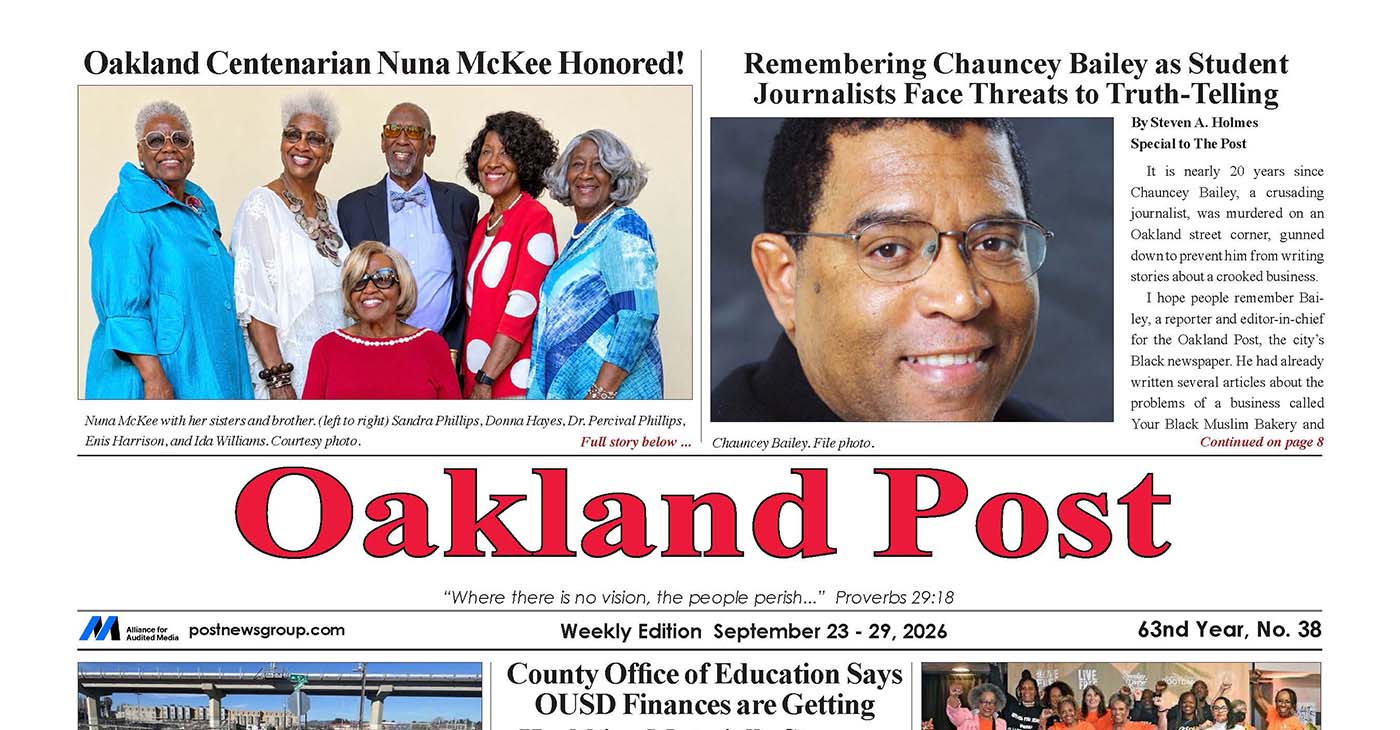
To enlarge your view of this issue, use the slider, magnifying glass icon or full page icon in the lower right corner of the browser window.
Activism
Oakland Post: Week of September 16 – 22, 2026
The printed Weekly Edition of the Oakland Post: Week of September 16 – 22, 2026
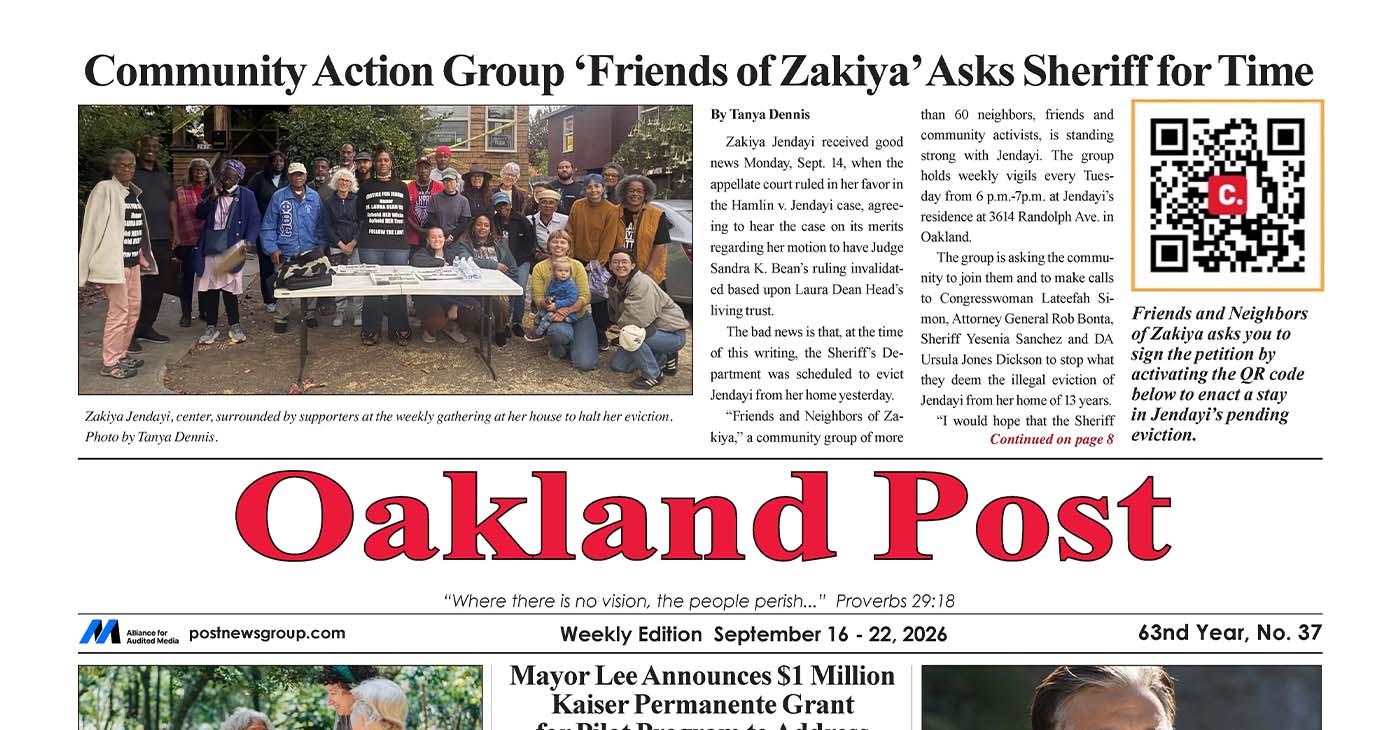
To enlarge your view of this issue, use the slider, magnifying glass icon or full page icon in the lower right corner of the browser window.
Activism
Oakland Post: Week of September 9 – 15, 2026
The printed Weekly Edition of the Oakland Post: Week of September 9 – 15, 2026

To enlarge your view of this issue, use the slider, magnifying glass icon or full page icon in the lower right corner of the browser window.


Asm. Corey Jackson Announces Launch of 24-Hour Childcare in His District

IN MEMORIAM: The Rev. Leon “Sonny” Clark, Longtime Orange County Pastor and Community Leader, Dies at 72

Poll: Becerra Widens His Lead Over Hilton; Californians Split on Wealth Tax

From Historic Memories to New Possibilities: Oakland Celebrates Coliseum 60

County Office of Education Says OUSD Finances Are Getting Healthier, Materially Stronger

LIVE FREE Sunday Dinner Brings Faith, Fellowship and Civic Conversation to Oakland

Remembering Chauncey Bailey as Student Journalists Face Threats to Truth-Telling

BLACspace Cooperative Invites Bay Area to Experience Oakland’s Black Cultural Ecosystem Through a BLAC Map Tour + Party

In Wake of Death on Doorstep, Williams Chapel Baptist Church Calls for Better Care, Funding for Unhoused

Oakland Centenarian Nuna McKee Honored!

Caribbean Nations Produce Action Plan Calling for UK Reparations Over Slavery

Oakland Post: Week of September 23 – 29, 2026

Doulas Are Helping Black California Moms Navigate Pregnancy–Even as High Mortality Rates Persist

Newsom Signs Addictive Social Media Law to Protect Kids

On Your November Ballot: Prop 38 Would Allocate $8.4 Billion to Immunology and Immunotherapy Funding

Four Candidates, Including Incumbent Barbara Lee, Qualify for Oakland Mayor’s Race

Standoff for Justice: Our Homes Are Worth Fighting For

Oakland Post: Week of August 26 – September 1, 2026

Frontier Airlines’ Return to Oakland Airport Brings Flights, Jobs and Opportunity

Gubernatorial Candidate Steve Hilton Blasts California New Tire Rules; Newsom Hits Back

Chef Sharon Lee Blends Culinary Excellence, Education and Empowerment

Jackie Wright Champions Bay Area Stories, Filmmakers and Cultural Institutions

Big City Mayors Ask for “Yes” Vote on Housing Bond Measure; Conservatives Say “No”

Gov. Newsom’s Latest Appointees Include Sacramento Advocate for Formerly Incarcerated Students; State’s New Tech Chief

Oakland Coliseum Project Opens Door for Small Businesses to Build Bigger

Misnamed ‘Parent’ PAC Seeks to Influence Oakland School Board Elections

Longtime BWOPA Member Brendalyn Goodall Appointed to California Workforce Development Board

Gov. Newsom Signs Law Shielding Immigration Aid Workers From Doxing Threats

Secretary of State Shirley N. Weber Urges Californians to Vote Early as Voter ID Battle Intensifies

From Palestine to Oakland: Seeds for Liberation Examines Shared Struggles for Freedom

The Conversation With Al McFarlane 6/23/26

Media Monday 6/22/26

LIVE! ASK ALMA! — TUES. 6.23.26 7PM EST

Car Buying Secrets: 4 Hidden Checks Before You Sign!

Is This 550 HP Charger Worth YOUR Money? AutoNetwork Review

Celebrating Juneteenth – Frederick Douglass on education and resistance

LIVE! — ASK ALMA! — TUES. 6.19.26 7PM EST

Hyundai Ioniq 5 Parking, Safety, and 360 View #shorts

2025 Ioniq 5 New Wiper & Powerful Performance! #shorts

Electric SUV Range: Is 259 Miles Enough? #shorts

EV Charging: How Fast Can You Charge an Electric Vehicle? #shorts

Biometric Cooling… Messaging Seats…Come on! 2025 Infiniti QX80 Autograph 4WD

Charged Up: Witness the Magic of a Fully Electric Car! #shorts

Range Rover Sport PHEV Included…: See What’s Inside This Luxury SUV! #shorts

Invisible Hood View: Perfect Parking with X-Ray Vision! #shorts
-
 Business4 weeks ago
Chef Sharon Lee Blends Culinary Excellence, Education and Empowerment
-
 Black History4 weeks ago
Jackie Wright Champions Bay Area Stories, Filmmakers and Cultural Institutions
-
 Community4 weeks ago
Big City Mayors Ask for “Yes” Vote on Housing Bond Measure; Conservatives Say “No”
-
 Community2 weeks ago
Misnamed ‘Parent’ PAC Seeks to Influence Oakland School Board Elections
-
 Business4 weeks ago
Longtime BWOPA Member Brendalyn Goodall Appointed to California Workforce Development Board
-
 Community4 weeks ago
Gov. Newsom Signs Law Shielding Immigration Aid Workers From Doxing Threats
-

 Activism3 weeks ago
Oakland Post: Week of September 2 – 8, 2026
-
 Featured4 weeks ago
‘Passing a Law Isn’t The Finish Line’: California Assembly Evaluates Implementation, Results
