
Activism
COMMENTARY: Beijing’s Winter Olympics? An African American Diplomat Speaks Out for the Uyghurs in China
Probably not “mass killing,” of an estimated 1 million like Pol Pot in Cambodia in the 1970s. But considering China’s restrictions on Uyghurs having children, and taking children away from families, it all falls within the conventional definition of the term, according to Naomi Kikoler, director of the Simon-Skjodt Center for the Prevention of Genocide at the United States Holocaust Memorial Museum in the latest Smithsonian Magazine.

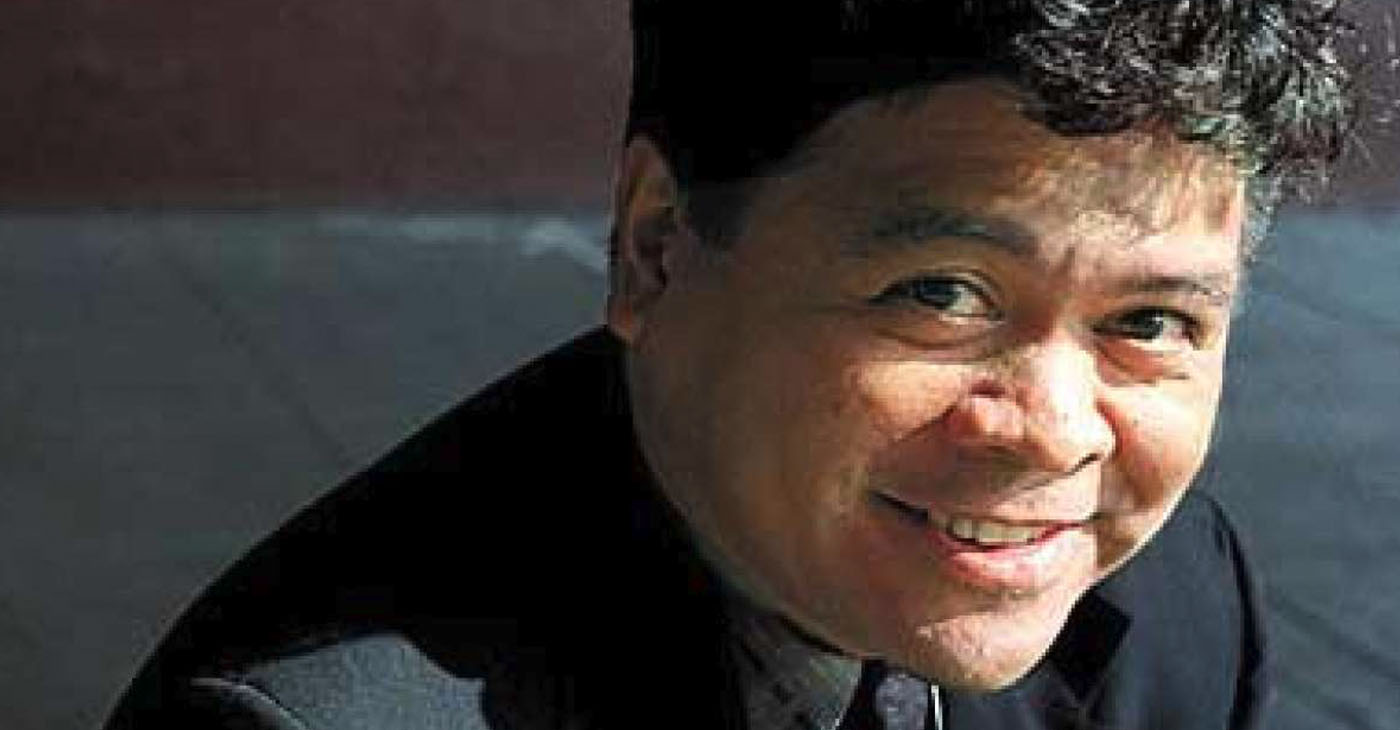
By Emil Guillermo
Elana Meyers Taylor, an African American and four-time Olympic bobsledder, missed out on the honor of being the U.S. flag-bearer at the Winter Olympics opening ceremony in Beijing last week.
After testing positive for COVID-19, she was forced into isolation. But by Monday she was cleared to compete in her events.
COVID-19 hangs over these games in China like a dense cloud. But it’s not the only cloud.
The other involves China’s treatment of the Uyghurs.
Pronounced “Wee-ger,” they are a centuries-old Turkic people of Central Asia, but has been annexed as part of western China for a fraction of that time. Uyghurs are often referred to as Uyghur Muslims, and that should be your clue.
In a country viewed as homogenous as China, there are actually more than 50 ethnic minorities. The ones that stick out are the Uyghur Muslims.
Uyghurs’ movements in their home area, the Chinese province of Xinjiang, are restricted. What they do. What they say. How they pray.
The Chinese have subjected them to a forced assimilation into the Chinese mainstream. It’s really the systematic erasure of Uyghur culture.
Human rights advocates would say it earns China the gold medal in oppression.
It’s the reason U.S. President Joe Biden isn’t attending the Olympics. The U.S. has joined other countries in declaring a diplomatic boycott.
And the leading voice in defense of the Uyghurs’ human rights? An African American, Linda Thomas-Greenfield, U.S. Ambassador to the U.N.
“Uyghurs are being tortured,” Thomas-Greenfield said recently on CNN. “And Uyghurs are the victims of human rights violations by the Chinese, and we have to keep that front and center.”
Mind you, as harsh and direct as those words were, Thomas-Greenfield from Louisiana, is being diplomatic. Makes you wonder just how bad it is for the Uyghurs.
The term ‘genocide’ is often used.
The Journal of Genocide Research in 2020 said many at first doubted the word should be used at all. But as British scholar Jo Smith Finley said, “More have shifted closer to this position, and others beyond our discipline have joined in.”
Genocide.
Probably not “mass killing,” of an estimated 1 million like Pol Pot in Cambodia in the 1970s. But considering China’s restrictions on Uyghurs having children, and taking children away from families, it all falls within the conventional definition of the term, according to Naomi Kikoler, director of the Simon-Skjodt Center for the Prevention of Genocide at the United States Holocaust Memorial Museum in the latest Smithsonian Magazine.
Since 2017, China has placed up to 3 million Uyghurs caught praying or practicing their Muslim religion in re-education camps. It qualifies as the largest mass internment of an ethnic-religious minority since World War II.
China calls the camps vocational training. But survivors of the detentions say they were prisoners, some subjected to torture, rape, and beatings.
And then when people “graduate” from their indoctrination, they are sent to forced labor assignments with Western companies like Adidas, Amazon, Apple, and Google.
Some are calling it a form of slavery.
The lucky ones have fled the country in the Uyghur diaspora. In the U.S., there are about 250,000 Uyghur Americans who are able to keep their language and culture intact. But many haven’t been able to contact family and friends for years.
China is using the 2022 games as a propaganda tool of Olympic proportions. It even had the lone Uyghur athlete, Dinigeer Yilamujiang, a cross-country skier, light the torch. But then wouldn’t let her speak to the media.
So, all is good in China? We should know better.
And all this because the Uyghurs are Muslim and seen by China as terrorist threats to the state.
Nothing sporting about any of that. Enjoy athletes like Elana Meyers Taylor. But heed the words of Linda Thomas-Greenfield.
She can see through Beijing’s Olympic rings. She’s fighting for the Uyghers.
Emil Guillermo is a journalist and commentator. He does a talk show on www.amok.com







Activism
Oakland Post: Week of April 8 – 14, 2026
The printed Weekly Edition of the Oakland Post: Week of April 8 – 14, 2026

To enlarge your view of this issue, use the slider, magnifying glass icon or full page icon in the lower right corner of the browser window.
Activism
Oakland Post: Week of April 1 – 7, 2026
The printed Weekly Edition of the Oakland Post: Week of April 1 – 7, 2026
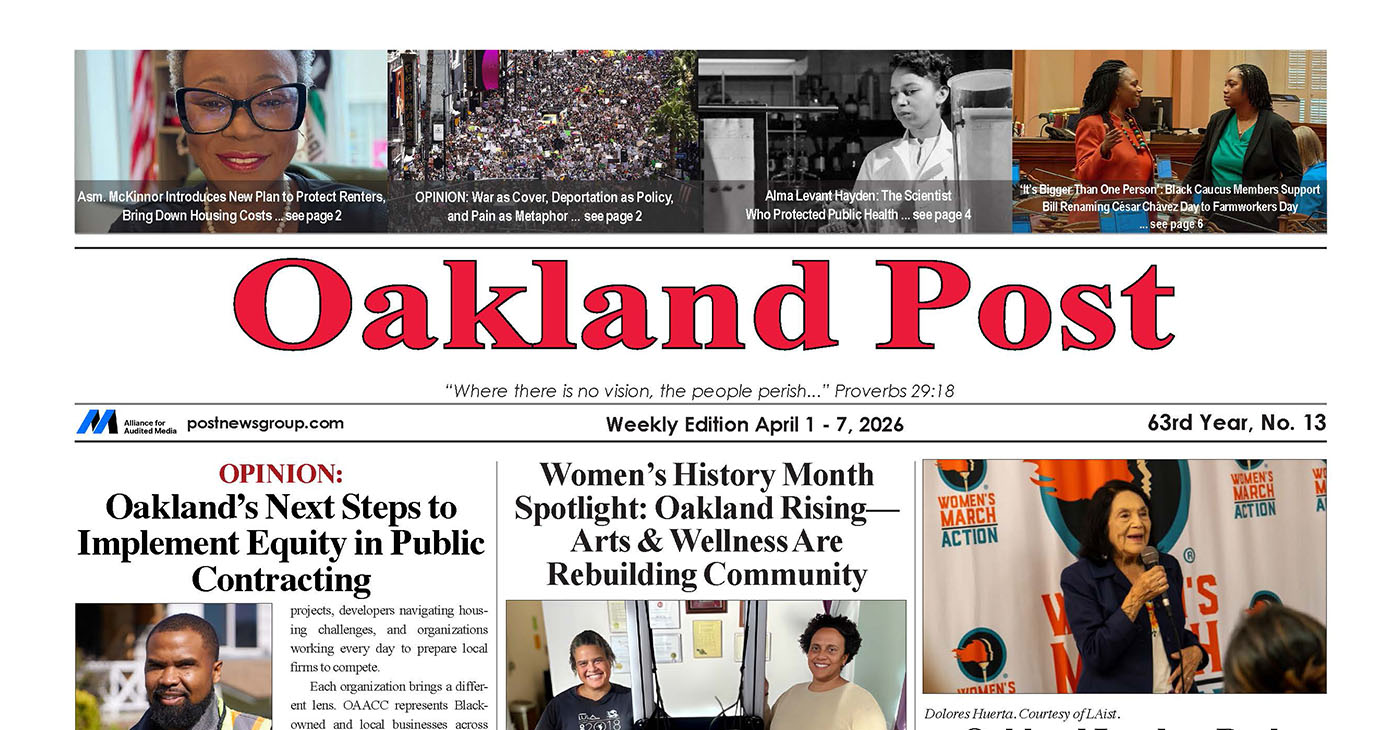
To enlarge your view of this issue, use the slider, magnifying glass icon or full page icon in the lower right corner of the browser window.
Activism
Oakland Post: Week of March 18 – 24, 2026
The printed Weekly Edition of the Oakland Post: Week of March 18 – 24, 2026

To enlarge your view of this issue, use the slider, magnifying glass icon or full page icon in the lower right corner of the browser window.

WORK FROM HOME
Home-based business with potential monthly income of $10K+ per month. A proven training system and website provided to maximize business effectiveness. Perfect job to earn side and primary income. Contact Lynne for more details: Lynne4npusa@gmail.com 800-334-0540


Oakland Post: Week of April 8 – 14, 2026

Oakland Post: Week of April 1 – 7, 2026

Black Artists in America, Installation Three Wraps at the Dixon Gallery and Gardens

Grief, Advocacy, and Education: A Counselor Reflects on Black Maternal Health

Future of Florida’s Black History Museum in Limbo

New Research Shows the Many Benefits of Early Learning

South Hampton K-8 Students Among Top 10 Finalists for Samsung’s ‘Solve for Tomorrow’ Competition

Cuba: No Negotiation with US on the President or Political System

Brooklyn Academy of Music Names Jamaican-Born Tamara McCaw as President

Trinidad & Tobego – U.S. Launches WhatsApp Channel for American Citizens in the Country

Oakland Post: Week of March 18 – 24, 2026

AI Innovation vs. Ethics and Environmental Impact

AI, Web3, and Digital Reparations

What If You Owned Your AI Agent?

Season 7, Episode 3 – January Reporter’s Roundtable 📱

Reflecting on Black History Milestones in Birmingham AL

Oakland Post: Week of February 25 – March 3, 2026

Oakland Post: Week of March 4 – 10, 2026

PRESS ROOM: NBA Hall of Fame Nominee Terry Cummings Joins 100 Black Men of DeKalb County to Launch Victory & Values Initiative
Oakland Post: Week of March 18 – 24, 2026

Trump’s MAGA Allies are Creating Executive Order Plan to Steal the 2026 Midterms

Oakland Post: Week of March 11 -17, 2026

Poll Shows Support for Policies That Help Families Afford Child Care

Financial Wellness and Mental Health: Managing Money Stress in College
New Research Shows the Many Benefits of Early Learning
Brooklyn Academy of Music Names Jamaican-Born Tamara McCaw as President

Woman’s Search for Family’s Roots Leads to Ancestor John T. Ward – A Successful Entrepreneur and Conductor on the Underground Railroad
Grief, Advocacy, and Education: A Counselor Reflects on Black Maternal Health
Future of Florida’s Black History Museum in Limbo
Black Artists in America, Installation Three Wraps at the Dixon Gallery and Gardens

Hyundai Ioniq 5 Parking, Safety, and 360 View #shorts

2025 Ioniq 5 New Wiper & Powerful Performance! #shorts

Electric SUV Range: Is 259 Miles Enough? #shorts

EV Charging: How Fast Can You Charge an Electric Vehicle? #shorts

Biometric Cooling… Messaging Seats…Come on! 2025 Infiniti QX80 Autograph 4WD

Charged Up: Witness the Magic of a Fully Electric Car! #shorts

Range Rover Sport PHEV Included…: See What’s Inside This Luxury SUV! #shorts

Invisible Hood View: Perfect Parking with X-Ray Vision! #shorts

AI Is Reshaping Black Healthcare: Promise, Peril, and the Push for Improved Results in California

ESSAY: Technology and Medicine, a Primary Care Point of View

Sanctuary Cities

The RESISTANCE – FREEDOM NOW

STATE OF THE PEOPLE: Freddie

ECONOMIC BOYCOTT DAY!!!!!

I told You So
-
 Activism3 weeks ago
Oakland Post: Week of March 18 – 24, 2026
-
 Activism4 weeks ago
Oakland Post: Week of March 11 -17, 2026
-
 Advice4 weeks ago
Financial Wellness and Mental Health: Managing Money Stress in College
-
 #NNPA BlackPress3 weeks ago
New Research Shows the Many Benefits of Early Learning
-
 #NNPA BlackPress3 weeks ago
Brooklyn Academy of Music Names Jamaican-Born Tamara McCaw as President
-
 #NNPA BlackPress3 weeks ago
Grief, Advocacy, and Education: A Counselor Reflects on Black Maternal Health
-
 #NNPA BlackPress3 weeks ago
Future of Florida’s Black History Museum in Limbo
-
 #NNPA BlackPress3 weeks ago
Black Artists in America, Installation Three Wraps at the Dixon Gallery and Gardens
