
Black History
College of Charleston African American Studies Professor Explains History of Juneteenth
CHARLESTON CHRONICLE — The United States of America is known for its annual celebration of freedom from the British Empire every year on the Fourth of July, a time when the stars and stripes of the American flag abound and fireworks light up the night sky. But there is another, lesser known, but equally significant, celebration of American independence that takes place ahead of the pomp and circumstance of July 4. Juneteenth is an annual celebration on June 19th that marks the date in 1865 when word reached Texas, more than two years after the Emancipation Proclamation, that slavery had been abolished and those enslaved were free.

By The Charleston Chronicle
The United States of America is known for its annual celebration of freedom from the British Empire every year on the Fourth of July, a time when the stars and stripes of the American flag abound and fireworks light up the night sky.
But there is another, lesser known, but equally significant, celebration of American independence that takes place ahead of the pomp and circumstance of July 4. Juneteenth is an annual celebration on June 19th that marks the date in 1865 when word reached Texas, more than two years after the Emancipation Proclamation, that slavery had been abolished and those enslaved were free.
In the more than 150 years since this seminal moment in American history, African-American communities have marked the occasion of Juneteenth with picnics, festivals and church services.
Anthony Greene, Associate Professor of African American Studies and sociology, says Juneteenth celebrations are uplifting, but that the annual holiday carries the weight of history within its cultural significance.
“Although it marks a day of family, food, and fun, it’s also critically important that Juneteenth is a tribute to the legacy and power of a people who endured and overcame the most unimaginable conditions,” says Greene.

Here are five questions to Greene about the history of Juneteenth, the significance of the annual celebration, and why it’s important to recognize Juneteenth within the larger context of American culture.
What are the historical origins of Juneteenth?
As America prepares to celebrate its independence, many African Americans conjure up a little known, and often omitted, significant fact during this time – upon gaining its independence, black people remained enslaved (see Frederick Douglass’s essay What Does the 4th of July Mean to Negroes). As such, independence, as it is celebrated, has two distinct historical meanings.
To commemorate when enslavement was abolished, Americans inaccurately highlight the Emancipation Proclamation signed by Abraham Lincoln, which took effect on Jan. 1, 1863. However, Lincoln’s proclamation was issued only to Confederate states in areas that were liberated by the Union Army. It was not for the intent and purpose to abolish slavery as an institution. Slavery remained legal until 1865 when the 13th Amendment abolished slavery and “involuntary servitude.”
Despite its abolishment, the 250,000 enslaved Africans in Texas did not immediately learn of their freedom. Several accounts have been put forth to explain why there was a two-and-a-half-year delay in the news of emancipation to Slaves in the Lone Star State:
· A messenger was murdered on his way to Texas with the news of freedom.
· The news was purposely withheld by slave masters to maintain a labor force.
· Slave owners wanted to generate one last cotton harvest.
The announcement of freedom to the enslaved population in Texas has become known as Juneteenth (also known as the Black 4th of July). It is the oldest known celebration commemorating the ending of slavery in the United States. This African-American holiday observes June 19, 1865, as the official day of independence and freedom for blacks in America. It is noted that June 19th is not the exact day blacks were freed, rather it’s the day they were told they were free.
Traditionally, how has Juneteenth been observed within African-American communities?
Early Juneteenth celebrations were marred by outward resistance among many southern whites. As Jim Crow laws started to emerge, black communities were unable to use public venues, such as parks, for celebrations, thus turning to church grounds and rural areas, often near rivers and creeks for activities such as fishing.
Festivities would include barbecues, fishing and horseback riding. As blacks became landowners, land often would be donated for Juneteenth celebrations. In the early decades of the celebration, Juneteenth flourished. Across the state of Texas, and in the south overall, Juneteenth celebrations became a boastful annual tradition.
Has the cultural awareness of Juneteenth changed in recent decades? Why?
In the early 20th century, there was a small decline in its celebration in large part due to how formal educational curriculums put emphasis on President Lincoln’s Emancipation Proclamation as the sole act to abolish slavery. Little to no formal acknowledgment of June 19th and its historical significance was taught in schools. Although celebrations did not completely cease, the large-scale celebrations did begin to decline.
Not until the civil rights and black power movements of the 1960s and early 1970s was there a resurgence of Juneteenth. The black power movement, in particular, with its emphasis on pride, culture, identity, and re-claiming history, helped spark a renewed interest in Juneteenth. Additionally, as Black Studies (African American Studies) programs have developed on college campuses, accurate black historical narratives have emerged, also helping to generate more interest in celebrations such as Juneteenth.
How is Juneteenth celebrated today?
Today, Juneteenth is observed by communities around the country. People celebrate black culture, commemorate black history, and uplift and honor the black freedom struggle.
With its significant place in the annals of black history, Charleston is a noteworthy locale for its Juneteenth (and Memorial Day) celebrations. Just three years ago, four days before Charleston’s Juneteenth holiday, Dylann Roof took the lives of nine members of Emanuel A.M.E. Church, home of the freedom fighter Denmark Vesey. The remembrances of those lives lost, the legacy of enslavement, the contributions of all those who fought to improve the lived experiences of Black Charlestonians would embody the 2015 Juneteenth celebration.
Why is it important to continue to recognize and observe the Juneteenth holiday?
American society has a unique, often detached, relationship regarding African-American holidays and observances. From Black History Month to Kwanzaa to Juneteenth, some Americans routinely question the “need” for these specialized celebrations. This questioning does not exist when Americans collectively embrace St. Patrick’s Day or Cinco de Mayo. Juneteenth is American history, a history that happens to reflect the cultural and historical existence of African-Americans. Outside of the holiday for Martin Luther King, Jr., American society does not collectively acknowledge Juneteenth as a critical moment in American history, despite in 2014 President Barack Obama declaring June 19th as a National Day of Observance.
American history continues to present the single-story narrative which often highlights and embraces dominant group culture. It has never recognized, embraced, nor honored the histories and culture of racialized minority groups. Consequently, these groups ( African- Americans, Native-Americans, Hispanics, Asians) have fought for their histories and cultures to be acknowledged and appreciated. For America to truly be inclusive, American history, and its celebratory traditions, must be re-written.
Until that moment occurs, African-Americans will continue to proudly and boldly embrace the rich cultural heritage of Juneteenth.
Source: The College Today
This article originally appeared in the Charleston Chronicle.









Activism
Oakland Post: Week of March 18 – 24, 2026
The printed Weekly Edition of the Oakland Post: Week of March 18 – 24, 2026
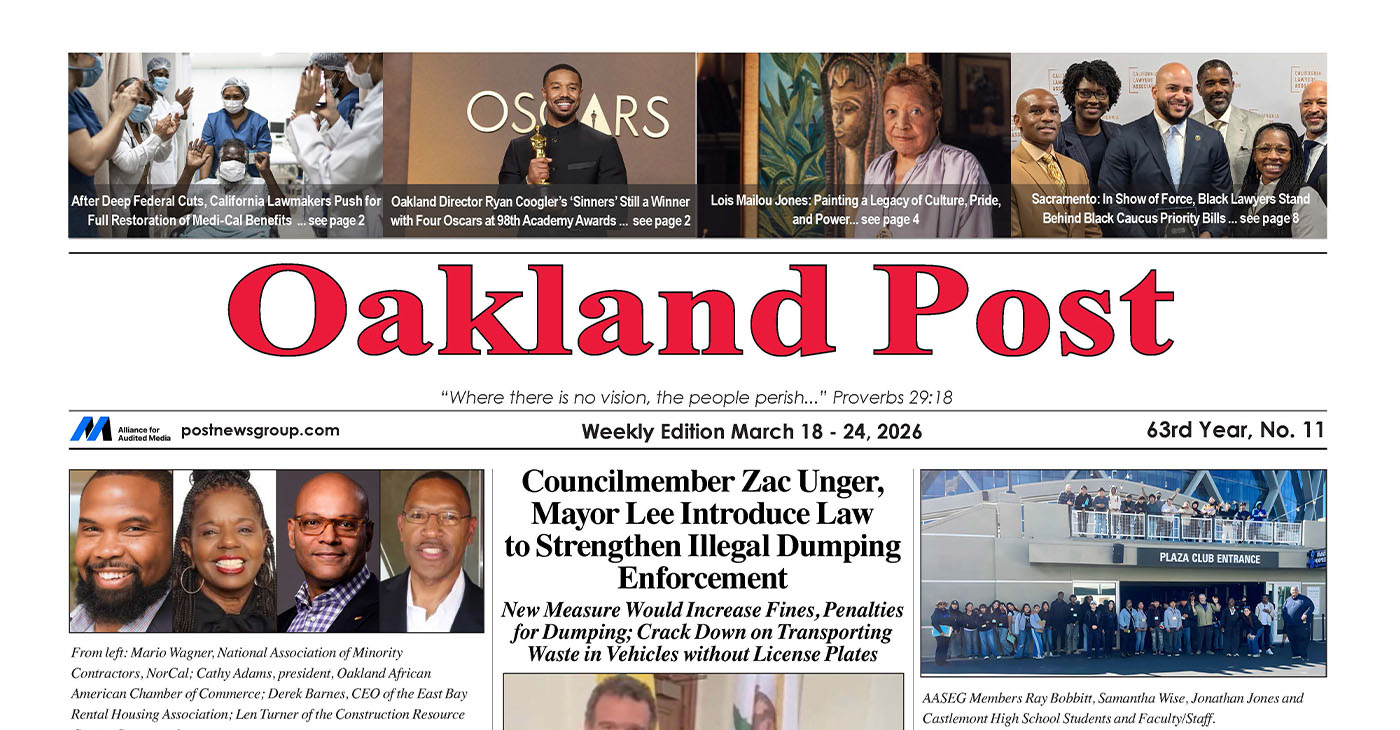
To enlarge your view of this issue, use the slider, magnifying glass icon or full page icon in the lower right corner of the browser window.
Activism
Oakland Post: Week of March 11 -17, 2026
The printed Weekly Edition of the Oakland Post: Week of March 11 – 17, 2026
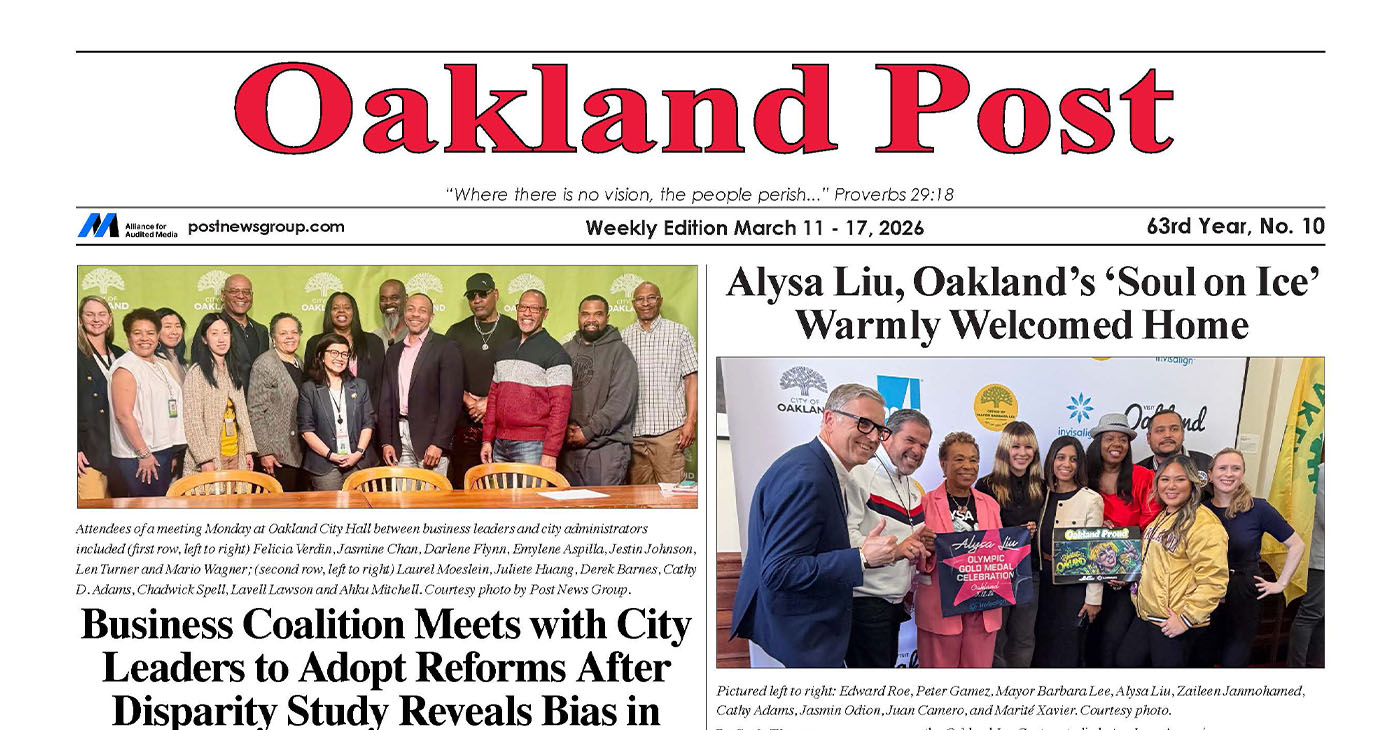
To enlarge your view of this issue, use the slider, magnifying glass icon or full page icon in the lower right corner of the browser window.
Activism
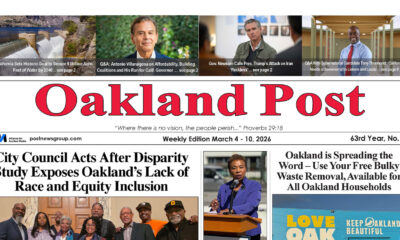
Oakland Post: Week of March 4 – 10, 2026
The printed Weekly Edition of the Oakland Post: Week of March 4 – 10, 2026
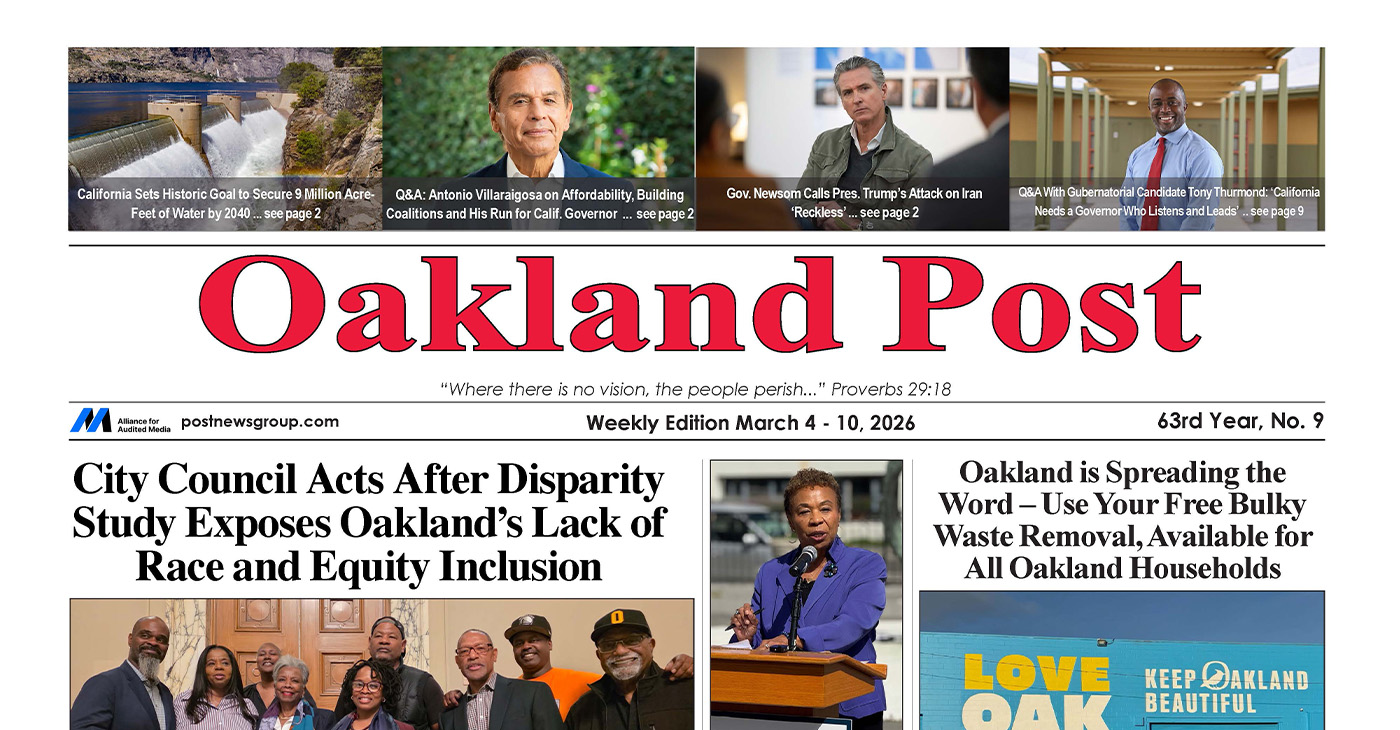
To enlarge your view of this issue, use the slider, magnifying glass icon or full page icon in the lower right corner of the browser window.

WORK FROM HOME
Home-based business with potential monthly income of $10K+ per month. A proven training system and website provided to maximize business effectiveness. Perfect job to earn side and primary income. Contact Lynne for more details: Lynne4npusa@gmail.com 800-334-0540


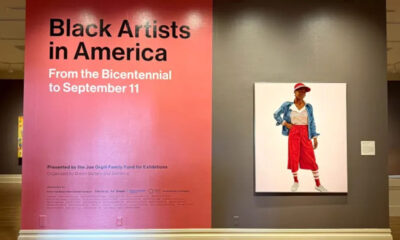
Black Artists in America, Installation Three Wraps at the Dixon Gallery and Gardens

Grief, Advocacy, and Education: A Counselor Reflects on Black Maternal Health

Future of Florida’s Black History Museum in Limbo

New Research Shows the Many Benefits of Early Learning

South Hampton K-8 Students Among Top 10 Finalists for Samsung’s ‘Solve for Tomorrow’ Competition

Cuba: No Negotiation with US on the President or Political System

Brooklyn Academy of Music Names Jamaican-Born Tamara McCaw as President

Trinidad & Tobego – U.S. Launches WhatsApp Channel for American Citizens in the Country

Oakland Post: Week of March 18 – 24, 2026

AI Innovation vs. Ethics and Environmental Impact

AI, Web3, and Digital Reparations

What If You Owned Your AI Agent?

Season 7, Episode 3 – January Reporter’s Roundtable 📱

Season 7, Episode 3 – January Reporter’s Roundtable

AI, Media, and Power | Part 2, Real-World Impacts and Tradeoffs

Oakland Post: Week of February 11 – 17, 2026

Reflecting on Black History Milestones in Birmingham AL

CITY OF SAN LEANDRO STATE OF CALIFORNIA PUBLIC WORKS DEPARTMENT ENGINEERING DIVISION NOTICE TO BIDDERS FOR ANNUAL STREET OVERLAY/REHABILITATION 2019-21 – PHASE III

Oakland Post: Week of February 18 – 24, 2026

PRESS ROOM: NBA Hall of Fame Nominee Terry Cummings Joins 100 Black Men of DeKalb County to Launch Victory & Values Initiative

Oakland Post: Week of February 25 – March 3, 2026

Trump’s MAGA Allies are Creating Executive Order Plan to Steal the 2026 Midterms

U.S. manufacturing rebounds – how foundry services are adapting to rising demand

OP-ED: One Hundred Years of Black Workers Telling the Truth

Advancements in solar technology that are changing the way we power the world

Chase Oakland Community Center Hosts Alley-Oop Accelerator Building Community and Opportunity for Bay Area Entrepreneurs

Poll Shows Support for Policies That Help Families Afford Child Care

Oakland Post: Week of March 4 – 10, 2026

PRESS ROOM: Civil Rights TV Launches in Selma as the World’s First 24/7 Civil Rights Television Network

Ghana Mourns a Son of the African World

Hyundai Ioniq 5 Parking, Safety, and 360 View #shorts

2025 Ioniq 5 New Wiper & Powerful Performance! #shorts

Electric SUV Range: Is 259 Miles Enough? #shorts

EV Charging: How Fast Can You Charge an Electric Vehicle? #shorts

Biometric Cooling… Messaging Seats…Come on! 2025 Infiniti QX80 Autograph 4WD

Charged Up: Witness the Magic of a Fully Electric Car! #shorts

Range Rover Sport PHEV Included…: See What’s Inside This Luxury SUV! #shorts

Invisible Hood View: Perfect Parking with X-Ray Vision! #shorts

AI Is Reshaping Black Healthcare: Promise, Peril, and the Push for Improved Results in California

ESSAY: Technology and Medicine, a Primary Care Point of View

Sanctuary Cities

The RESISTANCE – FREEDOM NOW

STATE OF THE PEOPLE: Freddie

ECONOMIC BOYCOTT DAY!!!!!

I told You So
-
 #NNPA BlackPress4 weeks ago
Poll Shows Support for Policies That Help Families Afford Child Care
-
 Activism4 weeks ago
Oakland Post: Week of March 4 – 10, 2026
-

 #NNPA BlackPress3 weeks ago
Woman’s Search for Family’s Roots Leads to Ancestor John T. Ward – A Successful Entrepreneur and Conductor on the Underground Railroad
-

 #NNPA BlackPress4 weeks ago
OP-ED: NNPA Launches 2026 “Leadership Matters” Video Series
-

 #NNPA BlackPress3 weeks ago
Advocates Raise Alarm Over ICE Operation, MOU and Detention Risks in Baltimore County
-

 #NNPA BlackPress3 weeks ago
COMMENTARY: Women of Color Shape Our Past and Future
-

 #NNPA BlackPress3 weeks ago
Pete Buttigieg to Join Mayor Randall Woodfin for Community Town Hall in Birmingham
-

 Activism2 weeks ago
Oakland Post: Week of March 11 -17, 2026

1 Comment