
Politics
Civil Rights Landmark Bridge is Named for Reputed KKK Leader


In this March 21, 1965 file photo, Martin Luther King, Jr. and his civil rights marchers cross the Edmund Pettus Bridge in Selma, Ala., heading for capitol, Montgomery, during a five day, 50 mile walk to protest voting laws. The Edmund Pettus Bridge gained instant immortality as a civil rights landmark when white police beat demonstrators marching for black voting rights 50 years ago this week in Selma, Alabama. Whats less known is that the bridge is named for a reputed leader of the early Ku Klux Klan. Now, a student group wants to rename the bridge that will be the backdrop when President Barack Obama visits Selma on Saturday, March 7, 2015. (AP Photo/File)
JAY REEVES, Associated Press
ALLEN G. BREED, Associated Press

SELMA, Ala. (AP) — When the nation’s first black president steps onto the Edmund Pettus Bridge to honor the marchers beaten there 50 years ago, he’ll be standing on a structure that’s at once synonymous with the civil rights struggle and a tribute to a reputed Ku Klux Klan leader.
The latter fact had all but faded from local memory until recently, when a Selma student group launched an online petition to rename the landmark bridge.
During his 50th anniversary address Saturday, President Barack Obama will be flanked on one side by a new historic marker commemorating “Bloody Sunday,” when white police beat demonstrators marching for black voting rights on March 7, 1965. The sign, erected earlier this year by the state tourism department, notes Obama’s 2007 appearance there just before his election and the accolades for “Selma,” the recent film about the march.
It offers no details about Edmund Winston Pettus, a Confederate general and U.S. senator who lived in Selma after the Civil War. The Encyclopedia of Alabama, an online database sponsored by the University of Alabama, Auburn University and the Alabama Department of Education, says Pettus held the title of grand dragon of the Alabama Klan in 1877 — an assertion that’s questioned by some historians.
Just beyond the other end of the bridge, a billboard erected recently bears a heroic image of another Confederate general, Klan founder Nathan Bedford Forrest. The ad, sponsored by a group dedicated to honoring Forrest, invites visitors to see Selma’s “War Between the States” historic sites; next month is the 150th anniversary of the Battle of Selma, in which Forrest fought.
As the “Bloody Sunday” anniversary approaches, a student group in Selma is petitioning to rename the bridge, whose twin metal arches soar above the murky Alabama River. The online petition, addressed to Selma Mayor George Patrick Evans and to the National Parks Service, has been up for about two weeks. It does not propose a new name for the bridge.
John Gainey, executive director of Students UNITE, a racially integrated youth group that began the petition, said having a white supremacist’s name attached to the city’s most visible landmark illustrates the city’s deep racial divisions a half-century after the marchers were beaten at the bridge.
Just as in the 1960s, Gainey said, Selma is split by race. Blacks attend public schools, most whites go to private academies and many blacks still live in run-down shanties while whites occupy nice homes with manicured lawns, he said. Yet the town of nearly 20,000 people is about 80 percent black.
“We think it really does represent something larger,” said Gainey.
The Rev. Joseph Lowery, a veteran civil rights leader, agrees the bridge’s name should be changed to quit honoring someone with alleged Klan ties.
“They’re responsible for too much death and misery. We don’t need to honor them,” said Lowery, a lieutenant of Martin Luther King Jr. who participated in the 1965 Selma-to-Montgomery march. “I’m with the kids. Let’s change it.”
However, Selma historian Alston Fitts doubts Pettus had anything to do with the KKK. Although the city was a hub of racial animus in the 1960s, Selma was known as a “safe place” for blacks aligned with liberal Republicans after the Civil War during Reconstruction partly because of a lack of Klan activity, he said.
“He was a pretty lousy Klan leader if that’s what he was,” said Fitts.
Pettus’ views on race were widely known during Reconstruction. In July 1871, when Pettus testified before a congressional committee investigating the Klan, he made it clear he believed whites, not blacks, were the victims in the post-Civil War South.
Pettus asserted that any campaign of intimidation was being waged by Republicans and “carpet-baggers” seeking to incite blacks to commit “acts of aggression on their part against the white people,” according to congressional archives.
Michael Fitzgerald, a professor of history at St. Olaf College in Northfield, Minnesota, is researching a book on Reconstruction-era Alabama. He said he hasn’t found “persuasive evidence” that Pettus was a Klan officer or even member, but he said Pettus was “almost certainly” involved with the White League, a later terrorist organization.
“He is a Confederate general, he is a Democratic leader when white supremacy is their slogan — is what they exist to do,” he said. “What I would say is Edmund Pettus is definitely a strong white supremacist.”
An attorney who entered the Confederate army as a major in 1861 and rose to the rank of brigadier general by 1863, Pettus was elected to the U.S. Senate in 1897 after Reconstruction and served until his death in 1907 at age 86.
Pettus’ legacy was still well known in Selma when the bridge was constructed just east of downtown in 1940, so the span was named for a man revered locally as a tenacious Southern leader. With Jim Crow laws still in effect, blacks had virtually no say in the decision.
And until now, there has never been a serious effort to rename it.
___
Breed, an AP national writer, contributed to this report from Raleigh, North Carolina.
Copyright 2015 The Associated Press. All rights reserved. This material may not be published, broadcast, rewritten or redistributed.










Activism
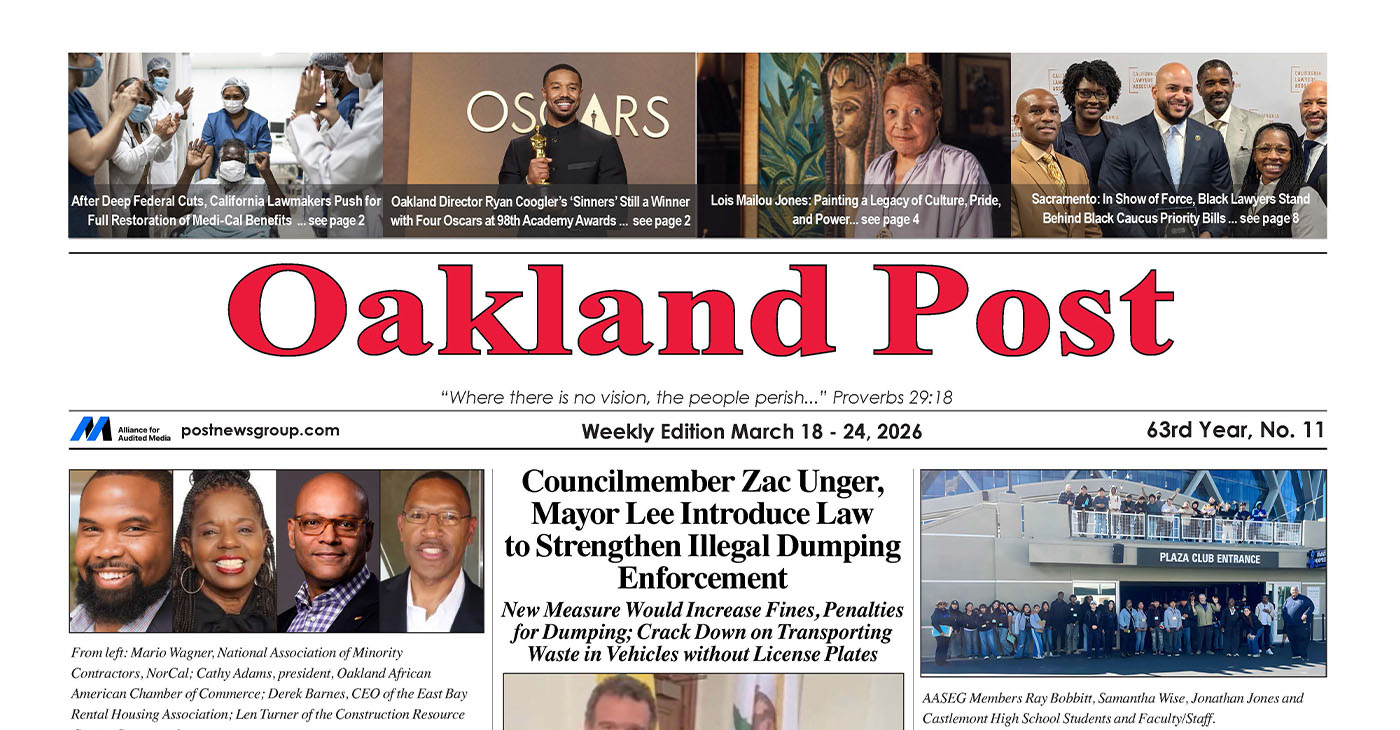
Oakland Post: Week of March 18 – 24, 2026
The printed Weekly Edition of the Oakland Post: Week of March 18 – 24, 2026
To enlarge your view of this issue, use the slider, magnifying glass icon or full page icon in the lower right corner of the browser window.
Activism
Oakland Post: Week of March 11 -17, 2026
The printed Weekly Edition of the Oakland Post: Week of March 11 – 17, 2026
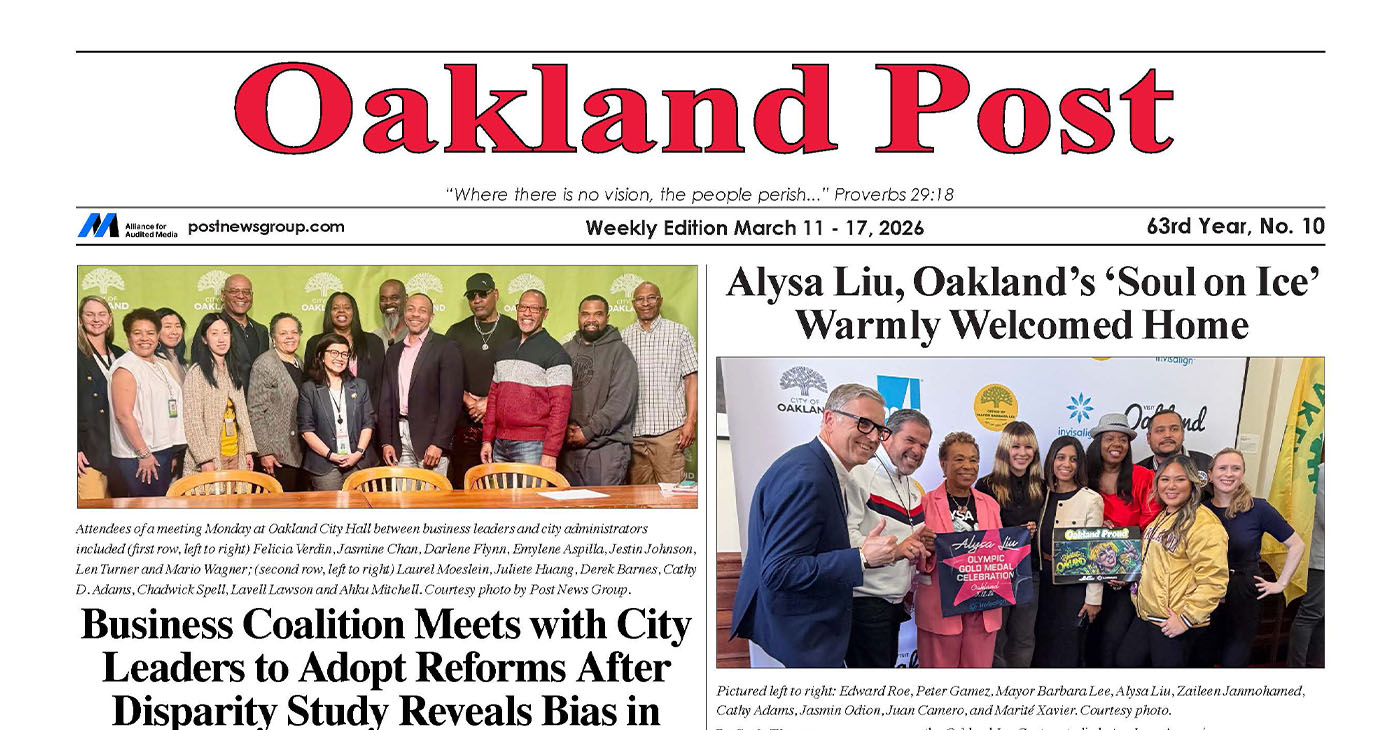
To enlarge your view of this issue, use the slider, magnifying glass icon or full page icon in the lower right corner of the browser window.
Activism
Oakland Post: Week of March 4 – 10, 2026
The printed Weekly Edition of the Oakland Post: Week of March 4 – 10, 2026

To enlarge your view of this issue, use the slider, magnifying glass icon or full page icon in the lower right corner of the browser window.

WORK FROM HOME
Home-based business with potential monthly income of $10K+ per month. A proven training system and website provided to maximize business effectiveness. Perfect job to earn side and primary income. Contact Lynne for more details: Lynne4npusa@gmail.com 800-334-0540


Black Artists in America, Installation Three Wraps at the Dixon Gallery and Gardens

Grief, Advocacy, and Education: A Counselor Reflects on Black Maternal Health

Future of Florida’s Black History Museum in Limbo

New Research Shows the Many Benefits of Early Learning

South Hampton K-8 Students Among Top 10 Finalists for Samsung’s ‘Solve for Tomorrow’ Competition

Cuba: No Negotiation with US on the President or Political System

Brooklyn Academy of Music Names Jamaican-Born Tamara McCaw as President

Trinidad & Tobego – U.S. Launches WhatsApp Channel for American Citizens in the Country

Oakland Post: Week of March 18 – 24, 2026

AI Innovation vs. Ethics and Environmental Impact

AI, Web3, and Digital Reparations

What If You Owned Your AI Agent?

Season 7, Episode 3 – January Reporter’s Roundtable 📱

Season 7, Episode 3 – January Reporter’s Roundtable

AI, Media, and Power | Part 2, Real-World Impacts and Tradeoffs

Oakland Post: Week of February 11 – 17, 2026

Reflecting on Black History Milestones in Birmingham AL

CITY OF SAN LEANDRO STATE OF CALIFORNIA PUBLIC WORKS DEPARTMENT ENGINEERING DIVISION NOTICE TO BIDDERS FOR ANNUAL STREET OVERLAY/REHABILITATION 2019-21 – PHASE III

Oakland Post: Week of February 18 – 24, 2026

PRESS ROOM: NBA Hall of Fame Nominee Terry Cummings Joins 100 Black Men of DeKalb County to Launch Victory & Values Initiative

Oakland Post: Week of February 25 – March 3, 2026

Trump’s MAGA Allies are Creating Executive Order Plan to Steal the 2026 Midterms

U.S. manufacturing rebounds – how foundry services are adapting to rising demand

OP-ED: One Hundred Years of Black Workers Telling the Truth

Chase Oakland Community Center Hosts Alley-Oop Accelerator Building Community and Opportunity for Bay Area Entrepreneurs

Advancements in solar technology that are changing the way we power the world

Poll Shows Support for Policies That Help Families Afford Child Care

Oakland Post: Week of March 4 – 10, 2026

PRESS ROOM: Civil Rights TV Launches in Selma as the World’s First 24/7 Civil Rights Television Network

Woman’s Search for Family’s Roots Leads to Ancestor John T. Ward – A Successful Entrepreneur and Conductor on the Underground Railroad

Hyundai Ioniq 5 Parking, Safety, and 360 View #shorts

2025 Ioniq 5 New Wiper & Powerful Performance! #shorts

Electric SUV Range: Is 259 Miles Enough? #shorts

EV Charging: How Fast Can You Charge an Electric Vehicle? #shorts

Biometric Cooling… Messaging Seats…Come on! 2025 Infiniti QX80 Autograph 4WD

Charged Up: Witness the Magic of a Fully Electric Car! #shorts

Range Rover Sport PHEV Included…: See What’s Inside This Luxury SUV! #shorts

Invisible Hood View: Perfect Parking with X-Ray Vision! #shorts

AI Is Reshaping Black Healthcare: Promise, Peril, and the Push for Improved Results in California

ESSAY: Technology and Medicine, a Primary Care Point of View

Sanctuary Cities

The RESISTANCE – FREEDOM NOW

STATE OF THE PEOPLE: Freddie

ECONOMIC BOYCOTT DAY!!!!!

I told You So
-
 Activism4 weeks ago
Oakland Post: Week of March 4 – 10, 2026
-
 #NNPA BlackPress3 weeks ago
Woman’s Search for Family’s Roots Leads to Ancestor John T. Ward – A Successful Entrepreneur and Conductor on the Underground Railroad
-

 #NNPA BlackPress4 weeks ago
OP-ED: NNPA Launches 2026 “Leadership Matters” Video Series
-

 #NNPA BlackPress3 weeks ago
Advocates Raise Alarm Over ICE Operation, MOU and Detention Risks in Baltimore County
-

 #NNPA BlackPress3 weeks ago
COMMENTARY: Women of Color Shape Our Past and Future
-

 #NNPA BlackPress3 weeks ago
Pete Buttigieg to Join Mayor Randall Woodfin for Community Town Hall in Birmingham
-
 Activism2 weeks ago
Oakland Post: Week of March 11 -17, 2026
-

 #NNPA BlackPress4 weeks ago
PRESS ROOM: PMG and Cranbrook Horizons-Upward Bound Launch Journey Fellowship Cohort 2

Pingback: Children of Color Likely to Be Majority of Kids in US by 2020 |
Pingback: Children of Color Likely to Be Majority of Kids in US by 2020 |