
Politics
Chicago Mayor Rahm Emanuel Forced Into April Runoff Election


Chicago Mayor Rahm Emanuel talks to supporters Tuesday, Feb. 24, 2015, in Chicago. Emanuel failed to capture a majority of the vote in Tuesday’s municipal election forcing him into a runoff this spring against Cook County Commissioner Jesus “Chuy” Garcia. (AP Photo/Charles Rex Arbogast)
SOPHIA TAREEN, Associated Press
CHICAGO (AP) — Chicago Mayor Rahm Emanuel failed to capture a majority of the vote Tuesday in his bid for a second term, an embarrassment for the former White House chief of staff who now faces a runoff against Cook County Commissioner Jesus “Chuy” Garcia.
The result exposed possible vulnerability for an incumbent who has widespread support from business leaders, national name recognition and millions of dollars in campaign funds. He participated in half a dozen debates and forums — often defending his more controversial decisions on schools and violence — and received a last-minute boost with a hometown visit from President Barack Obama.

Still, he wasn’t able to capture the more than 50 percent necessary to avoid an April 7 runoff against Garcia, a former alderman and state senator. With nearly all the votes counted, Emanuel had 45 percent, Garcia 34 percent, and the three other candidates divided the rest.
“We have come a long way, and we have a little bit further to go,” Emanuel told supporters. “This is the first step in a real important journey for our city.”
Nodding at the possible challenge appealing to diverse populations, the mayor lauded the immigrant history in the nation’s third-largest city. He was introduced in a bilingual address by U.S. Rep. Luis Gutierrez, a former critic of Emanuel who has been prominent in the national push for immigration reform.
During the campaign, Garcia and the three other challengers played on discontentment in Chicago’s neighborhoods, where frustrations linger over Emanuel’s push to close dozens of schools. They also criticized Emanuel’s roughly $16 million fundraising operation — more than four times his challengers combined — and attention to downtown improvements.
Garcia, born in Mexico and raised in Chicago, billed himself as the “neighborhood guy.” He drew on his contacts with community organizers and support from the Chicago Teachers Unions, whose leader, Karen Lewis, considered a mayoral bid before being diagnosed with a brain tumor.
“This city deserves a mayor who will put people first, not big money, special interests,” Garcia said. “I will be that mayor.”
Garcia and the other challengers — Alderman Bob Fioretti, businessman Willie Wilson and activist William Walls — also critiqued the mayor on his handling of violence.
Voters noted both issues at the polls, with estimates signaling lower turnout than 2011 after former Mayor Richard Daley retired, leaving the mayor’s race wide open. About 42 percent of eligible voters came to the polls then, compared with roughly 34 percent Tuesday.
Emanuel won his first mayoral race in 2011 without a runoff.
Joyce Rodgers, who is retired, said she believed the school closings cost Emanuel the trust of the African-American community — and possibly the president’s. Most Chicago Public Schools students are minorities.
“There is total disappointment (in Emanuel),” she said. “I believe that Obama’s been let down, too, he’s just not going to say it.”
Still others said they were supporting Emanuel because of his work on job creation, education and safer neighborhoods.
“Rahm has all (those) contacts and he is getting those corporations here, so he is giving people hope they can get a good job,” said Willie King, a 56-year-old retired janitor.
On the campaign trail, Emanuel said his first term saw some tough decisions and payoffs, including budgets that didn’t rely on property tax increases, drawing business to the city, getting a longer school day and raising the minimum wage.
He didn’t shy away from going after his opponents either. At debates, he opponents, particularly Garcia for a 1980s vote on a property tax increase. Garcia said that the city was in fiscal crisis at the time.
Garcia, who got his start as an immigrant rights activist, had perhaps the most name recognition of the four challengers. He was a water commissioner under the late Chicago Mayor Harold Washington, the city’s first black mayor. He then turned to statewide politics, serving two terms as a senator before he was elected Cook County commissioner.
Emanuel vowed to hit the campaign trail Wednesday morning, shaking hands at commuter-train stops.
“We will get back out there, talking to our friends and families and neighbors as they make a critical choice about who has the strength, who has the leadership, who has the ideas to move this great city forward,” Emanuel said.
___
Follow Sophia Tareen at http://twitter.com/sophiatareen.
Copyright 2015 The Associated Press. All rights reserved. This material may not be published, broadcast, rewritten or redistributed.









Activism
Oakland Post: Week of March 18 – 24, 2026
The printed Weekly Edition of the Oakland Post: Week of March 18 – 24, 2026

To enlarge your view of this issue, use the slider, magnifying glass icon or full page icon in the lower right corner of the browser window.
Activism
Oakland Post: Week of March 11 -17, 2026
The printed Weekly Edition of the Oakland Post: Week of March 11 – 17, 2026
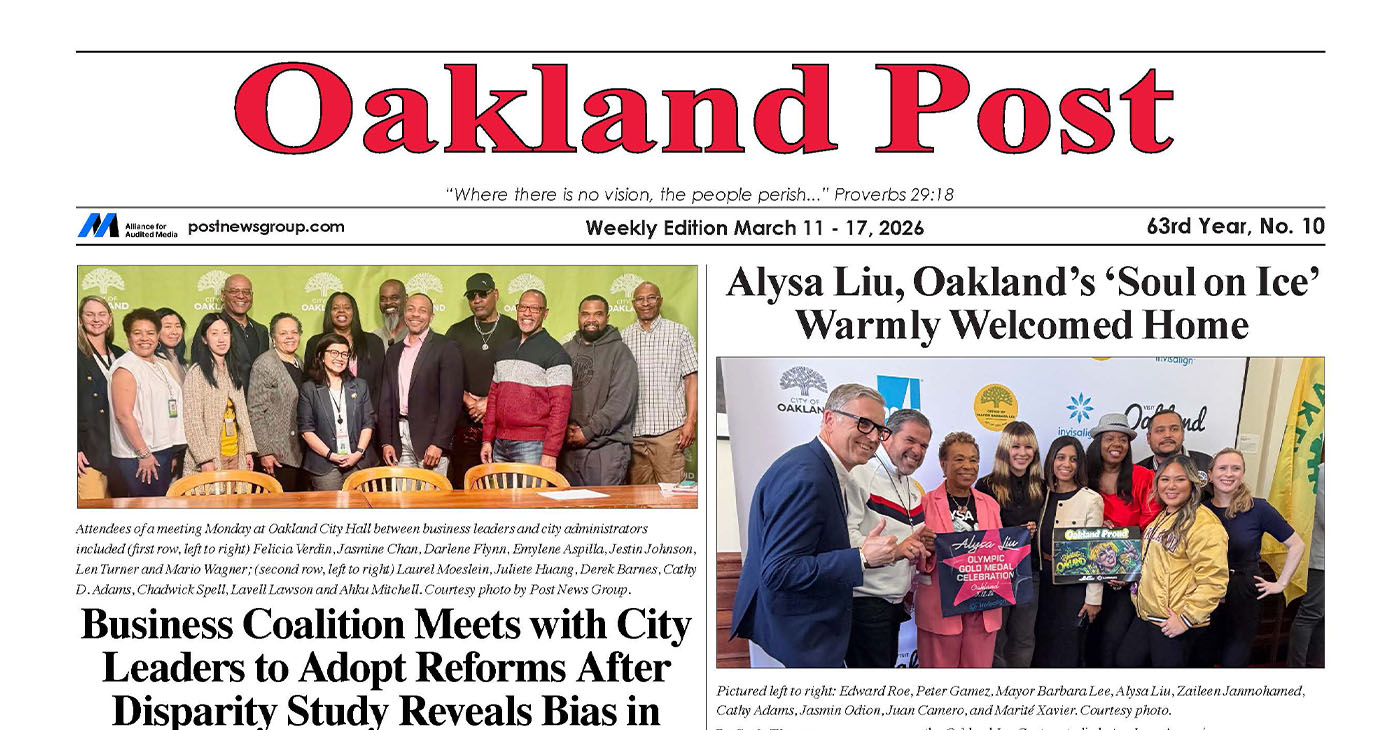
To enlarge your view of this issue, use the slider, magnifying glass icon or full page icon in the lower right corner of the browser window.
Activism
Oakland Post: Week of March 4 – 10, 2026
The printed Weekly Edition of the Oakland Post: Week of March 4 – 10, 2026

To enlarge your view of this issue, use the slider, magnifying glass icon or full page icon in the lower right corner of the browser window.

WORK FROM HOME
Home-based business with potential monthly income of $10K+ per month. A proven training system and website provided to maximize business effectiveness. Perfect job to earn side and primary income. Contact Lynne for more details: Lynne4npusa@gmail.com 800-334-0540


Black Artists in America, Installation Three Wraps at the Dixon Gallery and Gardens

Grief, Advocacy, and Education: A Counselor Reflects on Black Maternal Health

Future of Florida’s Black History Museum in Limbo

New Research Shows the Many Benefits of Early Learning

South Hampton K-8 Students Among Top 10 Finalists for Samsung’s ‘Solve for Tomorrow’ Competition

Cuba: No Negotiation with US on the President or Political System

Brooklyn Academy of Music Names Jamaican-Born Tamara McCaw as President

Trinidad & Tobego – U.S. Launches WhatsApp Channel for American Citizens in the Country

Oakland Post: Week of March 18 – 24, 2026

AI Innovation vs. Ethics and Environmental Impact

AI, Web3, and Digital Reparations

What If You Owned Your AI Agent?

Season 7, Episode 3 – January Reporter’s Roundtable 📱

Season 7, Episode 3 – January Reporter’s Roundtable

AI, Media, and Power | Part 2, Real-World Impacts and Tradeoffs

Reflecting on Black History Milestones in Birmingham AL

CITY OF SAN LEANDRO STATE OF CALIFORNIA PUBLIC WORKS DEPARTMENT ENGINEERING DIVISION NOTICE TO BIDDERS FOR ANNUAL STREET OVERLAY/REHABILITATION 2019-21 – PHASE III

Oakland Post: Week of February 18 – 24, 2026

Oakland Post: Week of February 25 – March 3, 2026

PRESS ROOM: NBA Hall of Fame Nominee Terry Cummings Joins 100 Black Men of DeKalb County to Launch Victory & Values Initiative

Trump’s MAGA Allies are Creating Executive Order Plan to Steal the 2026 Midterms

Oakland Post: Week of March 4 – 10, 2026

U.S. manufacturing rebounds – how foundry services are adapting to rising demand

Chase Oakland Community Center Hosts Alley-Oop Accelerator Building Community and Opportunity for Bay Area Entrepreneurs

Poll Shows Support for Policies That Help Families Afford Child Care

OP-ED: One Hundred Years of Black Workers Telling the Truth

Advancements in solar technology that are changing the way we power the world

Woman’s Search for Family’s Roots Leads to Ancestor John T. Ward – A Successful Entrepreneur and Conductor on the Underground Railroad

PRESS ROOM: Civil Rights TV Launches in Selma as the World’s First 24/7 Civil Rights Television Network

COMMENTARY: Women of Color Shape Our Past and Future

Hyundai Ioniq 5 Parking, Safety, and 360 View #shorts

2025 Ioniq 5 New Wiper & Powerful Performance! #shorts

Electric SUV Range: Is 259 Miles Enough? #shorts

EV Charging: How Fast Can You Charge an Electric Vehicle? #shorts

Biometric Cooling… Messaging Seats…Come on! 2025 Infiniti QX80 Autograph 4WD

Charged Up: Witness the Magic of a Fully Electric Car! #shorts

Range Rover Sport PHEV Included…: See What’s Inside This Luxury SUV! #shorts

Invisible Hood View: Perfect Parking with X-Ray Vision! #shorts

AI Is Reshaping Black Healthcare: Promise, Peril, and the Push for Improved Results in California

ESSAY: Technology and Medicine, a Primary Care Point of View

Sanctuary Cities

The RESISTANCE – FREEDOM NOW

STATE OF THE PEOPLE: Freddie

ECONOMIC BOYCOTT DAY!!!!!

I told You So

-
 Activism4 weeks ago
Oakland Post: Week of March 4 – 10, 2026
-
 #NNPA BlackPress4 weeks ago
Woman’s Search for Family’s Roots Leads to Ancestor John T. Ward – A Successful Entrepreneur and Conductor on the Underground Railroad
-
 #NNPA BlackPress4 weeks ago
COMMENTARY: Women of Color Shape Our Past and Future
-

 Activism3 weeks ago
Oakland Post: Week of March 11 -17, 2026
-

 #NNPA BlackPress4 weeks ago
OP-ED: NNPA Launches 2026 “Leadership Matters” Video Series
-

 #NNPA BlackPress4 weeks ago
Advocates Raise Alarm Over ICE Operation, MOU and Detention Risks in Baltimore County
-

 #NNPA BlackPress4 weeks ago
Pete Buttigieg to Join Mayor Randall Woodfin for Community Town Hall in Birmingham
-

 Advice3 weeks ago
Financial Wellness and Mental Health: Managing Money Stress in College
