
Activism
California Reparations Task Force Looks at Long History of Racism in American Agriculture
In March, the U.S. Congress passed a $4 billion debt relief program for farmers of color to address past discrimination in USDA programs. The debt relief program was passed as part of the ARP. It includes funding to pay off USDA loans held by 16,000 Black, Native American, Alaskan Native, Asian American, Pacific Islander, and Hispanic and Latino farmers.

By Antonio Ray Harvey | California Black Media
Last month, Lawrence Lucas, founder of the United States Department of Agriculture Coalition of Minority Employees (USDA-CME), testified before the California Task Force to Study and Develop Reparation Proposals for African Americans.
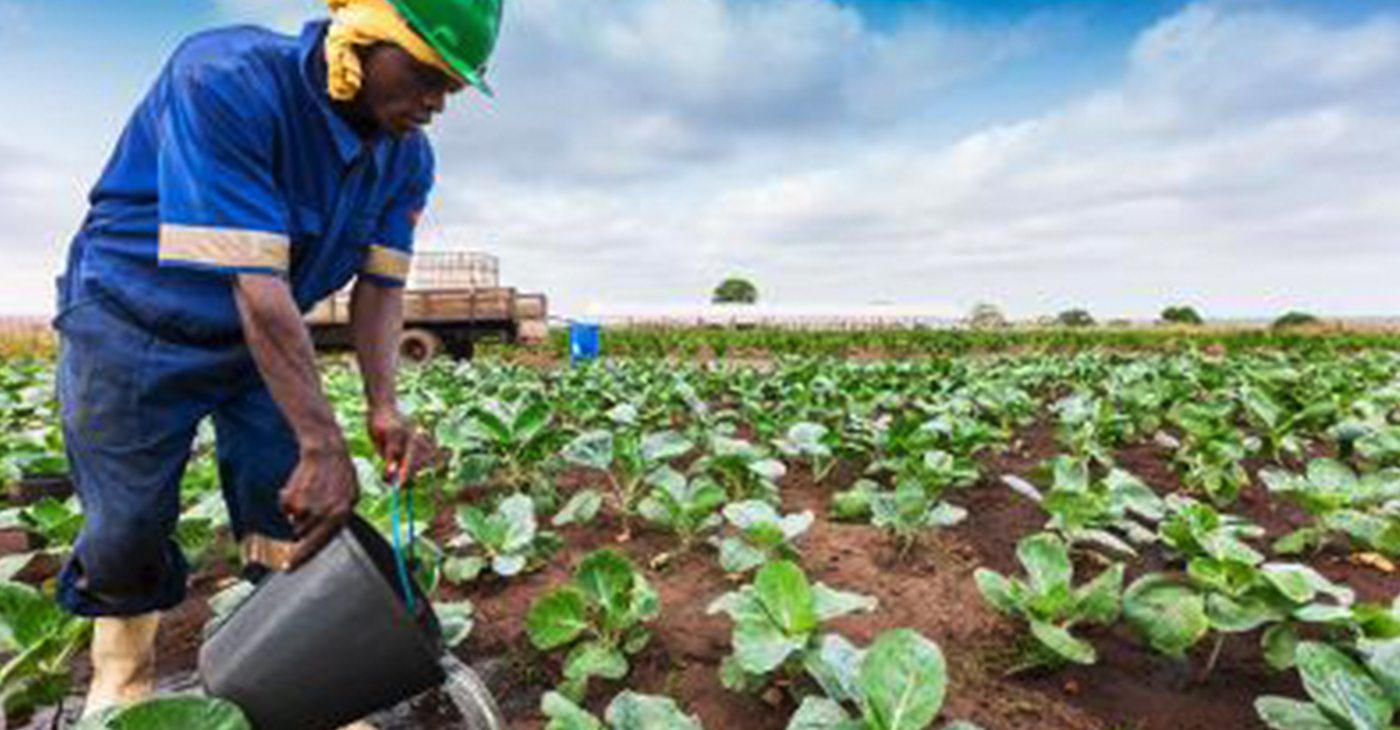
Lucas said racism is the prime reason there are just a little over 400 Black farmers in California.
“The income of Black Farmers has been drastically reduced and the amount of wealth that has been taken from Black farmers is tremendous,” Lucas said. “What you would call reparations, we call justice. It is why you must do what you have to do in California to right the wrongs suffered by Black people.”
Lucas is not the only one concerned about mounting evidence that documents a long history of race-based discrimination in American agriculture.
The United States Department of Agriculture recently created the Equity Commission (EC) to study racial discrimination and government policies that have disempowered Black farmers, depleted their wealth and nearly wiped out their presence for over 100 years.
EC will advise the Secretary of Agriculture by identifying USDA programs, policies, systems, structures, and practices that created barriers to inclusion or perpetuated racial, economic, health and social disparities.
USDA-CME was founded in 1994 to address discrimination within the USDA, which Lucas referred to as the “Last Plantation” during his testimony. The coalition also focuses its work on the historical loss of Black-owned land and how government policies deprived African Americans of generational wealth.
The EC is expected to issue a preliminary report and provide “actionable recommendations” within the next 12 months, and a final report to be finished within two years.
“The Equity Commission is taking important steps to dismantle barriers historically underserved communities have faced in accessing USDA programs and services,” said U.S. Agriculture Secretary Tom Vilsack in a statement issued on September 24.
Lucas said despite the USDA’s efforts to address decades-old discrimination practices, he does not see it “getting any better” for Black farmers. Non-Black farm producers are fighting back in the courts, Lucas said.
“You have white farmers, who own most of the land and get all the benefits from the land; they are the ones now bringing court cases around the country. They are saying that it’s discriminatory to have debt-relief for Black farmers,” Lucas said.
The CME’s biggest accomplishment is its involvement in securing debt relief for Black farmers as part of the American Rescue Plan (ARP). The ARP package included a multi-billion-dollar fund for socially disadvantaged farmers throughout the United States.
The coalition has worked alongside U.S. Senators Elizabeth Warren (D-MA) and Cory Booker (D-NJ) to create the Justice for Black Farmers Act, which will provide even more aid to socially disadvantaged farmers.
Of the approximately 70,000 farms in California, more than 90% are white-owned or white-managed and fewer than 1% are Black-owned or Black-managed, according to the 2017 federal agriculture census.
The 2012 census reported that California had 722 Black farmers. By 2017, that number had decreased to 429. Nationally, there are 45,508 Black farmers or 1.3% of all farmers according to the 2017 agriculture census. Their properties account for 0.5% of the country’s farmlands.
In contrast, about 14% of all U.S. farmers in 1920 were Black, according to that year’s agriculture census. At the time, there were 925,708 Black farmers. Nearly all of them farmed in Deep South states. Lucas blames the USDA for the depletion of Black farmlands over the last century.
However, the USDA says it is in the process of reversing harmful policies and taking restorative action for programs that affected the progress, financial stability, and productive livelihood of Black farmers.
“We are serious about our efforts to end discrimination across all areas of the Department and to improve access to services for key stakeholders,” said USDA Deputy Secretary Jewel Bronaugh in a statement.
In March, the U.S. Congress passed a $4 billion debt relief program for farmers of color to address past discrimination in USDA programs.
The debt relief program was passed as part of the ARP. It includes funding to pay off USDA loans held by 16,000 Black, Native American, Alaskan Native, Asian American, Pacific Islander, and Hispanic and Latino farmers.
Claiming discrimination, a group of white farmers have filed a dozen lawsuits against the program including one class action suit. Preliminary injunctions by three courts have momentarily blocked the program from issuing funds from the program.
According to Khubaka Michael Harris of the California Black Farmers and Agriculturalists Association (CBFAA), “The debt relief was written in a way to help Black folks, but it is not just for Black folks. That’s why it’s in the courts. It was written where anybody who is a farmer can say, ‘Hey, I’ve been affected by COVID, too.’ Then, you are going to say that this money is just earmarked for Black folks? Now, the legislators have to go back to write in a language that targets underserved communities.”
Based in Sacramento, CBFAA advocates for socially disadvantaged California Black farmers, and agriculturalists of color nationwide.
Lucas said it is actions such as the lawsuits that “deny Black farmers their dignity,” “a right to farm,” and deny Black farmers the “right to the same programs and services that white farmers get in this country.”
In California, farming is classified under the term “agricultural activity.”
The state defines it as “the harvesting of any agricultural commodity, including timber, viticulture, apiculture, or horticulture, the raising of livestock, fur-bearing animals, fish, or poultry, and any practices performed by a farmer or on a farm are also agricultural activities.”
“That goes for licensed cannabis farmers, too,” Harris said. “If you cultivate cannabis you are a farmer in this state.”
Assembly Bill (AB) 3121, titled “The Task Force to Study and Develop Reparation Proposals for African Americans,” was a law created to investigate the history of slavery in the United States, the extent of California’s involvement in slavery, segregation, and the denial of Black citizens their constitutional rights.
The nine-member task force is expected to hear more testimonies from Black farmers in California, including producers from the Central Valley.
“I see what all of you in California are doing is what needs to be done across this country,” Lucas said during his testimony. “It is the courage of your governor and the courage of the people on this Reparation Committee to take on this daunting task of talking to other people about their pain and suffering. Black farmers are suffering.”










Activism
Oakland Post: Week of April 1 – 7, 2026
The printed Weekly Edition of the Oakland Post: Week of April 1 – 7, 2026
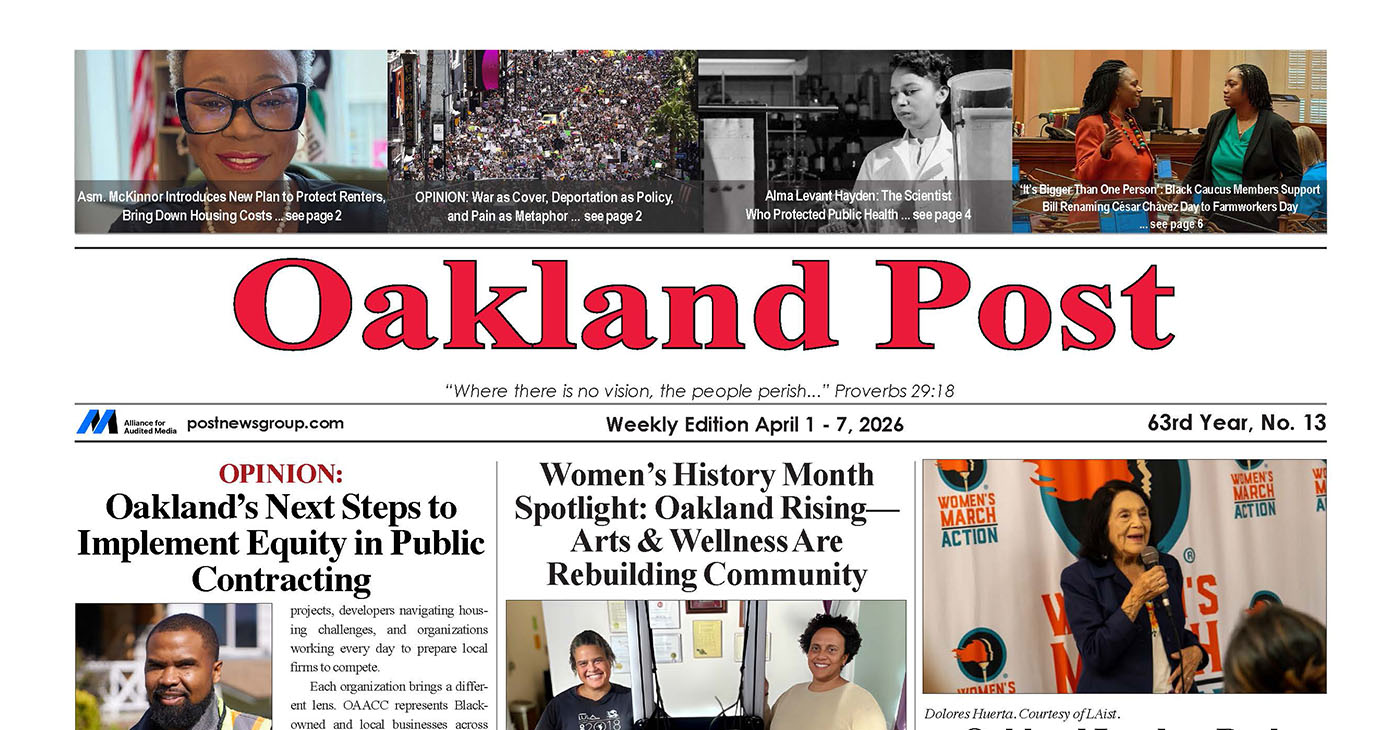
To enlarge your view of this issue, use the slider, magnifying glass icon or full page icon in the lower right corner of the browser window.
Activism
Oakland Post: Week of March 18 – 24, 2026
The printed Weekly Edition of the Oakland Post: Week of March 18 – 24, 2026

To enlarge your view of this issue, use the slider, magnifying glass icon or full page icon in the lower right corner of the browser window.
Activism
Oakland Post: Week of March 11 -17, 2026
The printed Weekly Edition of the Oakland Post: Week of March 11 – 17, 2026
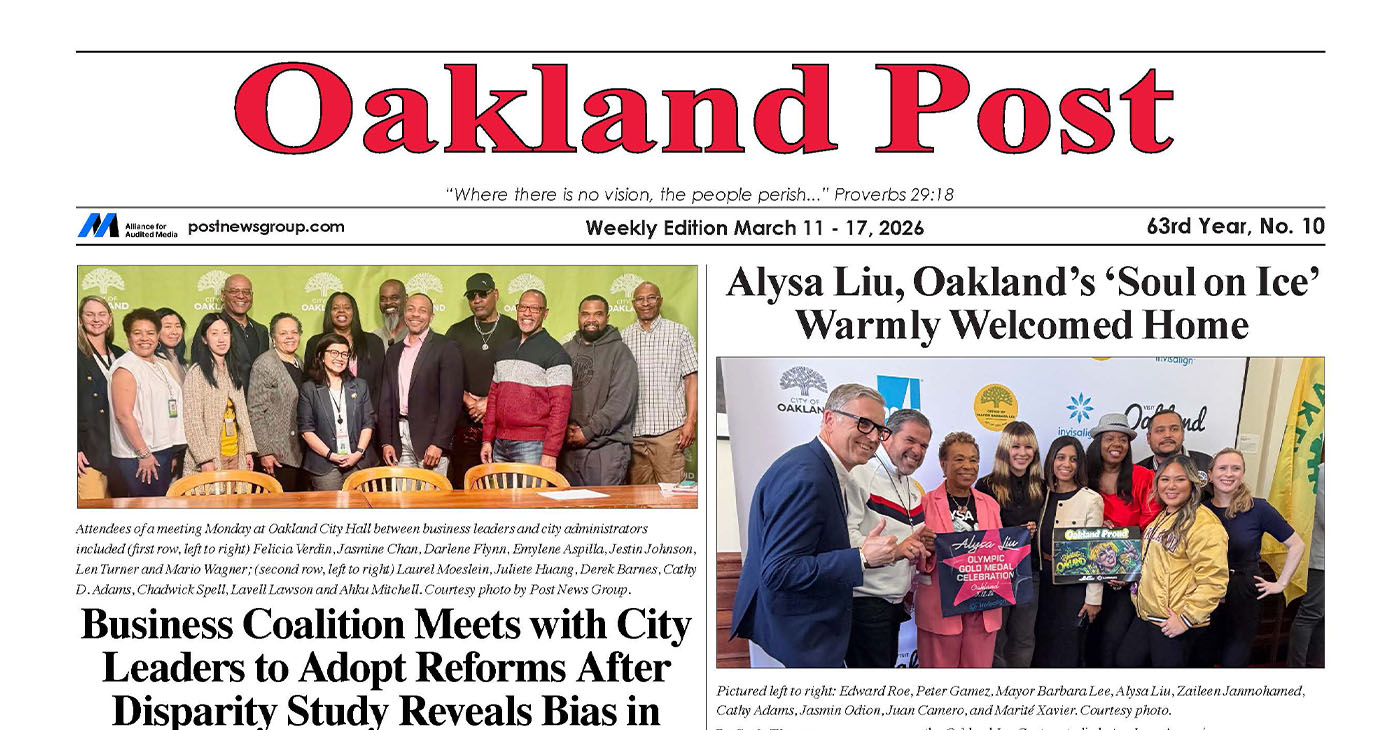
To enlarge your view of this issue, use the slider, magnifying glass icon or full page icon in the lower right corner of the browser window.

WORK FROM HOME
Home-based business with potential monthly income of $10K+ per month. A proven training system and website provided to maximize business effectiveness. Perfect job to earn side and primary income. Contact Lynne for more details: Lynne4npusa@gmail.com 800-334-0540


Oakland Post: Week of April 1 – 7, 2026

Black Artists in America, Installation Three Wraps at the Dixon Gallery and Gardens

Grief, Advocacy, and Education: A Counselor Reflects on Black Maternal Health

Future of Florida’s Black History Museum in Limbo

New Research Shows the Many Benefits of Early Learning

South Hampton K-8 Students Among Top 10 Finalists for Samsung’s ‘Solve for Tomorrow’ Competition

Cuba: No Negotiation with US on the President or Political System

Brooklyn Academy of Music Names Jamaican-Born Tamara McCaw as President

Trinidad & Tobego – U.S. Launches WhatsApp Channel for American Citizens in the Country

Oakland Post: Week of March 18 – 24, 2026

AI Innovation vs. Ethics and Environmental Impact

AI, Web3, and Digital Reparations

What If You Owned Your AI Agent?

Season 7, Episode 3 – January Reporter’s Roundtable 📱

Season 7, Episode 3 – January Reporter’s Roundtable

Reflecting on Black History Milestones in Birmingham AL

CITY OF SAN LEANDRO STATE OF CALIFORNIA PUBLIC WORKS DEPARTMENT ENGINEERING DIVISION NOTICE TO BIDDERS FOR ANNUAL STREET OVERLAY/REHABILITATION 2019-21 – PHASE III

Oakland Post: Week of February 18 – 24, 2026

Oakland Post: Week of February 25 – March 3, 2026

PRESS ROOM: NBA Hall of Fame Nominee Terry Cummings Joins 100 Black Men of DeKalb County to Launch Victory & Values Initiative

Trump’s MAGA Allies are Creating Executive Order Plan to Steal the 2026 Midterms

Oakland Post: Week of March 4 – 10, 2026

Chase Oakland Community Center Hosts Alley-Oop Accelerator Building Community and Opportunity for Bay Area Entrepreneurs

U.S. manufacturing rebounds – how foundry services are adapting to rising demand

Poll Shows Support for Policies That Help Families Afford Child Care

OP-ED: One Hundred Years of Black Workers Telling the Truth

Advancements in solar technology that are changing the way we power the world

Oakland Post: Week of March 11 -17, 2026

Woman’s Search for Family’s Roots Leads to Ancestor John T. Ward – A Successful Entrepreneur and Conductor on the Underground Railroad

COMMENTARY: Women of Color Shape Our Past and Future

Hyundai Ioniq 5 Parking, Safety, and 360 View #shorts

2025 Ioniq 5 New Wiper & Powerful Performance! #shorts

Electric SUV Range: Is 259 Miles Enough? #shorts

EV Charging: How Fast Can You Charge an Electric Vehicle? #shorts

Biometric Cooling… Messaging Seats…Come on! 2025 Infiniti QX80 Autograph 4WD

Charged Up: Witness the Magic of a Fully Electric Car! #shorts

Range Rover Sport PHEV Included…: See What’s Inside This Luxury SUV! #shorts

Invisible Hood View: Perfect Parking with X-Ray Vision! #shorts

AI Is Reshaping Black Healthcare: Promise, Peril, and the Push for Improved Results in California

ESSAY: Technology and Medicine, a Primary Care Point of View

Sanctuary Cities

The RESISTANCE – FREEDOM NOW

STATE OF THE PEOPLE: Freddie

ECONOMIC BOYCOTT DAY!!!!!

I told You So

-
 Activism4 weeks ago
Oakland Post: Week of March 4 – 10, 2026
-
 Activism3 weeks ago
Oakland Post: Week of March 11 -17, 2026
-
 #NNPA BlackPress4 weeks ago
Woman’s Search for Family’s Roots Leads to Ancestor John T. Ward – A Successful Entrepreneur and Conductor on the Underground Railroad
-
 #NNPA BlackPress4 weeks ago
COMMENTARY: Women of Color Shape Our Past and Future
-

 Advice3 weeks ago
Financial Wellness and Mental Health: Managing Money Stress in College
-

 #NNPA BlackPress4 weeks ago
Advocates Raise Alarm Over ICE Operation, MOU and Detention Risks in Baltimore County
-
 Activism2 weeks ago
Oakland Post: Week of March 18 – 24, 2026
-

 #NNPA BlackPress4 weeks ago
Pete Buttigieg to Join Mayor Randall Woodfin for Community Town Hall in Birmingham
