
Featured
California Recycling Bill Highlights Rift Between Mainstream Environmentalism and Environmental Justice Movement

(TriceEdneyWire.com) – When a group of liberal lawmakers in the state capitol in Sacramento recently proposed legislation that would raise the amount of recycled plastic required in bottled beverages sold in California, many environmental activists lauded the move as a much-needed step in the fight to curb plastic waste.
But as debate over the legislation begins to take shape, critics say that it is becoming increasingly clear that the proposed recycling requirement would, if enacted, have an unintended consequence that hurts one group in particular: low-income Californians, particularly those in African-American communities around the state.
The bill, AB792, would mandate that plastic bottles be made with 25 percent recycled plastic by 2021 before it steadily increasing the recycling requirement to 75 percent by 2030. The bill faces a major test in early July when the Senate Environmental Quality Committee considers whether to send it to the full Senate for a vote.
To supporters, the bill would put in place necessary targets to accelerate a reduction in California’s overall plastic use. But consumer advocates worry that the bill would create new production costs that average Californians would have to pay for.
A major concern is that the bill would unintentionally discourage bottled water consumption at a time when research shows that water is key for better nutrition and a successful diet.
The health implications are especially significant for African-Americans, who have experienced higher rates of diabetes than white Americans partly because of poor diet. The proposed legislation also comes at a time when studies have consistently shown black and Hispanic Americans are more inclined to drink bottled water than other ethnic groups.
In addition, research suggests that minority families without access to clean drinking water are more likely to turn to less healthy sugar-sweetened beverages. With African-Americans and Hispanics making up more than 60 percent of Californians suffering from obesity, some advocates say creating new barriers to healthy drinking options could put these individuals at an even greater risk of developing chronic conditions.
Therefore, experts and advocates are asking state lawmakers to slow down the pace of the bill in order to identify unintended consequences of the recycling legislation, regardless of its lofty goals.
The recycling bill has also had unintended consequences politically. It has exposed a rift between mainstream environmentalists and environmental justice advocates.
Specifically, some in the environmental justice movement complain that many mainstream environmental organizations have focused on high-profile issues like climate change and bottled-water recycling while largely neglecting the day-to-day environmental hazards that communities of color face in many American cities.
These environmental hazards largely stem from a number of factors, including rampant industrial development and unwise land-use policies in many cities. The toxic legacy that these communities confront include incinerators, landfills and contaminated water.
In fact, mainstream environmentalists have drawn heavy criticism for their relative silence during the water-contamination crisis in Flint, Michigan, a predominantly African-American city where there is now a pressing need for bottled water.
The differences between the mainstream environmental movement and the environmental justice movement appears to have deep roots: research that has shown people of color and low socioeconomic status have been historically excluded from preeminent environmental groups, many of which are largely white and enjoy the support of wealthy funders.
In 2014, researchers conducted one of the most comprehensive studies examining the intersection between race and environmentalism in environmental institutions. Their conclusion: An overwhelmingly white “green insiders’ club,” with racial minorities occupying less than 12 percent of the leadership positions in the environmental organizations studied.
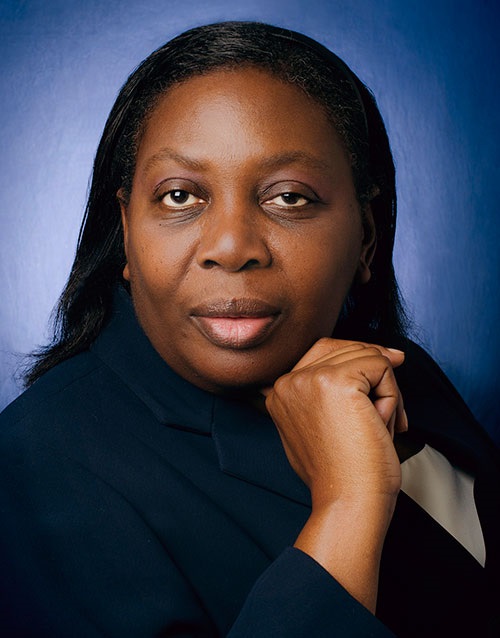
Dr. Dorecta E. Taylor, the study’s primary author, is a graduate of the Yale School of Forestry & Environmental Studies and is presently professor of environmental justice at the University of Michigan, where she also serves as the program director of the Multicultural Environmental Leadership Development Initiative. She is also the university’s director of Diversity, Equity, and Inclusion.
Taylor says White environmentalists are ignoring pressing environmental justice demands due to their failure to move outside of their own insular communities. She said, “One of the things they should be doing is stop being so afraid of people of color, and meet them, interact with them, cultivate them, and start recruiting them.”
Khalil Abdullah, is a Washington, D.C.-area writer and editor. He staffed the Committee on Transportation and Environment for the National Black Caucus of State Legislators before and while serving as executive director. As a national editor for San Francisco-based New America Media, he edited and occasionally wrote on environmental issues.

Activism
Oakland Post: Week of April 8 – 14, 2026
The printed Weekly Edition of the Oakland Post: Week of April 8 – 14, 2026


To enlarge your view of this issue, use the slider, magnifying glass icon or full page icon in the lower right corner of the browser window.

Activism
Oakland Post: Week of April 1 – 7, 2026
The printed Weekly Edition of the Oakland Post: Week of April 1 – 7, 2026
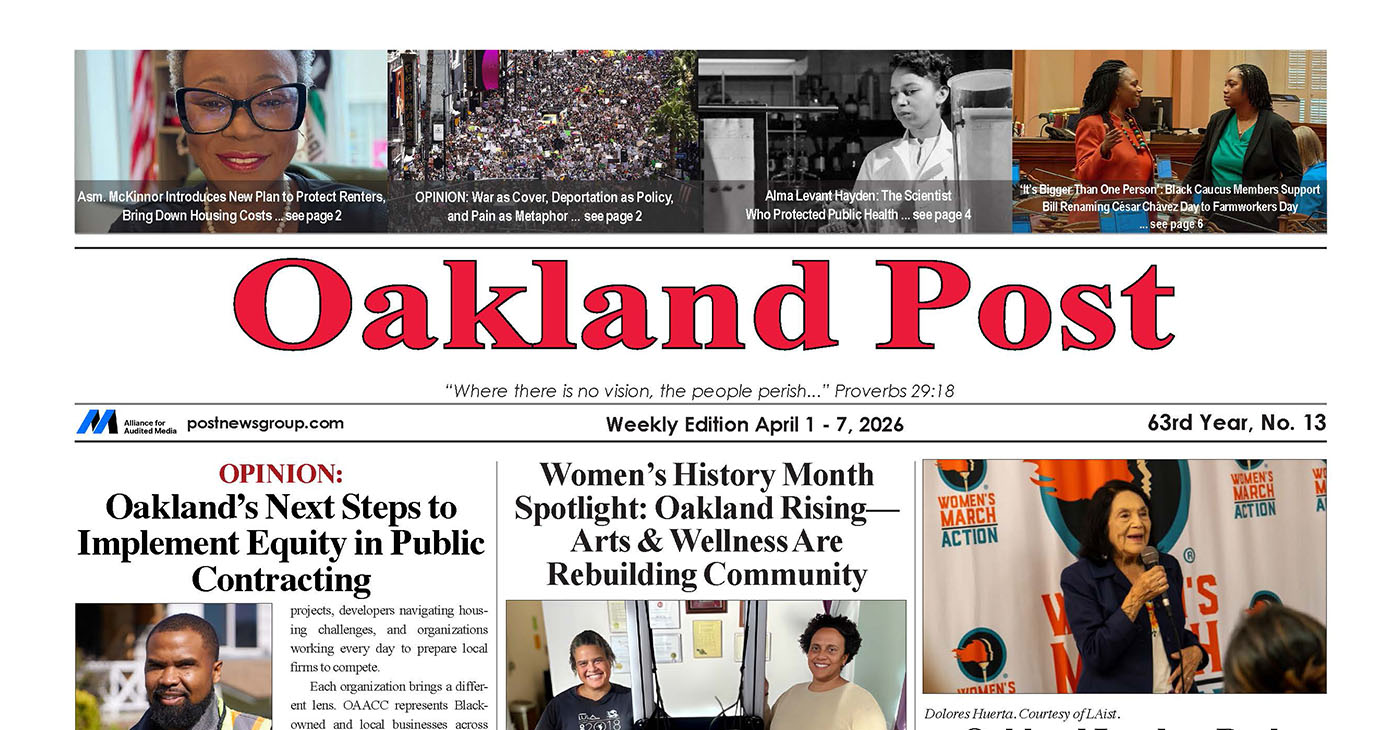
To enlarge your view of this issue, use the slider, magnifying glass icon or full page icon in the lower right corner of the browser window.
#NNPA BlackPress
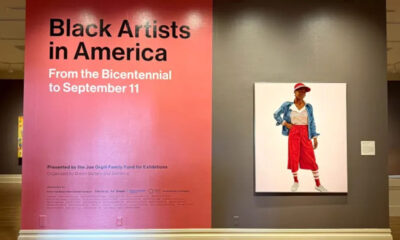
Black Artists in America, Installation Three Wraps at the Dixon Gallery and Gardens
TRI-STATE DEFENDER — With 50+ paintings, sculptures and assemblages, the exhibit features artists like Varnette Honeywood from Los Angeles, whose pieces appeared in Bill Coby’s private collection (before they were auctioned off) and on “The Cosby Show.” Also included are works by Alonzo Davis, another Los Angeles artist who opened one of the first galleries there where Black Artists could exhibit.

By Candace A. Gray | Tri-State Defender
The tulips gleefully greet those who enter the gates at the Dixon Gallery & Gardens on an almost spring day. More than 650,000 bulbs of various hues are currently on display. And they are truly breathtaking.
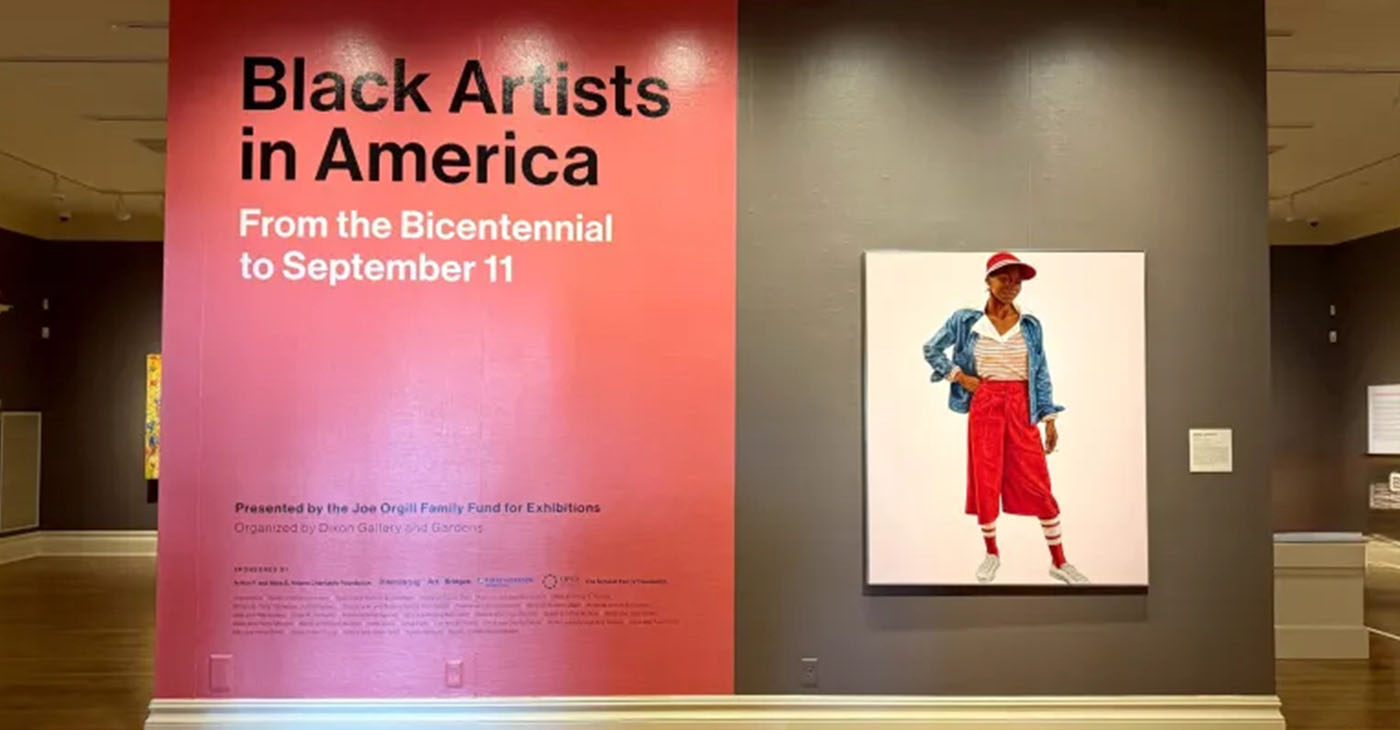
Inside the gallery, and equally as breathtaking, is the “Black Artists in America, From the Bicentennial to September 11” exhibit, which runs through Sunday, March 29. This is the third installment of a three-part series that started years ago and illustrates part of the Black experience through visual arts in the 20th century.
“This story picks up where part two left off,’’ said Kevin Sharp, the Linda W. and S. Herbert Rhea director for the Dixon. “This era is when we really start to see the emergence of these important Black artists’ agency and freedom shine through. They start to say and express what they want to, and it was a really beautiful time.”
With 50+ paintings, sculptures and assemblages, the exhibit features artists like Varnette Honeywood from Los Angeles, whose pieces appeared in Bill Coby’s private collection (before they were auctioned off) and on “The Cosby Show.” Also included are works by Alonzo Davis, another Los Angeles artist who opened one of the first galleries there where Black Artists could exhibit.
“Though [Davis] was from LA, he actually lived in Memphis for a decade,” said Sharp. “He was a dean at Memphis College of Art, and later opened the first gallery in New York owned and operated by black curators.”
Another featured artist is former NFL player, Ernie Barnes. His work is distinctive. Where have you seen one of his most popular paintings, Sugar Shack? On the end scene and credits of the hit show “Good Times.” His piece Saturday Night, Durham, North Carolina, 1974 is in this collection.
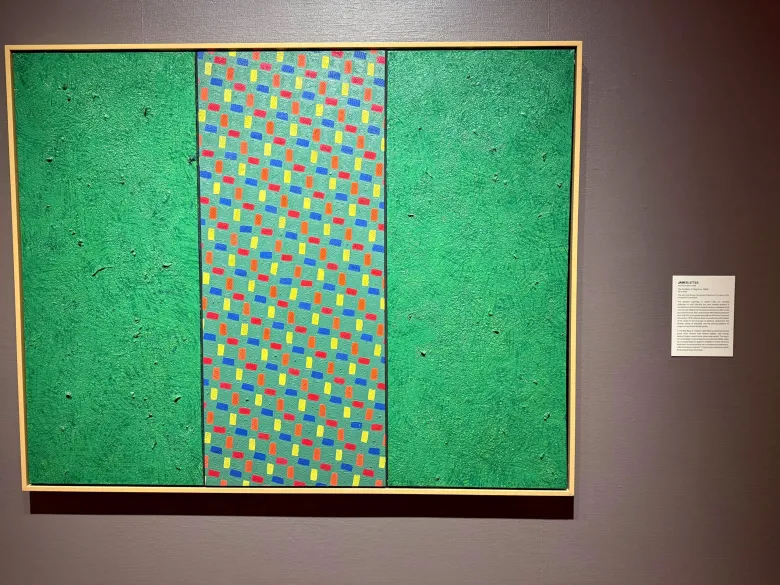
Memphis native James Little’s “The War Baby: The Triptych” is among more than 50 works featured in “Black Artists in America, From the Bicentennial to September 11” at the Dixon Gallery & Gardens, the final installment of a three-part series highlighting the impact and evolution of Black artists through 2011.
The exhibit features other artists with Memphis ties, including abstract painter James Little, who was raised in a segregated Memphis and attended Memphis Academy of Art (before it was Memphis College of Art). He later moved to New York, became a teacher and an internationally acclaimed fixture in the art world in 2022 when he was named a Whitney Biennial selected artist at the Whitney Museum of American Art in New York.
Other artists like Romare Bearden, who had a Southern experience but lived up North, were featured in all three installments.
“During this period of time, he was a major figure,” said Sharp. “He wrote one of the first books on the history of African American art during a time when there were more Black academics, art teachers, more Black everything!”
Speaking of Black educators, Sharp said the head curator behind this tri-part series and Dixon’s partner in the arts is Earnestine Jenkins, Ph.D., an art history professor at the University of Memphis, who also earned a Master of Arts degree from Memphis State University (now UofM). “We began working with Dr. Jenkins in 2018,” he said.
Sharp explained that it takes a team of curators, registrars, counterparts at other museums, and more, about three years to assemble an exhibit like this. It came together quite seamlessly, he added. Each room conjured up more jaw-dropping “wows” than the one before it. Each piece worked with the others to tell the story of Black people and their collective experience during this time period.
One of the last artists about whom Sharp shared information was Bettye Saar, who will turn 100 years old this year. She’s been working in Los Angeles for 80 years and is finally getting her due. Her medium is collages or assemblages, and an incredible work of hers is on display. She’s married to an artist and has two daughters, also artists.
The exhibit catalogue bears some of these artists’ stories, among other scholarly information.
The exhibit, presented by the Joe Orgill Family Fund for Exhibitions, is culturally and colorfully rich. It is a must see and admission to the Dixon is free.
Visit https://www.dixon.org/ to learn more.
Fun Facts: An original James Little design lives in the flooring of the basketball court at Tom Lee Park, and he makes and mixes his own paint colors.



WORK FROM HOME
Home-based business with potential monthly income of $10K+ per month. A proven training system and website provided to maximize business effectiveness. Perfect job to earn side and primary income. Contact Lynne for more details: Lynne4npusa@gmail.com 800-334-0540


Oakland Post: Week of April 8 – 14, 2026

Oakland Post: Week of April 1 – 7, 2026

Black Artists in America, Installation Three Wraps at the Dixon Gallery and Gardens

Grief, Advocacy, and Education: A Counselor Reflects on Black Maternal Health

Future of Florida’s Black History Museum in Limbo

New Research Shows the Many Benefits of Early Learning

South Hampton K-8 Students Among Top 10 Finalists for Samsung’s ‘Solve for Tomorrow’ Competition

Cuba: No Negotiation with US on the President or Political System

Brooklyn Academy of Music Names Jamaican-Born Tamara McCaw as President

Trinidad & Tobego – U.S. Launches WhatsApp Channel for American Citizens in the Country

Oakland Post: Week of March 18 – 24, 2026

AI Innovation vs. Ethics and Environmental Impact

AI, Web3, and Digital Reparations

What If You Owned Your AI Agent?

Season 7, Episode 3 – January Reporter’s Roundtable 📱

Reflecting on Black History Milestones in Birmingham AL

Oakland Post: Week of February 25 – March 3, 2026

Oakland Post: Week of March 4 – 10, 2026

PRESS ROOM: NBA Hall of Fame Nominee Terry Cummings Joins 100 Black Men of DeKalb County to Launch Victory & Values Initiative

Trump’s MAGA Allies are Creating Executive Order Plan to Steal the 2026 Midterms
Oakland Post: Week of March 18 – 24, 2026

Oakland Post: Week of March 11 -17, 2026

Poll Shows Support for Policies That Help Families Afford Child Care

OP-ED: One Hundred Years of Black Workers Telling the Truth

Financial Wellness and Mental Health: Managing Money Stress in College

Woman’s Search for Family’s Roots Leads to Ancestor John T. Ward – A Successful Entrepreneur and Conductor on the Underground Railroad

COMMENTARY: Women of Color Shape Our Past and Future
Brooklyn Academy of Music Names Jamaican-Born Tamara McCaw as President
New Research Shows the Many Benefits of Early Learning
Grief, Advocacy, and Education: A Counselor Reflects on Black Maternal Health

Hyundai Ioniq 5 Parking, Safety, and 360 View #shorts

2025 Ioniq 5 New Wiper & Powerful Performance! #shorts

Electric SUV Range: Is 259 Miles Enough? #shorts

EV Charging: How Fast Can You Charge an Electric Vehicle? #shorts

Biometric Cooling… Messaging Seats…Come on! 2025 Infiniti QX80 Autograph 4WD

Charged Up: Witness the Magic of a Fully Electric Car! #shorts

Range Rover Sport PHEV Included…: See What’s Inside This Luxury SUV! #shorts

Invisible Hood View: Perfect Parking with X-Ray Vision! #shorts

AI Is Reshaping Black Healthcare: Promise, Peril, and the Push for Improved Results in California

ESSAY: Technology and Medicine, a Primary Care Point of View

Sanctuary Cities

The RESISTANCE – FREEDOM NOW

STATE OF THE PEOPLE: Freddie

ECONOMIC BOYCOTT DAY!!!!!

I told You So
-
 Activism3 weeks ago
Oakland Post: Week of March 18 – 24, 2026
-
 Activism4 weeks ago
Oakland Post: Week of March 11 -17, 2026
-
 Advice4 weeks ago
Financial Wellness and Mental Health: Managing Money Stress in College
-
 #NNPA BlackPress3 weeks ago
Brooklyn Academy of Music Names Jamaican-Born Tamara McCaw as President
-
 #NNPA BlackPress3 weeks ago
New Research Shows the Many Benefits of Early Learning
-
 #NNPA BlackPress3 weeks ago
Grief, Advocacy, and Education: A Counselor Reflects on Black Maternal Health
-
 #NNPA BlackPress3 weeks ago
Future of Florida’s Black History Museum in Limbo
-
 #NNPA BlackPress3 weeks ago
Black Artists in America, Installation Three Wraps at the Dixon Gallery and Gardens
