
Bay Area
California Gas Prices to Spike Even More with July 1 Tax Increase
Democratic lawmakers, backed by environmentalists, are digging their heels in, defending their decision not to suspend the inflationary tax increase that they fought hard to approve when they voted to pass Senate Bill 1 in 2017. “As we’ve said before, suspending the gas tax would reduce critical funds available for road repair and improvement projects,” Senate President Pro Tem Toni Atkins, (D-San Diego) and Assembly Speaker Anthony Rendon, D-Lakewood said in a joint statement.


By Tanu Henry, California Black Media

“I really don’t understand how the price of gas can rise so drastically in California,” said a Black woman and 55-year-old Rancho Cucamonga resident who agreed to be interviewed for this article but asked to not be identified.
“Unfortunately, we need to purchase it regardless of the prices and that’s one of reasons, I believe, it continues to increase,” she complained. “Weekly, it is costing me approximately $75 to commute to and from work, which is $35 more than I used to pay.”
The woman, who is a collections officer with a lead abatement company, said filling her tank often means she has to forgo another obligation.
As of Friday, the average gas price per gallon was $5.82 in the state.
Now, news that the state is tacking an extra 3-cent tax on every gallon purchased — which will not be a significant increase — is still absurd, says the woman, considering that California already has the highest gas prices in the nation.
Because Gov. Gavin Newsom and the state Legislature missed the May 1 deadline to suspend an inflationary gas tax increase that is scheduled for July 1, it will still take effect.
Policymakers would have had to act 60 days in advance to avert the increase.
Democratic lawmakers, backed by environmentalists, are digging their heels in, defending their decision not to suspend the inflationary tax increase that they fought hard to approve when they voted to pass Senate Bill 1 in 2017.
“As we’ve said before, suspending the gas tax would reduce critical funds available for road repair and improvement projects,” Senate President Pro Tem Toni Atkins, (D-San Diego) and Assembly Speaker Anthony Rendon, D-Lakewood said in a joint statement.
“Additionally, as oil companies continue to rake in record-high profits, there is no guarantee this relief would be passed onto consumers,” Atkins and Rendon continued.
With the tax hike, the average excise tax price per gallon in the state will go from about 51 cents per gallon to 54 cents per gallon.
Last month, with the May 1 deadline looming, Newsom’s office acknowledged that it would not be able to convince lawmakers in the state Senate and Assembly to suspend the tax increase.
Instead, Newsom’s spokesperson Alex Stack released a statement suggesting that the Governor’s office was turning its attention to providing relief to Californians as the cost of gas, food and other commodities continue to skyrocket.
“We look forward to working with lawmakers on the governor’s proposal for direct payments to Californians wrestling with rising prices,” Stack said in a statement. “Helping offset the impact of inflation on California residents remains a top priority for the governor.”
Legislative Republicans blasted their Democratic colleagues for their “inaction” on the gas tax increase.
“Californians are desperate for any relief at the pump while paying the highest gas prices in the nation, but Democrats have decided to run out the clock and increase the state’s gas tax instead,” read a statement the state Republican Party released earlier this month.
Gov. Newsom and lawmakers in both chambers of the Legislature have still not agreed on how to address the excessive cost of gas in the state.













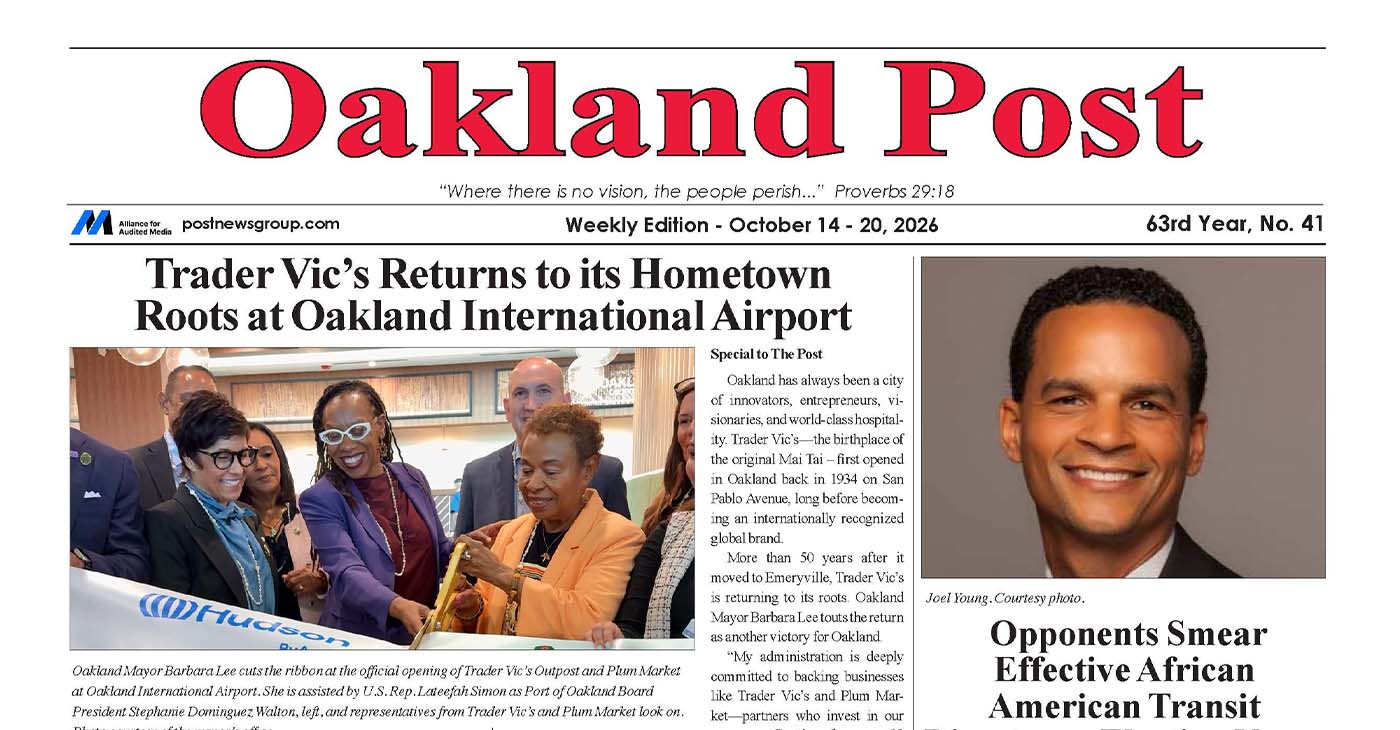
To enlarge your view of this issue, use the slider, magnifying glass icon or full page icon in the lower right corner of the browser window.
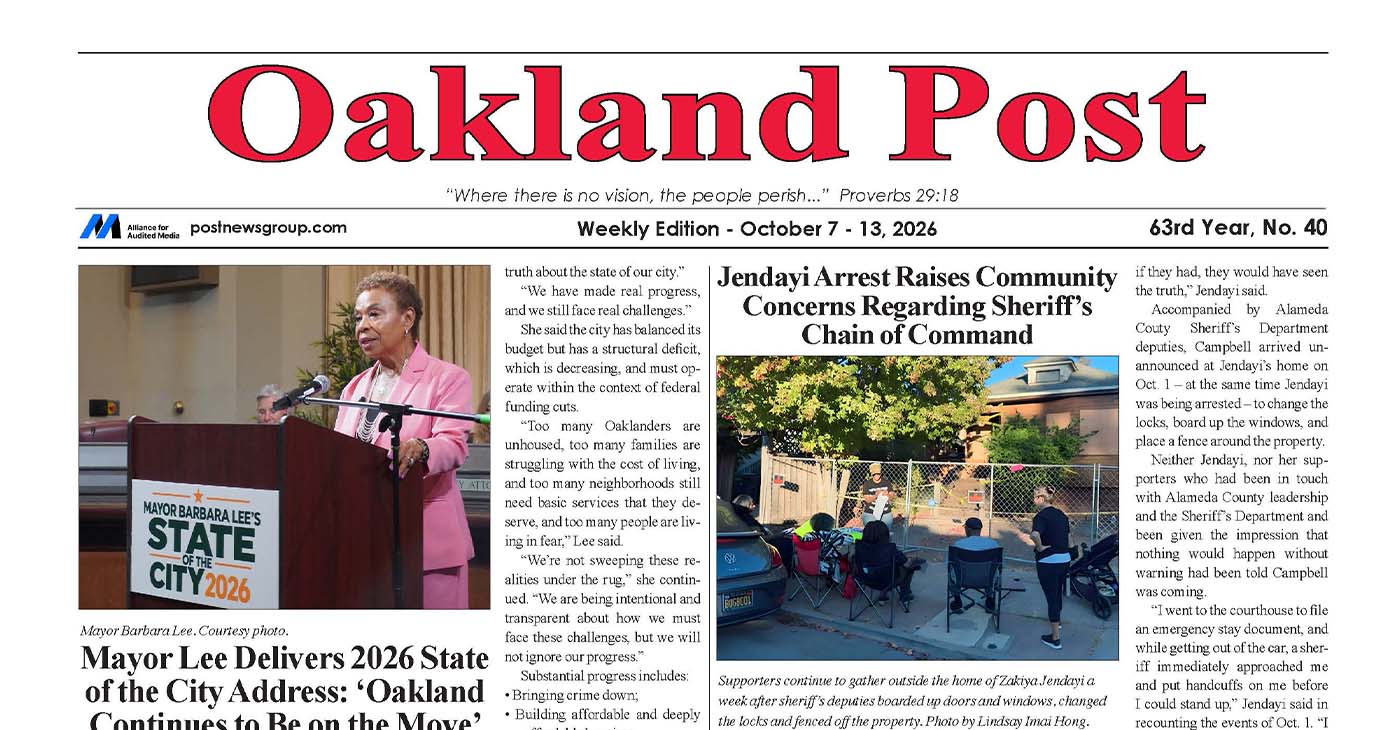
To enlarge your view of this issue, use the slider, magnifying glass icon or full page icon in the lower right corner of the browser window.
Activism
Oakland Post: Week of September 30 – October 6, 2026
The printed Weekly Edition of the Oakland Post: Week of September 30 – October 6, 2026

To enlarge your view of this issue, use the slider, magnifying glass icon or full page icon in the lower right corner of the browser window.



Mayor Barbara Lee Holds Special State of the City Address in Deep East Oakland

Practitioners of African Traditional Spirituality Offer Ancestral Reverence Ritual Oct. 31

It’s Time to Lose Weight Before the Holidays

Trader Vic’s Returns to Its Oakland Roots

Oakland Coal Terminal Backed by Trump Would Be Bigger, Dirtier Than Promised, Says Report

Opponents Smear Effective African American Transit Director as Election Nears

Oakland Post: Week of October 14 – 20, 2026

OP-ED: The Black Church Writes AI’s Next Chapter

OP-ED: The Black Church Writes AI’s Next Chapter

WCCUSD Joins Statewide Organic School Food Purchasing Cooperative

Democrats, Community Groups Back Measure EE to Change How Oakland Is Governed

Four Tips to Help You Plan a Holiday “Staycation”

Veterans Housing Project Proposed for South Richmond
PRESS ROOM: Transformative Justice Coalition 2026 Voting Rights Champion Awards Reception ‘Yesterday Is Today: The Battle For Voting Rights

Mayor Lee Delivers 2026 State of the City Address: ‘Oakland Continues to Be on the Move’

Misnamed ‘Parent’ PAC Seeks to Influence Oakland School Board Elections

Listening as a Lifeline: A Doula’s Witness to Black Maternal Health

Poll: Becerra Widens His Lead Over Hilton; Californians Split on Wealth Tax

Oakland Post: Week of September 9 – 15, 2026

County Office of Education Says OUSD Finances Are Getting Healthier, Materially Stronger

Richmond Tiny House Village Farm & Garden Set to Open Gates on Sept. 26

Mayor Lee Announces $1 Million Kaiser Permanente Grant for Pilot Program to Address Homelessness, Clean Up Public Spaces throughout Oakland

Latest Massacre in Haiti Reveals Cruelty U.S. Deportations

Zakiya Jendayi Arrested, Locked Out of Home by Sheriff’s Deputies

OPINION: Nolan Wells’ Death One of Several Signifying Racial Terror Lives on in U.S. South

Doulas Are Helping Black California Moms Navigate Pregnancy–Even as High Mortality Rates Persist

BLACspace Cooperative Invites Bay Area to Experience Oakland’s Black Cultural Ecosystem Through a BLAC Map Tour + Party

Oakland Post: Week of September 16 – 22, 2026

Oakland People’s Arms Embargo Coalition Demands End to Military Shipments Thru Oakland

Democratic Clubs Interview Candidates for Oakland School Board

The Conversation With Al McFarlane 6/23/26

Media Monday 6/22/26

LIVE! ASK ALMA! — TUES. 6.23.26 7PM EST

Car Buying Secrets: 4 Hidden Checks Before You Sign!

Is This 550 HP Charger Worth YOUR Money? AutoNetwork Review

Celebrating Juneteenth – Frederick Douglass on education and resistance

LIVE! — ASK ALMA! — TUES. 6.19.26 7PM EST

Hyundai Ioniq 5 Parking, Safety, and 360 View #shorts

2025 Ioniq 5 New Wiper & Powerful Performance! #shorts

Electric SUV Range: Is 259 Miles Enough? #shorts

EV Charging: How Fast Can You Charge an Electric Vehicle? #shorts

Biometric Cooling… Messaging Seats…Come on! 2025 Infiniti QX80 Autograph 4WD

Charged Up: Witness the Magic of a Fully Electric Car! #shorts

Range Rover Sport PHEV Included…: See What’s Inside This Luxury SUV! #shorts

Invisible Hood View: Perfect Parking with X-Ray Vision! #shorts
-
 Black History3 weeks ago
Listening as a Lifeline: A Doula’s Witness to Black Maternal Health
-
 Economy4 weeks ago
Poll: Becerra Widens His Lead Over Hilton; Californians Split on Wealth Tax
-
 Business4 weeks ago
County Office of Education Says OUSD Finances Are Getting Healthier, Materially Stronger
-
 Lead Story3 weeks ago
Zakiya Jendayi Arrested, Locked Out of Home by Sheriff’s Deputies
-
 Black History4 weeks ago
Doulas Are Helping Black California Moms Navigate Pregnancy–Even as High Mortality Rates Persist
-
 Art4 weeks ago
BLACspace Cooperative Invites Bay Area to Experience Oakland’s Black Cultural Ecosystem Through a BLAC Map Tour + Party
-

 Business4 weeks ago
From Historic Memories to New Possibilities: Oakland Celebrates Coliseum 60
-

 Community4 weeks ago
Asm. Corey Jackson Announces Launch of 24-Hour Childcare in His District
