
Crime
Black children continue to be sent to adult courts, jails at alarmingly high rates
NASHVILLE PRIDE — Juvenile arrest rates have fallen sharply in recent years, but Black youth are disproportionately sent to adult court by judges at some of the highest percentages seen in 30 years

By PRIDE Newsdesk
Juvenile arrest rates have fallen sharply in recent years, but Black youth are disproportionately sent to adult court by judges at some of the highest percentages seen in 30 years, according to a joint report from the Campaign for Youth Justice (CFYJ) and the National Association of Social Workers (NASW).
The new report, ‘The Color of Youth Transferred to the Adult Criminal Justice System: Policy and Practice Recommendations,’ discusses how the egregious practice of prosecuting and incarcerating black youth as adults, which is rooted in our nation’s past and ongoing racism, has had a devastating impact on Black youth and the black community.
Black children sent to adult jails and prisons are more likely to die by suicide, suffer from mental illness, and recidivate once they return to their communities than their peers in the juvenile justice system.
“Research has proven that adults courts and jails are no place for children. The brain development of youth is markedly different from adults and they are more prone to risk taking and not thinking through the consequences of their actions,” said NASW Social Justice and Human Rights Manager Mel Wilson. “Youth involved in the justice system are also more likely to have mental health needs and have suffered from trauma so they need rehabilitation and treatment services that are not provided in most adult jails.”

“This brief dives into the historical context of racial terror inflicted on Black communities that has shaped the foundation of systemic policies, practices, and procedures that compound disproportionality,” said CFYJ Policy Director Jeree Thomas.
“This is a symptom of chronic and systemic racism beyond the confines of the justice system itself, but we believe that intentional advocacy and transformative thinking by social workers, attorneys, youth advocates, and system leaders can begin to redress this issue in states across the country.”
CFYJ and NASW looked at the rate of Black youth who were sent to adult courts in Oregon, Florida and Missouri, three states that report their adult court transfer rates disaggregated by race.
In Oregon, while Black youth are 2.3% of the state’s population, they are 15.8% of youth transferred to adult court in 2017. Similarly, in Florida, although Black youth make up just 21% of the youth population, they accounted for 67.7% of youth transferred to adult court in 2016.
Missouri is one of the first states to urge judges to consider racial disparities before transferring youth to adult courts. Still in 2016, Black youth made up 14.8% of the youth population age 10 to 17, but 72% of youth that judges referred to adult courts, even though they accounted for 40% of youth charged with felony offenses.
CFYJ and NASW encourage advocates and social workers across the country to take action and mobilize against the adultification of Black youth in the criminal justice system.
These actions include: getting local officials such as county government and city council members to recognize the importance of keeping all youth, and especially youth of color, out of the adult criminal justice system; advocating for prosecutors to adopt transparent procedures around the decision to transfer youth to adult courts; passing legislation that would require a look at the racial impact of bills that increase the number of youth who are prosecuted, sentenced and incarcerated as adults; requiring more social workers be part of the defense team of juveniles because social workers can propose treatment and sentencing options that keep youth out of adult courts and jails; and researching and developing community-based alternatives to incarceration for youth who are sent to adult courts.
“The reason why Black youth are sent to adult courts and jails at higher rates are based on generations of institutionalized racism in the United States,” Wilson said.
“Federal, state and local officials must aggressively collect data and review their policies and practices to ensure they are not disproportionately harming Black youth and Black communities.”
“We are seeing that Black males of any age receive more punitive outcomes compared to other groups. For example, in Florida, there is recent research that indicates that Black male youth are more likely to receive a jail or prison sentence rather than community-based alternatives, and more likely to receive a longer jail and prison sentence than their peers,” said Thomas.
“This research highlights the need to continue to address the root causes of disproportionate minority contact and racial and ethnic disparities for youth transferred to the adult system.”
This article originally appeared in the Nashville Pride.













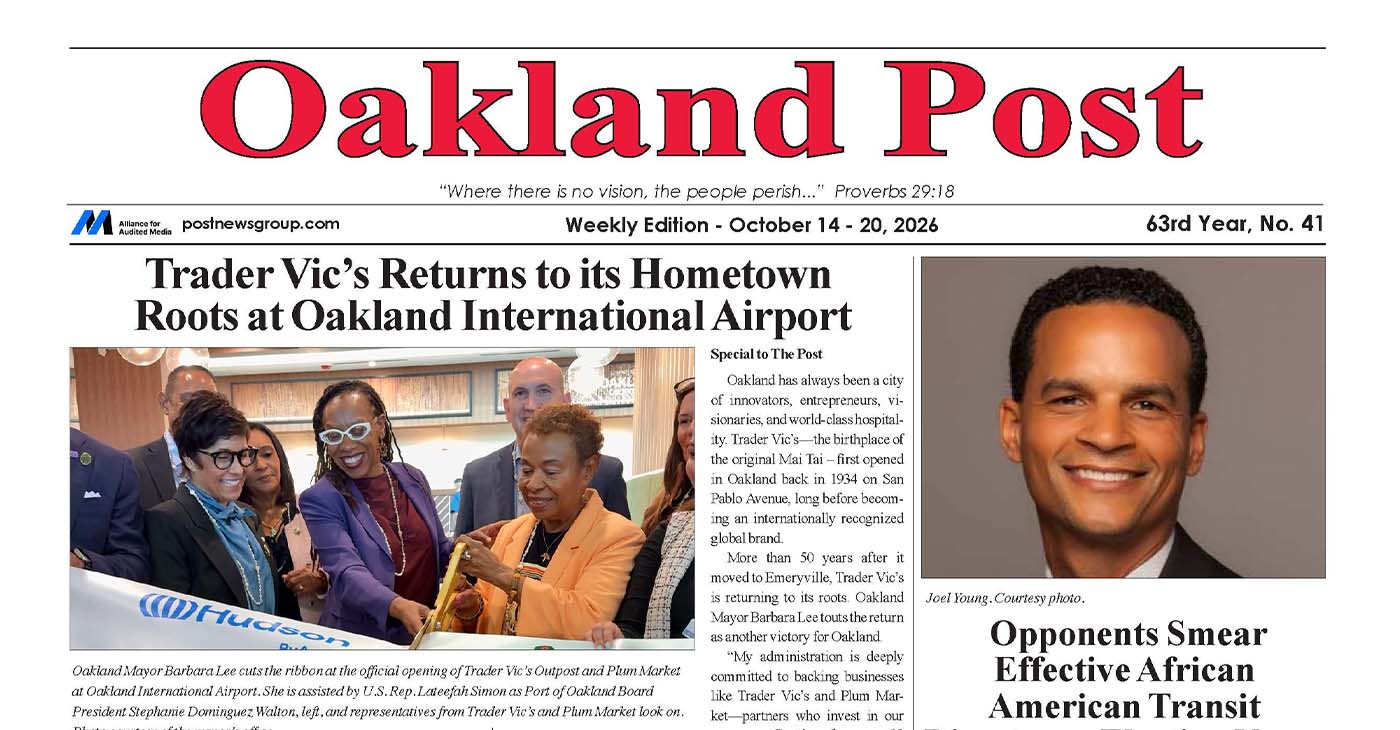
To enlarge your view of this issue, use the slider, magnifying glass icon or full page icon in the lower right corner of the browser window.
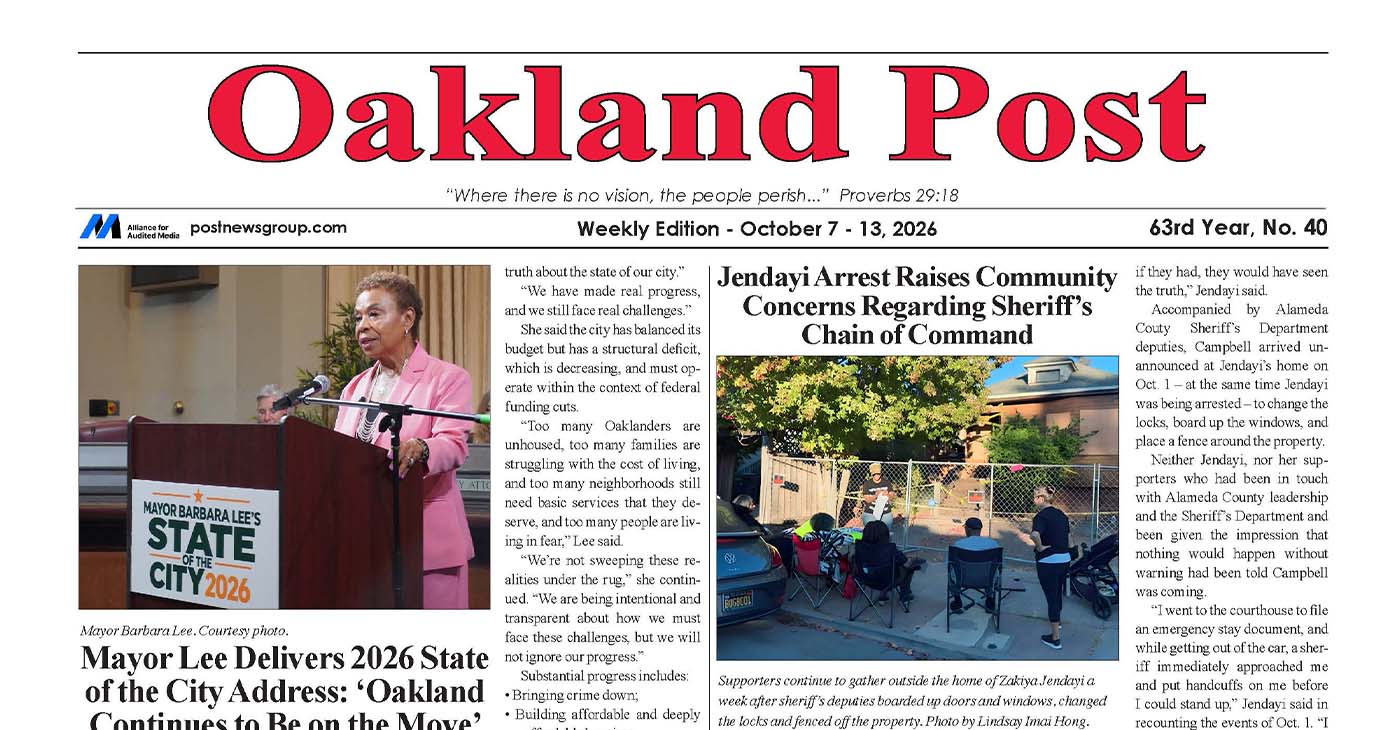
To enlarge your view of this issue, use the slider, magnifying glass icon or full page icon in the lower right corner of the browser window.
Activism
Oakland Post: Week of September 30 – October 6, 2026
The printed Weekly Edition of the Oakland Post: Week of September 30 – October 6, 2026

To enlarge your view of this issue, use the slider, magnifying glass icon or full page icon in the lower right corner of the browser window.



Mayor Barbara Lee Holds Special State of the City Address in Deep East Oakland

Practitioners of African Traditional Spirituality Offer Ancestral Reverence Ritual Oct. 31

It’s Time to Lose Weight Before the Holidays

Trader Vic’s Returns to Its Oakland Roots

Oakland Coal Terminal Backed by Trump Would Be Bigger, Dirtier Than Promised, Says Report

Opponents Smear Effective African American Transit Director as Election Nears

Oakland Post: Week of October 14 – 20, 2026

OP-ED: The Black Church Writes AI’s Next Chapter

OP-ED: The Black Church Writes AI’s Next Chapter

WCCUSD Joins Statewide Organic School Food Purchasing Cooperative

Democrats, Community Groups Back Measure EE to Change How Oakland Is Governed

Four Tips to Help You Plan a Holiday “Staycation”

Veterans Housing Project Proposed for South Richmond
PRESS ROOM: Transformative Justice Coalition 2026 Voting Rights Champion Awards Reception ‘Yesterday Is Today: The Battle For Voting Rights

Mayor Lee Delivers 2026 State of the City Address: ‘Oakland Continues to Be on the Move’

Misnamed ‘Parent’ PAC Seeks to Influence Oakland School Board Elections

Listening as a Lifeline: A Doula’s Witness to Black Maternal Health

Poll: Becerra Widens His Lead Over Hilton; Californians Split on Wealth Tax

Oakland Post: Week of September 9 – 15, 2026

County Office of Education Says OUSD Finances Are Getting Healthier, Materially Stronger

Richmond Tiny House Village Farm & Garden Set to Open Gates on Sept. 26

Mayor Lee Announces $1 Million Kaiser Permanente Grant for Pilot Program to Address Homelessness, Clean Up Public Spaces throughout Oakland

Latest Massacre in Haiti Reveals Cruelty U.S. Deportations

Zakiya Jendayi Arrested, Locked Out of Home by Sheriff’s Deputies

OPINION: Nolan Wells’ Death One of Several Signifying Racial Terror Lives on in U.S. South

Doulas Are Helping Black California Moms Navigate Pregnancy–Even as High Mortality Rates Persist

BLACspace Cooperative Invites Bay Area to Experience Oakland’s Black Cultural Ecosystem Through a BLAC Map Tour + Party

Oakland Post: Week of September 16 – 22, 2026

Oakland People’s Arms Embargo Coalition Demands End to Military Shipments Thru Oakland

Democratic Clubs Interview Candidates for Oakland School Board

The Conversation With Al McFarlane 6/23/26

Media Monday 6/22/26

LIVE! ASK ALMA! — TUES. 6.23.26 7PM EST

Car Buying Secrets: 4 Hidden Checks Before You Sign!

Is This 550 HP Charger Worth YOUR Money? AutoNetwork Review

Celebrating Juneteenth – Frederick Douglass on education and resistance

LIVE! — ASK ALMA! — TUES. 6.19.26 7PM EST

Hyundai Ioniq 5 Parking, Safety, and 360 View #shorts

2025 Ioniq 5 New Wiper & Powerful Performance! #shorts

Electric SUV Range: Is 259 Miles Enough? #shorts

EV Charging: How Fast Can You Charge an Electric Vehicle? #shorts

Biometric Cooling… Messaging Seats…Come on! 2025 Infiniti QX80 Autograph 4WD

Charged Up: Witness the Magic of a Fully Electric Car! #shorts

Range Rover Sport PHEV Included…: See What’s Inside This Luxury SUV! #shorts

Invisible Hood View: Perfect Parking with X-Ray Vision! #shorts
-
 Black History3 weeks ago
Listening as a Lifeline: A Doula’s Witness to Black Maternal Health
-
 Economy4 weeks ago
Poll: Becerra Widens His Lead Over Hilton; Californians Split on Wealth Tax
-
 Business4 weeks ago
County Office of Education Says OUSD Finances Are Getting Healthier, Materially Stronger
-
 Lead Story3 weeks ago
Zakiya Jendayi Arrested, Locked Out of Home by Sheriff’s Deputies
-
 Black History4 weeks ago
Doulas Are Helping Black California Moms Navigate Pregnancy–Even as High Mortality Rates Persist
-
 Art4 weeks ago
BLACspace Cooperative Invites Bay Area to Experience Oakland’s Black Cultural Ecosystem Through a BLAC Map Tour + Party
-

 Business4 weeks ago
From Historic Memories to New Possibilities: Oakland Celebrates Coliseum 60
-

 Community4 weeks ago
Asm. Corey Jackson Announces Launch of 24-Hour Childcare in His District
