
Commentary
“Big Sister” Barbara Lee’s Advice for the New Women of Color in Congress
NNPA NEWSWIRE — “…there have been vocal women of color pushing for progressive change in Congress for a long time. California Rep. Barbara Lee, who Pressley called a ‘big sister & mentor’ in her tweet, is one of them.”

“You have to break through all of that sexism and racism. You have to really confront that all of the time.”
By Christina Cauteruci
There’s a crew of new women in Congress who’ve become fast friends since the election. Reps. Rashida Tlaib, Ayanna Pressley, Ilhan Omar, and Alexandria Ocasio-Cortez have become instant progressive icons and visible markers of a long-overdue shift in legislative demographics. They’ve posted loads of selfies together, called themselves a “squad,” tweeted support for each other’s policy ideas, and defended each other from right-wing detractors. Their fans have seen them as harbingers of hope in a dark time descending on a stalled-out Congress to help save America from itself.
It’s important to remember, though, as Pressley told her Twitter followers over the weekend, that there have been vocal women of color pushing for progressive change in Congress for a long time. California Rep. Barbara Lee, who Pressley called a “big sister & mentor” in her tweet, is one of them. In a phone conversation earlier this month, I spoke to Lee about her role in the new, more progressive Congress, what it was like to be one of the few black women in national office in the 1990s, and what it might mean to have a “critical mass” in the legislature. Our conversation has been condensed and edited for clarity.

Christina Cauterucci: I was looking through all the pictures you and other Democratic women posed for on the first day of the new Congress, and there was a palpable feeling of celebration. What was that day like for you?
Barbara Lee: It was exciting. The younger and new members of Congress are very smart, they’re authentic, they’re passionate, they’re committed to their constituencies and to the country, to the world. And it’s just been wonderful being with them. I hope to be able to help them find their paths.
But also, I have to say, just as a progressive African-American woman, they give me a lot of hope. They strengthen me. They really formed that bond that means a heck of a lot when you’re in a Congress where—for example, in 1998, I was only the 20th African-American woman ever elected to Congress since 1789. So this is really quite a happy moment and a really profound and positive development for the country.
There seems to be an incredible camaraderie among this new class of congresswomen—they’re hugging each other in photos, calling each other sisters in their tweets. Is there always such a strong feeling of solidarity among new progressive members of Congress?
There’s always solidarity. But I think this year is unique because you have so many women of color, and women from diverse backgrounds, and women who have broken so many glass ceilings. For example, Pennsylvania did not have one single woman in their delegation. Now we have—I believe it’s four. This is amazing. This is groundbreaking. It really tells me there’s no way we can ever go back. I think the excitement and the joy and the hope that this election brought was really a special and unique moment in history.
I’ve been thinking a lot about power in numbers when it comes to race and gender representation in Congress. Some studies of women in business leadership suggest that there needs to be a critical mass of people from underrepresented groups to make a tangible difference, because one person alone can be more easily ignored or tokenized. Does that resonate with your experience in Congress?
Absolutely. You know, it’s really good to have allies. And coming to Congress then, as a progressive African-American woman, it took a while to build the level of collegiality that others have, especially white men, because there were so few of us.
In terms of speaking out in a meeting or at a hearing with new ideas—folks would shake their heads and say “Great,” or whatever. Then 10 minutes later they would reiterate the same thing I just said, as if it were new. [Laughs.] It’s just like being invisible. You know what that’s like, being invisible? But let me tell you: I wasn’t gonna let that happen. I was working for former Congressman Ron Dellums, who passed away in July. And when I started working as a chief of staff on Capitol Hill, there were maybe two African-American women as chiefs of staff, OK? Maybe three, but I think it was two. I had to represent Ron at meetings with Cabinet officials. And I’d walk into those meetings, and primarily white men were there, and I would engage in the meeting, and it was almost like I just wasn’t there. Or they didn’t recognize me as a chief of staff, or they would never call on me to ask my question or make my point. Or they sometimes didn’t know that I was a chief of staff, they thought I was another staffer just taking notes to take back to the congressman. You know, it was very ugly and demeaning, disrespectful.
So I remember those days, and we’ve made a lot of progress, but let me tell you, we have a long way to go. You still have institutional biases, you have to break through all of that sexism and racism. You have to really confront that all of the time, whether it’s subconscious or conscious.
[Congress is] still just a microcosm of America. It takes a while. But I think that we’re moving forward, we’re making progress. With this new Congress, you know, it’ll never go back to the days of long ago, when Shirley Chisholm, the first African-American congresswoman, was elected in the late ’60s.
You know what it’s like to stand alone on an issue—I’m thinking specifically of your vote against the Authorization for Use of Military Force in 2001. [Ed. note: Lee was the only member of Congress to vote against the broad, still-active authorization of war.] What advice are you giving new members of Congress on speaking up, even if they’re alone?
I think they all are very courageous and all have to know their bottom lines, what they bring to Congress, their values, who they are, and what they stand for. And it may not be the same thing, but you have to know how far to go for compromise, or how far you will allow yourself to go on any given issue. For me, as a daughter of veteran and someone whose dad was in World War II, Korea, and who was raised in a military family, I know that the use of force should only be the last option, recognizing that we have to make sure that our national security is secure. So for me, that’s a bottom line.
For me, another bottom line is you do not cut public assistance and food stamps. I had a very difficult period in my life—I was a single mother with two young sons. And I was on welfare and food stamps and Medicaid. And I knew what it was like, and it was really hard. But in that moment because I had this bridge over troubled waters, like a lifeline, I’m not gonna allow, on my watch, my involvement in cutting any of this basic support for people and families and children who need it. And I’m gonna look out for others who may be in similar circumstances. So that’s a bottom line for me.
[The new members of Congress] come with a lot of courage. Just to get here took a lot of courage—to break through, given the fundraising barriers and everything that you have to deal with. But now they’re here, and they’ve demonstrated how courageous they are. They just have to know how far they’re willing to compromise and what they stand for. And I think most of them know that.
How do you see your role in this wave of new progressive women, especially women of color, taking seats in Congress?
I hope I am a supportive peer who can really help them navigate the legislative process, and do exactly what they want to do in their congressional career—serving their constituents and how they want to go, what path they want to take. And now as a co-chair of the Steering and Policy Committee, I want to make sure they’re able to get to the committees that they want—to carve out what issues they want to address. In terms of the seniority system and how you navigate that—I’ve had a lot of experience … [with] ways to think out of the box and be creative in what I want to do when there are systemic and institutional kinds of roadblocks.
So I want to help [new members of Congress] figure those out. But also, I have to tell you: They encourage me, and they give me a lot of insight, and I learn a heck of a lot from them. It goes both ways.







Commentary
OPINION: The Philippines Isn’t Foreign When Your Family Still Lives There
Americans complain about inflation. Filipinos complain about surviving. That’s not a knock on America. It’s a reminder that for millions of Filipino Americans, the Philippines isn’t some faraway place we visit on vacation. It’s where our parents were born. Where our cousins still


Americans complain about inflation.
Filipinos complain about surviving.
That’s not a knock on America. It’s a reminder that for millions of Filipino Americans, the Philippines isn’t some faraway place we visit on vacation. It’s where our parents were born. Where our cousins still live. Where grandparents are buried. Where every phone call home can begin with, “We’re okay,” or, just as easily, “We need help.”
The Bay Area is home to one of the nation’s largest Filipino communities. California alone has nearly two million Filipinos—roughly half of all Filipino Americans in the United States.
Every year, Filipino Americans send an estimated $17 billion from the United States to the Philippines. Those remittances account for roughly a tenth of the Philippine economy. One wire transfer may keep children in school, put food on the table, pay hospital bills, or help elderly parents make it another month.
That’s why Filipino Americans were paying attention to President Ferdinand Marcos Jr.’s State of the Nation Address this week.
They were listening for justice.
They were listening for Lyle Prijoles.
Prijoles, a 40-year-old Filipino American from Hayward, was killed on April 19 during a Philippine military operation in Negros Occidental. Also killed was Kai Sorem, a 26-year-old activist from Seattle.
The Armed Forces of the Philippines say those killed were connected to the Communist Party’s New People’s Army.
Their families say otherwise.
Human-rights advocates describe Prijoles and Sorem as labor organizers and peaceful activists working alongside sugar workers struggling under crushing poverty. Prijoles had traveled repeatedly to the Philippines since 2006, documenting conditions in Negros and advocating for farm workers whose lives rarely improve no matter who occupies the presidential palace in Manila.
Those conflicting stories are exactly why members of Congress, led by Rep. Pramila Jayapal (D-WA-7), have called for an independent investigation.
After all, two American citizens are dead.
If an ally’s military kills Americans under disputed circumstances, shouldn’t we want to know exactly what happened?
Yet the story barely made news in the United States.
Perhaps because it’s inconvenient.
It’s inconvenient for Manila – and Washington.
Strategic allies aren’t supposed to kill American citizens.
The Philippines isn’t just another country.
It’s family.
President Marcos had bigger issues on his mind this week.
China’s growing aggression in the West Philippine Sea dominated much of the speech. Marcos rightly rejected racist insults aimed at Filipinos and insisted his country would not surrender its sovereignty.
“We are not racists. We are not liars,” Marcos declared. “We are respectful, and we are dignified. We are Filipinos, and we do not yield.”
Strong words.
But patriotism isn’t measured only by how forcefully a government stands up to China.
It’s also measured by how a government treats its own people.
The Philippines inherited many of America’s democratic institutions. Even the “State of the Nation Address” echoes our “State of the Union.” Congress. Elections. Constitutional government. We exported the architecture of democracy.
What we couldn’t export was accountability.
That’s why activists like Lyle Prijoles believed ordinary workers deserved better.
And that’s why his death matters.
About the Author
Emil Guillermo is an award-winning journalist, political analyst and comic monologist. See him on his microtalk show on YouTube at @emilamok1.

Commentary
Asm. McKinnor’s Bill Banning Drones Above Outdoor Entertainment Events Awaits Senate Decision
POST NEWS GROUP —
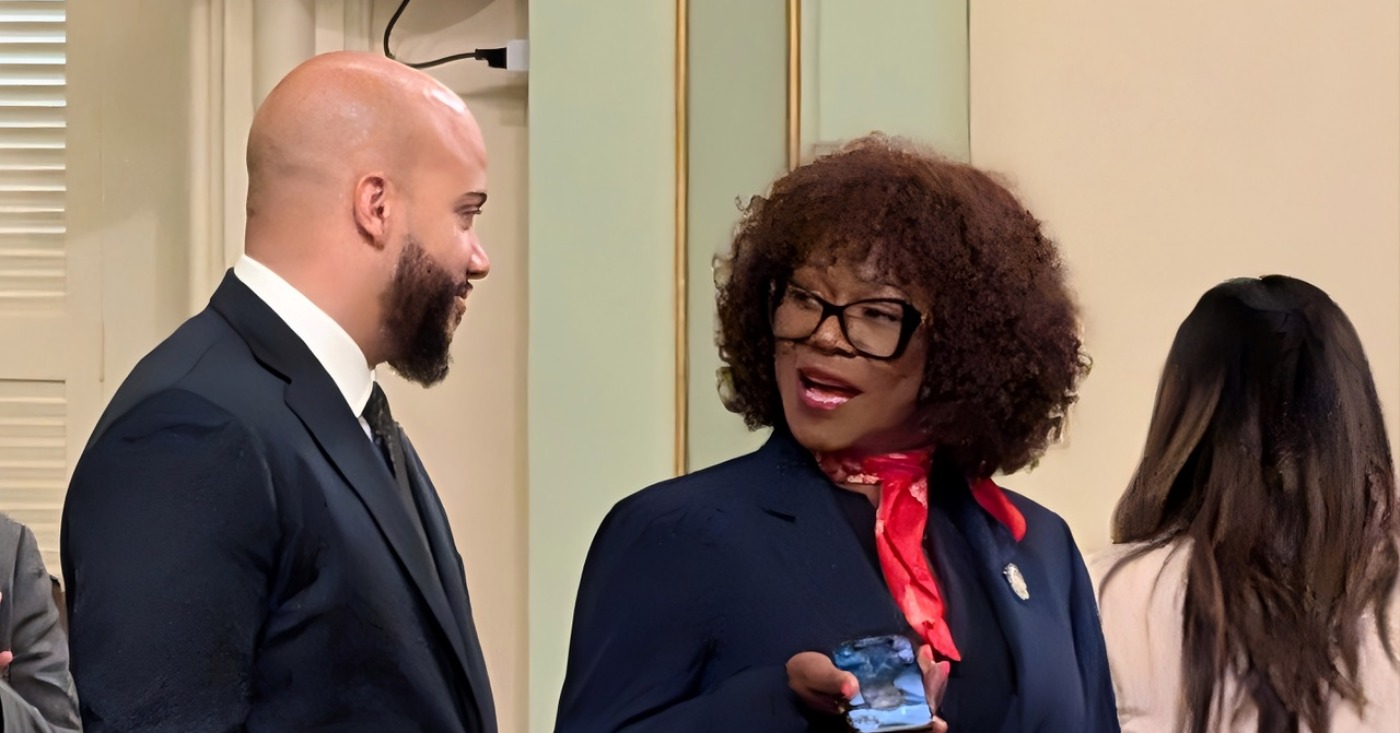
Photo Caption:
Assemblymember Tina McKinnor (D-Inglewood) is advancing legislation that would prohibit unauthorized drones from operating within 400 feet of large outdoor ticketed entertainment events.
Assembly Bill 2113, titled “Aviation: Unmanned Aircraft Systems: Ticketed Entertainment Events,” passed the Senate Public Safety Committee on June 30 by a 6-0 vote and was referred to the Senate Appropriations Committee.
The Assembly approved the bill May 18 on a bipartisan 72-0 vote, with support from 54 Democrats and 18 Republicans. AB 2113 must clear the Senate Appropriations Committee before the Legislature’s Aug. 31 deadline to remain active.
“Large, ticketed entertainment events such as concerts, festivals, and sporting events bring thousands of people into dense confined spaces, including many venues in my (California State Assembly District 61),” McKinnor said. “Unauthorized drones and activities in these settings pose a real risk to public safety and can interfere with event operations and emergency response.”
McKinnor said the legislation would establish a state-level restriction that local authorities could enforce while preserving the federal government’s authority over U.S. airspace.
McKinnor also said, “While the Federal Government regulates airspace, local law enforcement is responsible for protecting public safety on the ground, yet current law does not provide a clear state-level prohibition addressing this issue.
Under the bill, the restriction would apply to outdoor professional music, sporting, or performing arts events held at venues with a capacity of at least 1,000 people.
Each violation would be an infraction punishable by a $500 fine.
McKinnor, who chairs the Assembly Select Committee on the 2028 Olympic and Paralympic Games and the Los Angeles County Legislative Delegation, said the restrictions are particularly important as California prepares to host major international gatherings, including the 2028 Olympic and Paralympic Games.
“AB 2113 protects the intellectual property rights of artists and addresses a growing public safety gap at public events due to the growing use of drones across California,” said McKinnor, a member of the California Legislative Black Caucus (CLBC).
The Association for Uncrewed Vehicle Systems International (AUVSI) has raised concerns about the bill’s potential effects on legitimate commercial drone operations.
Mason Sisk, the group’s director of government affairs, said AB 2113 would address the “disruptive use of drones,” including operations that infringe on artists’ intellectual property. However, the trade association has asked McKinnor’s office to add an exemption for commercial flights providing services such as cargo transportation and infrastructure inspections.
“Our issue with the bill really has to do with the distinction between the ‘loitering and hovering’ and the disruptive use of drones. So, I would ask that the committee not support the bill until we have language figured out,” Sisk told the Senate Committee on Public Safety.
To address concerns raised during the legislative process, McKinnor accepted amendments that narrowed the bill’s scope and exempted certain authorized operations. The prohibition would not apply to venue-approved flights, venue employees conducting official business, regulated utility employees performing official duties, or emergency personnel responding to an incident.
“My office and the sponsor have been engaging with stakeholders throughout this process, and I want to thank everyone for their patience and collaboration,” McKinnor said. “We remain committed to working in good faith as the bill moves forward to address concerns of stakeholders.”
Black History
George Cook: The Inventor Who Made Fishing Smarter
George Cook was a Black American inventor from Louisville, Kentucky. He was born in 1863, during a time when Black Americans faced unfair laws, limited opportunities, and many barriers to education, jobs, and recognition. Even with these challenges, he became known for his intell

George Cook was a Black American inventor from Louisville, Kentucky. He was born in 1863, during a time when Black Americans faced unfair laws, limited opportunities, and many barriers to education, jobs, and recognition. Even with these challenges, he became known for his intelligence, honesty, and ability to think in practical ways. Some records say he worked as a cook for Buffalo Bill Cody and later as a chef on a private dining car for the Louisville and Nashville Railroad. He was even known by the nickname “Honest Mister Cook.”
As with many Black American inventors and scientists of that era, there is little biographical information about Mr. Cook.
Cook’s most famous invention was the Automatic Fishing Device. He received U.S. Patent No. 625,829 for it on May 30, 1899. His patent shows that he was not just someone with an idea, but someone who made it happen.
So, what did the Automatic Fishing Device do? Imagine fishing with a line in the water. Usually, you have to watch carefully and pull the line at just the right moment when a fish bites. Cook wanted to make that process easier. His device was designed to react when a fish pulled on the line. The tension from the fish would trigger a lever. That lever would release a spring-loaded part of the device, causing it to move quickly and help pull in the line. The device also had an alarm gong that would ring to let the fisher know something was happening.
This invention was important because it used simple mechanical ideas in a clever way. Springs, levers, rails, and alarms were not new by themselves, but Cook combined them to solve a real problem. His device showed how inventors often take familiar parts and arrange them in a new way to make life easier.
Cook looked at fishing and asked, “How can this be improved?” Then, he created a device that could respond automatically when a fish tugged on the line. His invention let fishermen relax instead of watching the line for hours, trusting the alarm to alert them.
Cook may not be as famous as some inventors, but his Automatic Fishing Device shows that creativity and innovation can be applied anywhere. His legacy lives on as part of the larger story of Black innovation in America.
WORK FROM HOME
Home-based business with potential monthly income of $10K+ per month. A proven training system and website provided to maximize business effectiveness. Perfect job to earn side and primary income. Contact Lynne for more details: Lynne4npusa@gmail.com 800-334-0540


Car Wash Workers Cope with Lingering Impacts of ICE Raids

Misty Copeland Shapes Ballet’s Tomorrow

As Part of Your Back-to- School Checklist, Vaccinate

As Part of Your Back-to- School Checklist, Vaccinate

Congresswoman Simon Demands Investigation into Trump’s Abuse of Emergency Powers for Coal Export Terminal in West Oakland

OPINION: The Philippines Isn’t Foreign When Your Family Still Lives There

Asm. McKinnor’s Bill Banning Drones Above Outdoor Entertainment Events Awaits Senate Decision

California Sen. Padilla Joins Colleagues to Introduce Bill Imposing Term Limits on Supreme Court Justices

Department of Homeland Security Demands California Secretary of State Shirley N. Weber Scrub Voter Rolls

George Cook: The Inventor Who Made Fishing Smarter

Gov. Newsom Announces $109.6 Million in Funding for 278 Supportive Homes in Bakersfield, Contra Costa, Sacramento and Fresno

Rep. Kamlager Dove Demands Care, Justice for Man Shot by ICE

“The Power to See Threats Sooner”: Gov. Newsom, Safety Officials Showcase California’s Investments in Hi-Tech Wildfire Prevention

100 Black Wings’ Team Oakland Youth Athletes Heading to Taiwan for 2026 International Children’s Games

Oakland ‘Port Serves as a Powerful Engine for Good Jobs and Economic Development
Department of Homeland Security Demands California Secretary of State Shirley N. Weber Scrub Voter Rolls

Oakland Children’s Hospital Workers and Patients Rally for Pediatric Medical Care

New Judge Could Decide if Karmelo Anthony Gets a New Trial
“The Power to See Threats Sooner”: Gov. Newsom, Safety Officials Showcase California’s Investments in Hi-Tech Wildfire Prevention

Alpha Kappa Alpha Sorority, Inc. Celebrates New North Atlantic Regional Director

Surveillance Pricing Fight: State Senate Debates Bill Banning Retailers from Using AI to Set Prices Based on a Buyer’s Profile

Mount Zion MBC, Church of Jesus Christ of Latter-day Saints Partner to Bring 29,000 Meals to Alameda County
California Sen. Padilla Joins Colleagues to Introduce Bill Imposing Term Limits on Supreme Court Justices

Starting This Summer, California Car Buyers Can Get an Instant $3500 Off the Cost of Electric Vehicles

COMMENTARY: You Are Already Paying for the AI Boom

California Bill Would Let Abuse Victims Use Trauma as Legal Defense for Violent Crime

Fed Court to Decide Landmark First Amendment Case

Gov. Gavin Newsom Signs Law Streamlining Affordable Housing Rules

Oakland Celebrates $125 Million Coliseum Sale
Car Wash Workers Cope with Lingering Impacts of ICE Raids

The Conversation With Al McFarlane 6/23/26

Media Monday 6/22/26

LIVE! ASK ALMA! — TUES. 6.23.26 7PM EST

Car Buying Secrets: 4 Hidden Checks Before You Sign!

Is This 550 HP Charger Worth YOUR Money? AutoNetwork Review

Celebrating Juneteenth – Frederick Douglass on education and resistance

LIVE! — ASK ALMA! — TUES. 6.19.26 7PM EST

Hyundai Ioniq 5 Parking, Safety, and 360 View #shorts

2025 Ioniq 5 New Wiper & Powerful Performance! #shorts

Electric SUV Range: Is 259 Miles Enough? #shorts

EV Charging: How Fast Can You Charge an Electric Vehicle? #shorts

Biometric Cooling… Messaging Seats…Come on! 2025 Infiniti QX80 Autograph 4WD

Charged Up: Witness the Magic of a Fully Electric Car! #shorts

Range Rover Sport PHEV Included…: See What’s Inside This Luxury SUV! #shorts

Invisible Hood View: Perfect Parking with X-Ray Vision! #shorts
-
 Featured5 days ago
Department of Homeland Security Demands California Secretary of State Shirley N. Weber Scrub Voter Rolls
-
 Business3 weeks ago
Oakland Children’s Hospital Workers and Patients Rally for Pediatric Medical Care
-
 #NNPA BlackPress2 weeks ago
New Judge Could Decide if Karmelo Anthony Gets a New Trial
-
 Environment5 days ago
“The Power to See Threats Sooner”: Gov. Newsom, Safety Officials Showcase California’s Investments in Hi-Tech Wildfire Prevention
-
 Black History2 weeks ago
Alpha Kappa Alpha Sorority, Inc. Celebrates New North Atlantic Regional Director
-
 Business3 weeks ago
Surveillance Pricing Fight: State Senate Debates Bill Banning Retailers from Using AI to Set Prices Based on a Buyer’s Profile
-
 Business3 weeks ago
Mount Zion MBC, Church of Jesus Christ of Latter-day Saints Partner to Bring 29,000 Meals to Alameda County
-
 Featured5 days ago
California Sen. Padilla Joins Colleagues to Introduce Bill Imposing Term Limits on Supreme Court Justices
