
Energy
Biden Reveals He’ll Deliver Eulogy for Former President Jimmy Carter
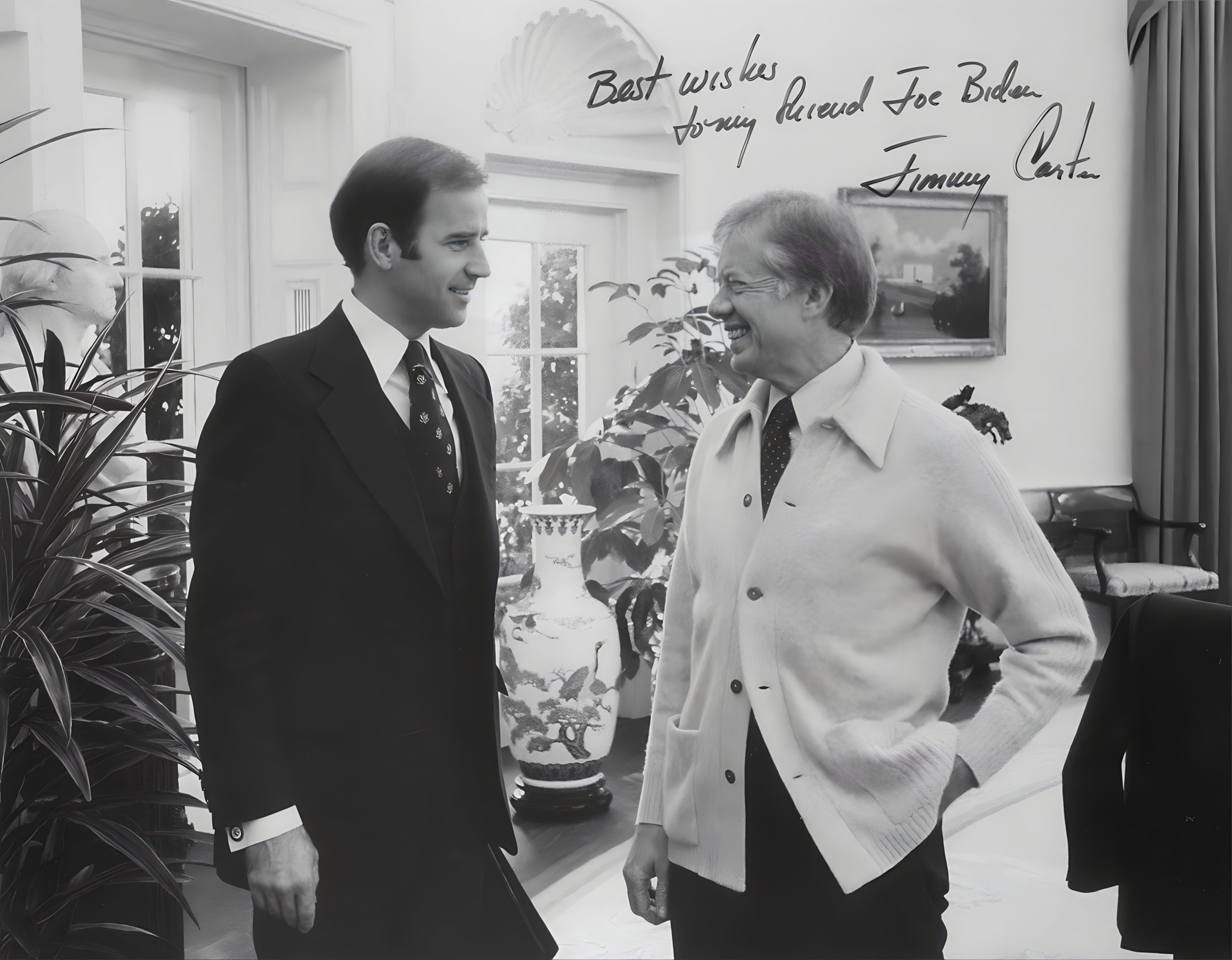
President Jimmy Carter served in the Navy during World War II, and his administration created the U.S. Department of Energy and Education. During his one term, Carter conducted the 1978 Camp David Peace Talks that led to a historic agreement between Israel and its Prime Minister Menachem Begin and Egypt’s President Anwar Sadat. The 98-year-old is the longest-lived President and the one with the longest post-presidency.

By Stacy M. Brown, NNPA Newswire Senior National Correspondent
@StacyBrownMedia
President Jimmy Carter served in the Navy during World War II, and his administration created the U.S. Department of Energy and Education.
During his one term, Carter conducted the 1978 Camp David Peace Talks that led to a historic agreement between Israel and its Prime Minister Menachem Begin and Egypt’s President Anwar Sadat.
The 98-year-old is the longest-lived President and the one with the longest post-presidency.
On Tuesday, March 14, nearly a month after entering hospice care, it’s been revealed that Carter had asked President Joe Biden to deliver his eulogy.
Biden told donors at a fundraiser about his “recent” visit to see the 39th president, whom he has known since he was a young Delaware senator supporting Carter’s 1976 presidential campaign.
“He asked me to do his eulogy,” Biden said before stopping himself from saying more. “Excuse me; I shouldn’t say that.”
Even though the Carter Center in Atlanta and the former President’s family haven’t said much about his health, Biden mentioned that Carter was diagnosed with cancer in 2015 and then got better.
“I spent time with Jimmy Carter, and it’s finally caught up with him, but they found a way to keep him going for a lot longer than they anticipated because they found a breakthrough,” Biden said.

Carter’s family reportedly has confirmed that a state funeral for the former President will occur in Washington after he dies.
“If people had listened to Jimmy Carter, there wouldn’t be an oil crisis right now,” Twitter user @mikesouthbch wrote.
“He ruled America with kindness and compassion. Nothing you ever see from any Republican.”
Despite a tumultuous presidency from 1976 to 1980 that concluded after the Iranian government released the 55 remaining American hostages there as Carter was exiting the White House following his losing his re-election bid in a landslide to Ronald Reagan.
Carter would become one of the most beloved ex-Presidents in American history, certainly more popular than when he traversed the oval office.
The one-time Georgia peanut farmer and his wife, Rosalyn, have spent their lives helping those in need.
For more than 30 years, Habitat for Humanity officials said the Carters had worked alongside nearly 103,000 volunteers in 14 countries to build, renovate and repair 4,331 homes.
“They’ve inspired millions across the globe with their dedication and rallied thousands of volunteers and even celebrities to take part in our mission, helping Habitat for Humanity become internationally recognized for our work to build decent and affordable housing,” the organization wrote on its website.
The Associated Press noted that Biden’s presidency represented a turnabout for Carter’s political standing.
He served just one term and lost in a landslide to Republican Ronald Reagan in 1980, prompting top Democrats to keep their distance, at least publicly, for decades after he left the White House, the outlet reported.
Presidents Bill Clinton and Barack Obama did not have close relationships with Carter. And the longshot presidential candidates who sometimes ventured to see Carter over the years typically did so privately.
“But as the Carters’ global humanitarian work and advocacy of democracy via The Carter Center garnered new respect, Democratic politicians began publicly circulating back to south Georgia ahead of the 2020 election cycle. And with Biden’s election, Carter again found a genuine friend and ally in the Oval Office,” the AP wrote.
“I remember President Carter’s many talks with ordinary people during that trip, and how he tried to reduce the stigma of HIV/AIDS and help people from all walks of life feel that their lives had value,” Dr. Helene Gayle, the President of Spelman College and a board member of the Bill & Melinda Gates Foundation, wrote in a statement posted to the Gates Foundation website.
“We spoke with commercial sex workers in Kenya and Nigeria about HIV/AIDS prevention and condom use. While President Carter came from a very traditional, religious Christian background, he was entirely nonjudgmental and really wanted to communicate to these women that their lives were worth protecting from HIV/AIDS,” Gayle continued.
“He even gave a sermon at the church of the then-president of Nigeria, and from the pulpit, he talked openly and honestly about condoms and safe sex without judgment or recrimination.”
Gayle added that from world leaders to migrant farmers, Carter’s ability to connect with people remains remarkable.
She called him down-to-earth and approachable.
“And because of his global stature as a former president, he can meet with people at the highest levels of government, capture their attention, and make the case for investing in local, regional, and global health,” Gayle exclaimed.
“He has elevated the significance of global health around the world. And he has been incredibly persistent and diligent around the issue of Guinea worm eradication, helping to lead that campaign to the threshold of success.”












Business
Starting This Summer, California Car Buyers Can Get an Instant $3500 Off the Cost of Electric Vehicles
OAKLAND POST — Beginning later this summer, eligible Californians can receive a $3,500 rebate on new zero-emission vehicles with a manufacturer’s suggested retail price of up to $50,000. Buyers purchasing qualifying used electric vehicles priced at up to $25,000 can receive a $1,750 rebate. The rebate will be applied directly at participating dealerships, allowing buyers to receive the discount immediately instead of waiting for reimbursement.


California residents purchasing their first zero-emission vehicle will soon be eligible for an instant rebate of up to $3,500 under a new state program aimed at making electric vehicles more affordable.
Gov. Gavin Newsom signed Senate Bill (SB) 168 on July 16, creating the MyFirstEV program as part of California’s 2026-27 state budget. The initiative dedicates $135.5 million in state funding for point-of-sale rebates, which participating automakers will match dollar for dollar. State officials said the combined investment will provide $270 million in savings for first-time electric vehicle buyers.
Beginning later this summer, eligible Californians can receive a $3,500 rebate on new zero-emission vehicles with a manufacturer’s suggested retail price of up to $50,000. Buyers purchasing qualifying used electric vehicles priced at up to $25,000 can receive a $1,750 rebate. The rebate will be applied directly at participating dealerships, allowing buyers to receive the discount immediately instead of waiting for reimbursement.
“With our new instant rebate program for electric vehicles, we’re making it easier for families to drive clean, breathe clean, and keep more money in their pockets,” Newsom said in a statement.
The MyFirstEV program is part of a broader $600 million investment in California’s clean transportation economy included in the state budget. The funding package also provides $150 million for the Community Air Protection Program, $19.8 million for the Clean Cars 4 All program for lower-income residents, $35 million for clean off-road equipment through the Air Quality Improvement Program, $135.5 million for the Clean Truck and Bus Voucher Incentive Project, and $130 million for the Carl Moyer Program to replace older heavy-duty engines with cleaner alternatives.
According to the governor’s office, the transportation investments are funded through Cap-and-Invest revenue and smog-abatement fees while maintaining a balanced state budget.
California continues to expand its zero-emission transportation network. The state surpassed 2.5 million cumulative zero-emission vehicle sales earlier this year, exceeding its original goal of 1.5 million sales by 2025. Officials also reported that California has more than 200,000 public and shared electric vehicle charging plugs statewide, in addition to an estimated 800,000 home charging stations.

Activism
More and More, Black Californians Are Worried About Rising Costs of Housing, Energy, Food and Gas
According to an April 2024 report by the Greenlining Institute, low-income Black Californians are struggling with affordability due to a combination of historical systemic barriers and modern economic pressures. The Greenlining Institute is a California-based policy, research, and advocacy nonprofit founded in 1993 to fight systemic racism and economic injustice.

By Antonio Ray Harvey, California Black Media
Housing, energy, food and gas are four essential household expenses, and their rising costs are forcing residents—especially lower-income households—to make difficult trade-offs, Assemblymember Rhodesia Ransom (D-Stockton) said at a conference on affordability last week in Sacramento.
Ransom, a member of the California Legislative Black Caucus (CLBC), noted a shift in consumer behavior, stating, “Before people used to choose between things that they wanted and things that they needed.”
“Now, what we’re hearing from constituents is they are prioritizing their needs differently,” she said. “Because of the affordability crisis, it’s no longer about choosing between other needs. Our constituents are now saying ‘what needs to be prioritized?’ Gas and food are at the top of the list.”
Ransom made the comments about affordability at Capitol Weekly’s informational conference titled “Affordability: The Cost of Living in California,” which was held on April 30 at the University of California’s Student and Policy Center.
Co-hosted with the University of California Student and Policy Center, the political conversations focused on identifying policy solutions to the state’s extremely high prices for energy, food, and essentials.
The keynote speakers at the conference were former Assemblymember Lorena Gonzalez, president of the California Federation of Labor Unions, and Mike Madrid, a political strategist, author, and senior fellow at UC Irvine.

Conversations about affordability are taking on greater urgency as the election season kicks in, speakers said.
According to an April 2024 report by the Greenlining Institute, low-income Black Californians are struggling with affordability due to a combination of historical systemic barriers and modern economic pressures. The Greenlining Institute is a California-based policy, research, and advocacy nonprofit founded in 1993 to fight systemic racism and economic injustice.
Black households in California experience the highest levels of rent burden; approximately 65% of Black renters, according to the Greenlining report. Historical “redlining” and ongoing discrimination have restricted homeownership. Black families also pay 43% more for energy than White households, partly because they are more likely to live in older, less energy-efficient rentals.
In addition, roughly 1 in 3 Black adults (36.5%) reported household food insecurity in late 2025, more than double the rate for White adults. This is often exacerbated by “food deserts” in predominantly Black neighborhoods.
In March, Assembly Minority Leader Heath Flora (R-Ripon) expressed concerns about affordability in California, describing it as a crisis where families are being “pushed to the edge.”
“Californians should not have to choose between putting food on the table or filling up their car,” Flora stated. “We need to cut costs now. Not tomorrow, not next week, not next month. Now.”
Cuts to the federal Supplemental Nutrition Assistance Program (SNAP) funding are being driven by the Trump Administration’s One Big Beautiful Bill Act (H.R. 1), which is reducing federal spending by approximately $187 billion through 2034.
Those reductions are putting more pressure on the state to help, Ransom said. According to the AAA Gas Prices website, as of May 8, California’s gasoline prices averaged over $6 per gallon in some areas, with various locations experiencing spikes of $7 to $8 per gallon. In California, fuel prices are driven by refinery maintenance and market volatility, while high food prices are linked to rising transportation costs, experts say.
Arts and Culture
Against All Odds: Mary Jackson’s Journey to NASA Engineer
Jackson’s life took a significant turn when she was offered the opportunity to work in a wind tunnel, a facility used to test the effects of air moving over aircraft structures. It was here that her passion for engineering truly took flight. However, there was a challenge: to become an engineer, she needed to take advanced courses that were only offered at a segregated high school.

By Tamara Shiloh
When we talk about breaking barriers in science, technology, engineering, and mathematics, the name Mary Jackson deserves a place at the top of the list.
Jackson was born in 1921 in Hampton, Virginia, a place that would later become central to her groundbreaking work. From an early age, she showed a strong aptitude for math and science—subjects that, at the time, were not widely encouraged for African American women. But Jackson was not one to be limited by expectations. She earned degrees in mathematics and physical science from Hampton Institute (now Hampton University), setting the foundation for a career that would change history.
Before joining NASA, Jackson worked as a teacher and later as a research mathematician at the National Advisory Committee for Aeronautics (NACA), the agency that eventually became NASA. Like many African American women of her time, she began her career as a “human computer,” performing complex calculations by hand. It was in this environment that she worked alongside brilliant minds like Katherine Johnson, forming part of a powerful group of African American women whose calculations helped launch America into space.
Jackson’s life took a significant turn when she was offered the opportunity to work in a wind tunnel, a facility used to test the effects of air moving over aircraft structures. It was here that her passion for engineering truly took flight. However, there was a challenge: to become an engineer, she needed to take advanced courses that were only offered at a segregated high school.

Jackson did something truly remarkable. She petitioned the city of Hampton for permission to attend those classes. She didn’t accept “no” as an answer. And she won.
In 1958, Jackson became NASA’s first African American female engineer.
But Jackson’s impact didn’t stop there.
Later in her career, she chose to step away from her engineering position—not because she couldn’t continue, but because she wanted to make a difference. She moved into roles focused on equal opportunity, working to ensure that women and minorities had access to the same opportunities she fought so hard to get.
Jackson’s story gained wider recognition through the book and film Hidden Figures, which highlighted the contributions of African American women at NASA. But long before the spotlight found her, Jackson was doing the work—quietly, persistently, and brilliantly.
Jackson retired from Langley in 1985. Among her many honors were an Apollo Group Achievement Award and being named Langley’s Volunteer of the Year in 1976. She served as the chair of one of the center’s annual United Way campaigns and a member of the National Technical Association (the oldest African American technical organization in the United States).
She and her husband Levi had an open-door policy for young Langley recruits trying to gain their footing in a new town and a new career. A 1976 Langley Researcher profile might have done the best job capturing Mary’s spirit and character, calling her a “gentlelady, wife and mother, humanitarian and scientist.”
For Jackson, science and service went hand in hand.
She died on Feb. 11, 2005, at age 83, at a convalescent home in Hampton, Virginia.

WORK FROM HOME
Home-based business with potential monthly income of $10K+ per month. A proven training system and website provided to maximize business effectiveness. Perfect job to earn side and primary income. Contact Lynne for more details: Lynne4npusa@gmail.com 800-334-0540


Four Candidates, Including Incumbent Barbara Lee, Qualify for Oakland Mayor’s Race

Oakland Observes Black August with Block Parties, Film Showings, Workshops

Oakland Post: Week of August 12 – 18, 2026

COMMENTARY: Why Local School Tax Measure G1 Will Not Be on the November Ballot

California Hispanic Chambers of Commerce Unveils: ‘Powering the Future’ Theme for 47th Annual Statewide Convention

Returning to Its Roots, the Oakland Black-Eyed Pea Festival Partners with the Freedom Farmers Market Sept. 12

Less Affluent School Districts, Including Sacramento City, Face Threat of State Takeover

From Blueprint to Breakthrough: Tackling Affordable Housing in Oakland

NPRC Scores First Advocacy Victory: David Shaw Finally Gets His Wish to ‘Go Home’

ESSAY: California Can Close Its Colorectal Cancer Gap

Car Wash Workers Cope with Lingering Impacts of ICE Raids

Misty Copeland Shapes Ballet’s Tomorrow

As Part of Your Back-to- School Checklist, Vaccinate

As Part of Your Back-to- School Checklist, Vaccinate

Congresswoman Simon Demands Investigation into Trump’s Abuse of Emergency Powers for Coal Export Terminal in West Oakland

Department of Homeland Security Demands California Secretary of State Shirley N. Weber Scrub Voter Rolls

Oakland Children’s Hospital Workers and Patients Rally for Pediatric Medical Care

New Judge Could Decide if Karmelo Anthony Gets a New Trial

“The Power to See Threats Sooner”: Gov. Newsom, Safety Officials Showcase California’s Investments in Hi-Tech Wildfire Prevention

Alpha Kappa Alpha Sorority, Inc. Celebrates New North Atlantic Regional Director

Surveillance Pricing Fight: State Senate Debates Bill Banning Retailers from Using AI to Set Prices Based on a Buyer’s Profile

Mount Zion MBC, Church of Jesus Christ of Latter-day Saints Partner to Bring 29,000 Meals to Alameda County

California Sen. Padilla Joins Colleagues to Introduce Bill Imposing Term Limits on Supreme Court Justices

Starting This Summer, California Car Buyers Can Get an Instant $3500 Off the Cost of Electric Vehicles
Less Affluent School Districts, Including Sacramento City, Face Threat of State Takeover

COMMENTARY: You Are Already Paying for the AI Boom

California Bill Would Let Abuse Victims Use Trauma as Legal Defense for Violent Crime
Car Wash Workers Cope with Lingering Impacts of ICE Raids

Fed Court to Decide Landmark First Amendment Case

Gov. Gavin Newsom Signs Law Streamlining Affordable Housing Rules

The Conversation With Al McFarlane 6/23/26

Media Monday 6/22/26

LIVE! ASK ALMA! — TUES. 6.23.26 7PM EST

Car Buying Secrets: 4 Hidden Checks Before You Sign!

Is This 550 HP Charger Worth YOUR Money? AutoNetwork Review

Celebrating Juneteenth – Frederick Douglass on education and resistance

LIVE! — ASK ALMA! — TUES. 6.19.26 7PM EST

Hyundai Ioniq 5 Parking, Safety, and 360 View #shorts

2025 Ioniq 5 New Wiper & Powerful Performance! #shorts

Electric SUV Range: Is 259 Miles Enough? #shorts

EV Charging: How Fast Can You Charge an Electric Vehicle? #shorts

Biometric Cooling… Messaging Seats…Come on! 2025 Infiniti QX80 Autograph 4WD

Charged Up: Witness the Magic of a Fully Electric Car! #shorts

Range Rover Sport PHEV Included…: See What’s Inside This Luxury SUV! #shorts

Invisible Hood View: Perfect Parking with X-Ray Vision! #shorts
-
 Featured1 week ago
Department of Homeland Security Demands California Secretary of State Shirley N. Weber Scrub Voter Rolls
-
 Business3 weeks ago
Oakland Children’s Hospital Workers and Patients Rally for Pediatric Medical Care
-
 #NNPA BlackPress2 weeks ago
New Judge Could Decide if Karmelo Anthony Gets a New Trial
-
 Environment1 week ago
“The Power to See Threats Sooner”: Gov. Newsom, Safety Officials Showcase California’s Investments in Hi-Tech Wildfire Prevention
-
 Black History2 weeks ago
Alpha Kappa Alpha Sorority, Inc. Celebrates New North Atlantic Regional Director
-
 Business3 weeks ago
Surveillance Pricing Fight: State Senate Debates Bill Banning Retailers from Using AI to Set Prices Based on a Buyer’s Profile
-
 Business3 weeks ago
Mount Zion MBC, Church of Jesus Christ of Latter-day Saints Partner to Bring 29,000 Meals to Alameda County
-
 Featured1 week ago
California Sen. Padilla Joins Colleagues to Introduce Bill Imposing Term Limits on Supreme Court Justices
