
Bay Area
Bernard James Tyson – Healthcare Hero and Humanitarian

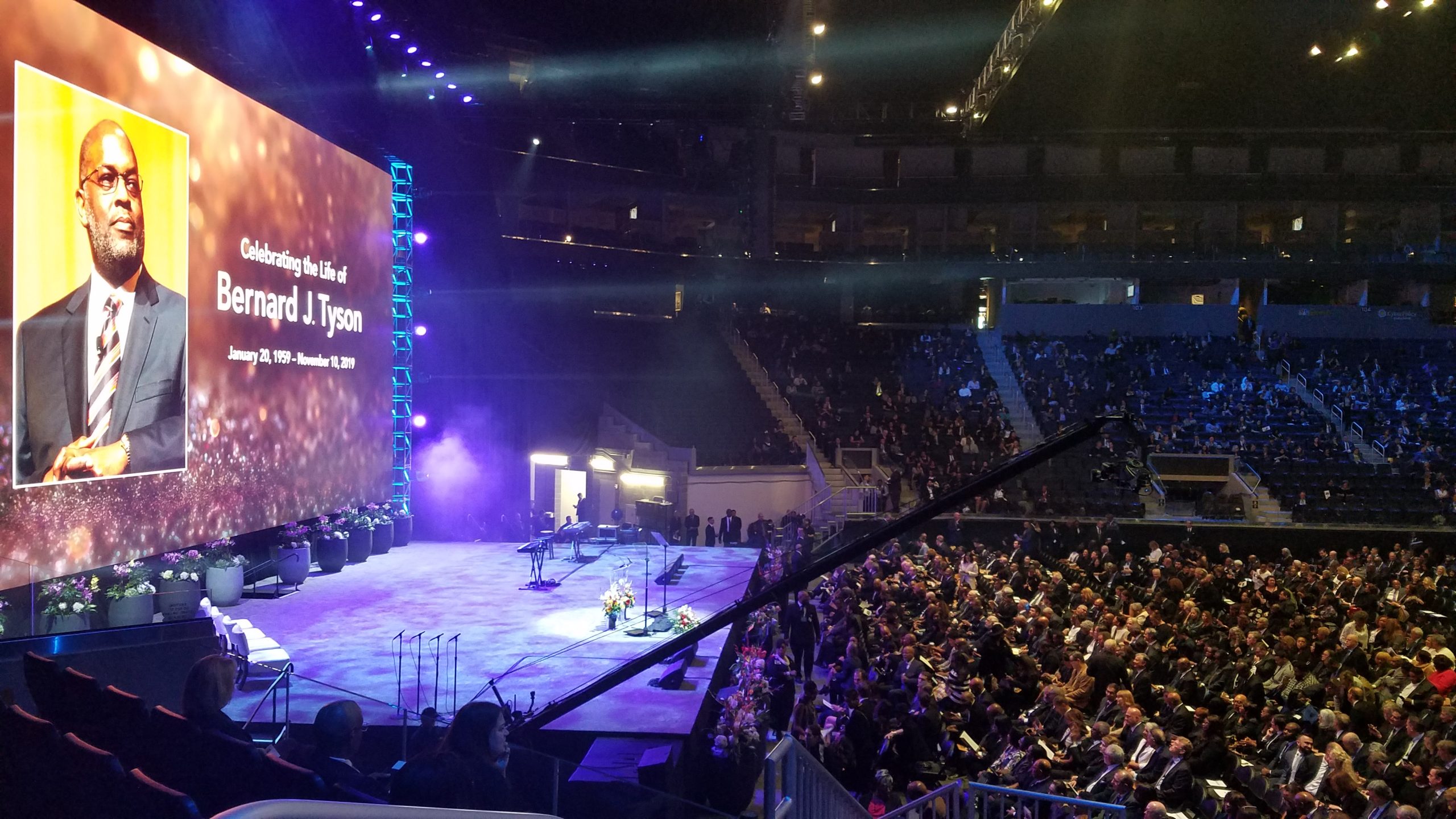
On Monday, Nov. 18, the celebration of a life well-lived was hosted at the Chase Center in San Francisco for the final goodbye to the beloved CEO and Board Chair of Kaiser Permanente, Bernard James Tyson. Tyson, who rose through the ranks of Kaiser for over three decades was named CEO in 2013 and Chairman of the Board in 2014. Rays of sun and clear blue skies set the tone for thousands who gathered at the brand new Chase Center in San Francisco to pay their final respects to Tyson’s family and reflect on a man who built a life on serving others with his lifelong medical mission of proving high-quality medical care to anyone who required it.
The San Francisco Symphony quartet performed along with Glad Tidings International Church of God in Christ choir members. The welcome and opening prayer were presented by Bishop J.W. Macklin, Senior Pastor of Glad Tidings International Church of God in Christ in Hayward. Videos and photos of Tyson’s life were also featured. Remarks were given by San Francisco Mayor London Breed, Kenneth I. Chenault Chairman, and Managing Director at General Catalyst also The Honorable Willie Brown Jr., Former Mayor of San Francisco and former Speaker of the California State Assembly also spoke. Entertainment icon Gladys Knight sang “The Best Thing That Ever Happened to Me” as well as “Memories” and “Midnight Train to Georgia.”
Holly Humphries, President, CEO the Josiah Macy Foundation and Mark A. Schuster, MD, PhD, the founding dean and CEO of the Kaiser Permanente School of Medicine announced that on July 26, 2020, the Kaiser Permanente Bernard James Tyson School of Medicine will open in Pasadena, CA, furthering his legacy. Humphries and Schuster serve on the school’s board of directors. “Bernard Tyson was a man of many dreams and his legacy will now live through thousands of students bearing the imprint of a medical school that will transform healthcare around the world,” said Humphries.
Other remarks were provided by Frances J. Crosson, MD, Former Executive Director of the Permanente Federation and Cynthia A. Telus, PhD, Kaiser Foundation Health Plan and Hospitals Boards of Directors. Delane Sims represented the family of Andrew Hatch. Sims shared a video of Tyson visiting her ailing father at his bedside and what it meant to have a man of Tyson’s great stature in the community take time out to visit and truly care.
Gregory A. Adams, Interim Executive Chief Executive Officer of Kaiser Foundation Health Plan and Hospitals also spoke. “Bernard was a person who imbedded the best in humanity. He drove a $200 million impact investment to address homelessness and affordable housing. He felt no one should have to go to bed on the streets in America.” Adams also shared that out of his own pocket, Tyson paid for several patients and two Kaiser managers to attend the 2019 CancerCon (Cancer Conference). “Because of Bernard, CancerCon will be in Oakland next year.”
John O. Utendahl, Executive Vice Chairman, Global Corporate Investment Banking for Bank of America, Lloyd H. Dean, CEO CommonSpirit Health, Nancy Brown, CEO American Heart Association, and Robert F. Smith, Founder, Chairman and CEO of Vista Equity Partners, and Alva Wheatley, Retired Kaiser Permanente Executive also spoke during the service. “He impressed and moved everyone around him and showed us to not only fight for what you believe in but own it,” said Utendahl.
“Bernard wanted to nurture the health and happiness of all patients,” said Brown.
Bernard believed in the concept of Ubuntu – “I am because we are,” said Smith. “Bernard manifested this in everything that he touched: healthcare programming in Crenshaw, homelessness in Oakland and taking on the stigma of mental health problems. America periodically invites few African Americans into its bounty, and without fail we produce (Bernard J. Tyson) a shining example of what we can be as a nation when all of its Black citizens — all citizens have a full seat at the education, civil rights, and economic inclusion table. Using his voice and his platform he pushed for MLK’s manifesto for America.”
Dean remembered Tyson for his wit, humor, and competitiveness. Dean recanted the times Bernard would call him from the White House among top healthcare professionals and question why Dean wasn’t included. Dean also joked about Tyson’s sticker shock at a shopping spree with Willie Brown at Wilkes Bashford. “He would call and say, ‘Man that Willie, got me today – the cashier rang up $10,000, I thought she meant all three suits, not $10,000 each.” Retired Kaiser Permanente Executive Director of Diversity, Alva Wiley, a mentor of Tyson said, “Bernard exceeded my expectations in every way.”
Tyson’s wife, Denise Bradley Tyson took the stage with her three sons; Bernard, Jr., Alexander, and Charles and thanked guests for the great outpouring of support. “My husband’s legacy will live on. We will continue what he began.”
The closing prayer was provided by Bishop Charles E. Blake, Sr. Presiding Bishop, West Angeles Church of God in Christ of Los Angeles. “Bernard was a brilliant man, said Blake. “Kaiser is a better company and the world is a better place because Bernard came through.” The audience fittingly sang “Lean On Me,” prior to departing.
Tyson died in his sleep on Sunday, Nov. 10, just 24 hours after addressing several thousand Black tech professionals at Afrotech (technology conference) at the Oakland Marriott Convention Center.Born in Vallejo California Tyson attended Vallejo High School, graduated from Golden Gate University where he received a Master of Business Administration in health services administration and held a leadership certificate from Harvard University. Tyson served on the boards of the American Heart Association and Salesforce.










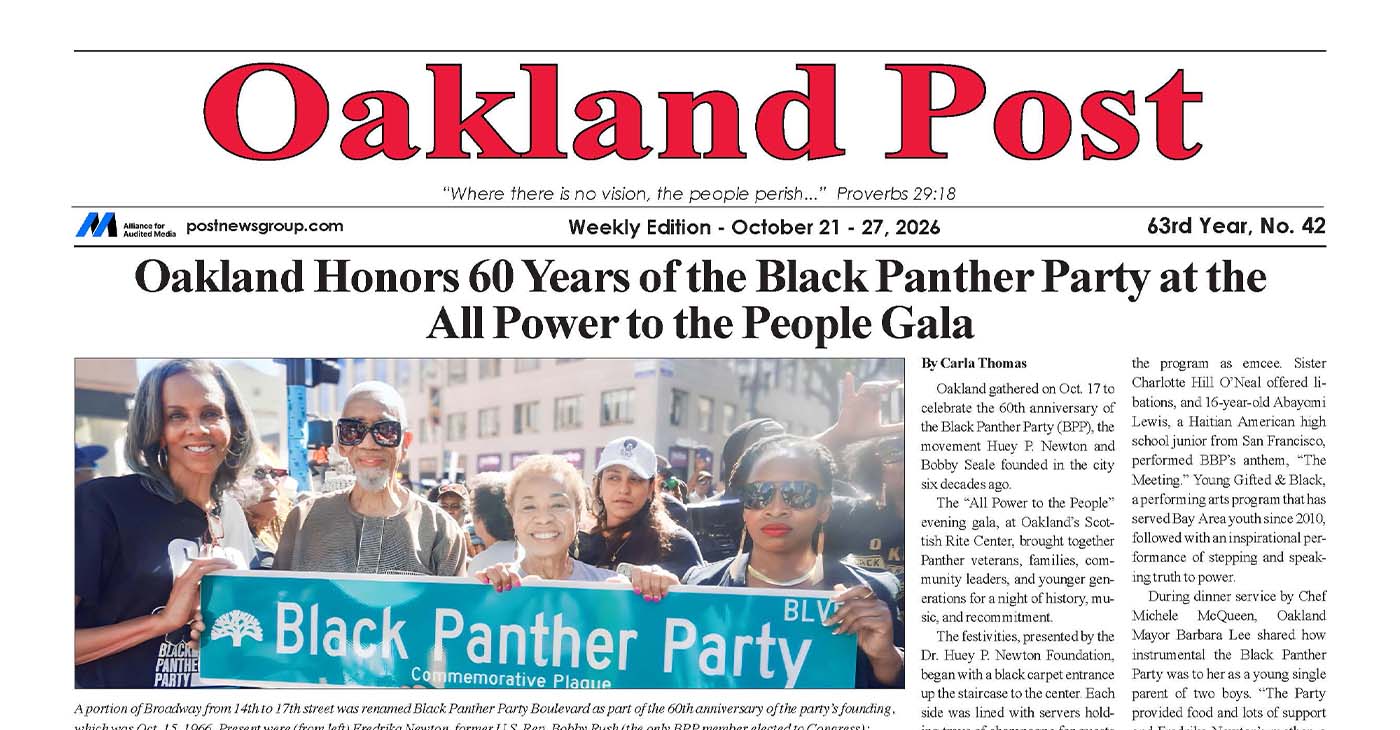
To enlarge your view of this issue, use the slider, magnifying glass icon or full page icon in the lower right corner of the browser window.

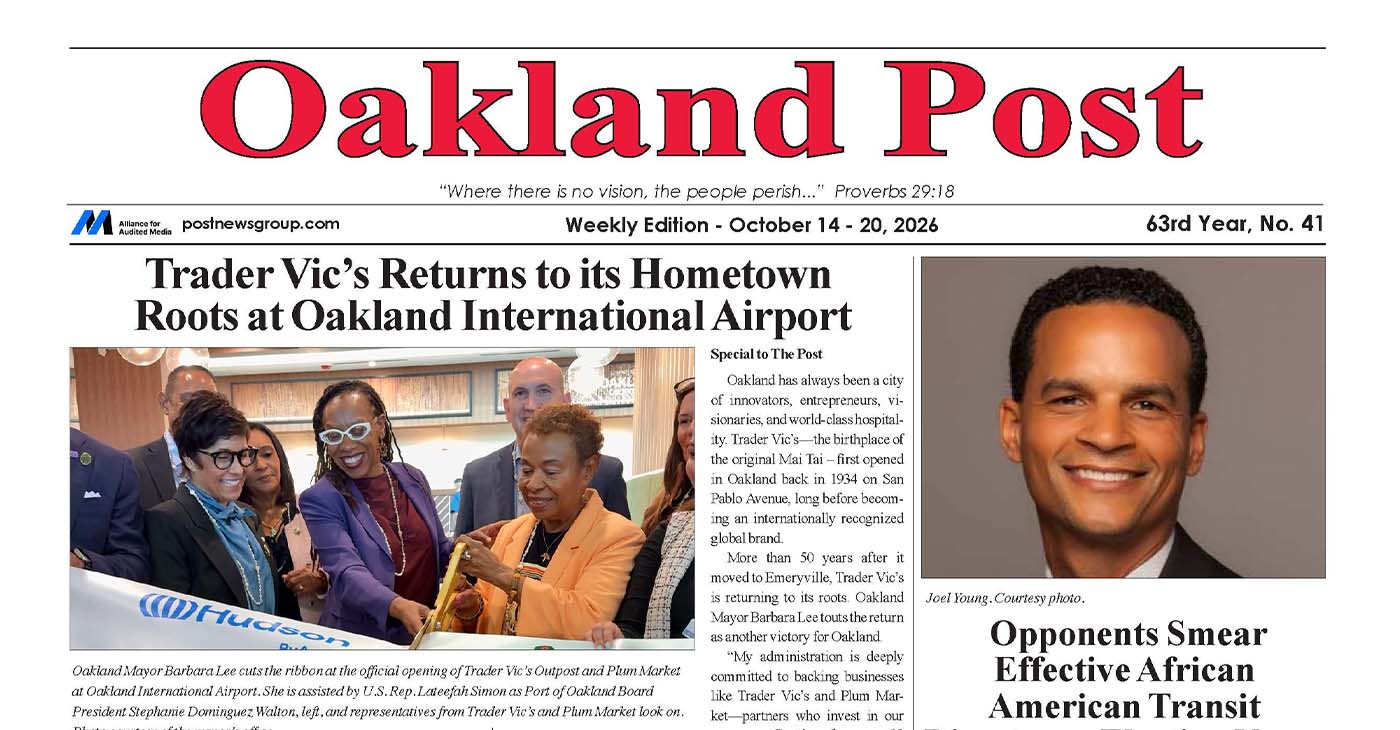
To enlarge your view of this issue, use the slider, magnifying glass icon or full page icon in the lower right corner of the browser window.

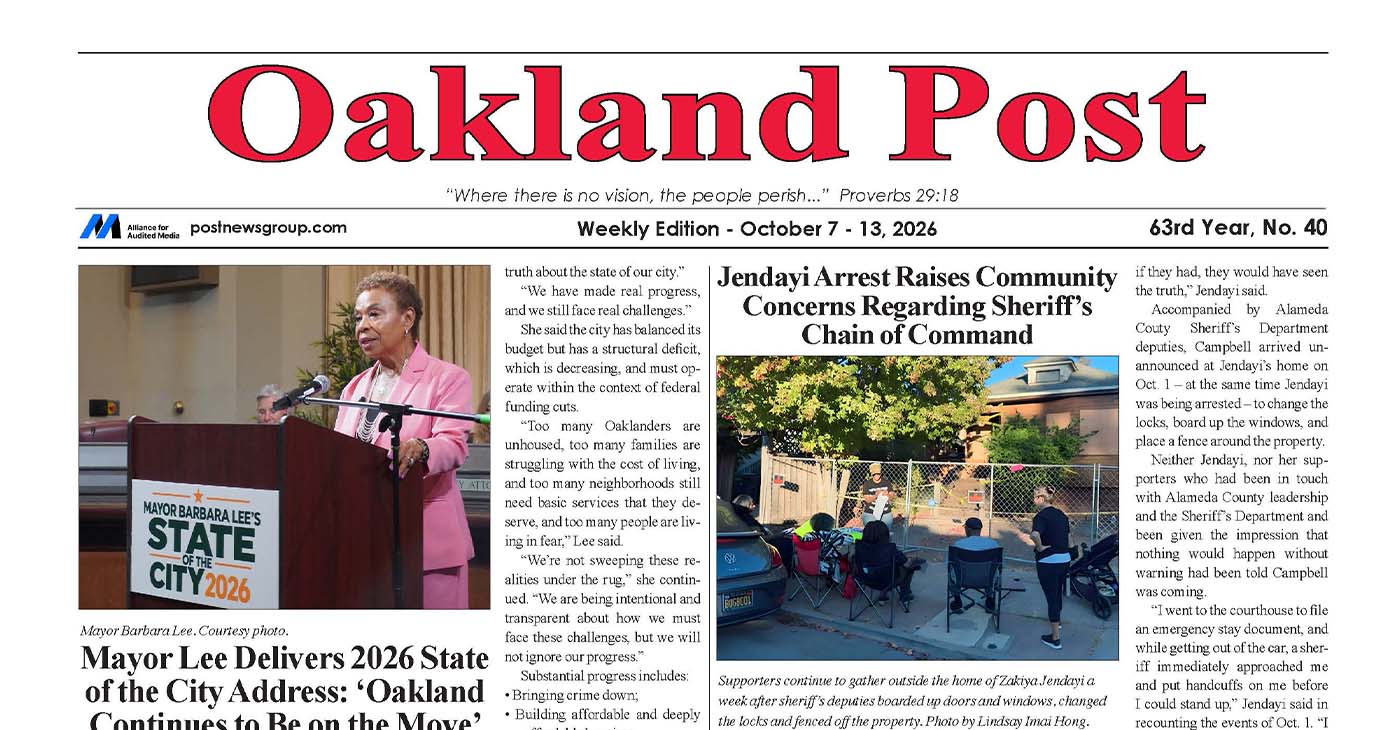
To enlarge your view of this issue, use the slider, magnifying glass icon or full page icon in the lower right corner of the browser window.


Oakland Probate Dispute Raises Questions About Court-Ordered Property Transfer and Missing Notice

‘Raising a Child Shouldn’t Break the Bank’: California Is Helping Families Save on Childcare Costs

Secretary of State Shirley Weber Pushes Back Against DOJ Demands Over California Voter Rolls

Chase Launches Fraud & Scam Prevention Month

U.S. Rep. Simon Secures More Than $1 Million for Public Safety at Mills College at Northeastern University Oakland, Surrounding Neighborhood

COMMENTARY: Valarie Bachelor and Jennfier Brouhard are Excellent School Board Members and Deserve to Be Reelected

Oakland Faith Leaders Gather to Revitalize the Interdenominational Ministerial Alliance of Oakland

Statue of ‘La Catrina,’ a Beloved Symbol of Dia de Los Muertos, Visits Oakland

Oakland Honors 60 Years of the Black Panther Party at the All Power to the People Gala

Fate of Bay Area Public Transit Hinges on Regional Transit Measure

Why AC Transit Director Joel Young is My Choice for AC Transit Board Ward 3

Oakland Post: Week of October 21 – 27, 2026

Mayor Barbara Lee Holds Special State of the City Address in Deep East Oakland

Practitioners of African Traditional Spirituality Offer Ancestral Reverence Ritual Oct. 31

It’s Time to Lose Weight Before the Holidays

Misnamed ‘Parent’ PAC Seeks to Influence Oakland School Board Elections

Listening as a Lifeline: A Doula’s Witness to Black Maternal Health

Poll: Becerra Widens His Lead Over Hilton; Californians Split on Wealth Tax

County Office of Education Says OUSD Finances Are Getting Healthier, Materially Stronger

Doulas Are Helping Black California Moms Navigate Pregnancy–Even as High Mortality Rates Persist

Oakland Post: Week of September 9 – 15, 2026

Zakiya Jendayi Arrested, Locked Out of Home by Sheriff’s Deputies

Mayor Lee Announces $1 Million Kaiser Permanente Grant for Pilot Program to Address Homelessness, Clean Up Public Spaces throughout Oakland

Richmond Tiny House Village Farm & Garden Set to Open Gates on Sept. 26

BLACspace Cooperative Invites Bay Area to Experience Oakland’s Black Cultural Ecosystem Through a BLAC Map Tour + Party

OPINION: Nolan Wells’ Death One of Several Signifying Racial Terror Lives on in U.S. South

Latest Massacre in Haiti Reveals Cruelty U.S. Deportations

Oakland People’s Arms Embargo Coalition Demands End to Military Shipments Thru Oakland

Oakland Post: Week of September 16 – 22, 2026

Democratic Clubs Interview Candidates for Oakland School Board

The Conversation With Al McFarlane 6/23/26

Media Monday 6/22/26

LIVE! ASK ALMA! — TUES. 6.23.26 7PM EST

Car Buying Secrets: 4 Hidden Checks Before You Sign!

Is This 550 HP Charger Worth YOUR Money? AutoNetwork Review

Celebrating Juneteenth – Frederick Douglass on education and resistance

LIVE! — ASK ALMA! — TUES. 6.19.26 7PM EST

Hyundai Ioniq 5 Parking, Safety, and 360 View #shorts

2025 Ioniq 5 New Wiper & Powerful Performance! #shorts

Electric SUV Range: Is 259 Miles Enough? #shorts

EV Charging: How Fast Can You Charge an Electric Vehicle? #shorts

Biometric Cooling… Messaging Seats…Come on! 2025 Infiniti QX80 Autograph 4WD

Charged Up: Witness the Magic of a Fully Electric Car! #shorts

Range Rover Sport PHEV Included…: See What’s Inside This Luxury SUV! #shorts

Invisible Hood View: Perfect Parking with X-Ray Vision! #shorts
-
 Black History3 weeks ago
Listening as a Lifeline: A Doula’s Witness to Black Maternal Health
-
 Economy4 weeks ago
Poll: Becerra Widens His Lead Over Hilton; Californians Split on Wealth Tax
-
 Business4 weeks ago
County Office of Education Says OUSD Finances Are Getting Healthier, Materially Stronger
-
 Lead Story3 weeks ago
Zakiya Jendayi Arrested, Locked Out of Home by Sheriff’s Deputies
-
 Art4 weeks ago
BLACspace Cooperative Invites Bay Area to Experience Oakland’s Black Cultural Ecosystem Through a BLAC Map Tour + Party
-
 Business4 weeks ago
From Historic Memories to New Possibilities: Oakland Celebrates Coliseum 60
-
 Community4 weeks ago
Asm. Corey Jackson Announces Launch of 24-Hour Childcare in His District
-
 Black History4 weeks ago
IN MEMORIAM: The Rev. Leon “Sonny” Clark, Longtime Orange County Pastor and Community Leader, Dies at 72
