
National
Angry Activists in Cleveland: Justice for Blacks in America Will Never Happen


Michael Brelo listens to the judge read his verdict May 23, in Cleveland. Brelo, a patrolman charged in the shooting deaths of two unarmed suspects during a 137-shot barrage of gunfire was acquitted in a case that helped prompt the U.S. Department of Justice determine the city police department had a history of using excessive force and violating civil rights.
By Richard B. Muhammad and Charlene Muhammad
Special to the NNPA from The Final Call
(FinalCall.com) – Protests were largely peaceful, calls for calm were plentiful and pleas for the city of Cleveland to be a model for dealing with deadly Black-police encounters and tense police-community relations were prominent.
But besides those voices was also a seething anger, outrage not quenched by promises of reform as some felt the time to give America’s systems a chance is over.
The United States will never give justice to Black people and, the activists bitterly added, this is not a country where Blacks can live with Whites in peace.Judge John P. O’Donnell’s acquittal of Officer Michael Brelo on involuntary manslaughter and felonious assault charges in the deaths of Timothy Russell and Malissa Williams in November 2012, was the final straw, these activists said.
Their voices may not reflect a majority of opinions but do reflect a strong sentiment and growing disgust as Blacks lose their lives to police officers and nothing is done about it.
Officer Brelo stood on the hood of the car driven by Mr. Russell and fired 15 shots into the windshield. His shots punctuated a 137-shot police barrage into the car carrying the two Black, unarmed suspects. There were so many deadly shots, the judge ruled that it was impossible to say Officer Brelo’s shots took the lives of the victims. Thirteen officers fired into the car.
“The blood of these brothers and sisters are crying out and we are seeing how people are wasting their blood and they’re acting like we have no value. I believe in my heart we are at a point of civil war and revolution and the young generation that’s coming up is going to take the reins on that,” said Mariah Crenshaw, a Cleveland activist.
Cleveland also awaits the outcome of investigations into the fatal police shooting of 12-year-old Tamir Rice, gunned down in seconds by an officer who pulled into the park where the Black boy was playing with a toy gun.
“My fear is that Cleveland, Cuyahoga County, just told us Tamir Rice will not receive justice either,” Ms. Crenshaw said.
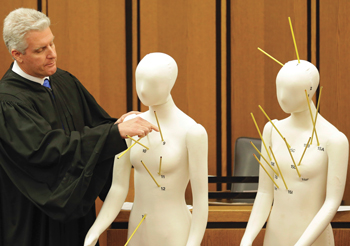
County Common Pleas Court Judge John O’Donnell points to mannequins marked with the gunshot wounds that the two motorists suffered; May 23 in Cleveland. Michael Brelo, a patrolman charged in the shooting deaths of two unarmed suspects during a 137-shot barrage of gunfire was acquitted in a case that helped prompt the U.S. Department of Justice determine the city police department had a history of using excessive force and violating civil rights.
|
John Boyd, another Cleveland activist, feels all of the cops involved in the 137-bullet barrage should have been indicted for murder. The couple had committed no crime. Their car backfired and cops thought shots had been fired, officials said. The officers were dead wrong. A high speed chase followed and the bullet-riddled bodies and car were the result. Officer Brelo fired his automatic weapon 49 times and at least the last 15 shots came after he reloaded and climbed onto the hood of the car. Other officers had already ceased firing.
Better training, so-called reforms and body cameras won’t solve police killings of Blacks despite what pundits, politicians and hopeful others say, declared the activists. They blame institutional racism and weak Black leadership in the city.
Rep. Marcia L. Fudge, who represents Cleveland and is an established leader, seemed fed up herself. “The decision of Judge John P. O’Donnell to acquit Officer Michael Brelo is a stunning setback on the road to justice for Timothy Russell, Malissa Williams and the people of Cleveland. The verdict is another chilling reminder of a broken relationship between the Cleveland Police Department and the community it serves. Today we have been told—yet again—our lives have no value,” the House Democrat said in a statement.
“By any measure, the firing of more than a hundred rounds of ammunition by the Cleveland Police Department toward two unarmed citizens was extreme, excessive, and unnecessary. The same can be said about Officer Brelo’s individual actions. My heart goes out to the families of Timothy Russell and Malissa Williams, and to the entire city of Cleveland,” the congresswoman added.
A history of police violence?
Still the words of Mayor Frank Johnson, Police Chief Calvin Williams and even basketball star LeBron James of the NBA’s Cleveland Cavaliers for channeling pain into positive activity and restraint rang hollow with activists and those fed up with loss of Black lives and no accountability.Rep. Fudge pointed out a scathing U.S. Department of Justice review of the Cleveland Police Dept. released last December and vowed to work with city officials for change.
An Associated Press report May 25 said the Justice Dept. had forged a deal with the Cleveland Police Dept., which has long had problems. That anonymous report came on Memorial Day, two days after the judge’s decision.
The city reached a settlement with the federal government over a pattern of excessive force and civil rights violations by the police department, a senior federal law enforcement official said. The official was not authorized to speak publicly of the settlement ahead of the official announcement, expected later in the week, and spoke on condition of anonymity.
The 2012 high-speed chase prompted an 18-month Justice Department investigation. The DOJ report required the city to work with community leaders and other officials to devise a plan to reform the police department.
The settlement must be approved by a judge and overseen by an independent monitor. The specifics of the settlement, first reported by The New York Times, were not available May 25.
The Justice Department’s report spared no one in the police chain of command. The worst examples of excessive force involved patrol officers who endangered lives by shooting at suspects and cars, hit people over the head with guns and used stun guns on handcuffed suspects.
The Justice Department said officers were poorly trained and some didn’t know how to implement use-of-force policies. The report also said officers are ill-equipped.
The agency said supervisors encouraged some of the bad behavior and often did little to investigate it. Some told the Justice Department that they often wrote their reports to make an officer look as good as possible, the federal agency said. The department found that only six officers had been suspended for improper use of force over a three-year period.
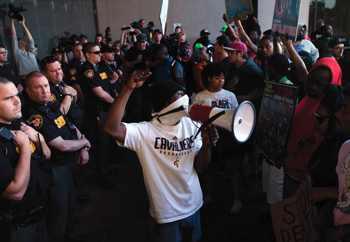
Demonstrators pause at the entrance to the Cuyahoga County Justice Center as police stand guard during a protest against the acquittal of Michael Brelo, a patrolman charged in the shooting deaths of two unarmed suspects, May 23, in Cleveland. Brelo was acquitted in a case involving a 137-shot barrage of gunfire that helped prompt the U.S. Department of Justice determine the city police department had a history of using excessive force and violating civil rights.
|
The investigation was the second time in recent years the Justice Department has taken the Cleveland police to task over the use of force. But unlike in 2004, when the agency left it up to local police to clean up their act, federal authorities intervened this time by way of a consent decree.
Two other high-profile police-involved deaths still hang over the city: Tamir Rice the boy holding a pellet gun fatally shot by a rookie patrolman and Tanisha Anderson, a mentally ill woman in distress who died after officers took her to the ground and handcuffed her.
Last year, the Justice Dept. report described the police department as poorly trained and reckless.
Ohio Attorney General Mike Dewine called the killings of Timothy Russell and Malissa Williams a “systemic failure” on the part of the police.
Failure of Black elected officials?
“The majority of the city is 60-65 percent Blacks. We have a Black mayor, a majority Black city council, and our political representatives are a part of the problem and not the solution,” John Boyd charged.
Black politicians are too busy trying to appease Whites and show they’re not giving preferential treatment to Blacks, rather than leading and rebuild the fabric of the Black community, he said.
Mr. Boyd added, Black politicians act like it’s okay for Whites to advocate for their people but not for Blacks to advocate for Blacks. He disagrees with that.
“Separating from America is definitely on the board as an option and some people are talking about it, because it’s never going to change,” Mr. Boyd said.
The Brelo acquittal sends a clear message that the system of White supremacy is intact, the activists said.
“We’re the ones who seem to think that things have changed,” another Black veteran activist said.
The verdict should be a confirmation, not a surprise or even a question, he added..
“We’re at a point now where America, White supremacy, Europeans have let it be known that African people are an overstocked item that has expired a long time ago and there is no use,” he said.
Judge O’Donnell declared he would not sacrifice Mr. Brelo to an angry public if the evidence proved otherwise. But not only should the officer have been convicted, he should have been fired, Cleveland activists told The Final Call.
She criticized Judge O’Donnell’s analysis and conclusion that Officer Brelo acted appropriately and attributing the chaos to Mr. Russell.
It’s a travesty to justice, the law and the Black community, she said.
“If I was taking a bar exam and I started off my analysis that way, I would fail that bar exam. The chaos started from the Cleveland Police Department when they had 62 patrol cars chasing this one vehicle and Officer Brelo being probably the fifth car in that chase, knowing he was breaking procedure in what created the chaos,” Ms. Crenshaw, a former law student said.
If Officer Brelo hadn’t violated policy and contributed to the chaos, the couple wouldn’t have been put in the position to have been killed, so he is not immune to accountability for their deaths, she said.
The prosecutor has also left no leeway to prosecute any other officers involved in the chase and shooting, said Ms. Crenshaw. “If you couldn’t prove that Brelo’s bullets killed Timothy and Malissa, you sure can’t prove that the other 12 contributed to their deaths,” she said.
Shortly after the news broke she said she turned away from television, sickened by news coverage and the Cleveland administration.
“I’m angry because the media and the administration have pushed on us peaceful protest and there is no such thing, because a peaceful protest means you want to see me and not hear me and a protest means you will hear my voice,” she said.
She’s outdone with Cleveland, its leadership and absence of justice.
“I’m not inciting violence but do I think that freeways should be shut down and businesses should be shut down and economics should be shut down? Yes. I most certainly do because that’s a protest. Do I think that voices should be raised for the firing of all 13 police officers and they are no longer able to work in this community? Yes. I think those voices should be raised and raised high,” Ms. Crenshaw said.
Adding insult to injury, nine White Cleveland cops filed a federal racial discrimination lawsuit against the city, claiming they are racially discriminated against when they shoot Blacks.
The officers (8 White and one Hispanic) alleged they were denied overtime pay and subject to boring menial tasks while placed on administrative leave and then restricted duty for firing their weapons during the encounter which took the lives of Mr. Russell and Ms. Williams.
“It does not surprise me that they would have the temerity to do something like that. They always seem to want to try to take advantage of the laws that prevent and preclude them from their mistreatment of us and try to flip it back on us and call it reverse discrimination,” said Mr. Boyd.
Racism is “ alive and well in Cleveland, Ohio and it’s endemic in the police force and it always has been. There’s nothing but a bunch of racist White cops in the city of Cleveland and unfortunately, the African American cops, the only difference in my estimation is that White cops think White first and then cops,” Mr. Boyd added.
“Black cops have been maneuvered into a position of feeling some sense of false loyalty to being a cop in a brotherhood and they think blue first and cop second. They never see Black,” he said.
Mr. Boyd believes the officers could win their ludicrous discrimination lawsuit because people tend to forget American values are for Whites—not for Blacks.
“There was no way that cracker judge was going to find that other murderous cracker guilty of killing those two Black people. That was not going to happen,” he said.
Mr. Boyd refused to attend protests after the verdict where media cameras delighted in showing people holding hands with red, black and green flags while singing Kumbaya.
“I’m not going to do it and preach peace because that is not what my experience has been,” he said, echoing the sentiments of many.
“I’ve said that I would not be disappointed if they burned this damn town down to the ground, because it’s just a damned shame that they have no value and no respect for Black lives,” Mr. Boyd said.










Business
OP-ED: Proposition 44 Would Put a Price on Trust
The danger in Proposition 44 is not only its 90 percent figure. It is that the meaning of “qualifying” spending will be worked out later. A clinic preparing a budget today may not know whether a navigator, health educator, transportation program, outreach worker, technology upgrade, or other patient-support service will be counted the way it expects. Yet the financial consequence of getting it wrong could be immediate.


Business
OP-ED: Proposition 40: It’s Time to Play Chess, Not Checkers
Proposition 40 would impose a one-time 5 percent tax on the wealth of Californians with more than $1 billion in assets. Most of that money would go toward health care, with the remainder supporting food assistance and education-related programs.

Black History
Listening as a Lifeline: A Doula’s Witness to Black Maternal Health
OAKLAND POST — Maternal mortality and pregnancy-related mortality use different time frames and methods and are not interchangeable. Finalized 2024 CDC data recorded 649 maternal deaths nationally. The overall rate was 17.9 deaths per 100,000 live births, but for non-Hispanic Black women it was 44.8, compared with 14.2 for White women and 12.1 for Hispanic women.

Word Count: 1058
Note: Client A, B & C, names are withheld for privacy; these accounts reflect my recollections as their Doula.
Client A rocked her hips on a birthing ball, surrounded by pale wood and warm textiles in a softly lit Scandinavian-style office. I was her doula through a Southern California maternal health company combining nurse-led care, technology, and wraparound support.
She was a healthy Black woman in her thirties. Her baby girl was doing well; her partner took notes as we discussed labor and advocacy.
Then we turned to their chosen hospital. I knew it well—and remembered a phrase from another client’s experience: “Policy of Sovereignty.”
Client B had been told she needed a repeat cesarean as a precaution, though the reasoning was unclear. Her obstetrician, who performed her first cesarean two years earlier, had assured her throughout pregnancy that she was healthy, healed, and ready for a vaginal birth. We asked staff to review her chart, consult her obstetrician, and reconsider immediate surgery. Instead, they invoked the “Policy of Sovereignty.”

The physician on duty, we were told, had final authority, regardless of her established care plan. I asked whether an ultrasound or reassessing the baby’s position could offer clarity. Cesareans can be lifesaving. But were Client B’s history, informed consent, and circumstances guiding this decision—or was routine overriding individualized care? We kept asking for her obstetrician. Beneath every request was a deeper question: Was she being heard?
The Numbers Behind the Stories
Statistics arrive in clean columns. The experiences behind them do not.
Maternal mortality and pregnancy-related mortality use different time frames and methods and are not interchangeable. Finalized 2024 CDC data recorded 649 maternal deaths nationally. The overall rate was 17.9 deaths per 100,000 live births, but for non-Hispanic Black women it was 44.8, compared with 14.2 for White women and 12.1 for Hispanic women.
In California, Black birthing people experienced 56.5 pregnancy-related deaths per 100,000 live births during 2020–2022—3.8 times the White rate and four times the Asian rate.
As a doula serving Los Angeles and San Bernardino Counties, I see faces behind those numbers. I remember concerns raised softly, then firmly, then desperately. I am tired of watching Black families enter spaces meant to protect them, only to discover they must defend themselves while laboring, bleeding, trembling, or recovering.
Returning to Client A
Client A’s labor stretched nearly 48 hours. As her condition worsened, she, her partner, and I asked whether a cesarean should happen sooner. A provider questioned my place as a doula, then said she was next.
Six more hours passed.
She entered surgery visibly ill with a serious uterine infection, her baby malpositioned and stuck. Her partner later recalled the provider saying, “This baby would never have made it through the birth canal.”
Those words landed like a blow. Our urgency had been treated as ignorance. With Client B, we questioned why surgery was inevitable. With Client A, why it was delayed. Doula advocacy is not about one kind of birth. It is about informed consent, individualized care, and timely action. Hospital routine should never outweigh the person carrying the risk.
Survival Cannot Be the Standard
The Black maternal health crisis includes unequal care, untreated conditions, racial bias, delayed referrals, poor communication, and inadequate postpartum support. It is about birth plans respected only until a hospital becomes less busy and postpartum care that asks whether a mother survived, not whether she has what she needs to recover.
Survival cannot be the standard. Technology can support care, but it cannot replace human connection. An algorithm cannot detect fear in a patient’s eyes, and a mission statement alone cannot ensure adequate staffing or culturally responsive care.
The Story of Client C
Before I arrived, I heard the chaos through Client C’s phone. Staff struggled to locate her baby’s heartbeat on an external monitor as her fear and blood pressure rose. I pleaded for an internal electrode before surgery.
“There’s not enough time,” a nurse said.
“I would like to wait for my doula,” Client C called out.
But she was medicated, hurried through consent, and wheeled away while I listened.
In the operating room, after a shift change, another nurse placed an internal electrode and said, “The previous monitor wasn’t working.”
No one responded.
According to her father, the obstetrician avoided eye contact: “We need to move forward.”
Surgery may still have been necessary; that was not mine to determine. But if faulty equipment helped create the emergency, the family deserved acknowledgment and explanation—not silence. No family should have to wonder whether major surgery followed an unavoidable crisis or a machine failure no one recognized in time.
From Prevention to Accountability
After supporting nearly 100 families, I have learned that danger often begins before admission. I have urged clients to seek care—and heard why they feared returning: dismissed pain, harsh words, shame for asking questions.
Care cannot be holistic where Black families do not feel safe enough to speak or return. Representation matters, but providers of color cannot repair inequity alone. They need adequate staffing, mentorship, culturally responsive training, reliable equipment, and colleagues that are reflective of all the aforementioned. It’s not the Black providers job to care for just the Black patients, everyone should have the same goal.
The Momnibus Act, California’s Medi-Cal doula benefit, the Transforming Maternal Health Model and the Perinatal Equity Initiative require more than promises; they need sustained funding, reliable reimbursement and accountable implementation.
Birth should be sacred. Yet too many Black birthing people arrive carrying the burden of proving their pain is real. A doula can listen, educate, comfort, and advocate—but cannot repair a system that refuses to listen. The true measure of progress is what happens when a Black birthing person says, “Something is wrong.”
Are they believed? When equipment fails, is that failure acknowledged? Do families leave not merely alive, but safe, respected, supported, and whole?
Until those answers are consistently yes, California’s maternal health success story remains unfinished.
About the Author
Antoinette Stewart-Eneh is a mother of two, holistic maternal wellness advocate, and birth and postpartum doula who has supported families since 2019. She serves as program operations coordinator for Frontline Doulas, a volunteer client coordinator with the Joy in Birthing Foundation and a childbirth educator in South Los Angeles. She is studying to become a midwife and lactation educator.



OP-ED: Proposition 44 Would Put a Price on Trust

OP-ED: Proposition 40: It’s Time to Play Chess, Not Checkers

Listening as a Lifeline: A Doula’s Witness to Black Maternal Health

New Protections for Ticket Buyers: Gov. Newsom Signs Assemblymember Isaac Bryan’s Bill

‘We Don’t Talk Trash — We Pick Up Trash!’

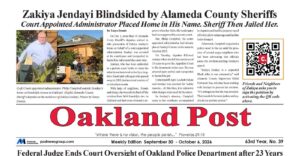
Zakiya Jendayi Arrested, Locked Out of Home by Sheriff’s Deputies

Oakland Post: Week of September 30 – October 6, 2026

Asm. Corey Jackson Announces Launch of 24-Hour Childcare in His District

IN MEMORIAM: The Rev. Leon “Sonny” Clark, Longtime Orange County Pastor and Community Leader, Dies at 72

Poll: Becerra Widens His Lead Over Hilton; Californians Split on Wealth Tax

From Historic Memories to New Possibilities: Oakland Celebrates Coliseum 60

County Office of Education Says OUSD Finances Are Getting Healthier, Materially Stronger

LIVE FREE Sunday Dinner Brings Faith, Fellowship and Civic Conversation to Oakland

Remembering Chauncey Bailey as Student Journalists Face Threats to Truth-Telling

BLACspace Cooperative Invites Bay Area to Experience Oakland’s Black Cultural Ecosystem Through a BLAC Map Tour + Party

Standoff for Justice: Our Homes Are Worth Fighting For

Oakland Post: Week of August 26 – September 1, 2026

Frontier Airlines’ Return to Oakland Airport Brings Flights, Jobs and Opportunity

Jackie Wright Champions Bay Area Stories, Filmmakers and Cultural Institutions

Gubernatorial Candidate Steve Hilton Blasts California New Tire Rules; Newsom Hits Back

Chef Sharon Lee Blends Culinary Excellence, Education and Empowerment

Misnamed ‘Parent’ PAC Seeks to Influence Oakland School Board Elections

Oakland Coliseum Project Opens Door for Small Businesses to Build Bigger

Big City Mayors Ask for “Yes” Vote on Housing Bond Measure; Conservatives Say “No”

Gov. Newsom’s Latest Appointees Include Sacramento Advocate for Formerly Incarcerated Students; State’s New Tech Chief

Oakland Post: Week of September 2 – 8, 2026

Longtime BWOPA Member Brendalyn Goodall Appointed to California Workforce Development Board

Gov. Newsom Signs Law Shielding Immigration Aid Workers From Doxing Threats

Secretary of State Shirley N. Weber Urges Californians to Vote Early as Voter ID Battle Intensifies

Oakland Post: Week of September 9 – 15, 2026

The Conversation With Al McFarlane 6/23/26

Media Monday 6/22/26

LIVE! ASK ALMA! — TUES. 6.23.26 7PM EST

Car Buying Secrets: 4 Hidden Checks Before You Sign!

Is This 550 HP Charger Worth YOUR Money? AutoNetwork Review

Celebrating Juneteenth – Frederick Douglass on education and resistance

LIVE! — ASK ALMA! — TUES. 6.19.26 7PM EST

Hyundai Ioniq 5 Parking, Safety, and 360 View #shorts

2025 Ioniq 5 New Wiper & Powerful Performance! #shorts

Electric SUV Range: Is 259 Miles Enough? #shorts

EV Charging: How Fast Can You Charge an Electric Vehicle? #shorts

Biometric Cooling… Messaging Seats…Come on! 2025 Infiniti QX80 Autograph 4WD

Charged Up: Witness the Magic of a Fully Electric Car! #shorts

Range Rover Sport PHEV Included…: See What’s Inside This Luxury SUV! #shorts

Invisible Hood View: Perfect Parking with X-Ray Vision! #shorts
-
 Community4 weeks ago
Misnamed ‘Parent’ PAC Seeks to Influence Oakland School Board Elections
-
 Activism4 weeks ago
Oakland Post: Week of September 9 – 15, 2026
-

 Community4 weeks ago
Richmond Tiny House Village Farm & Garden Set to Open Gates on Sept. 26
-

 Black History4 weeks ago
Latest Massacre in Haiti Reveals Cruelty U.S. Deportations
-

 Black History4 weeks ago
OPINION: Nolan Wells’ Death One of Several Signifying Racial Terror Lives on in U.S. South
-

 Business3 weeks ago
Mayor Lee Announces $1 Million Kaiser Permanente Grant for Pilot Program to Address Homelessness, Clean Up Public Spaces throughout Oakland
-
 Economy2 weeks ago
Poll: Becerra Widens His Lead Over Hilton; Californians Split on Wealth Tax
-

 Community4 weeks ago
Democratic Clubs Interview Candidates for Oakland School Board
