Connect with us

Activism

Alameda County Board of Supervisors Fails to OK Charter Amendment on Recall Process

In October, the board introduced the amendment after Alameda County Counsel Donna Zieglar brought forward that the existing charter is outdated and needs to align with California’s current recall process. The supervisors had originally planned to vote on the matter at their final October meeting but postponed the conversation when it became clear that there was too much confusion about the implications of the measure.


Published

on

By Magaly Muñoz | Post Staff

The Alameda County Board of Supervisors rejected, by a 3-2 vote, the proposal to place a measure on the March 2024 ballot to change the county’s recall process to match that of the state’s.

In October, the board introduced the amendment after Alameda County Counsel Donna Zieglar brought forward that the existing charter is outdated and needs to align with California’s current recall process.

The supervisors had originally planned to vote on the matter at their final October meeting but postponed the conversation when it became clear that there was too much confusion about the implications of the measure.

They recommended that the county counsel develop a ‘Frequently Asked Questions’ (FAQ) section about the charter amendment to answer questions that were being raised by the public.

The FAQ featured answers to questions about timelines before and after petitions are signed, signature amounts, and an alternate proposal recommendation on who could be subject to a recall.

The original item that the board discussed and voted on at their previous meeting would change the charter to read: “California state law applicable to the recall of county officers shall govern the recall of county of Alameda elected and appointed officers.”

The alternate item that was newly introduced and added at the Tuesday meeting would change the language from “Alameda elected and appointed officers” to only “Alameda elected officers” meaning that officials who were appointed to their positions would not be subjected to recall attempts.

Attendees in person and online spoke out against the amendment change, saying that it was taking their power away as voters and that even with the FAQ, there remains a degree of confusion.

Chris Moore, a member of Save Alameda For Everyone (SAFE), which is currently spearheading the recall efforts against Alameda D.A. Pamela Price, said that their current petition is extremely popular and they believe they can gather all the required signatures before the March deadline.

“The public wants this to happen,” Moore said.

With the current charter, only 73,000 signatures are needed to trigger a recall election, but if the amended charter were to be approved, almost 20,000 more signatures would be required.

Following the conclusion of public comments, SAFE held a press conference outside of the County Administration Building. Carl Chan, a key officer of SAFE, announced that in just five weeks they were able to collect over 70,000 signatures and affirmed that SAFE will not stop until they have 110,000 signatures, keeping in mind the potential changes to the charter.

Price is facing a recall despite her victory at the polls last year when she ran on a platform of judicial reform, defeating Terry Wiley who had been supported by Price’s predecessor, Nancy O’Malley.

Assertions that she is ‘soft on crime’ reached a fervor earlier this year as a surge of theft, robberies and shoplifting crimes alarmed residents in Oakland and other major cities in the Bay Area, the state, and the nation.

Price has had to remind media and citizens alike, that the district attorney can only charge and prosecute criminals after police arrest them.

“DA Price has been working as a civil rights attorney for over 40 years, she’s a fighter for justice and will continue to fight for the safety of the people across Alameda County, no matter how much money they spend trying to take her out.” said William Fitzgerald, campaign spokesperson for “Protect The Win” campaign, in a press release about the county charter amendment.

In contrast, despite Board President Nate Miley telling KQED that he’s “pretty confident the board is going to align our charter with state law,” he spoke and voted in opposition to both amendment recommendations.

Because there is still a lot of confusion on the charter amendment and because it as if the board is taking a side on the matter, Miley said it was unfair to put this measure in front of voters in March.

“I think at this point it doesn’t serve the public interest to move ahead with this at this time only because we would be placing ourselves in the way of an effort to move ahead with a particular recall and tainting that process,” Miley added.

Miley, alongside Board Vice President David Haubert, recommended tabling the discussion until after March 2024.

On the other hand, board members Keith Carson and Elisa Marquez argued that as public officials, they have an obligation to voters to allow them to decide for themselves if they want to change the charter to align it with the state’s. Tabling the issue would only delay a process that they know needs to happen soon.

Board members Miley, Haubert, and Lena Tam voted ‘no’ on the recommendation, while Carson and Marquez voted ‘yes.’

Although the vote to modify the charter to include “Alameda elected and appointed officers” failed, the alternate recommendation for the language to exclude “appointed officials” was approved for further discussion.

The Board of Supervisors will discuss and vote on the alternate recommendation at their Nov. 28 regular meeting.

Magaly Muñoz

Magaly Muñoz

A graduate of Sacramento State University, Magaly Muñoz’s journalism experience includes working for the State Hornet, the university’s student-run newspaper and conducting research and producing projects for “All Things Considered” at National Public Radio. She also was a community reporter for El Timpano, serving Latino and Mayan communities, and contributed to the Sacramento Observer, the area’s African American newspaper.

Muñoz is one of 40 early career journalists who are part of the California Local News Fellowship program, a state-funded initiative designed to strengthen local news reporting in California, with a focus on underserved communities.

The fellowship program places journalism fellows throughout the state in two-year, full-time reporting positions.

A graduate of Sacramento State University, Magaly Muñoz’s journalism experience includes working for the State Hornet, the university’s student-run newspaper and conducting research and producing projects for “All Things Considered” at National Public Radio. She also was a community reporter for El Timpano, serving Latino and Mayan communities, and contributed to the Sacramento Observer, the area’s African American newspaper. Muñoz is one of 40 early career journalists who are part of the California Local News Fellowship program, a state-funded initiative designed to strengthen local news reporting in California, with a focus on underserved communities. The fellowship program places journalism fellows throughout the state in two-year, full-time reporting positions.

Continue Reading
Click to comment

Leave a Reply

Your email address will not be published. Required fields are marked *

Activism

Marin City Public Housing Residents Demand a Voice in County’s Renovation Plans

Representation has been a continuous struggle for the Residents Council, she said in an interview with the Post News Group.  In 2014, the tenants took the county to federal court over this issue, and prevailed, resulting in an MOU that was in effect from 2014 to 2024, said McLemore. “Now, they are not responding to our rightful requests to participate.  They are not giving us a legal justification for their position.”

Published

on

The largest housing complex in Marin County, Golden Gate Village residents are for predominantly Black and low-income. Courtesy image.

Tenants say the County of Marin is ignoring federal law requiring resident council participation

By Ken Epstein

Marin City public housing residents say the County is illegally depriving them of their rights to participate in renovation decisions that affect the future of their housing, raising deep concerns over whether the county ultimately will find a way to displace them.

According to regulations established by the U.S. Department of Housing and Urban Development (HUD), Marin City public housing residents have the right to organize, elect resident councils, and hold public housing agencies accountable for involving them in management decisions.

Without resident participation, the Board of Housing Commissioners, made up of the five Marin County Board of Supervisors and two resident comissioners, has approved a $226 million project.  The plan calls for renovation of the 296 units in Golden Gate Village (GGV) and focuses on interior improvements. The project is scheduled to start in July.

Residents’ concerns have a long history, said Royce McLemore, president of the Golden Gate Village Residents Council and a 50-year resident of Marin City,

Representation has been a continuous struggle for the Residents Council, she said in an interview with the Post News Group.  In 2014, the tenants took the county to federal court over this issue, and prevailed, resulting in an MOU that was in effect from 2014 to 2024, said McLemore. “Now, they are not responding to our rightful requests to participate.  They are not giving us a legal justification for their position.”

With no current MOU mandating training and participation of residents, the legal basis for all the redevelopment decisions made by the county since 2024 is questionable, said Terrie Green, executive director of Marin City Climate Resilience. “We are experiencing voicelessness. If residents had a voice, we wouldn’t be where we are today,” she said.

County decisions include a plan, in line with federal regulations, to convert GGV from public housing to a public-private enterprise that allows for private investment. The Marin Housing Authority has created a limited partnership that includes Burbank Housing – which will renovate the units and manage the property – and Wells Fargo Bank, the investor.

This change in federal policy regarding public housing, which includes a shift to a Section-8 voucher system, has resulted in gentrification across the country, particularly affecting African Americans in cities such as San Francisco.

Shifts in criteria of what is considered affordable could also end up pricing residents out of their living units. At present, low income in Marin County is officially considered $156,000. But the median household income in Marin City is significantly lower at $68,846

Damian Morgan, a community advocate with Marin City Climate Resilience, questioned why the county is renovating apartments without fixing toxic infrastructure that is impacting the lives of people in GGV.

Morgan said tenants have filed a class action lawsuit because of unsafe conditions at Golden Gate Village.

Residents are also concerned that the County still does not have an adequate family plan for temporary displacement while their apartments are being renovated.  Although the County has suggested other community apartments as alternatives, nothing concrete has developed except vacant public housing units that have the same toxic conditions, such as mold and mildew.

Green said it doesn’t make sense. “…Why are we moving people around into temporary housing that’s uninhabitable, when you should be dealing first with the infrastructure, the foundational work, replacing old and rusted water pipes and new sewers.”

Morgan questions the County’s motivation for neglecting infrastructure repairs. “They’re remodeling the units but leaving the decayed infrastructure in place. I feel like they’re just setting this up for it to fail.”

“What slowed it down a little is that GGV is a historic preservation district, but I think what they’re striving for is demolition by neglect,” he said. “The neglect has always been on their part.”

Architect Ora Hatheway said her concern is about cutting corners. “You have to deal with the land issues. You have to deal with grading and drainage, and that’s being brushed under the rug.”

In an interview with KGO TV, Marin County Supervisor Stephanie Moulton-Peters responded to some of these concerns.  She said residents are guaranteed the right to return to their homes.

“This is a concern that we take seriously,” she said. “Every resident will move back into their own unit, and we’ve given this to them in writing. Before they leave their unit, we will sign a document together that guarantees their right to return.”

In response to residents who feel left out of the planning process, she said community input has focused on those affected by the first phase of the project. “So other residents may not have heard quite as much or felt like they had as much contact. But if there are residents who have concerns, we’re happy to hear from them. You can contact my office or the housing authority directly,” she said.

While County leaders may be giving some updates to some tenants, they are not sitting at the table with the Residents Council nor giving residents a voice in decision-making, said McLemore.

Without a voice in decisions, tenants are worried that Black people may be forced out of public housing, resulting in gentrification, she said in an interview with ABC 7.  It’s still paternalistic, she said.  “It’s still that ‘We know what’s best for you.’’’

Several years ago, the Residents Council proposed a land trust plan that would give tenants homeownership rights.  Though the plan had broad support throughout the county, it was rejected by the Board of Supervisors

In the final analysis, Green said, for Marin City tenants the fight is not just for decent housing but to maintain their community with dignity under conditions of mutual respect.

“We’re talking about people who came here to work in the shipyards during World War II to bring about peace and safety to this country,” she said. “Look at the discrimination we’ve faced down through the years. Look at the life-span issue of Marin City folks – almost 20 years less than the rest of the County.”

“We want educational equity so our children will have decent schools. We need a land trust, property ownership, so we can have wealth creation. Marin City needs the same quality of life as other communities in Marin County.”

Continue Reading

Activism

Oakland Post: Week of May 6 – 12, 2026

The printed Weekly Edition of the Oakland Post: Week of may 6 – 12, 2026

Published

on

To enlarge your view of this issue, use the slider, magnifying glass icon or full page icon in the lower right corner of the browser window.

Continue Reading

Activism

On the Frontlines of Hate: NAACP Links Victims to Critical Support

The NAACP CA/HI has a long and well-established record of supporting victims of discrimination and hate crimes — providing critical referrals and, when necessary, direct assistance through legal advocacy and other forms of support. Beyond responding to incidents, the organization continues to advocate on broader civil rights issues, including voting rights and legal protections. It has also worked to counter efforts at the state and federal levels that could weaken the voting power of communities of color.

Published

on

NAACP members at a recent advocacy day in Sacramento urging lawmakers to protect voting rights. Photo courtesy of California Black Media.

By Joe Kocurek
California Black Media

The California/Hawaii State Conference of the NAACP (CA/HI NAACP) has expanded its efforts to respond to rising hate incidents and civil rights complaints across California, supported in part by funding from California’s Stop the Hate Program

Through that grant, NAACP CA/HI has strengthened its ability to connect individuals experiencing hate or discrimination with critical resources. This includes referring those who file complaints to the CA vs Hate hotline, a statewide, non-emergency hate crime and incident reporting hotline and online portal created to help counter a more than 50% increase in reported hate crimes in California between 2020 and 2024. The system helps ensure incidents are documented, and victims are guided toward appropriate support.

LaJuana Bivens says the work of NAACP is as urgent as ever. Photo by Regina Wilson, California Black Media.

LaJuana Bivens says the work of NAACP is as urgent as ever. Photo by Regina Wilson, California Black Media.

LaJuana Bivens, who has served in a number of roles within the NAACP, said California has seen an increase in civil rights violations and hate-related incidents.

“We have 52 branches, and they are constantly receiving complaints,” she said. “So, without the Stop the Hate, we would not be able to refer those cases up to attorneys at the state level. A lot of the people would not have had an opportunity to be heard.”

Carmen-Nicole Cox helps survivors of hate with their legal options. Photo courtesy of Carmen-Nicole Cox.

Carmen-Nicole Cox helps survivors of hate with their legal options. Photo courtesy of Carmen-Nicole Cox.

Carmen-Nicole Cox, an attorney who works with NAACP CA/HI – as a part of California’s Stop the Hate Program – provides legal consultation to victims of hate incidents and discrimination through her legal practice, the Cox Firm for Law and Policy.

She said the complaints she receives span a wide range of issues.

“People are having home builders and landlords refusing to provide repairs, a student was denied promotion in an academic program, and targeted scrutiny at work,” she said. “It’s typically employment; it’s housing; it’s education.

“We’ll meet and they’ll share their experiences,” she said. “And then I make assessments about possible legal claims.”

According to the California Civil Rights Department (CRD), nearly 1,200 reports of hate against minority groups were submitted in 2024 through the CA vs Hate hotline and online portal for non-emergency incidents.

While the California/Hawaii State Conference of the NAACP, which has tens of thousands of members, does not directly investigate hate incidents or crimes, it plays a key role in connecting victims to the state’s reporting systems and support services.

The NAACP CA/HI has a long and well-established record of supporting victims of discrimination and hate crimes — providing critical referrals and, when necessary, direct assistance through legal advocacy and other forms of support.

Beyond responding to incidents, the organization continues to advocate on broader civil rights issues, including voting rights and legal protections. It has also worked to counter efforts at the state and federal levels that could weaken the voting power of communities of color.

Bivens recently traveled to Sacramento to speak with state lawmakers about voting rights during an advocacy day event hosted by the organization.

“It’s just so hard for communities of color to be up to date because of all of the confusing information coming from the federal level,” she said. “I love our great state of California because here it is possible to vote by mail and to vote early.

“And I’m seeing that trying to be eroded. So, I’m here to urge continued support for vote by mail and early voting.”

When Texas moved to redraw congressional districts in ways critics said would dilute minority voting strength, NAACP CA/HI supported the passage of Proposition 50 in California. The organization also intervened in United States v. Shirley Weber, where federal officials sought access to unredacted California voter records, including Social Security numbers, raising concerns about misuse and voter intimidation.

Cultivating the advocacy and leaderships of young people is central to NAACP’s mission to fight racism and dismantle inequality. Photo courtesy of California Black Media.

Cultivating the advocacy and leaderships of young people is central to NAACP’s mission to fight racism and dismantle inequality. Photo courtesy of California Black Media.

A federal district court dismissed that case in January 2026.

The organization’s current work builds on a long history of civil rights advocacy. Today, Bivens says, the organization’s mission remains as urgent as ever.

“We are the oldest, boldest, most feared Civil Rights organization,” Bivens said. “What we do every day is fight for better housing, education, economic development and political inclusion. We take it on because there are just so many people who need that support.

“You would be amazed that our phones ring every single day.”

Get Support After Hate:

California vs Hate is a non-emergency, multilingual hotline and online portal offering confidential support for hate crimes and incidents. Victims and witnesses can get help anonymously by calling 833-8-NO-HATE (833-866-4283), Monday to Friday, 9 a.m.–6 p.m. PT, or online at any time. Anonymous. Confidential. No Police. No ICE.

This story was produced in partnership with CA vs Hate. Join them for the first-ever CA Civil Rights Summit on May 11. More information at www.cavshate.org/summit.

https://youtu.be/_k7UVhI-sN8

Continue Reading

Subscribe to receive news and updates from the Oakland Post

* indicates required

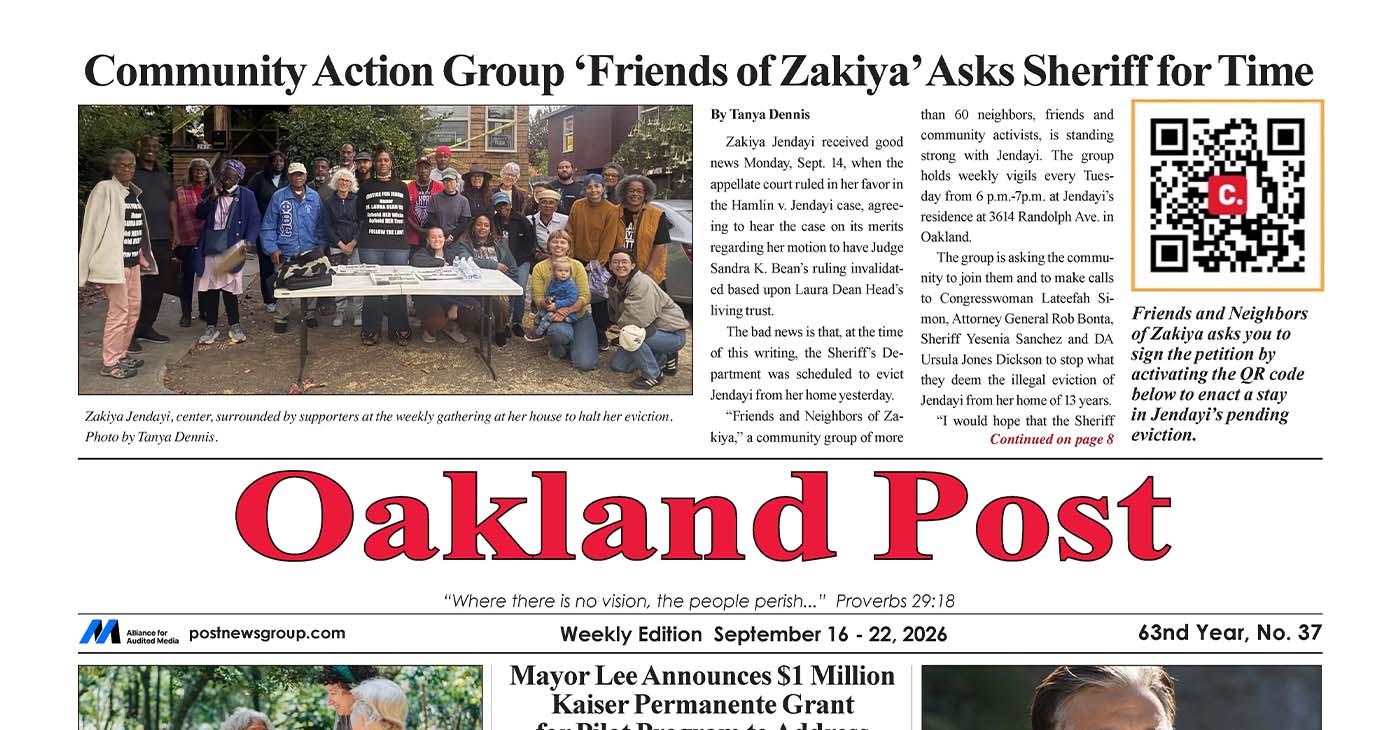
CHECK OUT THE LATEST ISSUE OF THE OAKLAND POST

ADVERTISEMENT

WORK FROM HOME

Home-based business with potential monthly income of $10K+ per month. A proven training system and website provided to maximize business effectiveness. Perfect job to earn side and primary income. Contact Lynne for more details: Lynne4npusa@gmail.com 800-334-0540

Facebook

Trending

Copyright ©2021 Post News Group, Inc. All Rights Reserved.