
Community
AG Bonta Says Oakland School Leaders Should Comply with State Laws to Avoid ‘Disparate Harm’ When Closing or Merging Schools
California Attorney General Rob Bonta sent a letter this week to the Oakland Unified School District (OUSD) Board of Education saying the district has a duty to comply with state education and civil rights laws to protect students and families from “disparate harm,” such as segregation and discrimination, if the district goes ahead with school closures, mergers or consolidations in 2025-2026.

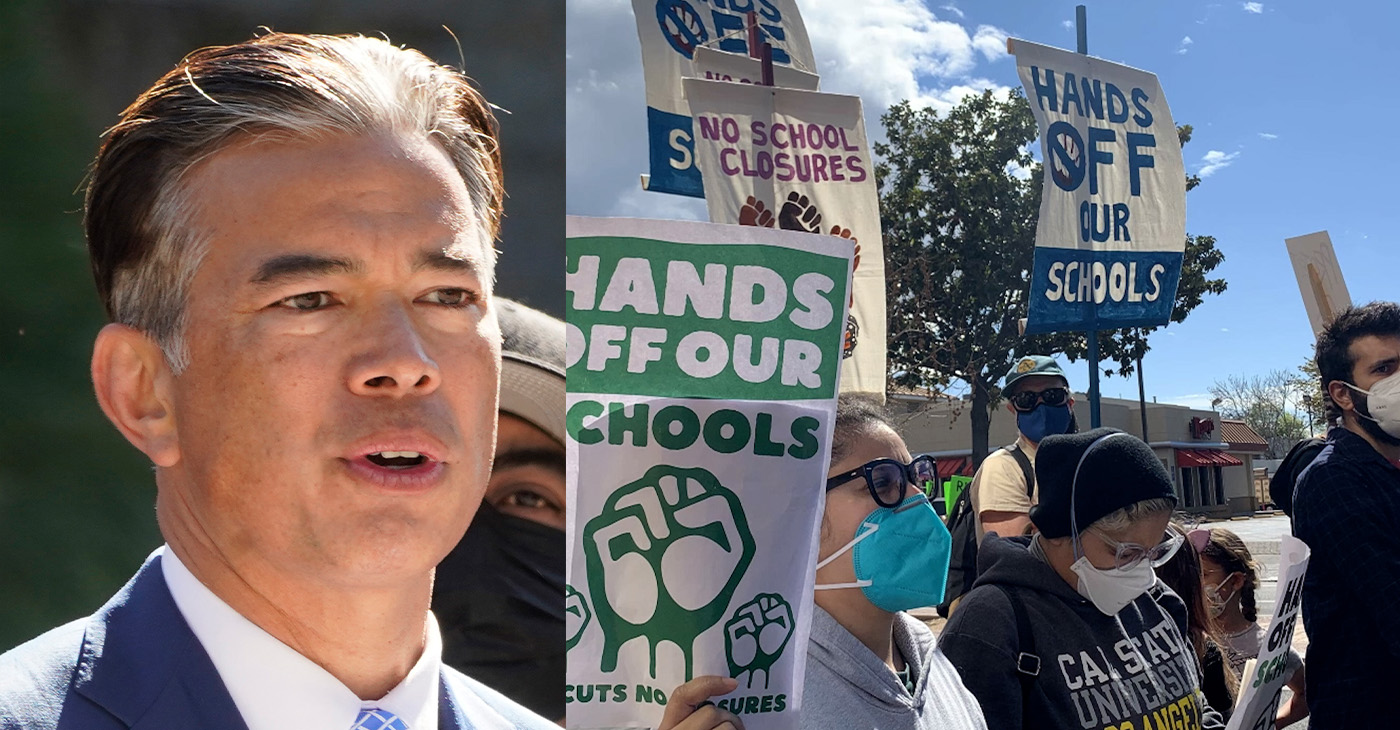
AG Bonta said DOJ investigation of 2022 closure decisions would have negatively impacted Black and low-income families.
By Post Staff
California Attorney General Rob Bonta sent a letter this week to the Oakland Unified School District (OUSD) Board of Education saying the district has a duty to comply with state education and civil rights laws to protect students and families from “disparate harm,” such as segregation and discrimination, if the district goes ahead with school closures, mergers or consolidations in 2025-2026.
The letter and an accompanying media release announced the findings of the California Department of Justice’s (DOJ) investigation into the OUSD Board’s Feb. 8, 2022, decision to close Parker Elementary, Brookfield Elementary, Carl B. Munck Elementary, Fred T. Korematsu Discovery Academy, Grass Valley Elementary, Horace Mann Elementary, and Community Day School and eliminate grades 6-8 of Hillcrest Elementary and La Escuelita Elementary.
“All school districts and their leadership have a legal obligation to protect vulnerable children and their communities from disparate harm when making school closure decisions,” said Attorney General Bonta.
“The bottom line is that discrimination in any form will not be tolerated,” he said. “I am committed to working with OUSD’s leadership to achieve successful outcomes for students.
“My office will continue to monitor OUSD’s processes and decision-making as it moves forward with the required community engagement, equity impact analysis, and planning to implement any future closures, mergers, or consolidations” to ensure compliance with California’s Constitution, AB 1912, and anti-discrimination laws.
By press time, the school district did not respond to a request for comment from OUSD.
The DOJ’s findings showed that the February 2022 decision, later partially rescinded, would have disproportionately impacted Black and low-income elementary students, as well as high-need students with disabilities, according to the media release.
The Attorney General outlined concerns about criteria OUSD has announced that it may rely on to determine future closures, mergers, and consolidations and provided recommendations to ensure OUSD does not violate state law, including prohibitions against closure decisions that reinforce school segregation or disproportionately impact any student group as required by the State Constitution, AB 1912, and anti-discrimination laws.
According to AB 1912, passed in September 2022, financially distressed school districts contemplating school closures, mergers, or consolidations must engage the community before closing schools; conduct an equity impact assessment; and provide the public with the set of criteria the district plans to utilize to make decisions.
In the letter, DOJ identified a “problematic” approach to planning for closing schools in 2025-2026 and “strongly recommends” steps OUSD should take going forward.
- “Take affirmative steps to ensure that its enrollment and attendance boundary and school closure decisions alleviate school segregation and do not create disproportionate transportation burdens for protected subgroups.”
- Don’t solely utilize criteria such as school facilities’ conditions, school operating costs, and school capacity without also including an assessment of past and present inequities in resources “due to educational segregation or other causes.”
- Some of OUSD’s proposed guidelines “may improperly penalize schools serving students with disabilities and students who have high needs.”
- The district’s decisions should also include “environmental factors, student demographics and feeder attendance patterns, transportation needs, and special programs.”
- Avoid overreliance on test scores and other quantitative data without also looking at “how each school is serving the needs of its specific student body, especially as it relates to historically marginalized communities.”
- “Engage an independent expert to facilitate community input and equity impact.”
The letter also emphasized that DOJ is willing to provide “feedback and consultation at any time during the process to ensure that OUSD’s process and outcomes are legally compliant and serve the best interests of the school community and all of its students.”











Business
Car Wash Workers Cope with Lingering Impacts of ICE Raids
WAVE COMMUNITY NEWSPAPERS — Hundreds of car wash workers across Southern California have been detained in federal immigration raids, leaving lingering impacts on families and communities. Mario, a 33-year U.S. resident and father of three, was arrested at a Santa Ana car wash last August and held for two months.


LOS ANGELES — Mario relied on his job in the car wash industry to raise his three children. It was during a shift at a Santa Ana car wash last August that he was arrested by federal agents, taken to a U.S. Immigration and Customs Enforcement detention center and held for two months.
“They made me sleep on the cold floor for a week without a blanket, a toothbrush or basic medical care for the injured man next to me,” Mario, a 33-year resident of the United States, said at a news conference earlier this summer at Inglewood’s Crenshaw Imperial Car Wash, which is now closed after being raided by federal agents.
Mario, who is being identified only by his first name for safety reasons, is among hundreds of car wash workers detained across Southern California in the year since the Trump administration began an aggressive immigration crackdown in the region, according to the CLEAN Carwash Worker Center.
News of raids by masked agents has faded from the headlines, but the effects still linger for those caught in the crosshairs. Family members have been deported or left to languish in detention, and many who remain live with the fear of being hunted down by immigration officers.
At least 373 car wash workers have been detained at car washes across Southern California since the raids began last summer, according to figures compiled by CLEAN. The group’s data also shows federal agents raided or attempted to raid at least 106 car washes in communities across Los Angeles, Orange County and surrounding areas, including Inglewood, Culver City, Westchester, Bell and Whittier.
CLEAN, an advocacy group founded in 2007, has been fighting to protect car wash workers from exploitation and unsafe conditions. When the raids began last year, the group sprang into action, working around the clock to help detained workers and provide their families with legal and financial support.
“We gathered our information from workers, managers, and owners of the car washes that were being raided,” CLEAN Deputy Director Andrea Gonzalez said. “We also gathered information from rapid response teams who were on the ground responding to the raids.”
The Department of Homeland Security did not respond to a request for comment on the group’s findings.
Mario said he was one of seven workers at the Harbor Blvd Car Wash detained on the same day last August, but the only one who has been released. He said he refused to sign deportation papers and is fighting to stay in the United States, a process that has drained his family emotionally and financially.
“Being released is not the same as being free,” he said.
During Mario’s detention at the Adelanto ICE Processing Center, his wife and children struggled to cope with his sudden absence while fighting for his release, his wife Alejandra said.
“The employer gave us a video showing my husband being taken away under arrest, treated worse than a common criminal, with chains binding his legs, arms and waist,” Alejandra said. “It wasn’t right.”
The experience of a car wash worker named José was recounted at the news conference by the Rev. Andy Schwiebert of Immanuel Presbyterian Church in Los Angeles, who said agents “took him” from the La Cienega Car Wash last August.
José’s wife is a U.S. citizen, Schwiebert said, and José had a pathway to gaining citizenship before he was detained. By the time a judge ordered his release on bond, the car wash had shut down, Schwiebert said, leaving José without a job.
“These raids did not just target workers; they destabilized families, congregations, workplaces and entire communities,” Schwiebert said.
The administration’s aggressive enforcement operations have continued across the nation in the months since José’s and Mario’s detention, with ICE arrests in July surging to their highest rate so far under President Donald Trump.
Last month, ICE agents shot and killed Lorenzo Salgado Araujo, a 52-year-old father of three in Houston. Less than a week later, an immigration officer fatally shot 26-year-old Johan Sebastián Duran Guerrero in Biddeford, Maine.
Back in Inglewood, Mario said he was grateful to share his story and that, even though he was released, his experience in detention stays with him.
“I still feel frustrated and traumatized,” Mario said, “because my life is no longer the same as it used to be.”
Ernesto Ureño is a Loyola Marymount University journalism major and intern at Capital & Main, a nonprofit publication focused on inequality. It is published here with permission.
Based on reporting by Wave Community Newspapers.

Art
Misty Copeland Shapes Ballet’s Tomorrow
THE POSITIVE COMMUNITY — Misty Copeland will curate the 2026 Joyce Ballet Festival, a two-week event in New York City from August 4-16. This role allows her to influence the future of ballet by showcasing a wide range of dancers, choreographers, and companies. The festival will present both established and contemporary works, blending classical traditions with new artistic expressions.

This summer, Misty Copeland will step into a different kind of spotlight. Instead of taking center stage as a dancer, she will help determine what audiences see onstage as curator of the 2026 Joyce Ballet Festival. Taking place August 4 through August 16 at The Joyce Theater in New York City, the two-week celebration will bring together dancers, choreographers and companies representing a broad spectrum of ballet. The festival gives Copeland an opportunity to share not only her appreciation for ballet’s traditions, but also her vision for its future.
Copeland understands better than most how powerful a ballet stage can be. Her historic career with American Ballet Theatre changed the conversation about representation in one of the world’s most traditional performing arts. When she became the company’s first Black woman to reach the rank of principal dancer, her achievement carried significance far beyond a personal milestone. It gave young dancers of color a new image of what was possible and challenged the industry to reconsider who belonged at the center of ballet.
That history informs the perspective she brings to the festival. Copeland has spent much of her career moving between performance, mentorship, advocacy and storytelling. Her curatorial role allows her to bring those interests together by creating a program that does not treat ballet as a museum piece. Instead, the festival presents dance as an evolving language capable of carrying classical traditions into new cultural and artistic territory.

Audiences will encounter a mixture of established works and contemporary creations during the festival. Classical ballet vocabulary will share space with choreography that pushes dancers toward different physical, emotional and theatrical possibilities. The result is intended to give audiences a broader understanding of the art form while demonstrating that tradition and innovation do not have to be competing forces.
The lineup also provides an opportunity to see dancers from different artistic environments. Performers connected to organizations including American Ballet Theatre, New York City Ballet, Paris Opera Ballet, Houston Ballet, Dance Theatre of Harlem and Complexions Contemporary Ballet are among those represented in the festival. Each company carries its own history and artistic identity, making their participation part of a larger conversation about the many ways ballet can be performed and interpreted.
The presence of Dance Theatre of Harlem is particularly meaningful within the larger story of Copeland’s career and the evolution of Black representation in ballet. Founded during a period when opportunities for Black dancers were severely limited, the company helped demonstrate that excellence and classical training could flourish in a Black cultural environment. Its legacy continues to influence dancers and audiences, making its connection to a festival curated by Copeland especially resonant.
The program also reaches beyond a single definition of contemporary ballet. Choreographers with different backgrounds and artistic philosophies contribute to an evening that can move from recognizable classical structures to works shaped by modern dance, theater, popular culture and new approaches to movement. That diversity reflects a generation of artists who increasingly see ballet not as a rigid vocabulary but as a foundation from which they can explore.
For New York audiences, the festival offers something that is increasingly valuable: the opportunity to experience outstanding dancers in an intimate setting. The Joyce is known for presenting dance in a theater where audiences can see movement and artistry up close. That environment can make a familiar ballet work feel newly personal while allowing experimental pieces to communicate with unusual immediacy.
Copeland’s role as curator also sends a message about the importance of artistic leadership. The people who select performers and choreography help determine which stories receive attention and which artists receive opportunities. By bringing a range of voices into the festival, Copeland is using that responsibility to broaden the conversation around ballet. Her choices can introduce audiences to artists they may not otherwise encounter while encouraging longtime ballet followers to look at the form from a different perspective.
The 2026 Joyce Ballet Festival ultimately arrives at an important moment for the art form. Ballet is carrying centuries of tradition into an era defined by changing audiences, broader representation and increasingly adventurous choreography. Copeland’s festival reflects that transition. For two weeks in August, The Joyce will become a meeting place for the familiar and the unexpected—a celebration of where ballet came from and a preview of where it may be going. And with Misty Copeland helping shape the conversation, the future of ballet promises to be as expansive as the dancers who are defining it.
Based on reporting by The Positive Community.
Community
As Part of Your Back-to- School Checklist, Vaccinate
POST NEWS GROUP — Vaccines protect your household and also limit the spread of diseases such as measles and polio. The higher the vaccination rate in a community, the greater the protection for everyone – especially the most vulnerable.

Berkeley Public Health recommends families catch up on immunizations before the new school year begins
Parents, check that your children return to school up to date on vaccinations. If necessary, schedule a visit with your family’s doctor or with the City of Berkeley’s Immunization Clinic to catch up.
Vaccines protect your household and also limit the spread of diseases such as measles and polio. The higher the vaccination rate in a community, the greater the protection for everyone – especially the most vulnerable.
Families are encouraged to:
- Check their child’s vaccination records. Ask their health care provider or check California’s Digital Vaccine Record portal.
- Schedule a check-up with your child’s doctor.
If your child doesn’t have a health care provider, you may be able to access free vaccinations through the City of Berkeley’s Immunization Clinic. Make an appointment by calling (510) 981-5350, emailing phmailbox@berkeleyca.gov, or booking online.
See what shots are required for pre-kindergarten or TK-12th grade, and check that your kids have all their recommended vaccines.
FREE VACCINE CLINICS AUG. 4-13
Children without health insurance or whose insurance doesn’t cover vaccines can get them for free:
City of Berkeley Immunization Clinic
West Berkeley Family Wellness Center
1900 Sixth St.
Hours: Tuesdays–Thursdays, 9 a.m.–3 p.m.
Closed 12 p.m.–1 p.m.
Make an appointment between Aug. 4–6 or Aug. 11–13 for back-to-school vaccine clinics:
- Call: (510) 981-5350
- Email: phmailbox@berkeleyca.gov
- Book online
Children 18 years and under are eligible for free City vaccines if they are:
- Medicaid-eligible
- Uninsured
- Underinsured (insurance does not cover vaccines)
- American Indian or Alaska Native
If you are unsure whether you or your child is up to date, the City of Berkeley Vaccination Clinic can help review records and provide recommended vaccines.
FAMILY WELLNESS RESOURCES
Vaccines are just one of the many public health services you can access at the West Berkeley Family Wellness Center. The center is home to the Women, Infants, and Children program, nutrition support, case management services, and a variety of family support services, plus free classes throughout the year.
Vaccinations aren’t just for kids. Throughout adult life, everyone should keep up with their vaccination needs. See recommended vaccines for adults.
Get a healthy start to the school year. Check your child’s vaccinations. Make an appointment with your doctor or get free vaccines at the City clinic.
VACCINE INFORMATION AND FAMILY RESOURCES
- City of Berkeley Immunization Clinic
- TK–12 school vaccine requirements:
- Family support services:
Get trusted information about the City of Berkeley by bookmarking berkeleyca.gov, subscribing to our newsletter, and following us on Bluesky and Instagram.
WORK FROM HOME
Home-based business with potential monthly income of $10K+ per month. A proven training system and website provided to maximize business effectiveness. Perfect job to earn side and primary income. Contact Lynne for more details: Lynne4npusa@gmail.com 800-334-0540


Car Wash Workers Cope with Lingering Impacts of ICE Raids

Misty Copeland Shapes Ballet’s Tomorrow

As Part of Your Back-to- School Checklist, Vaccinate

As Part of Your Back-to- School Checklist, Vaccinate

Congresswoman Simon Demands Investigation into Trump’s Abuse of Emergency Powers for Coal Export Terminal in West Oakland

OPINION: The Philippines Isn’t Foreign When Your Family Still Lives There

Asm. McKinnor’s Bill Banning Drones Above Outdoor Entertainment Events Awaits Senate Decision

California Sen. Padilla Joins Colleagues to Introduce Bill Imposing Term Limits on Supreme Court Justices

Department of Homeland Security Demands California Secretary of State Shirley N. Weber Scrub Voter Rolls

George Cook: The Inventor Who Made Fishing Smarter

Gov. Newsom Announces $109.6 Million in Funding for 278 Supportive Homes in Bakersfield, Contra Costa, Sacramento and Fresno

Rep. Kamlager Dove Demands Care, Justice for Man Shot by ICE

“The Power to See Threats Sooner”: Gov. Newsom, Safety Officials Showcase California’s Investments in Hi-Tech Wildfire Prevention

100 Black Wings’ Team Oakland Youth Athletes Heading to Taiwan for 2026 International Children’s Games

Oakland ‘Port Serves as a Powerful Engine for Good Jobs and Economic Development
Department of Homeland Security Demands California Secretary of State Shirley N. Weber Scrub Voter Rolls

Oakland Children’s Hospital Workers and Patients Rally for Pediatric Medical Care
“The Power to See Threats Sooner”: Gov. Newsom, Safety Officials Showcase California’s Investments in Hi-Tech Wildfire Prevention

New Judge Could Decide if Karmelo Anthony Gets a New Trial

Surveillance Pricing Fight: State Senate Debates Bill Banning Retailers from Using AI to Set Prices Based on a Buyer’s Profile

Alpha Kappa Alpha Sorority, Inc. Celebrates New North Atlantic Regional Director

Mount Zion MBC, Church of Jesus Christ of Latter-day Saints Partner to Bring 29,000 Meals to Alameda County
California Sen. Padilla Joins Colleagues to Introduce Bill Imposing Term Limits on Supreme Court Justices

Starting This Summer, California Car Buyers Can Get an Instant $3500 Off the Cost of Electric Vehicles

COMMENTARY: You Are Already Paying for the AI Boom

California Bill Would Let Abuse Victims Use Trauma as Legal Defense for Violent Crime

Fed Court to Decide Landmark First Amendment Case

Gov. Gavin Newsom Signs Law Streamlining Affordable Housing Rules

Oakland Celebrates $125 Million Coliseum Sale

Saving Black Mothers Starts Outside the Hospital

The Conversation With Al McFarlane 6/23/26

Media Monday 6/22/26

LIVE! ASK ALMA! — TUES. 6.23.26 7PM EST

Car Buying Secrets: 4 Hidden Checks Before You Sign!

Is This 550 HP Charger Worth YOUR Money? AutoNetwork Review

Celebrating Juneteenth – Frederick Douglass on education and resistance

LIVE! — ASK ALMA! — TUES. 6.19.26 7PM EST

Hyundai Ioniq 5 Parking, Safety, and 360 View #shorts

2025 Ioniq 5 New Wiper & Powerful Performance! #shorts

Electric SUV Range: Is 259 Miles Enough? #shorts

EV Charging: How Fast Can You Charge an Electric Vehicle? #shorts

Biometric Cooling… Messaging Seats…Come on! 2025 Infiniti QX80 Autograph 4WD

Charged Up: Witness the Magic of a Fully Electric Car! #shorts

Range Rover Sport PHEV Included…: See What’s Inside This Luxury SUV! #shorts

Invisible Hood View: Perfect Parking with X-Ray Vision! #shorts
-
 Featured4 days ago
Department of Homeland Security Demands California Secretary of State Shirley N. Weber Scrub Voter Rolls
-
 Business3 weeks ago
Oakland Children’s Hospital Workers and Patients Rally for Pediatric Medical Care
-
 Environment4 days ago
“The Power to See Threats Sooner”: Gov. Newsom, Safety Officials Showcase California’s Investments in Hi-Tech Wildfire Prevention
-
 #NNPA BlackPress2 weeks ago
New Judge Could Decide if Karmelo Anthony Gets a New Trial
-
 Business3 weeks ago
Surveillance Pricing Fight: State Senate Debates Bill Banning Retailers from Using AI to Set Prices Based on a Buyer’s Profile
-
 Black History1 week ago
Alpha Kappa Alpha Sorority, Inc. Celebrates New North Atlantic Regional Director
-
 Business3 weeks ago
Mount Zion MBC, Church of Jesus Christ of Latter-day Saints Partner to Bring 29,000 Meals to Alameda County
-
 Featured4 days ago
California Sen. Padilla Joins Colleagues to Introduce Bill Imposing Term Limits on Supreme Court Justices
