
World
African Migrants Find Uneasy EU Shelter After Rough Journey


In this June 13, 2015 photo Jean Paul Apetey , left, and a fellow asylum seeker walk through the northern German village of Otter. Apetey enjoyed a well-organized, warm arrival in the north German state of Lower Saxony. (AP Photo/Dalton Bennett)
DALTON BENNETT, Associated Press
SHAWN POGATCHNIK, Associated Press
CREIL, France (AP) — Against the odds, Hamed Kouyate has achieved his childhood dream of escaping African poverty and reaching the wealthy heart of Europe. But like many fellow migrants who endured a clandestine odyssey marked by toil and terror, the teenager now questions whether he’s just gambled his life on a cruel illusion.
“Europe has no gold or diamonds for me. I’ve had to sleep rough and go without food for days since arriving in France. Nothing has been as I thought it would be,” the 18-year-old says as he walks along the riverbank in the Parisian suburb of Creil, three years of travel and more than 5,000 meandering miles (8,000 kilometers) from his Ivory Coast home. “I regret leaving Africa. I would not recommend this route even to my worst enemy.”

Since January, The Associated Press has followed a 45-member group of West Africans as they traveled by foot and cramped smugglers’ vehicles from Greece to Hungary via the Balkans. The route, accessed from a Turkey clogged with refugees fleeing Islamic State barbarism, is already the second-most popular way to gain illegal entry to the 28-nation European Union and its two biggest destinations: Germany and France. Unprecedented waves of Asian, Arab and African migrants are taking the slow, grueling route in preference to a sea crossing from North Africa, the quicker but reckless path to Italy. Thousands making that journey have drowned in the Mediterranean over the past year.
Kouyate and several other migrants interviewed by the AP have documented the Balkans’ own risks: deadly night trains that crush trekkers trapped on ridges, bridges and inside tunnels; robberies by criminal gangs and corrupt police lingering like vultures along the route; smugglers who hold their own clients hostage, raping women and beating men, until distant relatives wire extra cash; staggering hunger and thirst as hikes expected to take days stretch into weeks.
That trauma was all supposed to be worth it, the travelers kept telling themselves with each brutal setback. By April they finally reached Hungary, from which they could travel by jitney cabs and public transport links within the largely passport-free EU to Germany and France. The vast majority of the West Africans reached their destinations by May, having paid a series of Asian and African smugglers more than 5,000 euros ($5,500) to cover every link in the chain from Turkey to the EU’s eastern frontier.
While Germany has proven to be comparatively generous to arrivals, France is posing a tougher test. Neither permits the asylum-seekers to work while their cases are under review, but Germany gives the newcomers often high-quality housing in bucolic suburban settings along with monthly payments in the low three figures. Kouyate, by contrast, says he has received a single 40 euro ($45) payment in France, where he has bounced from sofa to bedsit to park bench and back again.
Germany received 202,834 asylum-seekers in 2014 — nearly a third of the EU total — and expects to double that figure to reach another record high this year. Chancellor Angela Merkel has publicly committed to doubling federal government spending on asylum-seeker support and pledged an extra 1 billion euros this month to state and local authorities to ensure all newcomers have housing and can pursue German language education, mandatory for achieving residency.
It’s a starkly different picture in France, which already has accepted more than 250,000 foreigners as refugees — many of them French speakers from former colonial possessions such as Ivory Coast — and last year received another 101,895 asylum applicants, second-most in the EU, according to the United Nations High Commissioner for Refugees. The French Office for Protection of Refugees and Expatriates is able to house only a third of new applicants directly, while many sleep outdoors, in train stations or tent shantytowns.
The waiting for state accommodation can typically last a year — by which time migrants already have lost their court cases and exhausted their right to stay.
France’s immigration tribunals now are accepting less than a fifth of applicants. They favor candidates from active war zones such as Syria, not economic migrants from impoverished but relatively peaceful Ivory Coast, where a decade of bloody coups and civil war has abated since 2011.
The prospect of rejection has yet to sink in for Kouyate. He handed himself twice to police before getting a referral to child protection authorities, who helped him secure a state-funded spot in a youth hostel. He now hopes to win a job as a professional soccer player, a seemingly pie-in-the-sky ambition given that he failed to achieve this goal in less-competitive Turkey. He’s already been rebuffed by a few French clubs who said they couldn’t consider giving him a trial without proper residency documentation.
Kouyate, undaunted, appears to be disenchanted with everything about France except the football.
“Soccer is my passion. It’s because of soccer that I’m in Europe. In September I’m going to train with a team,” he said, noting he currently lacks studded soccer boots.
“The hostel will buy me soccer boots and they’ll register me with a team,” he insisted.
Around 500 miles (800 kilometers) to the northeast, his Ivorian travel mates Jean Paul Apetey and Hilarion Charlemagne have enjoyed a well-organized, warm arrival in the north German state of Lower Saxony. Unlike Kouyate, they are much happier with their state-provided surroundings in farming towns south of Hamburg, where fields of strawberries and white asparagus dominate the landscape. Both are focused on learning enough German quickly to demonstrate their earnestness and impress their hosts, to win residency and start to earn cash that they can wire home to their children.
Charlemagne held up the crumbling pair of shoes he has worn since Greece, including on more than two weeks of police-interrupted hikes through Macedonia. “I won’t be needing these shoes much longer,” said the 45-year-old teacher.
German authorities have placed him and three other West African migrants in a newly refurbished, two-apartment residence in the town of Brietlingen, population 3,400. The neighbors, an elderly German couple, don’t speak French or know where Ivory Coast is. Charlemagne calls the 70-something woman “Oma,” German for grandma.
The woman, who didn’t want to be named, said her family fled their native Poland in 1945 as the Russians closed in, so she relates to the Africans’ “feeling of the unknown” as newcomers.
Charlemagne and Apetey, a 34-year-old former Ivorian soldier, each receive around 140 euros ($157) a month to cover expenses, and those benefits could rise next month to more than 300 euros ($335) monthly.
Apetey has been placed in a refurbished former hotel in the center of Otter, a village of barely 1,500 residents, some of whom had never seen an African face in the flesh before. The college dorm-style facility opened just three months ago and already houses more than 40 migrants from across Africa and the Middle East.
He shares a room with another Ivorian and two Bosnians, whom he freely admits to distrusting, chiefly because they cannot talk to each other. He suspects a neighboring Libyan of stealing a 20-euro note from his room, but he cannot confront him directly because he doesn’t speak Arabic. Most annoying, he says, is the amateur Arab keyboardist down the hall. “He’s awful,” Apetey declared with a laugh.
Relations with locals are better. In an expression of solidarity, about 20 villagers organized a welcome party in the refugees’ new home, bringing cupcakes and board games and rebranding the residence’s sprawling living room the “international cafe” for the night.
“You can really never know what they have been through, but I can imagine and I can be compassionate about it,” said Maduria Roeper, a 59-year-old lifestyle consultant, Apetey smiling uncomprehendingly at her side. “They definitely must have gone through hard times … some sort of trauma.”
Roeper said some villagers opposed sheltering the foreigners in Otter, but most are determined “to make a bridge for the asylum seekers, to reduce the fear, the barriers … and really show them from our heart we want to integrate them.”
Apetey says he appreciates German hospitality, particularly the informative and friendly approach of police, which he contrasts with every other EU force he’s experienced from Greece to Austria. But he fears that his respite from homelessness could be short-lived, that German authorities could dismiss his case for refugee status. This already has happened to Ivorian friends pursuing appeals against deportation orders. He notes that his temporary residence card has an expiry date of just three months.
“I know people who went on the same journey as me, who got the card and three months later, they received a letter saying they have to leave Germany,” he said. “We are asylum seekers. We don’t have anything! I don’t have any contacts. I appeal to whom? With what money? You get a lawyer, that’s money.”
In France, Kouyate suggests that part of him wouldn’t mind going back home. He says Africans enjoy a happier environment and greater social solidarity, and contrasts that with the many times he’s seen Europeans walk callously past street beggars.
But Kouyate says he must remain resolute and make a European success of himself, because his parents have sacrificed many thousands in cash payments to smugglers and soccer agents. He doesn’t want their investment to be in vain.
“It’s not a debt exactly. It’s about pride,” he said. “When parents spend so much to send their child to Europe, it’s rare that the child shies from the challenge … so I can’t just go back.”
___
Pogatchnik reported from Dublin. Associated Press reporters Raphael Satter in Istanbul and Kirsten Grieshaber in Berlin contributed to this report.
Copyright 2015 The Associated Press. All rights reserved. This material may not be published, broadcast, rewritten or redistributed.












Activism
African Union Group to Award Rev. Dr. Amos Brown for Bringing Civil Rights Movement to Global Stage
Dr. Macaulay Kalu, secretary general of AU6RG, will present Dr. Brown with the Global Peace Builder Award. Other presenters include Rev. Dr. Freddie Haynes, senior pastor of Friendship West Baptist Church in Dallas; Oakland Mayor Barbara Lee, long-time advocate for appropriations to Africa as a congressmember; Rick Callendar, California-Hawaii president of the NAACP; Dr. Ike Neliaku, president and chairman of the Nigerian Institute of Public Relations; Pastor Ituah Ighodalo, head of the African Leadership Group and Ambassador Thompson and John William Templeton, founder of the Journal of Black Innovation National Black Business Month®.

By Carla Thomas and John William Templeton
On Aug. 31, the Third Baptist Church of San Francisco will mark its 173rd anniversary with an event steeped in history and global significance. This year’s commemoration, themed “Achieving Dr. King’s Promised Land Together,” will honor the lifelong achievements of Dr. Amos C. Brown, Sr.— a towering figure in the Civil Rights Movement — on a day that also observes the International Day for People of African Descent.
Brown will be recognized by the African Union’s organ for Africans abroad for ‘planetizing’ the civil rights movement gains at San Francisco’s Third Baptist Church, 1399 McAllister St., at 3 p.m.
The African Union, made up of 54 countries on the African continent, consists of five regions. It created a sixth region, the African Union Sixth Region Global (AU6RG), for the 400 million Africans living abroad. On Sept. 7, the second AU-Caribbean Community Summit occurs in Addis Ababa, Ethiopia.
Dr. Macaulay Kalu, secretary general of AU6RG, will present Dr. Brown with the Global Peace Builder Award. Other presenters include Rev. Dr. Freddie Haynes, senior pastor of Friendship West Baptist Church in Dallas; Oakland Mayor Barbara Lee, long-time advocate for appropriations to Africa as a congressmember; Rick Callendar, California-Hawaii president of the NAACP; Dr. Ike Neliaku, president and chairman of the Nigerian Institute of Public Relations; Pastor Ituah Ighodalo, head of the African Leadership Group and Ambassador Thompson and John William Templeton, founder of the Journal of Black Innovation National Black Business Month®.


Held during the 173rd anniversary of the church, the event called “Africa-America: Achieving Dr. King’s Promised Land Together” is a Diaspora-wide discussion led by Dr. Brown on what Martin Luther King, Jr. would say today.
Galvanized by the horrific 1955 slaying of Emmett Till, Dr. Brown’s journey in activism began in Jackson, Mississippi, where a neighbor, Medgar Evers, the NAACP’s first field secretary in that state, encouraged Brown to found the Mississippi NAACP Youth Council.
In 1956, Evers personally drove Brown to the NAACP convention in San Francisco, where Brown would first hear Dr. Martin Luther King Jr. speak. Brown became a prominent Freedom Rider, later attending Morehouse College and taking the only class Dr. King ever taught there. Thirteen years after Evers was assassinated in Jackson, Brown arrived at Third Baptist Church in 1976, serving with distinction for 49 years before his recent retirement. Under his stewardship, the church solidified its commitment to social justice and international unity.
His Excellency Rev. Ladi Peter Thompson, deputy secretary general for peace and security of AU6RG, said, “As a mentee of Medgar Evers, Freedom Rider and student of Dr. Martin Luther King Jr., Dr. Brown is the perfect authority for the young people of the Diaspora on achieving the prophetic goal that Dr. King foresaw in Memphis.”
Lady Dentaa Amoateng, founder of Grow, Unite, Build Africa (GUBA), will also announce that Dr. Brown is an honoree at the GUBA Award in Bridgetown, Barbados in November. The popular actress in Ghana and the United Kingdom will attend in person.
Dr. Lezli Baskerville, president/counsel of the National Association for Equal Opportunity in Higher Education, which includes 105 Historically Black Colleges and Universities (HBCUs) and 90 predominantly Black institutions (PBIs), invites its students, faculty, and alumni to attend or join remotely.
“HBCUs produced both Dr. King and Dr. Kwame Nkrumah and are the fountainhead for Diaspora unity,” said Baskerville.
Templeton, author of “ReUNION: State of Black Business, 22d edition,” said “Our movement will advocate the continuance of tariff-free treatment for Africa and the Caribbean; respect for African-American and African elected officials and the 13th, 14th, and 15th Amendments and the strengthening of educational and research connections across the Diaspora.”
Templeton said Black institutions have been at the forefront of defining the image of 1.5 billion Black people globally, a mission that is even more important as African youth will be the majority of the world’s young people in the coming decades.
ABOUT THIRD BAPTIST CHURCH
Founded on West Indian Emancipation Day on Aug.1, 1852, Third Baptist said in its annual report in 1858 that its sole purpose was the elimination of American chattel slavery and took an active role among the California abolitionists who convinced President Abraham Lincoln to issue the Emancipation Proclamation. The current sanctuary is constructed with wood from the Goodall Mansion, where President U.S. Grant stayed after leaving the White House, and is the last place where Dr. W.E.B. DuBois spoke before leaving for Africa in 1958.
Activism
Newsom, Pelosi Welcome Election of First American Pope; Call for Unity and Compassion
“In his first address, he reminded us that God loves each and every person,” said Newsom. “We trust that he will shepherd us through the best of the Church’s teachings: to respect human dignity, care for the poor, and wish for the common good of us all.” Newsom also expressed hope that the pontiff’s leadership would serve as a unifying force in a time of global instability.

By Bo Tefu, California Black Media
Gov. Gavin Newsom and First Partner Jennifer Siebel Newsom on May 8 issued a statement congratulating Pope Leo XIV on his historic election as the first American to lead the Catholic Church.
The announcement has drawn widespread reaction from U.S. leaders, including former House Speaker Nancy Pelosi, who called the moment spiritually significant and aligned with the values of service and social justice.
In their statement, the Newsoms expressed hope that the newly elected pope would guide the Church with a focus on compassion, dignity, and care for the most vulnerable. Newsom said he and the First Partner joined others around the world in celebrating the milestone and were encouraged by the pope’s first message.
“In his first address, he reminded us that God loves each and every person,” said Newsom. “We trust that he will shepherd us through the best of the Church’s teachings: to respect human dignity, care for the poor, and wish for the common good of us all.”
Newsom also expressed hope that the pontiff’s leadership would serve as a unifying force in a time of global instability.
“May he remind us that our better angels are not far away — they’re always within us, waiting to be heard,” he said.
Pelosi, a devout Catholic, also welcomed the pope’s election and noted his symbolic connection to earlier church leaders who championed workers’ rights and social equality.
“It is heartening that His Holiness continued the blessing that Pope Francis gave on Easter Sunday: ‘God loves everyone. Evil will not prevail,’” said Pelosi.
Activism
Retired Bay Area Journalist Finds Success in Paris with Black History Tours
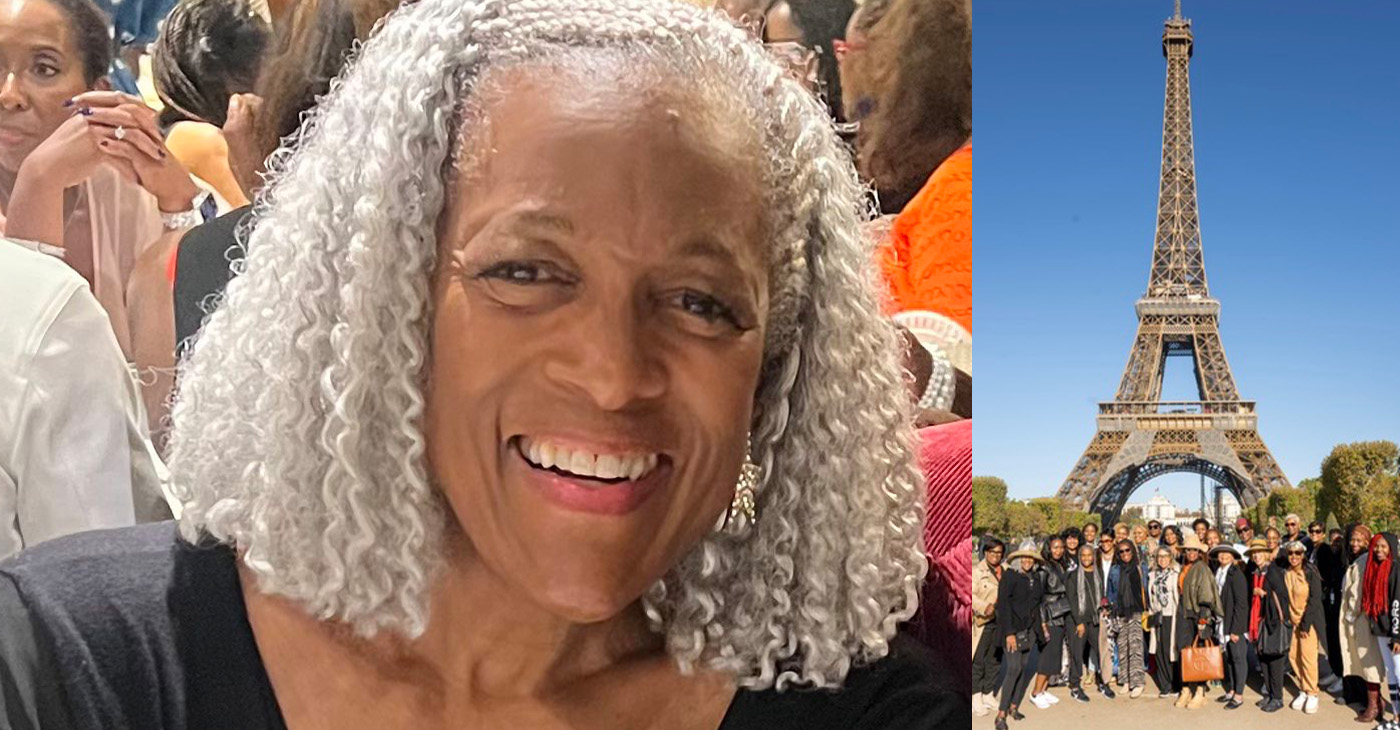
In the late 90s, Stevenson finally realized her dream of living in Paris, now with her daughter. She started exploring the history of Africans in the city and would go on to teach others the same. Her business, which she named Black Paris Tours (BPT), received a significant boost when a family friend gave her a stack of cash and encouraged her to expand on the knowledge that she had only started to share with people she knew.
By Post Staff
There were two things Oakland-born, East Palo Alto-raised Ricki Stevenson always dreamed of:
- Going to New York as a newscaster to tell the true story of Blacks in America.
- Living and working in Paris one day.
Her dreams of life in Paris began when she was three years old and her mother, a former professional dancer, took her to see Josephine Baker perform. She was 11 when her parents took her to the Stanford University campus to meet James Baldwin, who was speaking about his book, “The Fire Next Time.” Ricki says that’s when she knew she’d one day live in Paris, “the city of light!”
But before that would ever happen, she had a tumultuous career as a newscaster across the country that was inspired by her family’s history.
Stevenson recalls marching with Cesar Chavez as he fought for labor rights for farm workers in California.
“Are we Mexican too?” she asked her parents. “No, but we will fight for everyone’s human rights,” they responded to her.
Ironically, Ricki’s paternal family roots went back to Greenwood, Oklahoma, infamous for the 1921 bombing of Black Wall Street. A time when Black people had oil wells, banks, and a thriving business community.
This background would propel her into a 25-year journalism career that gave her the opportunity to interview greats like President Jimmy Carter, PLO leader Yassir Arafat, James Baldwin, Rev. Jesse Jackson, UN Ambassador Andrew Young, Miriam Makeba, and the leaders of South African liberation movements.
A job offer from KCBS radio brought her back to the Bay Area in the 1980s. Then came the switch to TV when she was hired as a Silicon Valley business reporter with KSTS TV, working at the first Black-owned television station in northern CA (created and owned by John Douglas). Along the way, Stevenson worked as an entertainment reporter with BET; coproduced, with her disc jockey brother Isaac, a Bay Area show called “Magic Number Video;” lived in Saudi Arabia; worked as an international travel reporter with News Travel Network; and worked at KRON TV a news anchor and talk show host.
In 1997, Stevenson realized her dream of living in Paris with her young daughter, Dedie. She started exploring the history of Africans in the city and would go on to teach others the same. Her business, which she named Black Paris Tours (BPT), received a significant boost when a family friend, Admiral Robert Toney put a chunk of money in her hand. He said, “Ricki, my wife and I have been coming to Paris for 20 years, but in just two days with you and Dedie, we’ve learned and seen more than we ever did before.”
Years after BPT took off, Ricki met Nawo Carol Crawford and Miguel Overton Guerra, who she recruited as senior scholar guides for Black Paris Tours.
Guerra says he is proud of his work with Black Paris Tours in that it provides a wealth of information about the rich legacy of African and African American history and influence in Paris and Europe.
“I tend to have a feeling for history always being a means of a reference point backwards … you start to understand the history, that it isn’t just the United States, that it began with African people,” Guerra says.
He said that it’s been a pleasure to watch people learn something they didn’t know before and to take them through the city to key points in Black history, like hangout spots for writers like Baldwin and Richard Wright, restaurants in the busiest parts of Paris, the home of Josephine Baker and so much more.
Although the tours are open to all, Guerra hopes that those of African descent from all over the world can embrace that they don’t have to just stay where they are because movies and media have portrayed cities like Paris to be only white, it’s multicultural and accepting to all.
“We’ve been here, and we’ve been there, going way back when. And we shouldn’t be considered or consider ourselves to be strangers in any place that we go to,” he said.
Stevenson notes they’ve had 150,000 people take their tour over the years, with notables like former NFL quarterback Colin Kaepernick, Smokey Robinson, Steve Harvey, Miriam Makeba, and more.
Friends and former media colleagues of Stevenson compliment the BPT crew on their knowledge of the city and their ability to always keep it interesting.
“He [Guerra] just had a deep, deep wealth of knowledge and he was constantly supplanting information with historical facts and the like. I love that it was demonstrating and showing how Black people have thrived in Paris or contributed to the culture in Paris,” Candice Francis said.
She toured in the summer of 2022 and stated that in the two weeks that they visited Paris, BPT was the highlight of her trip. She shared that she was proud of Stevenson and the life she’d managed to manifest and build for herself.
“Even if you’re visiting Paris for the tenth time, if you haven’t taken the tour, then by all means, take it,” Francis emphasized.
Magaly Muñoz, Gay Plair and Paul Cobb also contributed to this story. You can book your own adventure with Black Paris Tours at www.blackparistour.com.



OP-ED: Proposition 44 Would Put a Price on Trust

OP-ED: Proposition 40: It’s Time to Play Chess, Not Checkers

Listening as a Lifeline: A Doula’s Witness to Black Maternal Health

New Protections for Ticket Buyers: Gov. Newsom Signs Assemblymember Isaac Bryan’s Bill

‘We Don’t Talk Trash — We Pick Up Trash!’

Zakiya Jendayi Arrested, Locked Out of Home by Sheriff’s Deputies

Oakland Post: Week of September 30 – October 6, 2026

Asm. Corey Jackson Announces Launch of 24-Hour Childcare in His District

IN MEMORIAM: The Rev. Leon “Sonny” Clark, Longtime Orange County Pastor and Community Leader, Dies at 72

Poll: Becerra Widens His Lead Over Hilton; Californians Split on Wealth Tax

From Historic Memories to New Possibilities: Oakland Celebrates Coliseum 60

County Office of Education Says OUSD Finances Are Getting Healthier, Materially Stronger

LIVE FREE Sunday Dinner Brings Faith, Fellowship and Civic Conversation to Oakland

Remembering Chauncey Bailey as Student Journalists Face Threats to Truth-Telling

BLACspace Cooperative Invites Bay Area to Experience Oakland’s Black Cultural Ecosystem Through a BLAC Map Tour + Party

Standoff for Justice: Our Homes Are Worth Fighting For

Oakland Post: Week of August 26 – September 1, 2026

Frontier Airlines’ Return to Oakland Airport Brings Flights, Jobs and Opportunity

Gubernatorial Candidate Steve Hilton Blasts California New Tire Rules; Newsom Hits Back

Chef Sharon Lee Blends Culinary Excellence, Education and Empowerment

Jackie Wright Champions Bay Area Stories, Filmmakers and Cultural Institutions

Misnamed ‘Parent’ PAC Seeks to Influence Oakland School Board Elections

Oakland Coliseum Project Opens Door for Small Businesses to Build Bigger

Big City Mayors Ask for “Yes” Vote on Housing Bond Measure; Conservatives Say “No”

Gov. Newsom’s Latest Appointees Include Sacramento Advocate for Formerly Incarcerated Students; State’s New Tech Chief

Longtime BWOPA Member Brendalyn Goodall Appointed to California Workforce Development Board

Gov. Newsom Signs Law Shielding Immigration Aid Workers From Doxing Threats

Secretary of State Shirley N. Weber Urges Californians to Vote Early as Voter ID Battle Intensifies

Oakland Post: Week of September 2 – 8, 2026

IN MEMORIAM: Dolly Parton Dead at 80 — How She Built a Legacy of Love and Earned Her Place in Black Culture

The Conversation With Al McFarlane 6/23/26

Media Monday 6/22/26

LIVE! ASK ALMA! — TUES. 6.23.26 7PM EST

Car Buying Secrets: 4 Hidden Checks Before You Sign!

Is This 550 HP Charger Worth YOUR Money? AutoNetwork Review

Celebrating Juneteenth – Frederick Douglass on education and resistance

LIVE! — ASK ALMA! — TUES. 6.19.26 7PM EST

Hyundai Ioniq 5 Parking, Safety, and 360 View #shorts

2025 Ioniq 5 New Wiper & Powerful Performance! #shorts

Electric SUV Range: Is 259 Miles Enough? #shorts

EV Charging: How Fast Can You Charge an Electric Vehicle? #shorts

Biometric Cooling… Messaging Seats…Come on! 2025 Infiniti QX80 Autograph 4WD

Charged Up: Witness the Magic of a Fully Electric Car! #shorts

Range Rover Sport PHEV Included…: See What’s Inside This Luxury SUV! #shorts

Invisible Hood View: Perfect Parking with X-Ray Vision! #shorts
-
 Community3 weeks ago
Misnamed ‘Parent’ PAC Seeks to Influence Oakland School Board Elections
-
 Activism4 weeks ago
Oakland Post: Week of September 2 – 8, 2026
-

 Activism3 weeks ago
Oakland Post: Week of September 9 – 15, 2026
-

 Community3 weeks ago
Richmond Tiny House Village Farm & Garden Set to Open Gates on Sept. 26
-

 Black History3 weeks ago
Latest Massacre in Haiti Reveals Cruelty U.S. Deportations
-

 Black History3 weeks ago
OPINION: Nolan Wells’ Death One of Several Signifying Racial Terror Lives on in U.S. South
-

 Business2 weeks ago
Mayor Lee Announces $1 Million Kaiser Permanente Grant for Pilot Program to Address Homelessness, Clean Up Public Spaces throughout Oakland
-

 Community3 weeks ago
Democratic Clubs Interview Candidates for Oakland School Board
