
Bay Area
A Call for Self-Care for Restorers of Wellness
Where would our community be without the aid, guidance, and support of our treatment providers, practitioners, and restorers of wellness? Clinicians, counselors, doulas, midwives, medical doctors, nurses, nutritionists, therapists, and psychologists, among other restorers of wellness, have the capacity and potential to offer individuals, families, and communities from all walks of life medical, emotional, spiritual, and ancestral healing and restoration.

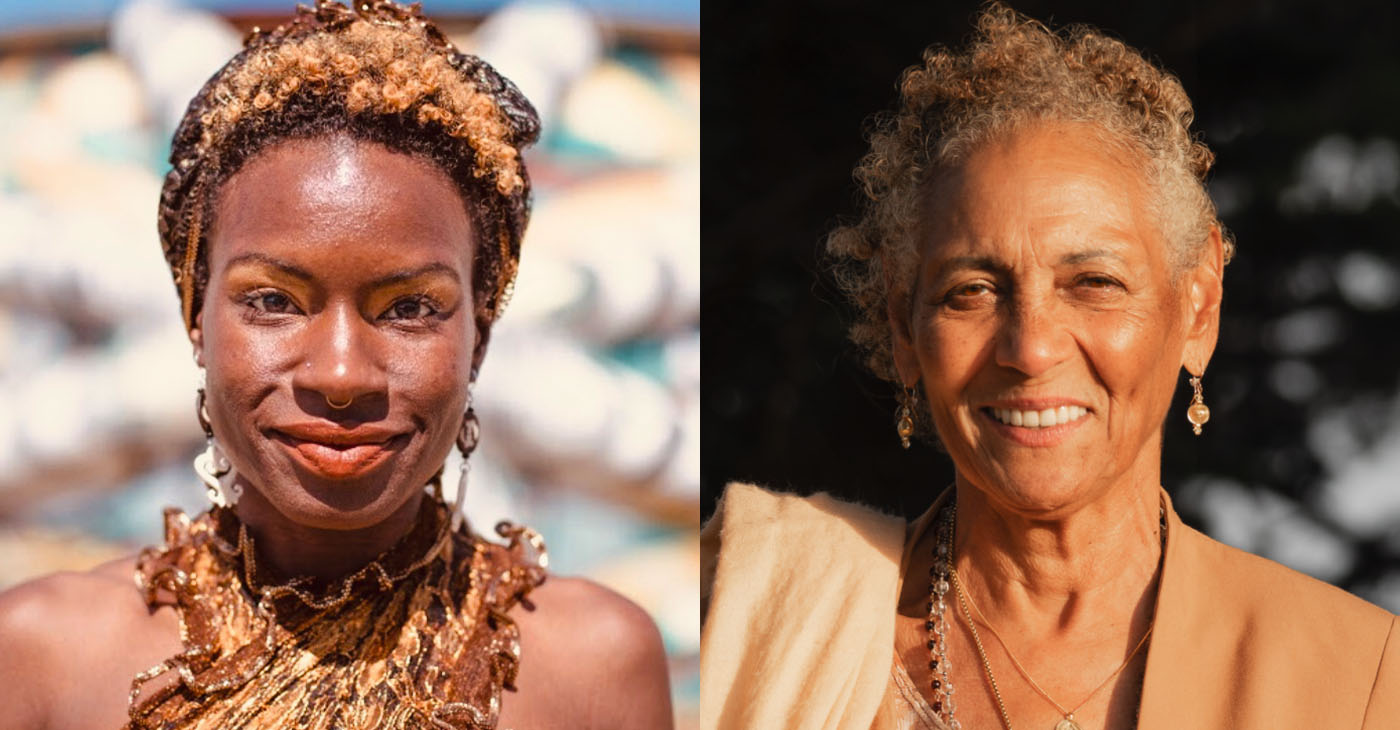
By Kumari Fabio, MA and Daktari S. Hicks, PsyD
Where would our community be without the aid, guidance, and support of our treatment providers, practitioners, and restorers of wellness?
Clinicians, counselors, doulas, midwives, medical doctors, nurses, nutritionists, therapists, and psychologists, among other restorers of wellness, have the capacity and potential to offer individuals, families, and communities from all walks of life medical, emotional, spiritual, and ancestral healing and restoration.
We would truly be at a loss without our dedicated wellness warriors who remedy our visible and invisible wounds and restore us to sound health, well-being, and optimal functioning. We offer appreciation, supreme gratitude, and the utmost respect, particularly to our African American and Afro-Diasporic restorers of wellness, who continue to dress our wounds despite enduring day-to-day battle scars themselves from ongoing oppression, insidious discrimination, everyday racism, and race-based traumatic stress.
What happens when our healing practitioners need nursing, mending, and healing of their own? Who is healing the healers? How do restorers of wellness care for themselves?
We call for enhanced and increased “self-care” for our restorers of wellness. Self-care essentially means activities we can engage in to attend to the needs of our mind, body, and spirit. Self-care is ultimately concerned with engaging in emotional, personal, physical, social, spiritual, and ancestral endeavors to evoke acceptance, awareness, bliss, calmness, forgiveness, love, relaxation, tranquility, inner divine presence, self-healing power/potential, peace, and pleasure.

Restorers of wellness must practice self-care regularly.
Taking time for self-care is vital for restorers to ensure proper health and well-being physically, mentally, energetically, and spiritually. Providers offer services to those in need, and at times, at a cost to themselves. For example, ‘burnout’ can occur when providers provide support to clients in an unbalanced way and fail to separate themselves from the adversity/stress of work and stressors in their clients’ lives. Routine self-care can serve as a guard and buffer against career burnout; rejuvenate/reset our health, our life, and our priorities; and lead to a balanced, sustainable, satisfying, and less stressful life.
There are many ways practitioners can take advantage of self-care skills and practices by setting aside time to focus on personal needs and eliminating unnecessary distractions. For instance, engaging in introspection, quiet self-reflection, and meditation is essential in maximizing your emotional and psychological well-being.
The disciplined practice of self-care encourages providers to listen deeply, practice self-love/loving-kindness, and discover ways to nurture/nourish themselves.
Some suggestions for self-care include acknowledging feelings, accepting what you can’t control, being honest with yourself, connecting with nature, communicating with your ancestors/community, creating art, creating a wellness plan, cuddling with a loved one, disconnecting from your cell phone/email/social media, dancing down the street, going for a spontaneous day/weekend trip, making a gratitude list, making a vision board, playing at a playground, spending time in the sunshine, sitting in a drum circle, slowing down from rushing, sound bathing, sleeping in, taking a power nap, taking breaks from the news, reading a book/journal article, and tuning into moments of bliss/freedom/joy.
The ABPsi-Bay Area Chapter is committed to providing the Post Newspaper readership with monthly discussions about critical issues in Black Mental Health. The ABPsi-Bay Area Chapter is a healing resource. Readers are welcome to join us at our monthly chapter meetings every 3rd Saturday via Zoom. We can be contacted at bayareaabpsi@gmail.com.










Activism
Oakland Post: Week of September 16 – 22, 2026
The printed Weekly Edition of the Oakland Post: Week of September 16 – 22, 2026

To enlarge your view of this issue, use the slider, magnifying glass icon or full page icon in the lower right corner of the browser window.
Activism
Oakland Post: Week of September 9 – 15, 2026
The printed Weekly Edition of the Oakland Post: Week of September 9 – 15, 2026

To enlarge your view of this issue, use the slider, magnifying glass icon or full page icon in the lower right corner of the browser window.
Activism
Oakland Post: Week of September 2 – 8, 2026
The printed Weekly Edition of the Oakland Post: Week of September 2 – 8, 2026
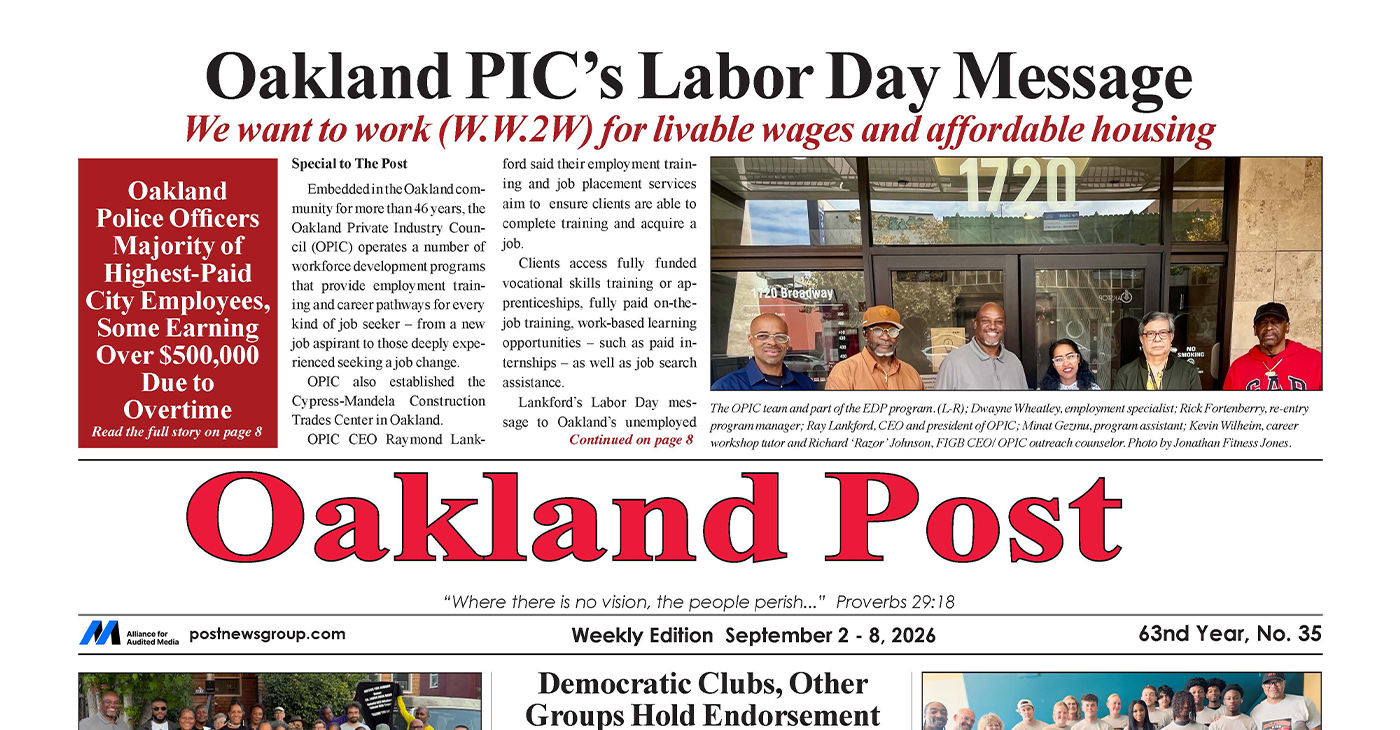
To enlarge your view of this issue, use the slider, magnifying glass icon or full page icon in the lower right corner of the browser window.



Doulas Are Helping Black California Moms Navigate Pregnancy–Even as High Mortality Rates Persist

Newsom Signs Addictive Social Media Law to Protect Kids

On Your November Ballot: Prop 38 Would Allocate $8.4 Billion to Immunology and Immunotherapy Funding

Ask California: Golden State Releases New AI Chatbot

Asm. Isaac Bryan’s Bill Banning California Police From ICE Side Jobs Reaches Newsom’s Desk

Assemblymember LaShae Sharp-Collins’s Bill Would Pause Law Enforcement’s Use of Shock Gloves Pending Study

BOOK REVIEW: ‘Laws of Solomon’ Reveals Tender Heart of Former Child Soldier

OPINION: The New American Fear – From 9-11 to AI

Passing for White, Fighting for Black America: The Courage of Walter White

Oakland People’s Arms Embargo Coalition Demands End to Military Shipments Thru Oakland

Barbara Lee Mourns Gloria Steinem, Remembers a Friendship Rooted in Equality

Event Preview: ‘Fashion v. Fascism’ – A Runway Revolution Is Coming to the Bay Area

Two Looming Threats Every Alameda County Elder Should Know About

Oakland Mayor Reads to Children at Bookout Block Party at Marcus Books Store

Tradition Comes to the Streets in 11th Annual Black-Eyed Pea Festival at the Freedom Farmers Market

Less Affluent School Districts, Including Sacramento City, Face Threat of State Takeover

ESSAY: California Can Close Its Colorectal Cancer Gap

California Hispanic Chambers of Commerce Unveils: ‘Powering the Future’ Theme for 47th Annual Statewide Convention

Four Candidates, Including Incumbent Barbara Lee, Qualify for Oakland Mayor’s Race

Oakland Post: Week of August 12 – 18, 2026

From Blueprint to Breakthrough: Tackling Affordable Housing in Oakland

Oakland Observes Black August with Block Parties, Film Showings, Workshops

COMMENTARY: Why Local School Tax Measure G1 Will Not Be on the November Ballot

Standoff for Justice: Our Homes Are Worth Fighting For

Returning to Its Roots, the Oakland Black-Eyed Pea Festival Partners with the Freedom Farmers Market Sept. 12

NPRC Scores First Advocacy Victory: David Shaw Finally Gets His Wish to ‘Go Home’

Oakland Post: Week of August 26 – September 1, 2026

Frontier Airlines’ Return to Oakland Airport Brings Flights, Jobs and Opportunity

Gubernatorial Candidate Steve Hilton Blasts California New Tire Rules; Newsom Hits Back

Chef Sharon Lee Blends Culinary Excellence, Education and Empowerment

The Conversation With Al McFarlane 6/23/26

Media Monday 6/22/26

LIVE! ASK ALMA! — TUES. 6.23.26 7PM EST

Car Buying Secrets: 4 Hidden Checks Before You Sign!

Is This 550 HP Charger Worth YOUR Money? AutoNetwork Review

Celebrating Juneteenth – Frederick Douglass on education and resistance

LIVE! — ASK ALMA! — TUES. 6.19.26 7PM EST

Hyundai Ioniq 5 Parking, Safety, and 360 View #shorts

2025 Ioniq 5 New Wiper & Powerful Performance! #shorts

Electric SUV Range: Is 259 Miles Enough? #shorts

EV Charging: How Fast Can You Charge an Electric Vehicle? #shorts

Biometric Cooling… Messaging Seats…Come on! 2025 Infiniti QX80 Autograph 4WD

Charged Up: Witness the Magic of a Fully Electric Car! #shorts

Range Rover Sport PHEV Included…: See What’s Inside This Luxury SUV! #shorts

Invisible Hood View: Perfect Parking with X-Ray Vision! #shorts
-
 Commentary4 weeks ago
Standoff for Justice: Our Homes Are Worth Fighting For
-
 Activism4 weeks ago
Oakland Post: Week of August 26 – September 1, 2026
-
 Business4 weeks ago
Frontier Airlines’ Return to Oakland Airport Brings Flights, Jobs and Opportunity
-
 Business4 weeks ago
Gubernatorial Candidate Steve Hilton Blasts California New Tire Rules; Newsom Hits Back
-
 Business4 weeks ago
Chef Sharon Lee Blends Culinary Excellence, Education and Empowerment
-

 Education4 weeks ago
Gov. Newsom’s Latest Appointees Include Sacramento Advocate for Formerly Incarcerated Students; State’s New Tech Chief
-

 Community4 weeks ago
Big City Mayors Ask for “Yes” Vote on Housing Bond Measure; Conservatives Say “No”
-

 Business4 weeks ago
Oakland Coliseum Project Opens Door for Small Businesses to Build Bigger
