
Community
Two Looming Threats Every Alameda County Elder Should Know About
Federal changes enacted under H.R. 1 are bringing new eligibility, reporting, and coverage rules beginning in 2027. Although Californians age 65 and older and people with disabilities are exempt from the new 80-hour-per-month work requirement and will continue with annual rather than six-month renewals, that does not mean elders can ignore the coming changes.


Alameda County elders are urged to attend the Elder Justice Symposium at Oakland City Hall on Sept. 25, from 9 a.m. to 5 p.m., for information that could profoundly affect both their health care and the legacy they hope to leave their families.
For many older adults, a lifetime of hard work has produced two things they understandably want to protect: access to health care while they are living and the home, savings, and other assets they hope to pass to loved ones when they die.
Changes already underway in California make understanding how to protect both increasingly urgent.
The first threat involves Medi-Cal.
Federal changes enacted under H.R. 1 are bringing new eligibility, reporting, and coverage rules beginning in 2027. Although Californians age 65 and older and people with disabilities are exempt from the new 80-hour-per-month work requirement and will continue with annual rather than six-month renewals, that does not mean elders can ignore the coming changes.
California has already reinstated an asset test for certain Medi-Cal recipients age 65 and older, people with disabilities and those needing long-term care. Assets must be reported when applying or renewing coverage.
And another significant change is coming.
Beginning July 1, 2027, California says the Medi-Cal asset limit for affected beneficiaries will fall from $130,000 for one person to just $21,000, and to $31,000 for two people, with certain assets excluded and special rules applying in some circumstances.
There is more. Beginning Jan. 1, 2027, Medi-Cal’s retroactive coverage period will also shrink. For most beneficiaries outside the ACA expansion adult group, coverage of qualifying medical expenses incurred before application will be reduced from three months to two.
For an elder facing hospitalization, long-term care or an unexpected medical crisis, misunderstanding these rules could have enormous financial consequences.
The second threat concerns what happens to everything you worked so hard to acquire.
Many people believe, “I have a will and a living trust, so my family is protected.”
It may not be that simple.
An estate plan is only as effective as the way it has been structured, maintained and implemented. How assets are titled, whether a trust has actually been funded, beneficiary designations, Medi-Cal eligibility and long-term-care planning can all affect whether a person’s wishes are ultimately carried out.
A will by itself does not automatically avoid probate, and simply possessing trust documents does not mean every asset has been properly protected or positioned to pass as intended.
That is why elders should learn the rules before a medical crisis, incapacity or death makes planning far more difficult.
At the Elder Justice Symposium, experts will explain these changes in understandable language and discuss steps that elders and their families should consider now.
Attendees will have an opportunity to learn what questions to ask about Medi-Cal eligibility and renewals, asset limits, estate planning and protecting the legacy they intend for their families.
Do not assume the rules you learned years ago are still the rules governing you today.
Come to Oakland City Hall on Sept. 25, from 9 a.m. to 5 p.m.
Bring your questions. Bring your family. Most importantly, bring a willingness to prepare.
The decisions you make before these changes take full effect could profoundly affect your health care, your financial security, and what remains for the people you love.





Community
Assemblymember LaShae Sharp-Collins’s Bill Would Pause Law Enforcement’s Use of Shock Gloves Pending Study
The device at the center of the debate is known as the G.L.O.V.E., an acronym for Generated Low Output Voltage Emitter. U.S. Immigration and Customs Enforcement awarded a $16.7 million contract for 6,000 pairs of the gloves, which are designed to deliver an electric shock through an officer’s hand.
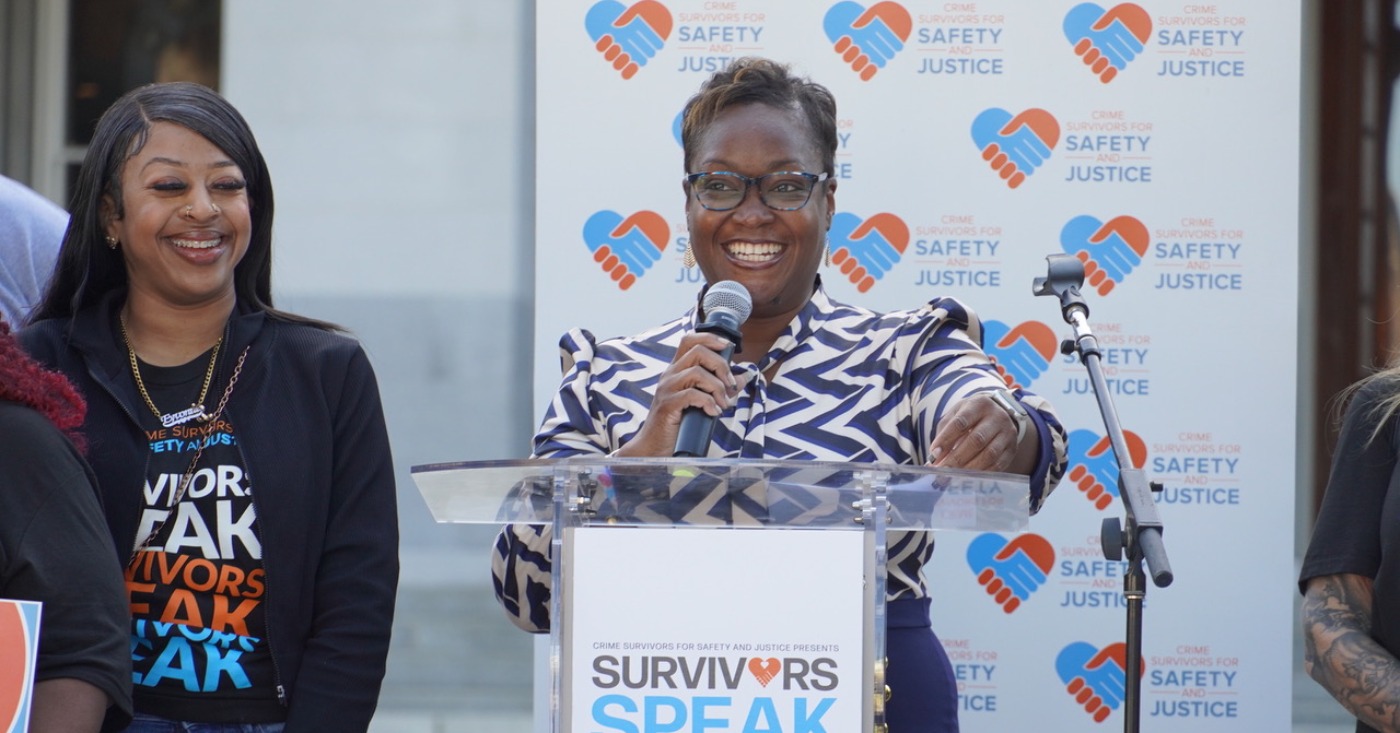
A bill temporarily prohibiting law enforcement agencies from using electric shock gloves in California is awaiting action by Gov. Gavin Newsom.
Assembly Bill (AB) 2760, authored by Assemblymember LaShae Sharp-Collins (D-San Diego), passed the Senate 29-9 on Aug. 31. The Assembly concurred in Senate amendments the same day on a 55-16 vote.
The bill would prohibit state, local and federal law enforcement agencies from using wearable electroshock devices in California until Jan. 1, 2030. It would also bar agencies from using state funds to purchase the devices and require them to update their use-of-force policies accordingly.
Traditional handheld devices, including tasers and stun guns, are exempt.
Newsom has until Sept. 30 to sign or veto the bill. If he takes no action, it will become law without his signature.
Sharp-Collins introduced the measure after reviewing information indicating that the devices could cause serious injury or death if used without adequate safeguards and training.
“AB 2760 draws a line that public safety technology must be proven safe and accountable before it is employed. Not after someone is killed or injured,” said Sharp-Collins, a member of the California Legislative Black Caucus (CLBC).
“Our commitment is to protect our communities, especially the most vulnerable. That is what AB 2760 is about and that is what AB 2760 will do,” Sharp-Collins told her colleagues.
The device at the center of the debate is known as the G.L.O.V.E., an acronym for Generated Low Output Voltage Emitter. U.S. Immigration and Customs Enforcement awarded a $16.7 million contract for 6,000 pairs of the gloves, which are designed to deliver an electric shock through an officer’s hand.
During the Assembly debate, Assemblymember Rhodesia Ransom (D-Stockton), also a CLBC member, thanked law enforcement representatives for helping negotiate amendments to the bill.
“This is something new to us (and) it’s something that absolutely should be studied,” Ransom said. “I appreciate law enforcement for agreeing to work with the legislature to figure out if this is an appropriate tool to be used.”
Neither the Los Angeles County Sheriff’s Department nor the Los Angeles Police Department has reported using electric shock gloves. However, the Santa Monica and El Monte police departments have obtained devices for testing.
The Sacramento County Sheriff’s Office purchased 10 shock gloves as part of a $35,000 acquisition that also included 10 remotely activated shock bands. Sheriff’s officials had been developing training and policies for the devices before AB 2760 advanced.
State Sen. Tony Strickland (R-Huntington Beach) opposed the legislation, arguing that it would unnecessarily force agencies to change their use-of-force policies and could compromise public safety.
“I don’t disagree with the author that the electric shocks are not a great option, but at the end of the day, I think it’s important to understand that we need to give law enforcement the tools they need to keep themselves safe and the community safe,” Strickland said.
Supporters countered that wearable electroshock devices have not been sufficiently studied and could pose particular risks to immigrants, children, older adults and other vulnerable groups.
“People who are Black or Brown could be test subjects for these gloves of torment,” Mark González (D-Los Angeles) said. “I appreciate law enforcement for agreeing to work with the legislature.”
Commentary
OPINION: The New American Fear – From 9-11 to AI
The terrorists didn’t invent American racism, xenophobia or political paranoia. We shouldn’t give 19 hijackers that much credit. But after 9/11, America built an enormous security structure around fear. Surveillance expanded. Wars followed. Congress created the Department of Homeland Security. TSA transformed airports. Immigration enforcement was reorganized and ICE was created.

I was quiet about 9/11 until this week, when terrorism got an upgrade.
Artificial intelligence.
I have taken 9/11 seriously every year. Twenty-five years later, I was all “feeled out.”
I’ve gone to Ground Zero. I’ve written about the dead, the survivors, the first responders and those who survived that day only to become sick years later.
But this isn’t another column about where we were.
It’s about what America became.
For me, September 11, 2001, marks the beginning of a New America. Not the diverse, multicultural America I hoped was emerging.
This is the America that fear built.
I was 3,000 miles away in the Bay Area watching CNBC.
Then the planes hit.
The markets shut down.
And something else opened.
Fear.
At first, fear brought us together. We had a common enemy and, briefly, rediscovered a common good.
But fear is a terrible foundation for democracy.
The person we feared was initially the terrorist.
Then the Muslim.
Then the Arab.
Then the Sikh mistaken for an Arab.
Then the immigrant. The undocumented. The person at the border.
The category continues to expand.
Maybe that’s the real 25-year story of 9/11.
We went from finding common ground to looking for flaws that prove somebody doesn’t belong.
The terrorists didn’t invent American racism, xenophobia or political paranoia. We shouldn’t give 19 hijackers that much credit.
But after 9/11, America built an enormous security structure around fear.
Surveillance expanded. Wars followed. Congress created the Department of Homeland Security. TSA transformed airports. Immigration enforcement was reorganized and ICE was created.
Temporary emergency became permanent infrastructure.
Recently, Anthropic researcher Jacob Coxon quit his job and warned that people building advanced AI genuinely believe it could kill humanity by the end of this decade.
He walked away two months before his Anthropic equity vested.
That’s credibility.
President Trump has taken a different view. On Sept. 14 he called fears of AI destroying humanity a “HOAX” and declared, “WHOEVER WINS AI, WINS!” He said the only guardrail AI needs is a “STRONG AND SMART (High IQ!) PRESIDENT.”
We have built the threat.
We finance it. We feed it our words, photographs, voices, art and knowledge. We invite it into our homes and carry it in our pockets.
Americans are confronting something genuinely frightening.
AI could eliminate or transform jobs. And its increasingly powerful systems raise questions even some of their creators say they cannot fully answer.
So, the question what do we do with fear without surrendering our common humanity.
That requires real leadership and oversight from Congress, if not the president.
Trump insists Iran can’t have a nuclear weapon. But on AI, his emphasis is winning the race, especially against China.
That’s the trap.
Fear of China becomes the argument for going full speed ahead.
Twenty-five years after 9/11, we have another chance to get fear right.
Be smart enough to know what to be afraid of.
And make sure we stay in control of the tech.
We’ve got to be smarter than the machines.
About the Author
Emil Amok Guillermo is an award-winning journalist, commentator and comic monologist. He hosts a micro-talk show on YouTube. See him at Comedy Day at Robin Williams Meadow in San Francisco’s Golden Gate Park, on Sept. 20, around 2:45 p.m. Free.
Commentary
Barbara Lee Mourns Gloria Steinem, Remembers a Friendship Rooted in Equality
Steinem became one of the country’s most recognizable advocates for women’s rights, reproductive alternatives and political representation. Lee said one of the most persistent inequities confronting Black women was inadequate access to reproductive healthcare, an issue Lee addressed throughout her years in the California Legislature and Congress.
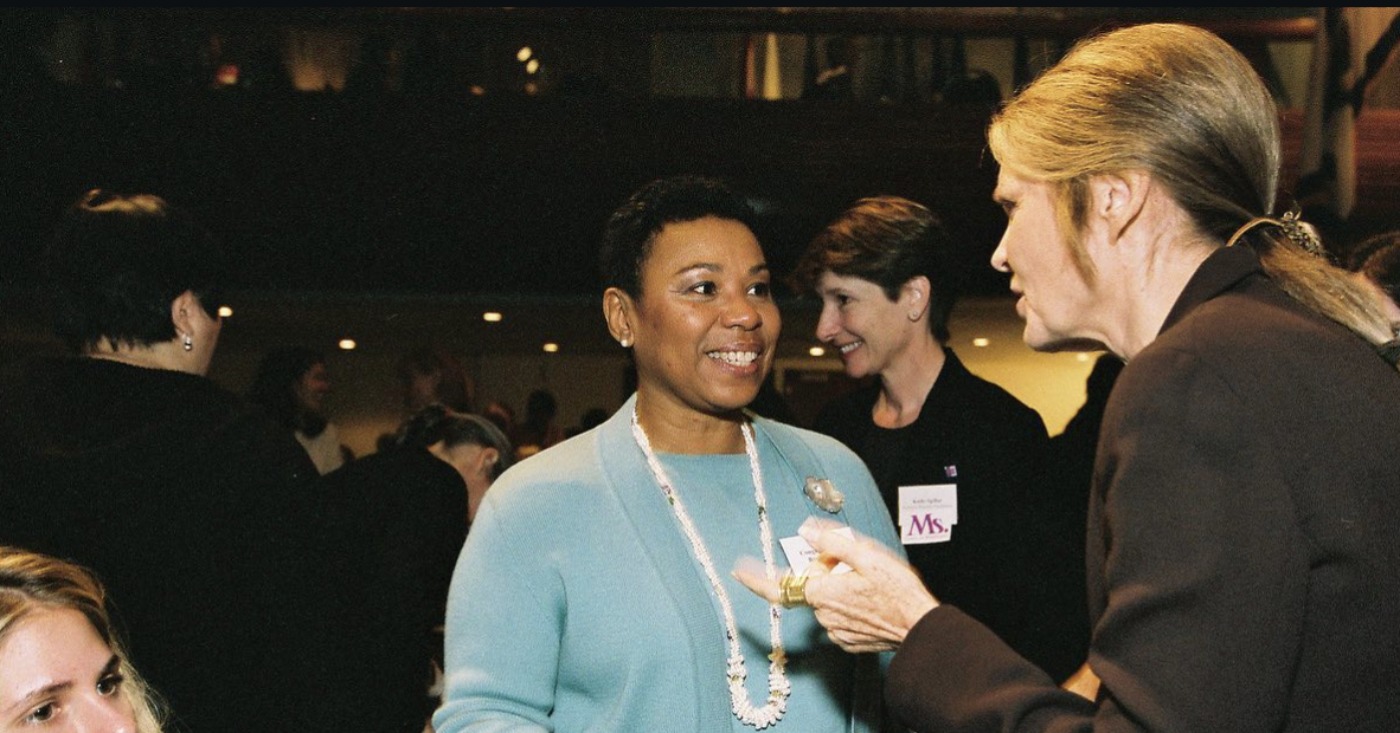
Oakland Mayor Barbara Lee is mourning the death of her longtime friend Gloria Steinem, remembering the feminist icon as a devoted ally who understood that the struggles for racial justice and gender equality were inseparable.
Steinem died Sept. 2 in New York City at the age of 92. A pioneering journalist, author and political activist, she spent more than six decades advocating for women’s equality and reproductive choices. She also co-founded Ms. magazine and the National Women’s Political Caucus.
“I called her recently and could hear the weakness in her voice,” Lee said. “She was also very fragile at my New York event, but she remained supportive.”
The friendship between Lee and Steinem grew from their connections to the late U.S. Rep. Shirley Chisholm, the first Black woman elected to Congress and the first Black candidate to seek a major political party’s presidential nomination.
Chisholm was Lee’s mentor and inspired her to enter politics. Lee worked on Chisholm’s historic 1972 presidential campaign and served as one of her delegates at the Democratic National Convention.

According to Lee, Chisholm helped Steinem deepen her understanding of racial inclusion and recognize that the women’s movement could not succeed without addressing the experiences of Black women and other women of color.
“Gloria really understood what racial equity was about as a white woman and knew the value of building coalitions,” Lee said.
Steinem became one of the country’s most recognizable advocates for women’s rights, reproductive alternatives and political representation. Lee said one of the most persistent inequities confronting Black women was inadequate access to reproductive healthcare, an issue Lee addressed throughout her years in the California Legislature and Congress.
Lee considered Steinem a genuine ally who recognized the intersections of race, gender, healthcare and economic opportunity. Steinem also understood the importance of elevating women into leadership positions and encouraging them to claim their rightful places at decision-making tables.
Their relationship extended beyond politics and public advocacy. Lee recalled joining Steinem and her husband for dinner in Manhattan Beach with Lee’s son, Tony.
“It was beautiful to see how she could be a wonderful wife, feminine and be a strong woman,” Lee said.
Tony Lee also had a professional connection to Steinem through the rerelease of “The Road to Galveston,” the 1996 television film he wrote about the life of his grandmother, Mildred Parish Massey. The film starred Cicely Tyson.
“My son’s tribute to Gloria on Facebook is very touching,” Lee said.
Lee expressed profound heartbreak over losing her friend and gratitude for Steinem’s support throughout her political career, including during reelection campaigns.
As Lee continues carrying forward the lessons of Chisholm and Steinem, she has also helped encourage a new generation of women leaders, including U.S. Reps. Lateefah Simon and Jasmine Crockett.



Assemblymember LaShae Sharp-Collins’s Bill Would Pause Law Enforcement’s Use of Shock Gloves Pending Study

BOOK REVIEW: ‘Laws of Solomon’ Reveals Tender Heart of Former Child Soldier

OPINION: The New American Fear – From 9-11 to AI

Passing for White, Fighting for Black America: The Courage of Walter White

Oakland People’s Arms Embargo Coalition Demands End to Military Shipments Thru Oakland

Barbara Lee Mourns Gloria Steinem, Remembers a Friendship Rooted in Equality

Event Preview: ‘Fashion v. Fascism’ – A Runway Revolution Is Coming to the Bay Area

Two Looming Threats Every Alameda County Elder Should Know About

Oakland Mayor Reads to Children at Bookout Block Party at Marcus Books Store

Tradition Comes to the Streets in 11th Annual Black-Eyed Pea Festival at the Freedom Farmers Market

Attorney General Rob Bonta Continues Opposition to President Trump’s Tariff Regime

Neighborhood Empowerment Day in Deep East Oakland Brings Community Together After Recent Tragedy

Community Action Group ‘Friends of Zakiya’ Ask Sheriff for Time

Oakland Launches Aerbits Program to Identify, Report Abandoned Trash

Mayor Lee Announces $1 Million Kaiser Permanente Grant for Pilot Program to Address Homelessness, Clean Up Public Spaces throughout Oakland

Department of Homeland Security Demands California Secretary of State Shirley N. Weber Scrub Voter Rolls

“The Power to See Threats Sooner”: Gov. Newsom, Safety Officials Showcase California’s Investments in Hi-Tech Wildfire Prevention

California Sen. Padilla Joins Colleagues to Introduce Bill Imposing Term Limits on Supreme Court Justices

Less Affluent School Districts, Including Sacramento City, Face Threat of State Takeover

Car Wash Workers Cope with Lingering Impacts of ICE Raids

ESSAY: California Can Close Its Colorectal Cancer Gap

As Part of Your Back-to- School Checklist, Vaccinate

Oakland ‘Port Serves as a Powerful Engine for Good Jobs and Economic Development

Gov. Newsom Announces $109.6 Million in Funding for 278 Supportive Homes in Bakersfield, Contra Costa, Sacramento and Fresno

California Hispanic Chambers of Commerce Unveils: ‘Powering the Future’ Theme for 47th Annual Statewide Convention

Congresswoman Simon Demands Investigation into Trump’s Abuse of Emergency Powers for Coal Export Terminal in West Oakland

Four Candidates, Including Incumbent Barbara Lee, Qualify for Oakland Mayor’s Race

Oakland Post: Week of August 12 – 18, 2026

From Blueprint to Breakthrough: Tackling Affordable Housing in Oakland

Oakland Observes Black August with Block Parties, Film Showings, Workshops

The Conversation With Al McFarlane 6/23/26

Media Monday 6/22/26

LIVE! ASK ALMA! — TUES. 6.23.26 7PM EST

Car Buying Secrets: 4 Hidden Checks Before You Sign!

Is This 550 HP Charger Worth YOUR Money? AutoNetwork Review

Celebrating Juneteenth – Frederick Douglass on education and resistance

LIVE! — ASK ALMA! — TUES. 6.19.26 7PM EST

Hyundai Ioniq 5 Parking, Safety, and 360 View #shorts

2025 Ioniq 5 New Wiper & Powerful Performance! #shorts

Electric SUV Range: Is 259 Miles Enough? #shorts

EV Charging: How Fast Can You Charge an Electric Vehicle? #shorts

Biometric Cooling… Messaging Seats…Come on! 2025 Infiniti QX80 Autograph 4WD

Charged Up: Witness the Magic of a Fully Electric Car! #shorts

Range Rover Sport PHEV Included…: See What’s Inside This Luxury SUV! #shorts

Invisible Hood View: Perfect Parking with X-Ray Vision! #shorts
-

 Commentary3 weeks ago
Standoff for Justice: Our Homes Are Worth Fighting For
-

 Activism3 weeks ago
Oakland Post: Week of August 26 – September 1, 2026
-

 Business3 weeks ago
Gubernatorial Candidate Steve Hilton Blasts California New Tire Rules; Newsom Hits Back
-

 Business3 weeks ago
Frontier Airlines’ Return to Oakland Airport Brings Flights, Jobs and Opportunity
-

 Business3 weeks ago
Chef Sharon Lee Blends Culinary Excellence, Education and Empowerment
-

 Education3 weeks ago
Gov. Newsom’s Latest Appointees Include Sacramento Advocate for Formerly Incarcerated Students; State’s New Tech Chief
-

 Business3 weeks ago
Oakland Coliseum Project Opens Door for Small Businesses to Build Bigger
-

 Community3 weeks ago
Big City Mayors Ask for “Yes” Vote on Housing Bond Measure; Conservatives Say “No”
