
#NNPA BlackPress
A Five-Hundred-Year-Old Shared History
BLACKPRESSUSA NEWSWIRE — Slavery, and the global political, socio-economic, and banking systems that supported it, constitute one of the greatest tragedies in the history of humanity, both in terms of scale and duration.

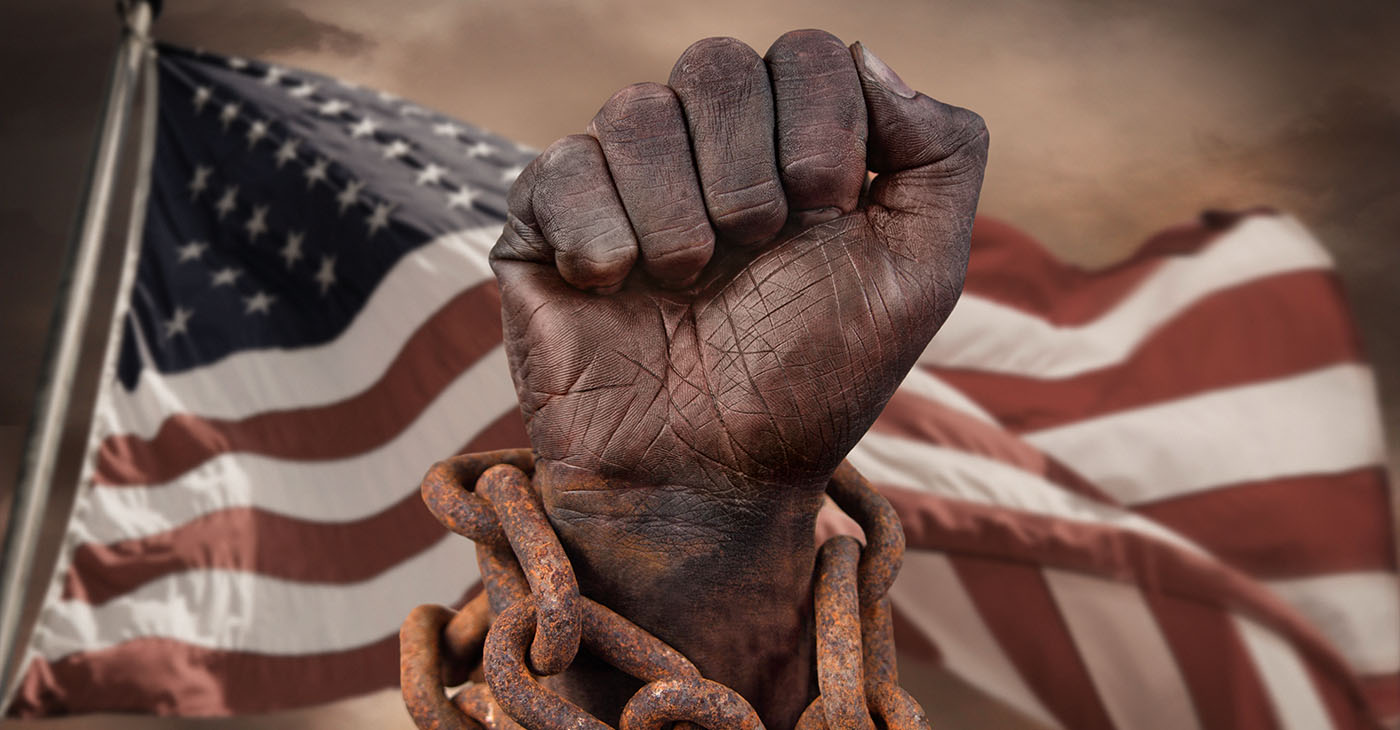
The Transatlantic Slave Trade is not just Black history—it is American history, and Black Americans lived it. Their ancestors were violently torn from their homes, forced into brutal labor, and stripped of basic humanity. That legacy of injustice echoes loudly in every aspect of our society—because the slave trade wasn’t just cruel, it was foundational.
Yet today, that truth itself is under attack. President Donald Trump denounced the Smithsonian Institution as allegedly “out of control” for telling the unvarnished history of slavery—claiming museums focus too much on how bad slavery was and not enough on “brightness” or success, even as his administration reviews exhibits and threatens funding cuts to sanitize the narrative. He dismissed honest reflection as “woke,” arguing it undermines national pride.
We are re-running this series, which we originally published in 2019, each day because confronting our painful past is urgent—and because critics who erase suffering do so to keep oppression alive.
By Stacy M. Brown
Black Press USA Senior National Correspondent
“It started with slave ships… There are more records of slave ships than one would dream. It seems inconceivable until you reflect that for 200 years, ships sailed carrying cargo of slaves. How can man be nonviolent… in the face of the… violence that we’ve been experiencing for the past (500) years is actually doing our people a disservice; in fact, it’s a crime, it’s a crime.” — Public Enemy- “Can’t Truss It.” The transatlantic slave trade is often regarded as the first system of globalization and lasted from the 16th century through much of the 19th century. Slavery, and the global political, socio-economic, and banking systems that supported it, constitute one of the greatest tragedies in the history of humanity, both in terms of scale and duration.

The transatlantic slave trade was the largest mass deportation of humans in history and a determining factor in the world economy of the 18th century, where millions of Africans were torn from their homes, deported to the American continent, and sold as slaves, according to the United Nations Educational, Scientific and Cultural Organization – or UNESCO. The transatlantic slave trade that began about 500 years ago connected the economies of three continents, with Spain, Portugal, the Netherlands, England, and France acting as the primary trading countries.
“The transatlantic slave trade transformed the Americas,” wrote Dr. Alan Rice, a Reader in American Cultural Studies at the University of Central Lancashire in Preston, the United Kingdom. “Three factors combined to cause this transformation. Large amounts of land had been seized from Native Americans and were not being used,” Rice said. “Europeans were looking for somewhere to invest their money, and very cheap labor was available in the form of enslaved Africans; thus, the Americas became a booming new economy.” The transatlantic slave trade also formed an essential bridge between Europe’s New World and its Asia trade and, as such, it was a crucial element in the development of the global economy in the 18th century, Professor Robert Harms wrote for Yale University’s “Global Yale.”
Harms, a professor of History at Yale and chair of the Council on African Studies, continued: “There was one basic economic fact – little noticed by historians – that provides the key to the relationship between the direct trade and the circuit trade. “When a French ship arrived in the New World with a load of slaves to be bartered for sugar, the value of the slaves equaled about twice as much sugar as the ship could carry back to France. For that reason, the most common form of slave contract called for fifty percent of the sugar to be delivered immediately and the remainder to be delivered a year later. “The second delivery carried no interest penalty, and so the slave sellers were in effect giving the buyers an interest-free loan.”
In total, UNESCO estimates that between 25 and 30 million people — men, women, and children — were deported from their homes and sold as slaves in the different slave trading systems. More than half – 17 million – were deported and sold during the transatlantic slave trade, a figure that UNESCO historians said doesn’t include those who died aboard the ships and during the course of wars and raids connected to the slave trade. The trade proceeded in three steps. The ships left Western Europe for Africa loaded with goods that were to be exchanged for slaves. Upon their arrival in Africa, the captains traded their merchandise for captive slaves. Weapons and gunpowder were the most important commodities, but textiles, pearls, and other manufactured goods, as well as rum, were also in high demand.
The exchange could last from one week to several months. The second step was the crossing of the Atlantic. Africans were transported to America to be sold throughout the continent. The third step connected America to Europe. The slave traders brought back mostly agricultural products produced by the slaves. The main products were sugar, cotton, coffee, tobacco, and rice. The circuit lasted approximately eighteen months, and, to be able to transport the maximum number of slaves, the ship’s steerage was frequently removed, historians said. Many researchers are convinced that the slave trade had more to do with economics than racism. “Slavery was not born of racism; rather, racism was the consequence of slavery,” historian Eric Williams wrote in his study, “Capitalism & Slavery.”
“Unfree labor in the New World was brown, white, black, and yellow; Catholic, Protestant, and pagan. The origin of Negro slavery? The reason was economic, not racial; it had to do not with the color of the laborer, but the cheapness of the labor,” Williams said. Also, contrary to “the popular portrayal of African slaves as primitive, ignorant and stupid, the reality is that not only were Africans skilled laborers, they were also experts in tropical agriculture,” said editor and social media and communications expert, Michael Roberts. In a dissertation for op-ed news earlier this year, Roberts said, Africans were well-suited for plantation agriculture in the Caribbean and South America. Also, the high immunity of Africans to malaria and yellow fever, compared to white Europeans and the indigenous peoples of the Caribbean and South America, meant Africans were more suitable for tropical labor. “While Native Americans’ labor were initially used, Africans were the final solution to the acute labor problem in the New World,” Roberts said.
“The slave trade was one of the most important business enterprises of the 17th century. The undisputed fact is that the nation states of Europe stabilized themselves and developed their economies mainly at the expense of millions of Black African people,” he said. During the 16th Century, when Europeans first made regular contact, West Africa had highly developed civilizations, and Africans were keen to trade their gold, silver, copper, Ivory, and spices for European pots, pans, cloth, and guns. However, Europeans soon became more interested in exploiting the people of Africa and forcing them into slave labor. Most of the slaves were taken from the West coast, but some were kidnapped further inland from the interior.
“The biggest lesson to be learned from this dark and evil chapter in human history is that exploiting fellow humans for cheap labor never pays off in the long run,” said Pablo Solomon, an internationally recognized artist and designer who’s been featured in 29 books and in newspapers, magazines, television, radio, and film. “The acts of using fellow humans as beasts of burden to save a few bucks always end up costing more in the long run, both in real money and in societal decay,” Solomon said. “Any rationalization of misusing fellow humans is both evil and ignorant,” he said.
One aspect of the transatlantic slave trade that would greatly enhance its understanding is that the English began to enslave and export Irish persons to the Caribbean in the time of Oliver Cromwell, said Heather Miller, an educator and writer with expertise in the teaching of reading and writing, who holds graduate degrees from Harvard and MIT. Cromwell was known for his campaign in Ireland that centered on ethnic cleansing and the transportation of slave labor to Barbados.“Irish enslaved persons worked alongside African enslaved persons in the Caribbean,” Miller said. However, historians generally agree that the most cruel and exploitative people have been the Africans.
Up Next: The Economic Engine of the New Nation














#NNPA BlackPress
NFL: Week Two Recap | Jalen Hurts did not fold; Caleb Williams exits game with injury
Philadelphia Eagles quarterback Jalen Hurts found Darius Cooper with nine seconds left for the game winning touchdown as his team beat the Tennessee Titans 24-20 in Nashville. Hurts finished the day 26/37 for 264 yards. He threw for two touchdowns and two interceptions. Prior to the final drive, the Eagles ran 25 plays for 45 […]
The post NFL: Week Two Recap | Jalen Hurts did not fold; Caleb Williams exits game with injury appeared first on BlackPressUSA.

Philadelphia Eagles quarterback Jalen Hurts found Darius Cooper with nine seconds left for the game winning touchdown as his team beat the Tennessee Titans 24-20 in Nashville. Hurts finished the day 26/37 for 264 yards. He threw for two touchdowns and two interceptions.
Prior to the final drive, the Eagles ran 25 plays for 45 yards. During the final drive Hurts went 6-8 with 61 passing yards and the touchdown. Titans defensive tackle — and team captain — Jeffery Simmons said this week that the way to defend Jalen Hurts is to make him “play quarterback.”
Hurts said to Simmons after today’s game: “You started that sh**. I had to finish it.”
Running back Saquon Barkley suffered a stinger in the first half but he ultimately finished the game. He had four carries and nine yards and one catch for eleven yards. He will get an MRI for his injury, but admitted to Cameron Wolfe of the NFL Network he was fine.
Caleb Williams leaves game against Vikings with apparent lower-body injury
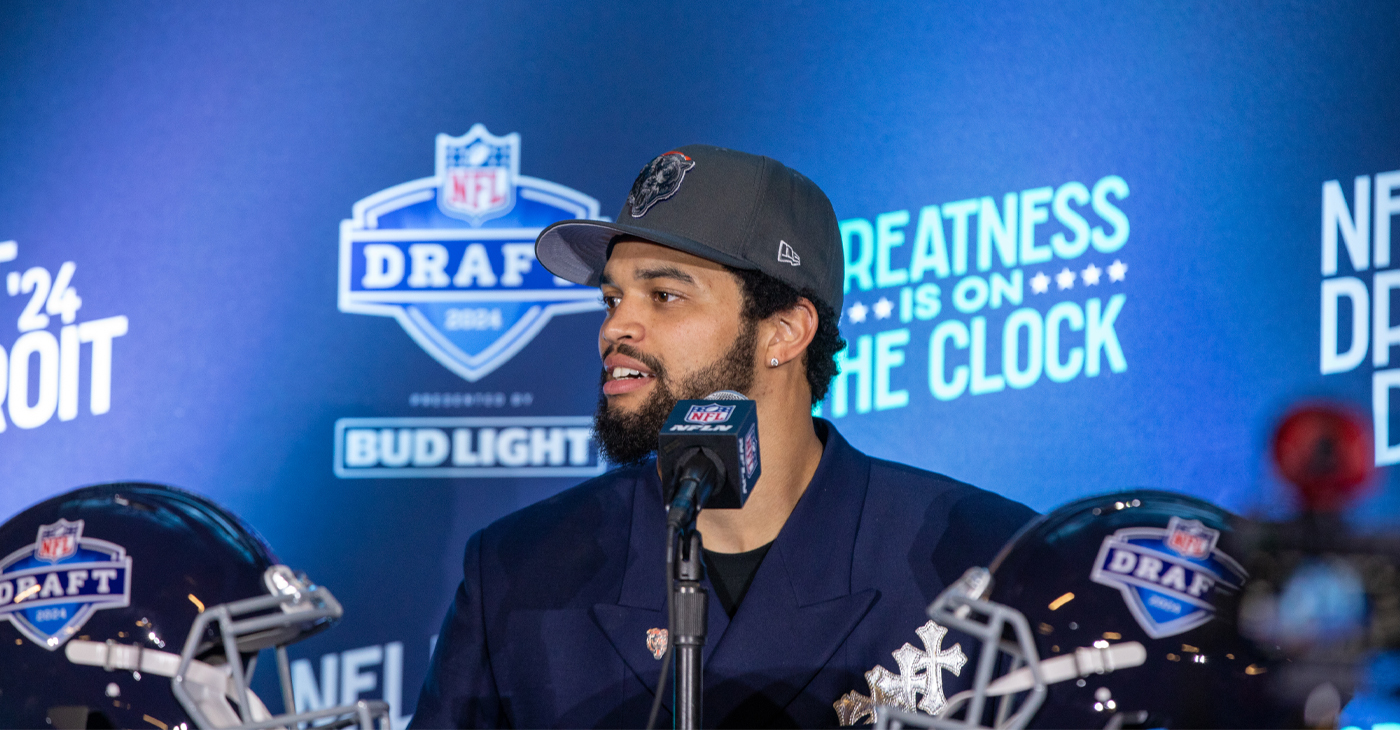
Chicago Bears quarterback Caleb Williams was helped off the field with a right leg injury with 7:42 remaining in the fourth quarter. Williams was down, writhing in pain after scrambling to his left. After departing the injury tent, Williams raised his right fist, acknowledging the crowd while expressing his frustration. Testing will commence on Monday to find out more details about his injury.
“We’ll know tomorrow,” Johnson admitted regarding Williams’ injury. “He’s in good spirits. He’s a team player.”
Williams finished the day with 138 passing yards and one interception.
“I’m actually happy it’s nothing with the knee — that was my first inclination,” Johnson said. “But, a hamstring could be pretty damaging as well. So, we’ll see. We’ll see how bad it is tomorrow and we’ll go from there.”
Bryce Young once again dominated the Falcons
Carolina Panthers quarterback Bryce Young is 5-1 against the Atlanta Falcons and is undefeated at Mercedes-Benz Stadium. Today, Young threw for 287 yards and three touchdowns as he led the Panthers to a 34-3 dismembering of the Atlanta Falcons. Georgia Tech alumnus Darren Waller caught two touchdowns and linebacker Devin Lloyd returned one of his two interceptions for a touchdown.
Cooper Rush started his second straight game for the Falcons and it did not go well. The partisan crowd voiced their displeasure after Rush completed 10/17 passes for 86 yards and two interceptions. Jack Strand entered the game for Rush prompting cheers from the Falcons fans. The rookie threw a pick-six on his first career pass attempt. Strand was the first QB to accomplish that feat since Sam Darnold in 2018 and is the first Falcons player to do that since Brett Favre in 1991. Strand finished the day with 59 passing yards and 16 rushing yards.
According to reports, quarterback Michael Penix, Jr. is expected to make his season debut this Thursday at the Green Bay Packers. His return should help the Falcons. They are the first team since the 2008 Rams to not run any plays in the red zone after the first two games to open a season.
The bright spots for the Falcons today were the Spelman College Jaguarettes performing with the Falcons cheerleaders and Florida A&M’s marching band, The Marching 100, also performed during halftime!
Jayden Daniels gets carted off after apparent arm injury
Washington Commanders quarterback Jayden Daniels appeared to injure his left elbow on the final play of the first half in his game against the Dallas Cowboys. During the play, Daniels got stepped on, braced himself for the fall, and his elbow bent the wrong way. Daniels draped a towel over his head as he exited the field on the cart.
He was later ruled out.
Daniels suffered a dislocated elbow to the same arm during week nine of last season against the Washington Commanders, which led to him being shut down for the remainder of the season.
The post NFL: Week Two Recap | Jalen Hurts did not fold; Caleb Williams exits game with injury appeared first on BlackPressUSA.

#NNPA BlackPress
The Complete Negotiation Framework — Every Stage, Every Tactic, Every Win
Master the complete vehicle-purchase negotiation framework with Roosevelt Gist and Roosevelt. Learn every stage, tactic, and win!
The post The Complete Negotiation Framework — Every Stage, Every Tactic, Every Win appeared first on BlackPressUSA.

Roosevelt Gist and Roosevelt deliver the complete vehicle-purchase negotiation framework in Episode 8 of The Color of Our Money Is Green. This episode covers the three foundations of every effective negotiation, the full seven-stage negotiation sequence with exact language for every stage, and five of the most common dealership tactics with the specific response each one requires.
What You Learn in This Episode:
The three foundations that make every negotiation tactic work
The complete seven-stage car-buying negotiation sequence
Exact language for every stage of the dealership conversation
Five common dealership tactics — the turnover, the four-square, the packed payment, spot delivery, and forced add-ons — and how to counter each one
Why signing preliminary paperwork isn’t the same as signing the final contract
___________________________________________________________________
“The Color of Our Money Is Green: A Buyer’s Guide to What Cars Actually Cost” — stan.store/RGist
____________________________________________________________________
AutoNetwork helps serious car shoppers inspect any new vehicle online before walking into a dealership. I’m Roosevelt — I’ve been reviewing cars and shaping digital car buying and credit union auto leasing since before YouTube car reviews existed.
You’ll find detailed walkaround reviews, POV test drives, and buyer-focused breakdowns covering comfort, space, features, and real-world value.
How to use the channel:
Watch the walkaround of the car you’re considering
Visit AutoNetwork.com for the full review
Check CouponsOffersAndDeals.com for current dealer specials
Walk in already knowing what you want — and what it should cost
 AutoNetwork.com
 CouponsOffersAndDeals.com
Affiliate disclosure: some links earn a small commission at no cost to you and help support the channel. Insta360 is one of those partners.
The post The Complete Negotiation Framework — Every Stage, Every Tactic, Every Win appeared first on BlackPressUSA.
#NNPA BlackPress
Mazda CX-90 Luxury: Heated Seats & Premium Comfort! #shorts
Stay toasty in the CX-90! Plush Nappa leather, heated/ventilated seats, and a memory-equipped heated steering wheel deliver ultimate luxury.
The post Mazda CX-90 Luxury: Heated Seats & Premium Comfort! #shorts appeared first on BlackPressUSA.

Experience ultimate comfort in the CX-90. Nappa leather, heated/ventilated seats, 8-way power adjustments, and memory settings for both front passengers. The heated steering wheel with memory tilt/telescope adds premium convenience.
 Watch the full video: https://youtu.be/EH5A4eQ4ipY
#AutoNetwork
The post Mazda CX-90 Luxury: Heated Seats & Premium Comfort! #shorts appeared first on BlackPressUSA.



Doulas Are Helping Black California Moms Navigate Pregnancy–Even as High Mortality Rates Persist

Newsom Signs Addictive Social Media Law to Protect Kids

On Your November Ballot: Prop 38 Would Allocate $8.4 Billion to Immunology and Immunotherapy Funding

Ask California: Golden State Releases New AI Chatbot

Asm. Isaac Bryan’s Bill Banning California Police From ICE Side Jobs Reaches Newsom’s Desk

Assemblymember LaShae Sharp-Collins’s Bill Would Pause Law Enforcement’s Use of Shock Gloves Pending Study

BOOK REVIEW: ‘Laws of Solomon’ Reveals Tender Heart of Former Child Soldier

OPINION: The New American Fear – From 9-11 to AI

Passing for White, Fighting for Black America: The Courage of Walter White

Oakland People’s Arms Embargo Coalition Demands End to Military Shipments Thru Oakland

Barbara Lee Mourns Gloria Steinem, Remembers a Friendship Rooted in Equality

Event Preview: ‘Fashion v. Fascism’ – A Runway Revolution Is Coming to the Bay Area

Two Looming Threats Every Alameda County Elder Should Know About

Oakland Mayor Reads to Children at Bookout Block Party at Marcus Books Store

Tradition Comes to the Streets in 11th Annual Black-Eyed Pea Festival at the Freedom Farmers Market

Less Affluent School Districts, Including Sacramento City, Face Threat of State Takeover

ESSAY: California Can Close Its Colorectal Cancer Gap

California Hispanic Chambers of Commerce Unveils: ‘Powering the Future’ Theme for 47th Annual Statewide Convention

Four Candidates, Including Incumbent Barbara Lee, Qualify for Oakland Mayor’s Race

Oakland Post: Week of August 12 – 18, 2026

From Blueprint to Breakthrough: Tackling Affordable Housing in Oakland

Oakland Observes Black August with Block Parties, Film Showings, Workshops

COMMENTARY: Why Local School Tax Measure G1 Will Not Be on the November Ballot

Standoff for Justice: Our Homes Are Worth Fighting For

Returning to Its Roots, the Oakland Black-Eyed Pea Festival Partners with the Freedom Farmers Market Sept. 12

NPRC Scores First Advocacy Victory: David Shaw Finally Gets His Wish to ‘Go Home’

Oakland Post: Week of August 26 – September 1, 2026

Frontier Airlines’ Return to Oakland Airport Brings Flights, Jobs and Opportunity

Gubernatorial Candidate Steve Hilton Blasts California New Tire Rules; Newsom Hits Back

Chef Sharon Lee Blends Culinary Excellence, Education and Empowerment

The Conversation With Al McFarlane 6/23/26

Media Monday 6/22/26

LIVE! ASK ALMA! — TUES. 6.23.26 7PM EST

Car Buying Secrets: 4 Hidden Checks Before You Sign!

Is This 550 HP Charger Worth YOUR Money? AutoNetwork Review

Celebrating Juneteenth – Frederick Douglass on education and resistance

LIVE! — ASK ALMA! — TUES. 6.19.26 7PM EST

Hyundai Ioniq 5 Parking, Safety, and 360 View #shorts

2025 Ioniq 5 New Wiper & Powerful Performance! #shorts

Electric SUV Range: Is 259 Miles Enough? #shorts

EV Charging: How Fast Can You Charge an Electric Vehicle? #shorts

Biometric Cooling… Messaging Seats…Come on! 2025 Infiniti QX80 Autograph 4WD

Charged Up: Witness the Magic of a Fully Electric Car! #shorts

Range Rover Sport PHEV Included…: See What’s Inside This Luxury SUV! #shorts

Invisible Hood View: Perfect Parking with X-Ray Vision! #shorts
-
 Commentary4 weeks ago
Standoff for Justice: Our Homes Are Worth Fighting For
-
 Activism4 weeks ago
Oakland Post: Week of August 26 – September 1, 2026
-
 Business4 weeks ago
Frontier Airlines’ Return to Oakland Airport Brings Flights, Jobs and Opportunity
-
 Business4 weeks ago
Gubernatorial Candidate Steve Hilton Blasts California New Tire Rules; Newsom Hits Back
-
 Business4 weeks ago
Chef Sharon Lee Blends Culinary Excellence, Education and Empowerment
-

 Education4 weeks ago
Gov. Newsom’s Latest Appointees Include Sacramento Advocate for Formerly Incarcerated Students; State’s New Tech Chief
-

 Community4 weeks ago
Big City Mayors Ask for “Yes” Vote on Housing Bond Measure; Conservatives Say “No”
-

 Business4 weeks ago
Oakland Coliseum Project Opens Door for Small Businesses to Build Bigger
