
Activism
California NAACP Conference Honors 1968 Olympics Heroes
The California Hawaii State Conference of the National Association for the Advancement of Colored People (CA/HI NAACP) held its 11th annual Legacy Hall of Fame induction ceremony. The event took place on June 24 at the Sheraton Hotel in downtown Sacramento.

By Antonio Ray Harvey
California Black Media

The California Hawaii State Conference of the National Association for the Advancement of Colored People (CA/HI NAACP) held its 11th annual Legacy Hall of Fame induction ceremony. The event took place on June 24 at the Sheraton Hotel in downtown Sacramento.
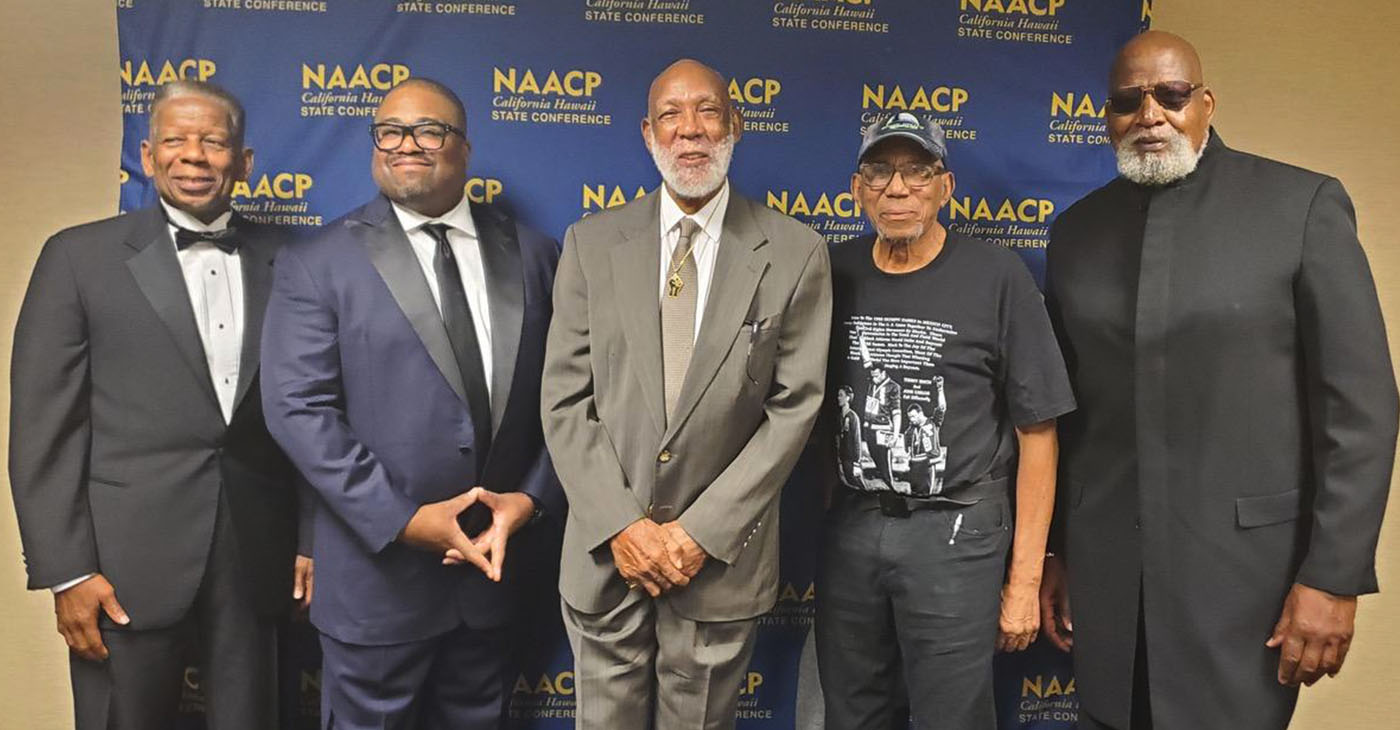
At the event, the NAACP paid tribute to 1968 Olympic medalists Dr. Tommie Smith and Dr. John Carlos, and 1967 Olympic Project for Human Rights co-organizers Dr. Harry Edwards and Dr. Kenneth Noel. These men were honored for their contributions to the civil rights movement in the 1960s.
All the honorees except Smith were present at the ceremony. Smith’s friend Darrell Goode accepted the award on his behalf.
“If you receive this award, it exemplifies greatness of your career whether it’s in politics, whether it’s in business, or whether it be activism,” said Rick Callender, president of the CA/HI NAACP.
“I’m sure you can see why now our current inductees are receiving this honor. It just shows you what an incredible impact they had on the lives of everyone in their fight for civil rights,” he added.
After placing first and third in the 200-meter dash at the Olympic Games in Mexico City in 1968, sprinters Smith and Carlos ascended the medal stand to receive their respective gold and bronze metals with second-place silver medalist Peter Norman of Australia. During that historic moment, the men led a protest to draw attention to racial discrimination and other negative conditions affecting Black people in America and across the globe.
Shoeless, donning black socks to represent Black poverty, and wearing beads to protest violence against African Americans, the athletes raised a black-gloved fist to show support for Black and oppressed people. Smith wore a black scarf around his neck to show Black pride.
The iconic image of their stance on the podium and their bold display of the Black power movement’s most recognizable symbol (the raised fist) was seen around the world. That moment changed the racial dynamics of international sports forever.
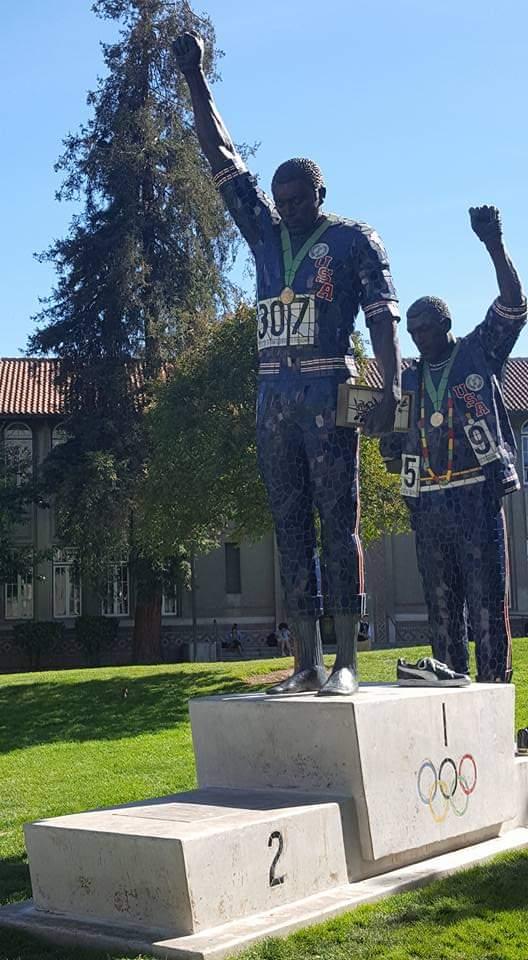
On the morning of Oct. 16, 1968, African American athletes Tommie Smith and John Carlos each raised a black-gloved fist while the U.S. national anthem, “The Star-Spangled Banner,” played during their medal ceremony at the Olympics in Mexico City. CBM photo by Antonio Ray Harvey was taken at their alma mater on Oct.6, 2016 on the campus of San Jose State University. Statue designed by artist Rigo 23 in 2005.
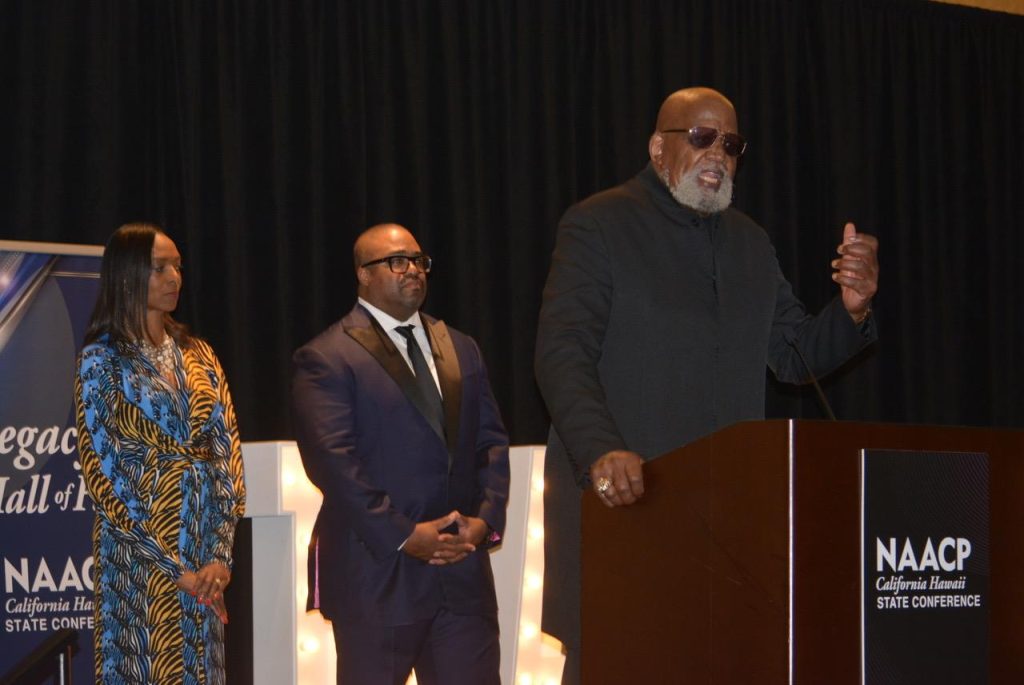
Dr. Harry Edwards (Legacy Hall of Fame recipient), at the podium, and Dr. Kenneth Noel organized the protest at the 1968 Olympics in Mexico City. He is shown here with CA/HI NAACP President Rick Callendar and Carolyn Veal-Hunter (CA/HI NAACP treasurer) at the Legacy Hall of Fame induction ceremony in Sacramento, June 24, 2023. CBM photo by Antonio Ray Harvey.
After their stand against racial injustice, Smith and Carlos never relinquished their medals even though the International Olympic Committee (IOC) prohibits protests at the games. They were immediately asked to leave the games in Mexico City.
Carlos said it was a widespread myth for decades that the IOC took his and Smith’s medals.
“They never took our medals. It was pure propaganda,” Carlos told California Black Media. “They were saying for years that they took our medals but what it really was was a fear factor. They said it to try to instill fear into every Black athlete after 1968.”
Carlos, Smith, Edwards, and Noel were associated with San Jose State College’s track and field team in the mid-1960s. Facing discrimination as students on the campus, Edwards and Noel orchestrated rallies, protests and social justice events to attract African American student-athletes and fellow campus activists.
Noel and Edwards started The United Black Students for Action (UBSA). They both noticed that Black student-athletes could use their fame to elevate civil rights issues. They both converted UBSA into the Olympic Project for Human Rights (OPHR), a civil rights organization created to boycott the 1968 Summer Olympics.
On Oct. 16, 1968, Smith won the 200-meter race in a world-record time of 19.83 seconds. Norman finished second with a time of 20.06 seconds, and Carlos was third with a time of 20.10 seconds.
“There were several other people who were really important in our lives and involved in the struggle too,” said Noel, who was known as a gifted middle-distance runner. “One of the things that I will say about the fight for human rights is we endeavored to change the paradigm of what it means to be a champion athlete. Not only to perform on the field but to get involved in politics, and support activities in our communities.”
Edwards, an emeritus professor of Sociology at the University of California, Berkeley, and former scholar-athlete at San Jose State College (today San Jose State University), encouraged African American athletes to protest the 1968 summer Olympics in Mexico City with the support of the Project for Human Rights.
Edwards, a long-time consultant for the San Francisco 49ers, is a proud and committed social activist.
In 2016, Edwards supported then-49ers quarterback Colin Kaepernick’s controversial protest against excessive use of force by police officers.
Kaepernick took a knee during the playing of the National Anthem before each game, as a way of bringing attention to police brutality against Black people in the United States.
After the first time Kaepernick knelt, Edwards told him to give him his uniform immediately because his action would be a monumental moment in sports and representative of the new wave of civil rights. Edwards sent the garment to the National Museum of African American History and Culture in Washington, D.C., to be displayed alongside Carlos, Smith, and Muhammad Ali’s exhibits.
“He felt strong enough about it to put his career and life on the line. Look at the number of death threats and other things that happened to him. He put it all on the line in order to make that statement,” Edwards said. “He was saying we are better than this. He started a movement that swept the world.”
The Legacy Hall of Fame honors outstanding community leaders who have fought tirelessly to advance the Civil Rights Movement while also creating vital funding for local unit capacity building, youth leadership programs, and NextGen Leadership programs and initiatives, according to the CA/HI NAACP.











Activism
Oakland Post: Week of September 30 – October 6, 2026
The printed Weekly Edition of the Oakland Post: Week of September 30 – October 6, 2026
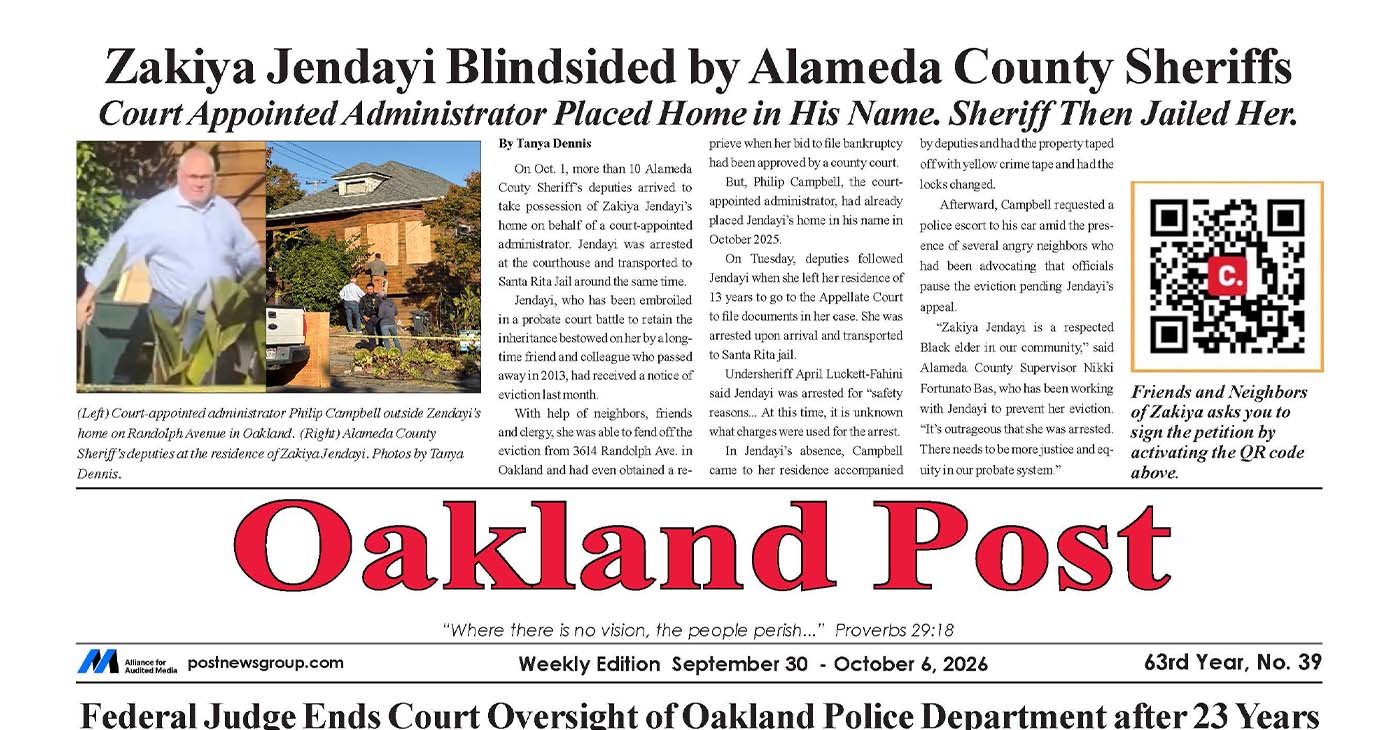
To enlarge your view of this issue, use the slider, magnifying glass icon or full page icon in the lower right corner of the browser window.
Activism
Oakland Post: Week of September 23 – 29, 2026
The printed Weekly Edition of the Oakland Post: Week of September 23 – 29, 2026

To enlarge your view of this issue, use the slider, magnifying glass icon or full page icon in the lower right corner of the browser window.
Activism
Oakland Post: Week of September 16 – 22, 2026
The printed Weekly Edition of the Oakland Post: Week of September 16 – 22, 2026

To enlarge your view of this issue, use the slider, magnifying glass icon or full page icon in the lower right corner of the browser window.


OP-ED: Proposition 44 Would Put a Price on Trust

OP-ED: Proposition 40: It’s Time to Play Chess, Not Checkers

Listening as a Lifeline: A Doula’s Witness to Black Maternal Health

New Protections for Ticket Buyers: Gov. Newsom Signs Assemblymember Isaac Bryan’s Bill

‘We Don’t Talk Trash — We Pick Up Trash!’

Zakiya Jendayi Arrested, Locked Out of Home by Sheriff’s Deputies

Oakland Post: Week of September 30 – October 6, 2026

Asm. Corey Jackson Announces Launch of 24-Hour Childcare in His District

IN MEMORIAM: The Rev. Leon “Sonny” Clark, Longtime Orange County Pastor and Community Leader, Dies at 72

Poll: Becerra Widens His Lead Over Hilton; Californians Split on Wealth Tax

From Historic Memories to New Possibilities: Oakland Celebrates Coliseum 60

County Office of Education Says OUSD Finances Are Getting Healthier, Materially Stronger

LIVE FREE Sunday Dinner Brings Faith, Fellowship and Civic Conversation to Oakland

Remembering Chauncey Bailey as Student Journalists Face Threats to Truth-Telling

BLACspace Cooperative Invites Bay Area to Experience Oakland’s Black Cultural Ecosystem Through a BLAC Map Tour + Party

Standoff for Justice: Our Homes Are Worth Fighting For

Oakland Post: Week of August 26 – September 1, 2026

Frontier Airlines’ Return to Oakland Airport Brings Flights, Jobs and Opportunity

Gubernatorial Candidate Steve Hilton Blasts California New Tire Rules; Newsom Hits Back

Chef Sharon Lee Blends Culinary Excellence, Education and Empowerment

Jackie Wright Champions Bay Area Stories, Filmmakers and Cultural Institutions

Misnamed ‘Parent’ PAC Seeks to Influence Oakland School Board Elections

Oakland Coliseum Project Opens Door for Small Businesses to Build Bigger

Big City Mayors Ask for “Yes” Vote on Housing Bond Measure; Conservatives Say “No”

Gov. Newsom’s Latest Appointees Include Sacramento Advocate for Formerly Incarcerated Students; State’s New Tech Chief

Longtime BWOPA Member Brendalyn Goodall Appointed to California Workforce Development Board

Gov. Newsom Signs Law Shielding Immigration Aid Workers From Doxing Threats

Oakland Post: Week of September 2 – 8, 2026

Secretary of State Shirley N. Weber Urges Californians to Vote Early as Voter ID Battle Intensifies

IN MEMORIAM: Dolly Parton Dead at 80 — How She Built a Legacy of Love and Earned Her Place in Black Culture

The Conversation With Al McFarlane 6/23/26

Media Monday 6/22/26

LIVE! ASK ALMA! — TUES. 6.23.26 7PM EST

Car Buying Secrets: 4 Hidden Checks Before You Sign!

Is This 550 HP Charger Worth YOUR Money? AutoNetwork Review

Celebrating Juneteenth – Frederick Douglass on education and resistance

LIVE! — ASK ALMA! — TUES. 6.19.26 7PM EST

Hyundai Ioniq 5 Parking, Safety, and 360 View #shorts

2025 Ioniq 5 New Wiper & Powerful Performance! #shorts

Electric SUV Range: Is 259 Miles Enough? #shorts

EV Charging: How Fast Can You Charge an Electric Vehicle? #shorts

Biometric Cooling… Messaging Seats…Come on! 2025 Infiniti QX80 Autograph 4WD

Charged Up: Witness the Magic of a Fully Electric Car! #shorts

Range Rover Sport PHEV Included…: See What’s Inside This Luxury SUV! #shorts

Invisible Hood View: Perfect Parking with X-Ray Vision! #shorts
-
 Community3 weeks ago
Misnamed ‘Parent’ PAC Seeks to Influence Oakland School Board Elections
-

 Activism3 weeks ago
Oakland Post: Week of September 9 – 15, 2026
-

 Community3 weeks ago
Richmond Tiny House Village Farm & Garden Set to Open Gates on Sept. 26
-

 Black History3 weeks ago
Latest Massacre in Haiti Reveals Cruelty U.S. Deportations
-

 Black History3 weeks ago
OPINION: Nolan Wells’ Death One of Several Signifying Racial Terror Lives on in U.S. South
-

 Business2 weeks ago
Mayor Lee Announces $1 Million Kaiser Permanente Grant for Pilot Program to Address Homelessness, Clean Up Public Spaces throughout Oakland
-

 Community3 weeks ago
Democratic Clubs Interview Candidates for Oakland School Board
-
 Uncategorized3 weeks ago
NBA All-Star Damian Lillard Returns Home for 15th Annual Backpack Giveaway
