
Activism
Rally Calls for Removal of Two Oakland Police Commissioners
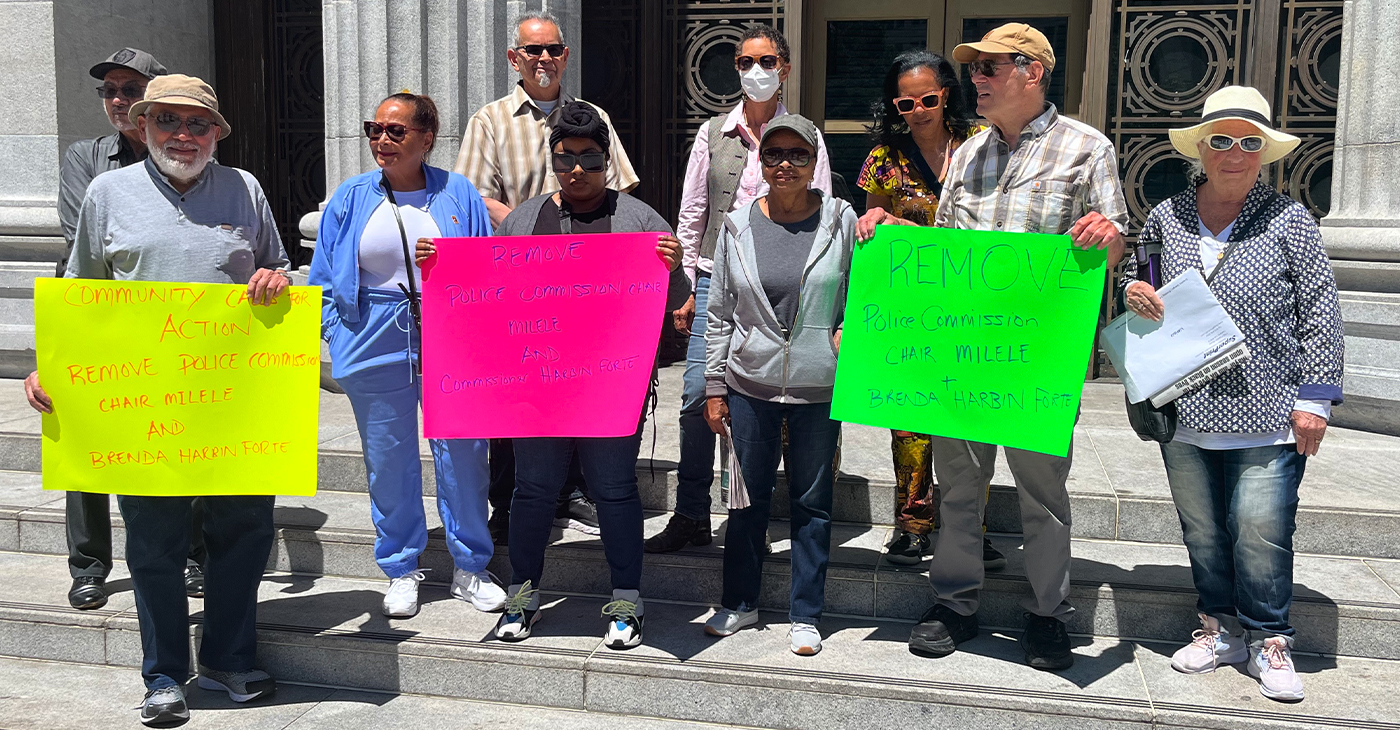
Several current police commissioners and police accountability activists held a rally this week calling for removal or resignation of two members of the Oakland’s appointed Police Commission, accusing them of attacking fellow commissioners and members of the public, and creating chaos that has kept the commission from fulfilling its duties to the community.

By Ken Epstein

Several current police commissioners and police accountability activists held a rally this week calling for removal or resignation of two members of the Oakland’s appointed Police Commission, accusing them of attacking fellow commissioners and members of the public, and creating chaos that has kept the commission from fulfilling its duties to the community.
“We are calling for a new leadership on the Police Commission.…In the last year, we have seen disunity, disrespectful proceedings, and a lack of attention to pressing police oversight matters,” said Mariano Contreras of the Oakland Latino Taskforce and the Coalition for Police Accountability.
According to speakers at the rally Tuesday at noon on the steps of Oakland City Hall, Commission Chair Tyfahra Milele and Commissioner Brenda Harbin-Forte should be removed because they have created dysfunction on the commission that for months stalled the search for a new police chief.
Speakers also charged that the commission was unable to weigh in on a crucial issue, the firing of Oakland Police Department Chief LeRonne Armstrong, because Milele failed to subpoena records related to the handling and mishandling of an internal OPD case against Sgt. Michael Chung, which was connected to the chief’s firing.
Speakers said they are calling for the removal of the commissioners after internal attempts to settle the conflicts were ignored or attacked.
Milele was appointed to the commission by the official selection panel, and Harbin-Forte was appointed by former Mayor Libby Schaaf. Milele’s term expires on October 16, while Harbin-Forte’s expired several months ago; she is serving until Mayor Sheng Thao names a replacement.
Contreras, who chaired the rally, said that rather than investigating the case that resulted in the firing of the police chief, the two commissioners have spent their time “looking for dirt” on community members, Oakland City Council members and the commission’s inspector general.
Police Commissioner Marsha Peterson, an attorney and Oakland native, said, “What we are up against (is) a lack of leadership,” adding that she has not been able to have conversations with Milele that don’t result in “threats, complaints, and chaos.”
At deadline, the Oakland Post has not received comments from Milele. However, in a press statement on June 7, Milele denounced the KTVU Channel 2 coverage of complaints against her and characterized the disputes as “an attempted power grab by a small band of political extremists with a personal agenda.”
“The extremist attack by an unelected, unaccountable, small group of politically ambitious zealots counters the will of the Oakland electorate and makes flagrantly false allegations,” she wrote.
In an email, Harbin-Forte told the Post:
“Yesterday’s pathetic rally totally vindicated Chair Tyfahra Milele and me. The Coalition for Police Accountability and Commissioners Regina Jackson and Marsha Peterson invited more than 2,000 people to their party and ended up with more picture-takers than participants.”
She added: “Regina and Marsha suffered an embarrassing loss in January when Regina’s candidate, Marsha, who was then vice chair, ran to become chair of the commission. We not only overwhelmingly voted in Dr. Milele for a second term, but we also voted out Marsha as vice chair.”
Defending those criticized by Milele, Vice Mayor of Emeryville Courtney Welch, a former Oakland resident, said she stood in solidarity with “great leaders … who have been on the receiving end of vicious attacks, retaliation and character assassination” and that “it has to stop.”
Among those under attack, said Welch, have been Regina Jackson, currently a police commissioner and three-time past police commission chair; Police Commissioner Peterson; District 6 Oakland Councilmember Kevin Jenkins; and Cathy Leonard, a longtime police accountability activist, Oakland native, and president of the Coalition for Police Accountability.
The Coalition for Police Accountability was instrumental in putting Measure LL on the ballot, which created the police commission in 2016 with the support of 83% of voters.
In her remarks Leonard said, “We are raising a critical issue with the police commission,” only deciding to ask for the removal of the two commissioners after numerous attempts to meet with them failed to resolve the issues.
“We want the commission to work as a commission of all of the commissioners, not a police commission of two people,” she said. “(But) it’s been attack after attack after attack.”
Jackson has served for six years on the Police Commission – its longest serving member – and for 30 years as a community leader. She said of Harbin-Forte, a retired judge, “We have seen ridiculous harassment and bullying, not just of community members, not just of city employees … but also of fellow commissioners.”
Jackson said Harbin-Forte has attacked those who are willing to stand up to her. “She called for three resignations in 72 hours: Councilmember Kevin Jenkins, myself, and Commissioner Marsha Peterson.”
She said she has requested five times but still has not seen an accounting of how the commission is spending its money. “We have received no budget updates,” she said.
Jackson ended the rally with a chant, joined by other rally participants: “Remove, remove, remove!”










Activism
Oakland Post: Week of September 30 – October 6, 2026
The printed Weekly Edition of the Oakland Post: Week of September 30 – October 6, 2026
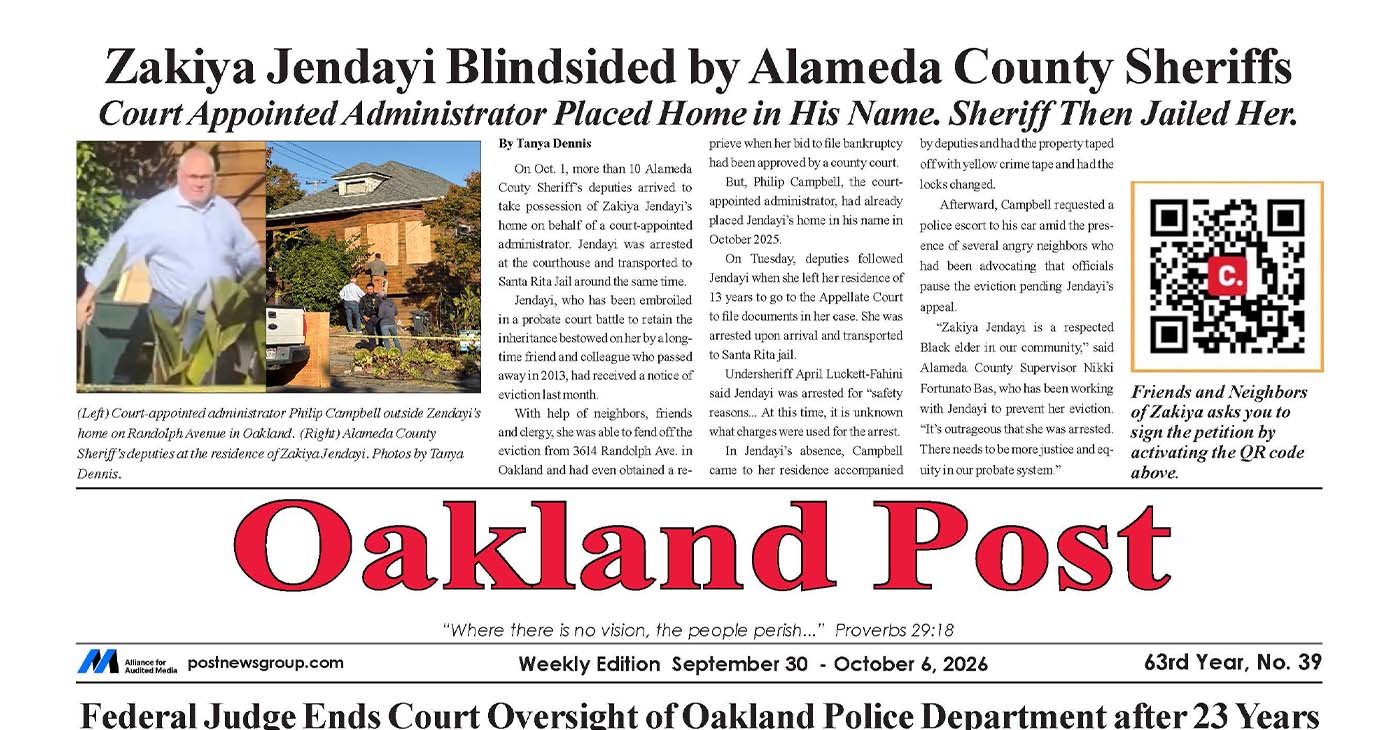
To enlarge your view of this issue, use the slider, magnifying glass icon or full page icon in the lower right corner of the browser window.
Activism
Oakland Post: Week of September 23 – 29, 2026
The printed Weekly Edition of the Oakland Post: Week of September 23 – 29, 2026

To enlarge your view of this issue, use the slider, magnifying glass icon or full page icon in the lower right corner of the browser window.
Activism
Oakland Post: Week of September 16 – 22, 2026
The printed Weekly Edition of the Oakland Post: Week of September 16 – 22, 2026
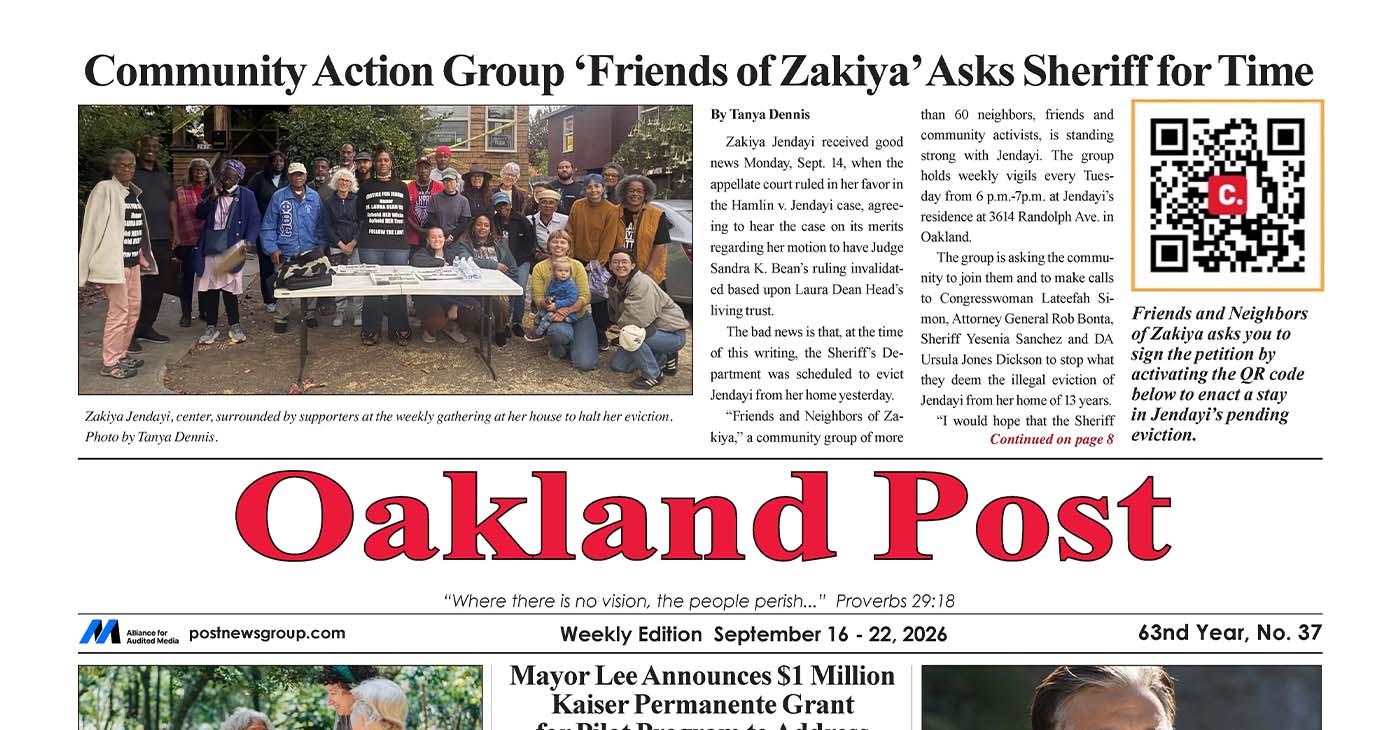
To enlarge your view of this issue, use the slider, magnifying glass icon or full page icon in the lower right corner of the browser window.



Listening as a Lifeline: A Doula’s Witness to Black Maternal Health

New Protections for Ticket Buyers: Gov. Newsom Signs Assemblymember Isaac Bryan’s Bill

‘We Don’t Talk Trash — We Pick Up Trash!’

Zakiya Jendayi Arrested, Locked Out of Home by Sheriff’s Deputies

Oakland Post: Week of September 30 – October 6, 2026

Asm. Corey Jackson Announces Launch of 24-Hour Childcare in His District

IN MEMORIAM: The Rev. Leon “Sonny” Clark, Longtime Orange County Pastor and Community Leader, Dies at 72

Poll: Becerra Widens His Lead Over Hilton; Californians Split on Wealth Tax

From Historic Memories to New Possibilities: Oakland Celebrates Coliseum 60

County Office of Education Says OUSD Finances Are Getting Healthier, Materially Stronger

LIVE FREE Sunday Dinner Brings Faith, Fellowship and Civic Conversation to Oakland

Remembering Chauncey Bailey as Student Journalists Face Threats to Truth-Telling

BLACspace Cooperative Invites Bay Area to Experience Oakland’s Black Cultural Ecosystem Through a BLAC Map Tour + Party

In Wake of Death on Doorstep, Williams Chapel Baptist Church Calls for Better Care, Funding for Unhoused

Oakland Centenarian Nuna McKee Honored!

Standoff for Justice: Our Homes Are Worth Fighting For

Oakland Post: Week of August 26 – September 1, 2026

Frontier Airlines’ Return to Oakland Airport Brings Flights, Jobs and Opportunity

Gubernatorial Candidate Steve Hilton Blasts California New Tire Rules; Newsom Hits Back

Chef Sharon Lee Blends Culinary Excellence, Education and Empowerment

Jackie Wright Champions Bay Area Stories, Filmmakers and Cultural Institutions

Oakland Coliseum Project Opens Door for Small Businesses to Build Bigger

Big City Mayors Ask for “Yes” Vote on Housing Bond Measure; Conservatives Say “No”

Misnamed ‘Parent’ PAC Seeks to Influence Oakland School Board Elections

Gov. Newsom’s Latest Appointees Include Sacramento Advocate for Formerly Incarcerated Students; State’s New Tech Chief

Longtime BWOPA Member Brendalyn Goodall Appointed to California Workforce Development Board

Gov. Newsom Signs Law Shielding Immigration Aid Workers From Doxing Threats

Secretary of State Shirley N. Weber Urges Californians to Vote Early as Voter ID Battle Intensifies

Oakland Post: Week of September 2 – 8, 2026

IN MEMORIAM: Dolly Parton Dead at 80 — How She Built a Legacy of Love and Earned Her Place in Black Culture

The Conversation With Al McFarlane 6/23/26

Media Monday 6/22/26

LIVE! ASK ALMA! — TUES. 6.23.26 7PM EST

Car Buying Secrets: 4 Hidden Checks Before You Sign!

Is This 550 HP Charger Worth YOUR Money? AutoNetwork Review

Celebrating Juneteenth – Frederick Douglass on education and resistance

LIVE! — ASK ALMA! — TUES. 6.19.26 7PM EST

Hyundai Ioniq 5 Parking, Safety, and 360 View #shorts

2025 Ioniq 5 New Wiper & Powerful Performance! #shorts

Electric SUV Range: Is 259 Miles Enough? #shorts

EV Charging: How Fast Can You Charge an Electric Vehicle? #shorts

Biometric Cooling… Messaging Seats…Come on! 2025 Infiniti QX80 Autograph 4WD

Charged Up: Witness the Magic of a Fully Electric Car! #shorts

Range Rover Sport PHEV Included…: See What’s Inside This Luxury SUV! #shorts

Invisible Hood View: Perfect Parking with X-Ray Vision! #shorts
-
 Community3 weeks ago
Misnamed ‘Parent’ PAC Seeks to Influence Oakland School Board Elections
-
 Activism4 weeks ago
Oakland Post: Week of September 2 – 8, 2026
-

 Community3 weeks ago
Richmond Tiny House Village Farm & Garden Set to Open Gates on Sept. 26
-

 Activism3 weeks ago
Oakland Post: Week of September 9 – 15, 2026
-

 Black History3 weeks ago
Latest Massacre in Haiti Reveals Cruelty U.S. Deportations
-

 Black History3 weeks ago
OPINION: Nolan Wells’ Death One of Several Signifying Racial Terror Lives on in U.S. South
-

 Community3 weeks ago
Democratic Clubs Interview Candidates for Oakland School Board
-

 Business2 weeks ago
Mayor Lee Announces $1 Million Kaiser Permanente Grant for Pilot Program to Address Homelessness, Clean Up Public Spaces throughout Oakland
