
Bay Area
14th Annual Powerful Women of the Bay Luncheon
The 14th Annual Powerful Woman of the Bay Luncheon was held at Scott’s Pavilion in Jack London Square on March 30. The event celebrated women that are passionate about educating, empowering, and connecting with women in business and the community.


By Carla Thomas

The 14th Annual Powerful Woman of the Bay Luncheon was held at Scott’s Pavilion in Jack London Square on March 30. The event celebrated women that are passionate about educating, empowering, and connecting with women in business and the community.
Honorees included Tali Bray, Wells Fargo Executive Vice President of Technology Diversity, Community & Sustainability. Bray leads a global team with focus on strategy, cultural transformation, and sustainability.
Dr. Chris Wachira, Founder & CEO of the Wachira Group received the C. Diane Howell Entrepreneur Award. C. Diane Howell was the publisher of Black Business Listings, a publication created to connect, promote and inform Black business owners. Wachira, a Kenyan born entrepreneur and her husband Chadwick Spells are the owners of Karibou Wine Lounge in Alameda.
California Lt. Gov. Eleni Kounalakis was also recognized. Kounalakis is the first woman lieutenant governor of California and also serves as California’s representative for International Affairs and Trade.
California Assemblymember Mia Bonta was also recognized. Bonta serves the 18th Assembly District of the East Bay, including Alameda, Emeryville, and Oakland. Bonta’s husband in attendance, California Attorney General Rob Bonta acknowledged his wife’s accomplishments.
Honoree Nola J. Turnage is the senior manager of Legal Operations of Contracts for Okta, Inc. Turnage and her team are responsible for managing Okta’s go-to market agreements worldwide.
The head of Uber’s Public Policy and Communications in the Western U.S., Ramona Pierto, was recognized. Pierto leads the work spanning policy, stakeholder, community engagement, and corporate communications.
Artist Chrisel Ahime Martinez was honored. Martinez is an artistic director fusing her political ideologies and grassroots understanding with her love for public programming. The DWJ Public Policy Initiative develops leaders for public office. The seven-month fellowship is named in honor of Dezie Woods Jones by BWOPA, Business Women Organized for Political Action.
President and publisher of the San Francisco Business Times, Mary Huss was honored. Huss currently serves on the San Francisco State University Foundation Board and Silicon Valley Leadership Group.
The Innovator Award was presented to Ay’Anna Moody, Social Impact & Sports Senior Director for the Golden State Warriors. Moody launched Generation Thrive that has served over 6,000 educators with free professional development and learning opportunities.
State Controller Malia Cohen provided the keynote address. Elected in November 2022 as chief fiscal officer responsible for the world’s fifth-largest economy, Cohen is responsible for protecting and accounting for the state’s financial resources.
Cohen serves on 70 boards and commissions and chairs the Franchise Tax Board. The nation’s two largest public pension funds, the California Public Employees’ Retirement System (CalPERS) and the California State Teacher’s Retirement System (CalSTRS), which have a combined portfolio of $750 billion, are also boards Cohen serves on.











Activism
Oakland Post: Week of September 30 – October 6, 2026
The printed Weekly Edition of the Oakland Post: Week of September 30 – October 6, 2026
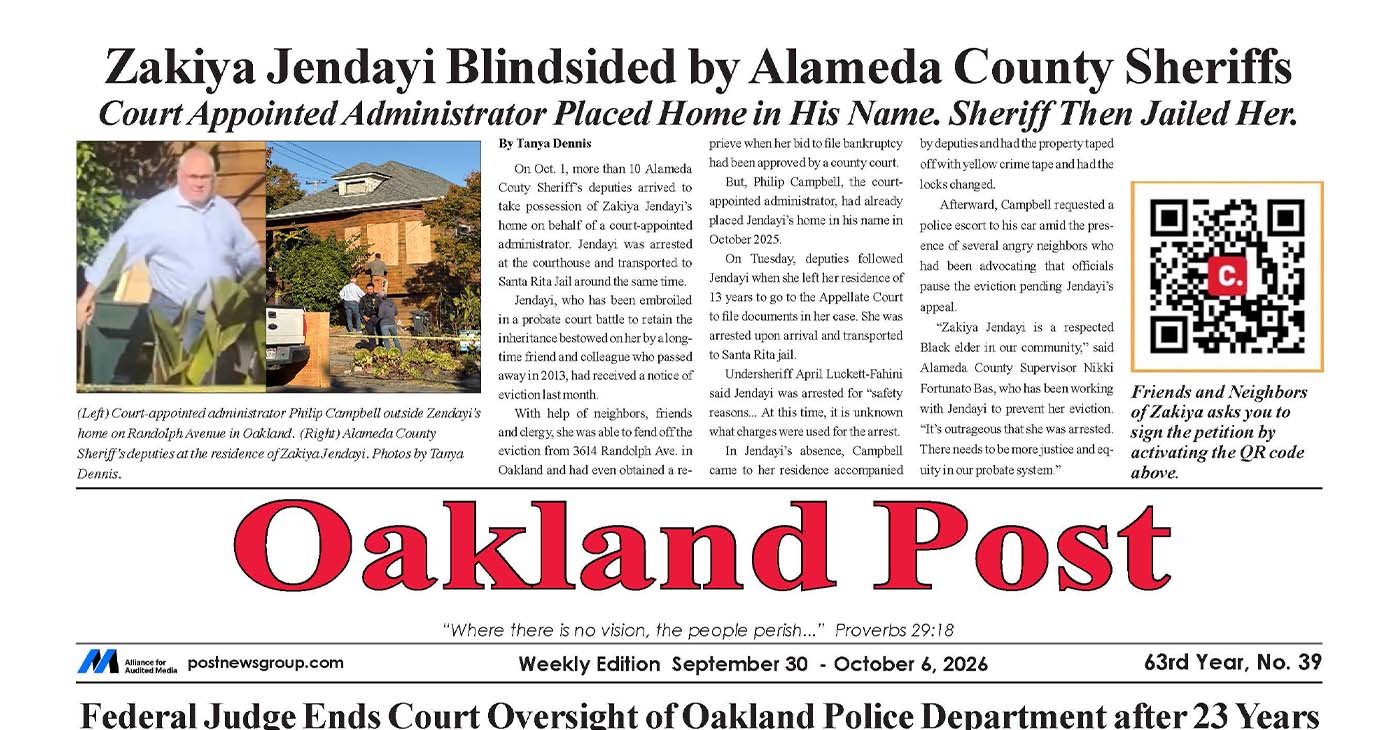
To enlarge your view of this issue, use the slider, magnifying glass icon or full page icon in the lower right corner of the browser window.
Activism
Oakland Post: Week of September 23 – 29, 2026
The printed Weekly Edition of the Oakland Post: Week of September 23 – 29, 2026

To enlarge your view of this issue, use the slider, magnifying glass icon or full page icon in the lower right corner of the browser window.
Activism
Oakland Post: Week of September 16 – 22, 2026
The printed Weekly Edition of the Oakland Post: Week of September 16 – 22, 2026

To enlarge your view of this issue, use the slider, magnifying glass icon or full page icon in the lower right corner of the browser window.



OP-ED: Proposition 44 Would Put a Price on Trust

OP-ED: Proposition 40: It’s Time to Play Chess, Not Checkers

Listening as a Lifeline: A Doula’s Witness to Black Maternal Health

New Protections for Ticket Buyers: Gov. Newsom Signs Assemblymember Isaac Bryan’s Bill

‘We Don’t Talk Trash — We Pick Up Trash!’

Zakiya Jendayi Arrested, Locked Out of Home by Sheriff’s Deputies

Oakland Post: Week of September 30 – October 6, 2026

Asm. Corey Jackson Announces Launch of 24-Hour Childcare in His District

IN MEMORIAM: The Rev. Leon “Sonny” Clark, Longtime Orange County Pastor and Community Leader, Dies at 72

Poll: Becerra Widens His Lead Over Hilton; Californians Split on Wealth Tax

From Historic Memories to New Possibilities: Oakland Celebrates Coliseum 60

County Office of Education Says OUSD Finances Are Getting Healthier, Materially Stronger

LIVE FREE Sunday Dinner Brings Faith, Fellowship and Civic Conversation to Oakland

Remembering Chauncey Bailey as Student Journalists Face Threats to Truth-Telling

BLACspace Cooperative Invites Bay Area to Experience Oakland’s Black Cultural Ecosystem Through a BLAC Map Tour + Party

Standoff for Justice: Our Homes Are Worth Fighting For

Oakland Post: Week of August 26 – September 1, 2026

Frontier Airlines’ Return to Oakland Airport Brings Flights, Jobs and Opportunity

Gubernatorial Candidate Steve Hilton Blasts California New Tire Rules; Newsom Hits Back

Chef Sharon Lee Blends Culinary Excellence, Education and Empowerment

Jackie Wright Champions Bay Area Stories, Filmmakers and Cultural Institutions

Misnamed ‘Parent’ PAC Seeks to Influence Oakland School Board Elections

Oakland Coliseum Project Opens Door for Small Businesses to Build Bigger

Big City Mayors Ask for “Yes” Vote on Housing Bond Measure; Conservatives Say “No”

Gov. Newsom’s Latest Appointees Include Sacramento Advocate for Formerly Incarcerated Students; State’s New Tech Chief

Longtime BWOPA Member Brendalyn Goodall Appointed to California Workforce Development Board

Gov. Newsom Signs Law Shielding Immigration Aid Workers From Doxing Threats

Oakland Post: Week of September 2 – 8, 2026

Secretary of State Shirley N. Weber Urges Californians to Vote Early as Voter ID Battle Intensifies

IN MEMORIAM: Dolly Parton Dead at 80 — How She Built a Legacy of Love and Earned Her Place in Black Culture

The Conversation With Al McFarlane 6/23/26

Media Monday 6/22/26

LIVE! ASK ALMA! — TUES. 6.23.26 7PM EST

Car Buying Secrets: 4 Hidden Checks Before You Sign!

Is This 550 HP Charger Worth YOUR Money? AutoNetwork Review

Celebrating Juneteenth – Frederick Douglass on education and resistance

LIVE! — ASK ALMA! — TUES. 6.19.26 7PM EST

Hyundai Ioniq 5 Parking, Safety, and 360 View #shorts

2025 Ioniq 5 New Wiper & Powerful Performance! #shorts

Electric SUV Range: Is 259 Miles Enough? #shorts

EV Charging: How Fast Can You Charge an Electric Vehicle? #shorts

Biometric Cooling… Messaging Seats…Come on! 2025 Infiniti QX80 Autograph 4WD

Charged Up: Witness the Magic of a Fully Electric Car! #shorts

Range Rover Sport PHEV Included…: See What’s Inside This Luxury SUV! #shorts

Invisible Hood View: Perfect Parking with X-Ray Vision! #shorts
-
 Community3 weeks ago
Misnamed ‘Parent’ PAC Seeks to Influence Oakland School Board Elections
-
 Activism4 weeks ago
Oakland Post: Week of September 2 – 8, 2026
-

 Activism3 weeks ago
Oakland Post: Week of September 9 – 15, 2026
-

 Community3 weeks ago
Richmond Tiny House Village Farm & Garden Set to Open Gates on Sept. 26
-

 Black History3 weeks ago
Latest Massacre in Haiti Reveals Cruelty U.S. Deportations
-

 Black History3 weeks ago
OPINION: Nolan Wells’ Death One of Several Signifying Racial Terror Lives on in U.S. South
-

 Business2 weeks ago
Mayor Lee Announces $1 Million Kaiser Permanente Grant for Pilot Program to Address Homelessness, Clean Up Public Spaces throughout Oakland
-

 Community3 weeks ago
Democratic Clubs Interview Candidates for Oakland School Board
