
Bay Area
Proposed New Fund Would Boost Economic Opportunities: Residents of Golden Gate Village would be the voice in financial priorities
San Rafael, CA — Under a new proposal, residents of Golden Gate Village in Marin City will have a voice in prioritizing investments from a new fund to expand economic opportunities for those living in the 296-unit affordable housing neighborhood. The proposal for the Golden Gate Village Resident Empowerment Fund is to be presented before the Marin County Board of Supervisors during the Feb. 28 meeting, which begins at 9 a.m. in the Board Chamber (Suite 330) at the Marin County Civic Center, 3501 Civic Center Drive, San Rafael.


San Rafael, CA — Under a new proposal, residents of Golden Gate Village in Marin City will have a voice in prioritizing investments from a new fund to expand economic opportunities for those living in the 296-unit affordable housing neighborhood.
The proposal for the Golden Gate Village Resident Empowerment Fund is to be presented before the Marin County Board of Supervisors during the Feb. 28 meeting, which begins at 9 a.m. in the Board Chamber (Suite 330) at the Marin County Civic Center, 3501 Civic Center Drive, San Rafael.
The Board will consider establishing the new fund with the nonprofit Marin Community Foundation (MCF) and transferring $2 million as an initial balance. MCF will then consider making its own grant contribution, as requested by the County. The goal of MCF request is to encourage private donors to follow suit in a unified approach to enhance services for low-income residents of the village, where there is a longstanding need for investments to support new economic opportunities. A series of Resident Listening Sessions are being held between January and March 2023, ensuring that village residents’ direct needs and service requests set the priorities for how the fund is invested. Residents will also be developing the formal name of the fund.
“Through the listening sessions, village residents are giving voice to what their service needs are, how they would like to receive services, and how this fund should invest directly into their community,” said District 3 Supervisor Stephanie Moulton-Peters.

In November 2022, the Marin County Housing Board of Commissioners voted to approve a complete rehabilitation of the 60-year-old village, the largest affordable housing community in Marin. Many longstanding residents, especially among the Black/African American population, have given voice to a history of discrimination and disinvestment in Marin City and Golden Gate Village. This history stems from village residents or their descendants moving to Marin County during World War II to work in the Sausalito shipyards, experiencing first-hand government-endorsed discriminatory practices that prevented them from obtaining loans and purchasing local homes in the post-war era. The segregationally driven practice known as redlining has been illegal since the 1960s.
“Recognizing and rectifying past harms in Marin City is a top priority for me,” said Moulton-Peters. “This resident fund is one example of that.”
If the Board approves the fund’s creation and the initial allocation, County personnel and the Marin Housing Authority will work directly with village residents to develop a Fund Advisory Committee charged with establishing an expenditure plan. The expenditure plan would be based upon the service needs and requests identified during the Resident Listening Sessions, with a goal of beginning initial investments by Fall 2023.
Addressing issues of affordable housing and social equity have been major priorities for the Board of Supervisors, especially after additional economic hardships were brought on by the COVID-19 pandemic. About 12% of Marin County residents identify as a racial minority, but the figure is more than 83% among Golden Gate Village households. The median income for a village resident is $10,820; the countywide figure is $142,300. The homeownership rate in Marin City is 17%, a fraction of the countywide rate of 60%. The census showed 11.2% of village residents live below the poverty line — most of them older adults on fixed incomes.
The County contribution to the Resident Empowerment Fund would originate from $5 million received from the federal government as part of the $1.9 trillion American Rescue Plan Act (ARPA), signed by President Biden in March 2021 to help the country recover from the pandemic.
To watch or participate in the Feb. 28 Board of Supervisors meeting, see instructions on the Board’s archive webpage.
For disability accommodations, please phone (415) 473-6358 (voice), CA Relay 711, or e-mail the Digital Access staff at least five business days in advance of the event. The County will do its best to fulfill requests received with less than five business days’ notice. Copies of documents are available in alternative formats, upon request.














To enlarge your view of this issue, use the slider, magnifying glass icon or full page icon in the lower right corner of the browser window.
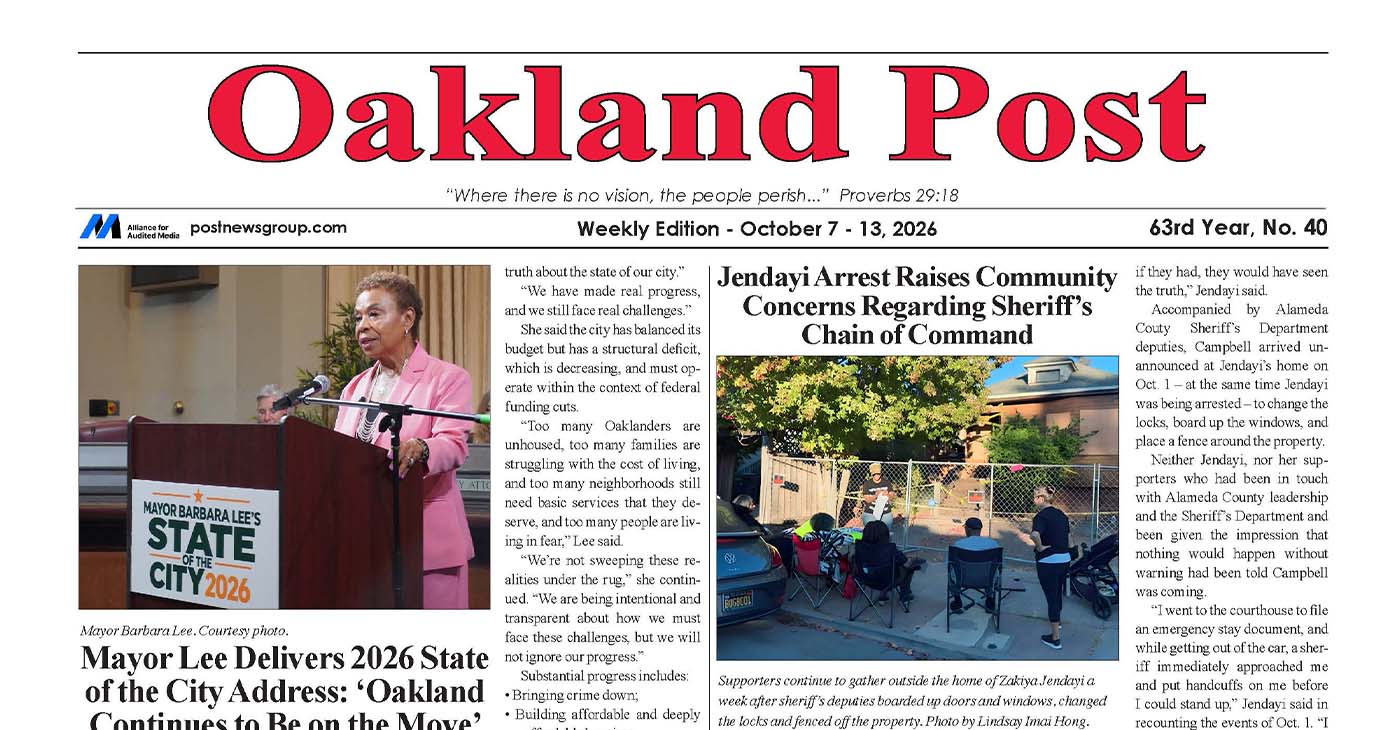
To enlarge your view of this issue, use the slider, magnifying glass icon or full page icon in the lower right corner of the browser window.
Activism
Oakland Post: Week of September 30 – October 6, 2026
The printed Weekly Edition of the Oakland Post: Week of September 30 – October 6, 2026

To enlarge your view of this issue, use the slider, magnifying glass icon or full page icon in the lower right corner of the browser window.



Mayor Barbara Lee Holds Special State of the City Address in Deep East Oakland

Practitioners of African Traditional Spirituality Offer Ancestral Reverence Ritual Oct. 31

It’s Time to Lose Weight Before the Holidays

Trader Vic’s Returns to Its Oakland Roots

Oakland Coal Terminal Backed by Trump Would Be Bigger, Dirtier Than Promised, Says Report

Opponents Smear Effective African American Transit Director as Election Nears

Oakland Post: Week of October 14 – 20, 2026

OP-ED: The Black Church Writes AI’s Next Chapter

OP-ED: The Black Church Writes AI’s Next Chapter

WCCUSD Joins Statewide Organic School Food Purchasing Cooperative

Democrats, Community Groups Back Measure EE to Change How Oakland Is Governed

Four Tips to Help You Plan a Holiday “Staycation”

Veterans Housing Project Proposed for South Richmond
PRESS ROOM: Transformative Justice Coalition 2026 Voting Rights Champion Awards Reception ‘Yesterday Is Today: The Battle For Voting Rights

Mayor Lee Delivers 2026 State of the City Address: ‘Oakland Continues to Be on the Move’

Misnamed ‘Parent’ PAC Seeks to Influence Oakland School Board Elections

Listening as a Lifeline: A Doula’s Witness to Black Maternal Health

Poll: Becerra Widens His Lead Over Hilton; Californians Split on Wealth Tax

Oakland Post: Week of September 9 – 15, 2026

County Office of Education Says OUSD Finances Are Getting Healthier, Materially Stronger

Doulas Are Helping Black California Moms Navigate Pregnancy–Even as High Mortality Rates Persist

Mayor Lee Announces $1 Million Kaiser Permanente Grant for Pilot Program to Address Homelessness, Clean Up Public Spaces throughout Oakland

Richmond Tiny House Village Farm & Garden Set to Open Gates on Sept. 26

Latest Massacre in Haiti Reveals Cruelty U.S. Deportations

Zakiya Jendayi Arrested, Locked Out of Home by Sheriff’s Deputies

OPINION: Nolan Wells’ Death One of Several Signifying Racial Terror Lives on in U.S. South

BLACspace Cooperative Invites Bay Area to Experience Oakland’s Black Cultural Ecosystem Through a BLAC Map Tour + Party

Democratic Clubs Interview Candidates for Oakland School Board

Oakland Post: Week of September 16 – 22, 2026

Oakland People’s Arms Embargo Coalition Demands End to Military Shipments Thru Oakland

The Conversation With Al McFarlane 6/23/26

Media Monday 6/22/26

LIVE! ASK ALMA! — TUES. 6.23.26 7PM EST

Car Buying Secrets: 4 Hidden Checks Before You Sign!

Is This 550 HP Charger Worth YOUR Money? AutoNetwork Review

Celebrating Juneteenth – Frederick Douglass on education and resistance

LIVE! — ASK ALMA! — TUES. 6.19.26 7PM EST

Hyundai Ioniq 5 Parking, Safety, and 360 View #shorts

2025 Ioniq 5 New Wiper & Powerful Performance! #shorts

Electric SUV Range: Is 259 Miles Enough? #shorts

EV Charging: How Fast Can You Charge an Electric Vehicle? #shorts

Biometric Cooling… Messaging Seats…Come on! 2025 Infiniti QX80 Autograph 4WD

Charged Up: Witness the Magic of a Fully Electric Car! #shorts

Range Rover Sport PHEV Included…: See What’s Inside This Luxury SUV! #shorts

Invisible Hood View: Perfect Parking with X-Ray Vision! #shorts
-
 Black History3 weeks ago
Listening as a Lifeline: A Doula’s Witness to Black Maternal Health
-
 Economy4 weeks ago
Poll: Becerra Widens His Lead Over Hilton; Californians Split on Wealth Tax
-
 Business4 weeks ago
County Office of Education Says OUSD Finances Are Getting Healthier, Materially Stronger
-
 Lead Story3 weeks ago
Zakiya Jendayi Arrested, Locked Out of Home by Sheriff’s Deputies
-
 Art4 weeks ago
BLACspace Cooperative Invites Bay Area to Experience Oakland’s Black Cultural Ecosystem Through a BLAC Map Tour + Party
-

 Business4 weeks ago
From Historic Memories to New Possibilities: Oakland Celebrates Coliseum 60
-

 Community4 weeks ago
Asm. Corey Jackson Announces Launch of 24-Hour Childcare in His District
-

 Black History4 weeks ago
IN MEMORIAM: The Rev. Leon “Sonny” Clark, Longtime Orange County Pastor and Community Leader, Dies at 72
