
Activism
The Updated Booster is Here, Just in Time for the Holiday Season
The facts speak for themselves: vaccines and boosters have undeniable benefits. These tools are what is best for your children as we continue to fight against COVID-19. To prevent severe outcomes, including long COVID, I strongly recommend all parents consider getting their children vaccinated and boosted. If you remain uncertain, don’t hesitate to speak with your child’s doctor and get the facts from someone you trust.


By Dr. Jerry Abraham, MD, CMQ, MPH

Thanksgiving is next week, and Christmas is around the corner. The holiday season has officially arrived. Now that the updated booster authorized for individuals as young as 5, we’re even closer to ensuring the whole family is protected during fall and winter when the spread of respiratory viruses is at its peak.
The booster has been updated to strengthen protection against the original coronavirus strain while also targeting the dominant Omicron subvariants that have recently spread widely and continue to infect many. We all need to get boosted, and there are groups we need to ensure are protected – children 5 years and older, older adults and those most at risk for serious infection.
As for our older adults, your risk of getting very sick from COVID-19 goes up as you age, and COVID-19 booster doses can help lower the risk of severe illness, long-term effects, hospitalization and death. This means less strain on our hospitals, less risk to our most vulnerable populations and less worry for you and your loved ones this holiday season.
A recent study found that overall life expectancy for Californians decreased by three years and noted higher-than-average decreases in life expectancy for Hispanic and Black Californians due to their exposure to higher COVID-19 infection, hospitalization, and death rates. That’s why older adults are encouraged to prioritize vaccination to stay safer from severe outcomes and achieve your highest level of health and well-being.
And for parents, I know many of you are feeling fear and uncertainty around getting your children vaccinated and boosted because you want to be sure you make the best choice for your children’s health and futures. Misinformation that is largely spread online and on social media amplifies apprehension and confusion about vaccines.
But the facts speak for themselves: vaccines and boosters have undeniable benefits. These tools are what is best for your children as we continue to fight against COVID-19. To prevent severe outcomes, including long COVID, I strongly recommend all parents consider getting their children vaccinated and boosted. If you remain uncertain, don’t hesitate to speak with your child’s doctor and get the facts from someone you trust.
Everyone 5 and older is eligible to get the updated booster at least two months following their last dose, whether that was their primary series or following a booster dose. Getting vaccinated and boosted lowers the risk of contracting, spreading, and getting severely ill from COVID-19.
The updated boosters will help children’s and older adults’ immune systems fight off a wider variety of variants that we most likely will see during the flu season.
The booster is similar to flu vaccines, where the components of the flu vaccine are updated to help protect against the specific flu viruses circulating that year. Similarly, COVID-19 boosters are updated to protect us against the newest variants of COVID-19.
If you are under-vaccinated or unvaccinated, the risk of complications and death increases. Get vaccinated and boosted to protect older loved ones, young children, immunocompromised friends, family and neighbors.
Wearing a mask in public indoor spaces also helps slow the spread of many different respiratory viruses including RSV, flu and COVID-19.
Everyday preventative actions like staying home when you feel sick, frequent handwashing, covering your cough, avoiding close contact with sick people, wearing a mask in public indoor spaces and getting vaccinated or boosted can help protect you and your family, especially as we head into the colder months. To schedule an appointment for a vaccination or a booster, visit MyTurn.ca.gov.








Activism
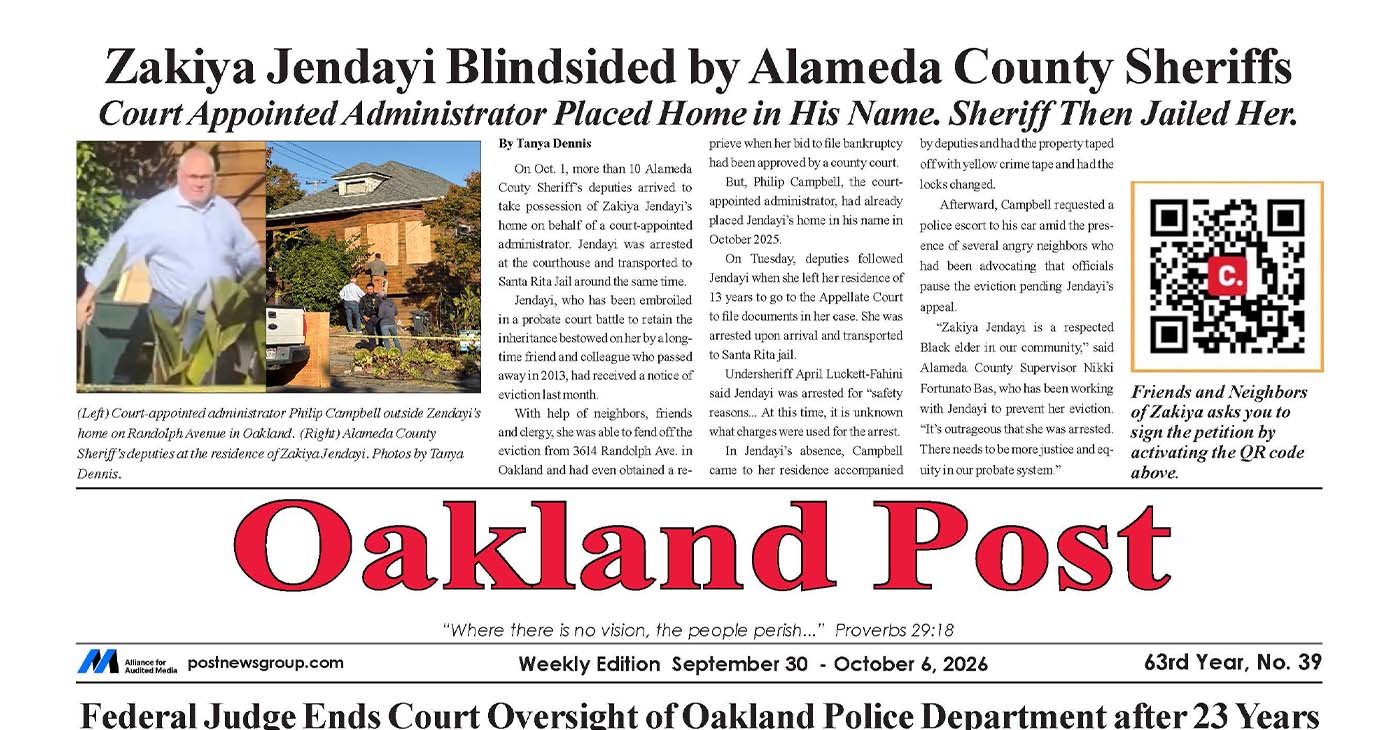
Oakland Post: Week of September 30 – October 6, 2026
The printed Weekly Edition of the Oakland Post: Week of September 30 – October 6, 2026
To enlarge your view of this issue, use the slider, magnifying glass icon or full page icon in the lower right corner of the browser window.
Activism
Oakland Post: Week of September 23 – 29, 2026
The printed Weekly Edition of the Oakland Post: Week of September 23 – 29, 2026

To enlarge your view of this issue, use the slider, magnifying glass icon or full page icon in the lower right corner of the browser window.
Activism
Oakland Post: Week of September 16 – 22, 2026
The printed Weekly Edition of the Oakland Post: Week of September 16 – 22, 2026

To enlarge your view of this issue, use the slider, magnifying glass icon or full page icon in the lower right corner of the browser window.



OP-ED: Proposition 44 Would Put a Price on Trust

OP-ED: Proposition 40: It’s Time to Play Chess, Not Checkers

Listening as a Lifeline: A Doula’s Witness to Black Maternal Health

New Protections for Ticket Buyers: Gov. Newsom Signs Assemblymember Isaac Bryan’s Bill

‘We Don’t Talk Trash — We Pick Up Trash!’

Zakiya Jendayi Arrested, Locked Out of Home by Sheriff’s Deputies

Oakland Post: Week of September 30 – October 6, 2026

Asm. Corey Jackson Announces Launch of 24-Hour Childcare in His District

IN MEMORIAM: The Rev. Leon “Sonny” Clark, Longtime Orange County Pastor and Community Leader, Dies at 72

Poll: Becerra Widens His Lead Over Hilton; Californians Split on Wealth Tax

From Historic Memories to New Possibilities: Oakland Celebrates Coliseum 60

County Office of Education Says OUSD Finances Are Getting Healthier, Materially Stronger

LIVE FREE Sunday Dinner Brings Faith, Fellowship and Civic Conversation to Oakland

Remembering Chauncey Bailey as Student Journalists Face Threats to Truth-Telling

BLACspace Cooperative Invites Bay Area to Experience Oakland’s Black Cultural Ecosystem Through a BLAC Map Tour + Party

Standoff for Justice: Our Homes Are Worth Fighting For

Oakland Post: Week of August 26 – September 1, 2026

Frontier Airlines’ Return to Oakland Airport Brings Flights, Jobs and Opportunity

Gubernatorial Candidate Steve Hilton Blasts California New Tire Rules; Newsom Hits Back

Chef Sharon Lee Blends Culinary Excellence, Education and Empowerment

Jackie Wright Champions Bay Area Stories, Filmmakers and Cultural Institutions

Misnamed ‘Parent’ PAC Seeks to Influence Oakland School Board Elections

Oakland Coliseum Project Opens Door for Small Businesses to Build Bigger

Big City Mayors Ask for “Yes” Vote on Housing Bond Measure; Conservatives Say “No”

Gov. Newsom’s Latest Appointees Include Sacramento Advocate for Formerly Incarcerated Students; State’s New Tech Chief

Longtime BWOPA Member Brendalyn Goodall Appointed to California Workforce Development Board

Gov. Newsom Signs Law Shielding Immigration Aid Workers From Doxing Threats

Secretary of State Shirley N. Weber Urges Californians to Vote Early as Voter ID Battle Intensifies

Oakland Post: Week of September 2 – 8, 2026

IN MEMORIAM: Dolly Parton Dead at 80 — How She Built a Legacy of Love and Earned Her Place in Black Culture

The Conversation With Al McFarlane 6/23/26

Media Monday 6/22/26

LIVE! ASK ALMA! — TUES. 6.23.26 7PM EST

Car Buying Secrets: 4 Hidden Checks Before You Sign!

Is This 550 HP Charger Worth YOUR Money? AutoNetwork Review

Celebrating Juneteenth – Frederick Douglass on education and resistance

LIVE! — ASK ALMA! — TUES. 6.19.26 7PM EST

Hyundai Ioniq 5 Parking, Safety, and 360 View #shorts

2025 Ioniq 5 New Wiper & Powerful Performance! #shorts

Electric SUV Range: Is 259 Miles Enough? #shorts

EV Charging: How Fast Can You Charge an Electric Vehicle? #shorts

Biometric Cooling… Messaging Seats…Come on! 2025 Infiniti QX80 Autograph 4WD

Charged Up: Witness the Magic of a Fully Electric Car! #shorts

Range Rover Sport PHEV Included…: See What’s Inside This Luxury SUV! #shorts

Invisible Hood View: Perfect Parking with X-Ray Vision! #shorts
-
 Community3 weeks ago
Misnamed ‘Parent’ PAC Seeks to Influence Oakland School Board Elections
-
 Activism4 weeks ago
Oakland Post: Week of September 2 – 8, 2026
-

 Activism3 weeks ago
Oakland Post: Week of September 9 – 15, 2026
-

 Community3 weeks ago
Richmond Tiny House Village Farm & Garden Set to Open Gates on Sept. 26
-

 Black History3 weeks ago
Latest Massacre in Haiti Reveals Cruelty U.S. Deportations
-

 Black History3 weeks ago
OPINION: Nolan Wells’ Death One of Several Signifying Racial Terror Lives on in U.S. South
-

 Business2 weeks ago
Mayor Lee Announces $1 Million Kaiser Permanente Grant for Pilot Program to Address Homelessness, Clean Up Public Spaces throughout Oakland
-

 Community3 weeks ago
Democratic Clubs Interview Candidates for Oakland School Board
