
Activism
Charles R. Drew Univ. Launches M.D. Program as Newsom Announces COVID Emergency End
“The benefits of having more doctors of color in the mix are abundantly clear and supported by research. Doctors of color are more likely to practice in underserved communities, and patients of color have better health outcomes when attended to by a physician of the same ethnicity,” said Dean of CDU’s College of Medicine, Dr. Deborah Prothrow-Stith.

By Aldon Thomas Stiles | California Black Media
On Monday, Oct. 17, Gov. Gavin Newsom announced that the COVID-19 emergency in California will end Feb. 28, 2023
The governor’s powers to suspend constitutional laws and procedures in the event of eminent danger – authority that has been criticized as overreaching by critics – will come to an end.
The pandemic highlighted racial disparities in the health care delivery system for Black people and the lack of representation in health care occupations – considering Black people only made up about 3% of California’s active patient care physicians in 2020 despite making up roughly 6.5% of the state’s overall population.
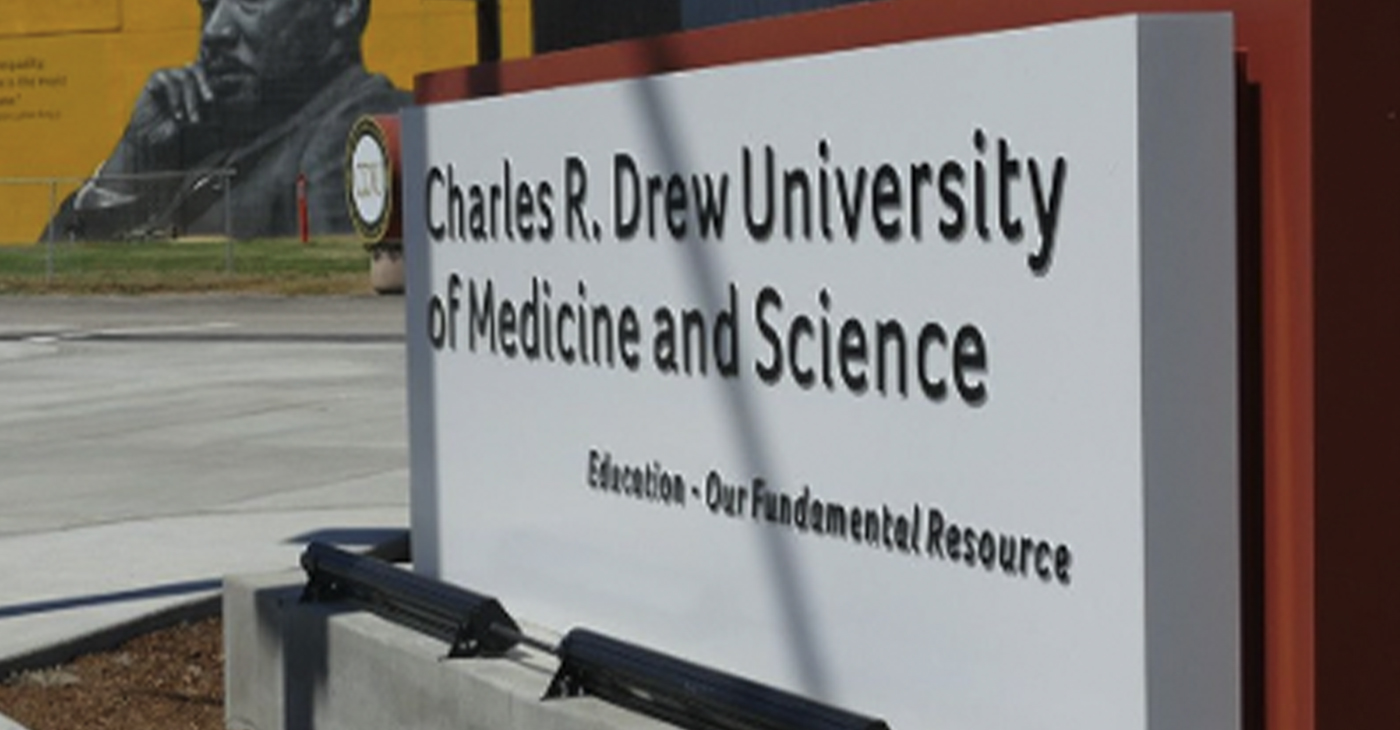
The Charles R. Drew University of Medicine and Science (CDU) has taken a huge step toward a remedy for this issue by launching an independent, four-year medical degree (MD) program.
This is the first and only program of its kind in a historically Black institution west of the Mississippi. It is one of four U.S. historically Black medical colleges.
CDU is located in South Los Angeles. It was founded on the heels of the Watts Rebellion in the mid-1960s. L.A.’s Black population is about 9% of its residents, totaling about 1 million people.

“Our community, and in fact the entire Western United States, has for too long been deprived of an MD program built from the ground up with diversity, equity, and inclusion fused into its very bones. No more,” said David M. Carlisle, CDU President and CEO, in an address to the campus. “It is a great honor and achievement to announce to you today that CDU will finally remedy this once and for all.”
After a turbulent couple of years, California now has a seven-day average of 562 for COVID-19 hospitalizations per 100,000 people and a seven-day average death rate of 29.
Up until recently, the Black community was more likely to suffer more severe symptoms due to COVID.
CDU – a nonprofit institution committed to cultivating future health professionals and leaders “who are dedicated to social justice and health equity” – is partnering with UCLA by educating medical students through a joint MD program.
Funds for the program came from the University’s five year, $75 million CDU Rising Campaign.
According to the Dean of CDU’s College of Medicine, Dr. Deborah Prothrow-Stith, the MD program is designed to aid underserved communities.
“The benefits of having more doctors of color in the mix are abundantly clear and supported by research. Doctors of color are more likely to practice in underserved communities, and patients of color have better health outcomes when attended to by a physician of the same ethnicity,” said Prothrow-Stith.
Prothrow-Stith noted that because the program encourages more doctors of color to practice in communities of need, it could help solve the “root cause of many inequities in healthcare” across California that were exposed during the COVID-19 pandemic.
While the end of the pandemic emergency status has an expiration date, officials with California Health and Human Services (CalHHS) assure citizens that this does not mean the State will be abandoning them.
“California’s response to the COVID-19 pandemic has prepared us for whatever comes next. As we move into this next phase, the infrastructure and processes we’ve invested in and built up will provide us the tools to manage any ups and downs in the future,” said Secretary of CalHHS Dr. Mark Ghaly in a statement. “While the threat of this virus is still real, our preparedness and collective work have helped turn this once crisis emergency into a manageable situation.”
As state officials and community members tackle these issues, they hope that the state will have the infrastructure and personnel to provide an adequate response should another public health crisis arise.










Activism
Oakland Post: Week of September 16 – 22, 2026
The printed Weekly Edition of the Oakland Post: Week of September 16 – 22, 2026

To enlarge your view of this issue, use the slider, magnifying glass icon or full page icon in the lower right corner of the browser window.
Activism
Oakland Post: Week of September 9 – 15, 2026
The printed Weekly Edition of the Oakland Post: Week of September 9 – 15, 2026

To enlarge your view of this issue, use the slider, magnifying glass icon or full page icon in the lower right corner of the browser window.
Activism
Oakland Post: Week of September 2 – 8, 2026
The printed Weekly Edition of the Oakland Post: Week of September 2 – 8, 2026
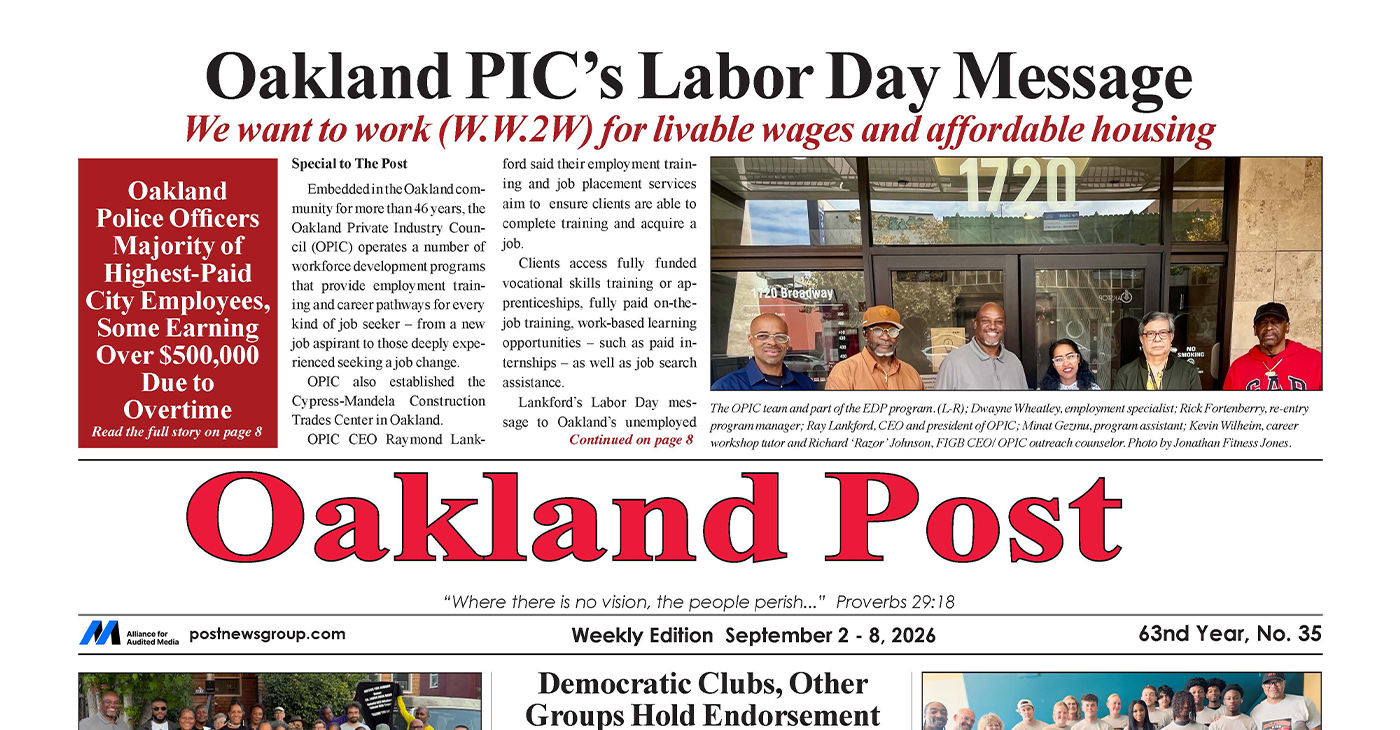
To enlarge your view of this issue, use the slider, magnifying glass icon or full page icon in the lower right corner of the browser window.



Doulas Are Helping Black California Moms Navigate Pregnancy–Even as High Mortality Rates Persist

Newsom Signs Addictive Social Media Law to Protect Kids

On Your November Ballot: Prop 38 Would Allocate $8.4 Billion to Immunology and Immunotherapy Funding

Ask California: Golden State Releases New AI Chatbot

Asm. Isaac Bryan’s Bill Banning California Police From ICE Side Jobs Reaches Newsom’s Desk

Assemblymember LaShae Sharp-Collins’s Bill Would Pause Law Enforcement’s Use of Shock Gloves Pending Study

BOOK REVIEW: ‘Laws of Solomon’ Reveals Tender Heart of Former Child Soldier

OPINION: The New American Fear – From 9-11 to AI

Passing for White, Fighting for Black America: The Courage of Walter White

Oakland People’s Arms Embargo Coalition Demands End to Military Shipments Thru Oakland

Barbara Lee Mourns Gloria Steinem, Remembers a Friendship Rooted in Equality

Event Preview: ‘Fashion v. Fascism’ – A Runway Revolution Is Coming to the Bay Area

Two Looming Threats Every Alameda County Elder Should Know About

Oakland Mayor Reads to Children at Bookout Block Party at Marcus Books Store

Tradition Comes to the Streets in 11th Annual Black-Eyed Pea Festival at the Freedom Farmers Market

Less Affluent School Districts, Including Sacramento City, Face Threat of State Takeover

ESSAY: California Can Close Its Colorectal Cancer Gap

California Hispanic Chambers of Commerce Unveils: ‘Powering the Future’ Theme for 47th Annual Statewide Convention

Four Candidates, Including Incumbent Barbara Lee, Qualify for Oakland Mayor’s Race

Oakland Post: Week of August 12 – 18, 2026

From Blueprint to Breakthrough: Tackling Affordable Housing in Oakland

Oakland Observes Black August with Block Parties, Film Showings, Workshops

COMMENTARY: Why Local School Tax Measure G1 Will Not Be on the November Ballot

Standoff for Justice: Our Homes Are Worth Fighting For

Returning to Its Roots, the Oakland Black-Eyed Pea Festival Partners with the Freedom Farmers Market Sept. 12

NPRC Scores First Advocacy Victory: David Shaw Finally Gets His Wish to ‘Go Home’

Oakland Post: Week of August 26 – September 1, 2026

Frontier Airlines’ Return to Oakland Airport Brings Flights, Jobs and Opportunity

Gubernatorial Candidate Steve Hilton Blasts California New Tire Rules; Newsom Hits Back

Chef Sharon Lee Blends Culinary Excellence, Education and Empowerment

The Conversation With Al McFarlane 6/23/26

Media Monday 6/22/26

LIVE! ASK ALMA! — TUES. 6.23.26 7PM EST

Car Buying Secrets: 4 Hidden Checks Before You Sign!

Is This 550 HP Charger Worth YOUR Money? AutoNetwork Review

Celebrating Juneteenth – Frederick Douglass on education and resistance

LIVE! — ASK ALMA! — TUES. 6.19.26 7PM EST

Hyundai Ioniq 5 Parking, Safety, and 360 View #shorts

2025 Ioniq 5 New Wiper & Powerful Performance! #shorts

Electric SUV Range: Is 259 Miles Enough? #shorts

EV Charging: How Fast Can You Charge an Electric Vehicle? #shorts

Biometric Cooling… Messaging Seats…Come on! 2025 Infiniti QX80 Autograph 4WD

Charged Up: Witness the Magic of a Fully Electric Car! #shorts

Range Rover Sport PHEV Included…: See What’s Inside This Luxury SUV! #shorts

Invisible Hood View: Perfect Parking with X-Ray Vision! #shorts
-
 Commentary4 weeks ago
Standoff for Justice: Our Homes Are Worth Fighting For
-
 Activism4 weeks ago
Oakland Post: Week of August 26 – September 1, 2026
-
 Business4 weeks ago
Frontier Airlines’ Return to Oakland Airport Brings Flights, Jobs and Opportunity
-
 Business4 weeks ago
Gubernatorial Candidate Steve Hilton Blasts California New Tire Rules; Newsom Hits Back
-
 Business4 weeks ago
Chef Sharon Lee Blends Culinary Excellence, Education and Empowerment
-

 Education4 weeks ago
Gov. Newsom’s Latest Appointees Include Sacramento Advocate for Formerly Incarcerated Students; State’s New Tech Chief
-

 Community4 weeks ago
Big City Mayors Ask for “Yes” Vote on Housing Bond Measure; Conservatives Say “No”
-

 Business4 weeks ago
Oakland Coliseum Project Opens Door for Small Businesses to Build Bigger
