
Activism
IN MEMORIAM: Oakland’s Own Bill Russell, 88, Greatest Athlete/Civil Rights Activist Ever (Part 1)
NNPA NEWSWIRE — William Felton Russell was born on Feb. 12, 1934, in Monroe, La., and his family moved to West Oakland in 1942 when he was 8. His father found work on the waterfront and in the Bay Area shipyards in the middle of World War II. They instilled in him a history of racial and family pride that helped him survive in a racially discriminatory Boston environment while playing for the Boston Celtics.

By Paul Cobb, Post News Group Publisher
Bill Russell, the center of attention in professional basketball, died at 88 after becoming the most decorated athlete in all of the team sports in the United States.
The star of the Boston Celtics from 1956-1969, he changed the way basketball was played by applying his rare combination of basketball and track and field athleticism to fashion a defense-centered dominance. In a sport where one’s ability to score points was prized, he reversed the focus by making defensive thinking to prevent others from scoring.
He died on July 31, after more than 70 years of basketball and civil rights activism.
William Felton Russell was born on Feb. 12, 1934, in Monroe, La., and his family moved to West Oakland in 1942 when he was 8. His father found work on the waterfront and in the Bay Area shipyards in the middle of World War II. They instilled in him a history of racial and family pride that helped him survive in a racially discriminatory Boston environment while playing for the Boston Celtics.
In his early years his home was only three blocks east from Ron Dellums, Oakland’s first Black congressman, and just three blocks west from Frank Robinson, Oakland’s first Black Major League Baseball coach.
While living near Ninth and Center streets, he learned early on that one must fight for honor, dignity, and respect by never backing down from any challenge whether through fisticuffs or verbal slights.
He was mentored at Defremery Park and Recreation Center by the late Dorothy Seale Pitts and George Scotlan along with Bill Patterson, who now serves as an EBMUD Director, to stay centered on what mattered.
Even though he pioneered greatness as an athlete and as a scholar/athlete/civil rights activist who fought to achieve dignity and respect for African Americans, his path to recognition and honor was not easy because was not considered good enough to crack the starting five basketball Warriors lineup at McClymonds High School in West Oakland.
He never stopped trying and practicing with his teammates who were better shooters and scorers. But, at 6-foot 10 inches, he was taller and could jump higher and played defense above the rim. He even became the Warriors’ mascot who created a stunning nimble artistic dance routine as the team’s mascot.
(His achievements attracted many who sought to follow in his footsteps with stylized dance routines that were featured during halftime breaks.)
His mother died when he was 12, never seeing Bill win two state prep titles and two national college crowns at the University of San Francisco after being ignored by many colleges because he was Black.
He was a five-time NBA Most Valuable Player and captain of the 1956 U.S. Gold Medal team at the Melbourne Olympics. He drastically altered defensive play by excelling in rebounding, shot-blocking, and passing to ignite a fast-paced style of play.
He won eight consecutive NBA titles from 1959-1966. As a player-coach in his final three seasons, Russell was the first Black coach in North American sports and the first to win a title, doing so in 1968 and again in his 1969 farewell campaign.
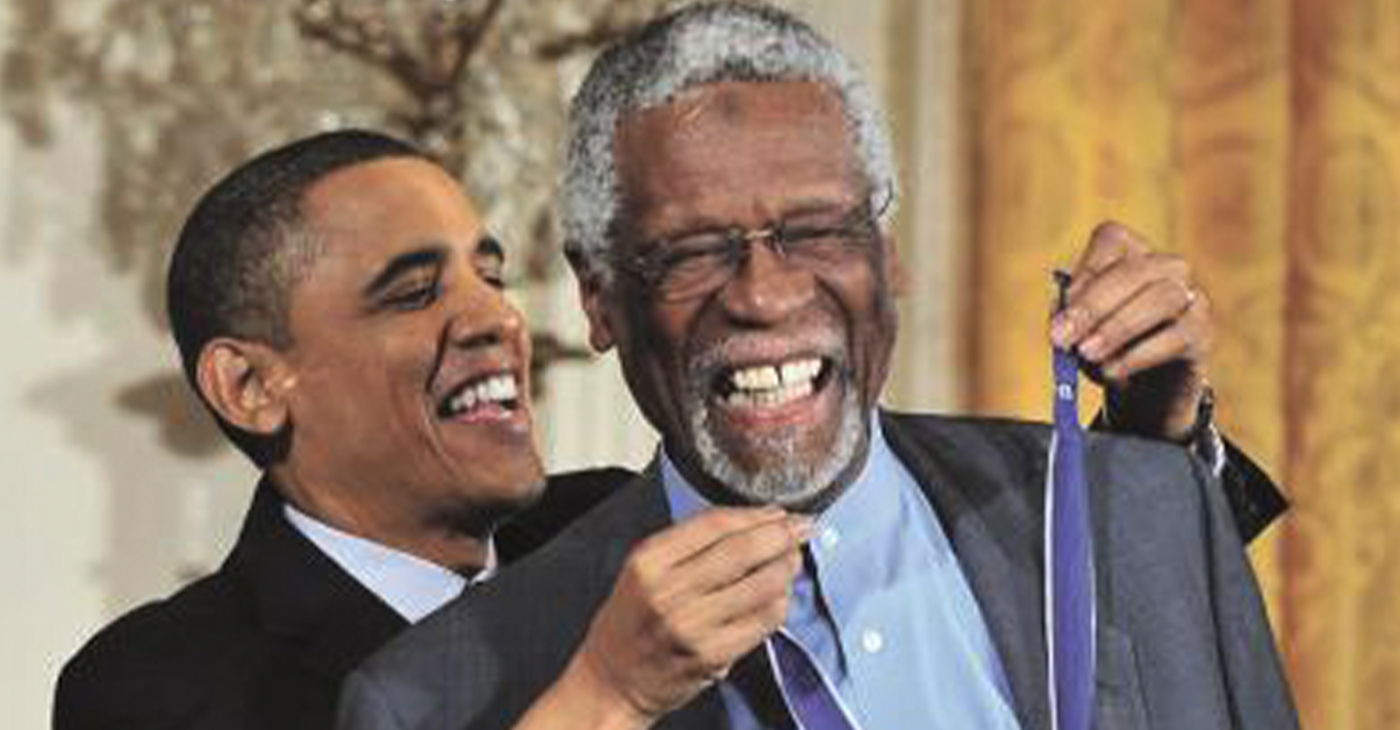
He was the first Black player inducted into the Basketball Hall of Fame in 1975 and was awarded the Presidential Medal of Freedom in 2011 by Barack Obama, America’s first Black president, for his civil rights and basketball achievements.
Russell was first among Oakland’s and the country’s athletic achievers. His USF team was the first major college to start three Black players. His Celtics team was the first to start five Black players. He was the first to become a player-coach. And he was the first player-coach to win an NBA title. He was first to be invited by Dr. Martin Luther King, Jr. to speak at the 1963 March on Washington. He was the first athlete to utilize his celebrity by traveling to Mississippi to use sports to bring racial healing after the KKK killed NAACP leader Medgar Evers.
As the first-ranked and highest respected Black sportsman, he used his status to lead the nation’s leading Black athletes which included Jim Brown, Lew Alcindor (Kareem Abdul Jabbar) and many others to support Muhammad Ali’s stance against the Vietnam War.
He always remembered his friends and mentors here in Oakland. Whenever he traveled to Oakland, he would often check in with Maxine Willis Ussery and reminisce about the days when his family would visit her family’s cleaning establishment.
She said he was protective of her and wanted to meet and give his approval to any of her dates and he insisted that he go to dinner with her and fiance Wilfred Ussery to give his approval. Maxine is now the office manager at the Post News Group (Oakland Post).
He paid one of his highest compliments to Bill Patterson for guiding and counseling him since his high school days. He said Patterson helped him understand that he must never allow himself to be a victim. He was proud of Coach Ben Tapscott, the McClymonds’ basketball coach, who not only continued to maintain the school’s tradition as the winningest high school in the country with an emphasis on academic achievements.
He invited Tapscott to share the glory with him when he was inducted and honored by the University of San Francisco.
In an interview with Russell and former WNBA Coach Nancy Lieberman, just months before his passing, he was making plans to donate a jointly signed basketball to salute the achievement of Oakland’s African American Sports and Entertainment Group for purchasing the Oakland Coliseum.
Bill Patterson, Geoffrey Pete, Ben Tapscott, Joe Ellis, Jumoke Hinton, Rev. Gerald Agee, Ray Bobbitt, Arif Khatib, Virtual Murrell, Gary Reeves, Nancy Lieberman, Jonathan Jones, Al Attles, Jr. and many others have asked The Post to put them on the task force to gather the list and honor the Bay Area’s historic cavalcade of Athlete/Activists who also became “firsts” in their respective sports. For those who want to volunteer to be included, please contact Maxine Ussery @510-287-8200 or mussery@postnewsgroup.com.
“We must find a way to honor our highest achievers,” said Bill Patterson and Ben Tapscott






Activism
Oakland Post: Week of September 23 – 29, 2026
The printed Weekly Edition of the Oakland Post: Week of September 23 – 29, 2026

To enlarge your view of this issue, use the slider, magnifying glass icon or full page icon in the lower right corner of the browser window.
Activism
Oakland Post: Week of September 16 – 22, 2026
The printed Weekly Edition of the Oakland Post: Week of September 16 – 22, 2026

To enlarge your view of this issue, use the slider, magnifying glass icon or full page icon in the lower right corner of the browser window.
Activism
Oakland Post: Week of September 9 – 15, 2026
The printed Weekly Edition of the Oakland Post: Week of September 9 – 15, 2026

To enlarge your view of this issue, use the slider, magnifying glass icon or full page icon in the lower right corner of the browser window.


Asm. Corey Jackson Announces Launch of 24-Hour Childcare in His District

IN MEMORIAM: The Rev. Leon “Sonny” Clark, Longtime Orange County Pastor and Community Leader, Dies at 72

Poll: Becerra Widens His Lead Over Hilton; Californians Split on Wealth Tax

From Historic Memories to New Possibilities: Oakland Celebrates Coliseum 60

County Office of Education Says OUSD Finances Are Getting Healthier, Materially Stronger

LIVE FREE Sunday Dinner Brings Faith, Fellowship and Civic Conversation to Oakland

Remembering Chauncey Bailey as Student Journalists Face Threats to Truth-Telling

BLACspace Cooperative Invites Bay Area to Experience Oakland’s Black Cultural Ecosystem Through a BLAC Map Tour + Party

In Wake of Death on Doorstep, Williams Chapel Baptist Church Calls for Better Care, Funding for Unhoused

Oakland Centenarian Nuna McKee Honored!

Caribbean Nations Produce Action Plan Calling for UK Reparations Over Slavery

Oakland Post: Week of September 23 – 29, 2026

Doulas Are Helping Black California Moms Navigate Pregnancy–Even as High Mortality Rates Persist

Newsom Signs Addictive Social Media Law to Protect Kids

On Your November Ballot: Prop 38 Would Allocate $8.4 Billion to Immunology and Immunotherapy Funding

Standoff for Justice: Our Homes Are Worth Fighting For

Oakland Post: Week of August 26 – September 1, 2026

Frontier Airlines’ Return to Oakland Airport Brings Flights, Jobs and Opportunity

Gubernatorial Candidate Steve Hilton Blasts California New Tire Rules; Newsom Hits Back

Chef Sharon Lee Blends Culinary Excellence, Education and Empowerment

Jackie Wright Champions Bay Area Stories, Filmmakers and Cultural Institutions

Big City Mayors Ask for “Yes” Vote on Housing Bond Measure; Conservatives Say “No”

Oakland Coliseum Project Opens Door for Small Businesses to Build Bigger

Gov. Newsom’s Latest Appointees Include Sacramento Advocate for Formerly Incarcerated Students; State’s New Tech Chief

Misnamed ‘Parent’ PAC Seeks to Influence Oakland School Board Elections

Longtime BWOPA Member Brendalyn Goodall Appointed to California Workforce Development Board

Gov. Newsom Signs Law Shielding Immigration Aid Workers From Doxing Threats

Secretary of State Shirley N. Weber Urges Californians to Vote Early as Voter ID Battle Intensifies

Oakland Post: Week of September 2 – 8, 2026

IN MEMORIAM: Dolly Parton Dead at 80 — How She Built a Legacy of Love and Earned Her Place in Black Culture

The Conversation With Al McFarlane 6/23/26

Media Monday 6/22/26

LIVE! ASK ALMA! — TUES. 6.23.26 7PM EST

Car Buying Secrets: 4 Hidden Checks Before You Sign!

Is This 550 HP Charger Worth YOUR Money? AutoNetwork Review

Celebrating Juneteenth – Frederick Douglass on education and resistance

LIVE! — ASK ALMA! — TUES. 6.19.26 7PM EST

Hyundai Ioniq 5 Parking, Safety, and 360 View #shorts

2025 Ioniq 5 New Wiper & Powerful Performance! #shorts

Electric SUV Range: Is 259 Miles Enough? #shorts

EV Charging: How Fast Can You Charge an Electric Vehicle? #shorts

Biometric Cooling… Messaging Seats…Come on! 2025 Infiniti QX80 Autograph 4WD

Charged Up: Witness the Magic of a Fully Electric Car! #shorts

Range Rover Sport PHEV Included…: See What’s Inside This Luxury SUV! #shorts

Invisible Hood View: Perfect Parking with X-Ray Vision! #shorts
-
 Community3 weeks ago
Misnamed ‘Parent’ PAC Seeks to Influence Oakland School Board Elections
-
 Activism4 weeks ago
Oakland Post: Week of September 2 – 8, 2026
-

 Community3 weeks ago
Richmond Tiny House Village Farm & Garden Set to Open Gates on Sept. 26
-

 Activism3 weeks ago
Oakland Post: Week of September 9 – 15, 2026
-

 Black History3 weeks ago
Latest Massacre in Haiti Reveals Cruelty U.S. Deportations
-

 Black History3 weeks ago
OPINION: Nolan Wells’ Death One of Several Signifying Racial Terror Lives on in U.S. South
-

 Community3 weeks ago
Democratic Clubs Interview Candidates for Oakland School Board
-

 Business2 weeks ago
Mayor Lee Announces $1 Million Kaiser Permanente Grant for Pilot Program to Address Homelessness, Clean Up Public Spaces throughout Oakland
