
Activism
New 988 Behavioral Health Crisis Number Launches in Marin County
“We hope that calling 988 in a behavioral health crisis becomes as second nature as calling 911 in a medical or safety emergency,” said Dr. Jei Africa, BHRS Director. “Everybody has a role to play in crisis response and suicide prevention and that’s why we’d like everyone to be aware of this new number.”

Courtesy of Marin County

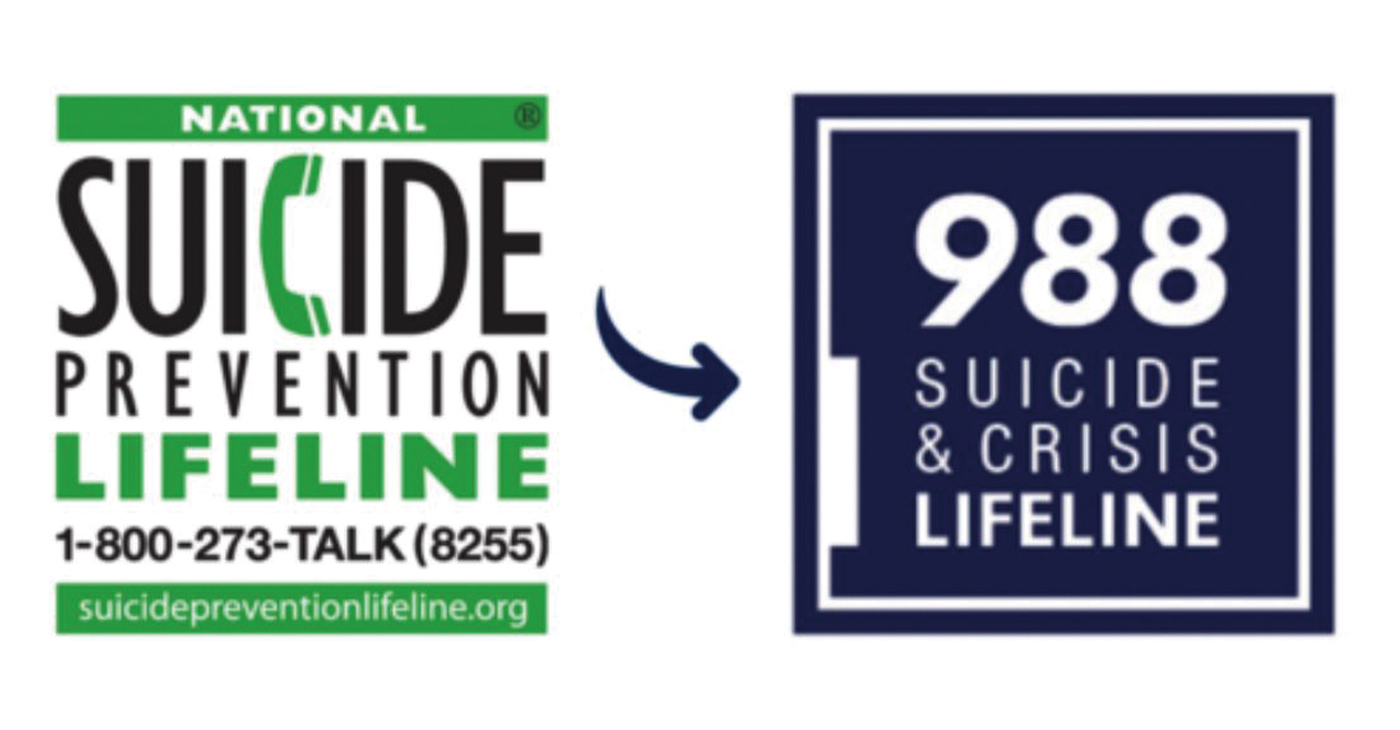
A new phone number for behavioral health crisis needs will soon launch nationwide. Instead of dialing 911, people should call 988 to report when someone is in danger of self-harm or suicide. Marin County agencies are raising local awareness of the new option and explaining when to use it.
Beginning July 16, 988 is the number to dial or text for urgent help in a time of mental health or substance use crisis, or even witnessing another person deal with a behavioral health challenge. The federal Substance Abuse and Mental Health Services Administration (SAMHSA) envisions 988 as a first step toward a transformed national crisis care system. The service is a universal entry point to a trained crisis counselor regardless of the caller’s location. Marin will be among the first counties to launch 988, as other areas across the U.S. plan to launch later in 2022.
“We hope that calling 988 in a behavioral health crisis becomes as second nature as calling 911 in a medical or safety emergency,” said Dr. Jei Africa, BHRS Director. “Everybody has a role to play in crisis response and suicide prevention and that’s why we’d like everyone to be aware of this new number.”
The local provider of the Suicide Prevention Lifeline is Novato-based Buckelew Programs. Staff who receive 988 calls or text messages will quickly evaluate the emergency and use trained crisis counselors to provide an appropriate intervention. Urgent calls requiring an in-person mobile crisis response are directed to clinical staff in the Marin County Department of Health and Human Services (HHS) and its Behavioral Health and Recovery Services (BHRS) division.
“Buckelew Programs is proud to lead the 988 transition, providing life-saving services for Marin residents,” said Buckelew Programs Chief Executive Officer Chris Kughn. “It means greater access for those experiencing mental health, substance use or suicidal crises. Our trained counselors can provide callers with de-escalation, safety planning, connection to resources, and engagement with mobile and emergency response teams as needed. The hotline helps a person experiencing any level of distress with inclusive, multilingual and culturally sensitive services. 988 is about understanding the caller’s urgent mental health needs and is an alternative to our current emergency response systems.”
The creation of the 988 line is an expansion of the free 24-7 services and confidential support to callers in emotional distress that have been available since 2005. The federal government designated the 988 number to operate through the existing National Suicide Prevention Lifeline in 2020 and went to work creating the infrastructure and training counselors fluent in many languages to respond to caller needs. States can now raise money to fund the call centers and related mental health crisis services by attaching new fees to phone lines. In California, Assembly Bill (AB) 988 is under review in the state senate and would assist with hotline launch and provide funding for local service providers to handle calls.
The launch’s timing this summer ties in with the COVID-19 pandemic, which has added stress to many lives. The national suicide rate has climbed nearly 30% since 1999 and is now the second leading cause of death among young people, according to federal sources. About 20% of the American population has a documented mental health condition.
Recently, high-profile acts of violence against innocent people — especially in the U.S. and especially with firearms — have brought more attention to the need for mental health services. It is estimated that victims in 25% of all officer-involved shootings are people in a mental health crisis. Thus far, law enforcement agencies across the country have supported the 988 program.
“While our 911 dispatchers will continue to be trained in crisis communications, de-escalation and recognizing those experiencing a mental health crisis through our inhouse Crisis Intervention Team post certified training program we welcome the opportunity to work cohesively with 988 operators,” said Heather Costello, Communications Manager for Marin County Sheriff’s 911 Call Center. “Cross-system partnerships are critical to 988’s success because the dedicated phone number will utilize resources from various disciplines, such as mental health, police, and fire, depending on which services may be needed by the person in crisis.”
Marin HHS oversees government-funded behavioral health and recovery services on a local scale. More resources are on the BHRS webpage.
If you or someone you know is in mental health distress, find resources on Prevention.MarinBHRS.org or contact:
Marin Suicide Prevention Hotline: (415) 499-1100
National Suicide Prevention Lifeline: 1 (800) 273-8255 y en Español: 1 (888) 628-9454
The Trevor Lifeline: 1 (866) 488-7386
Friendship Line (for 60 and older): 1 (800) 971-0016
Crisis Text Line: Text MARIN to 741741












To enlarge your view of this issue, use the slider, magnifying glass icon or full page icon in the lower right corner of the browser window.
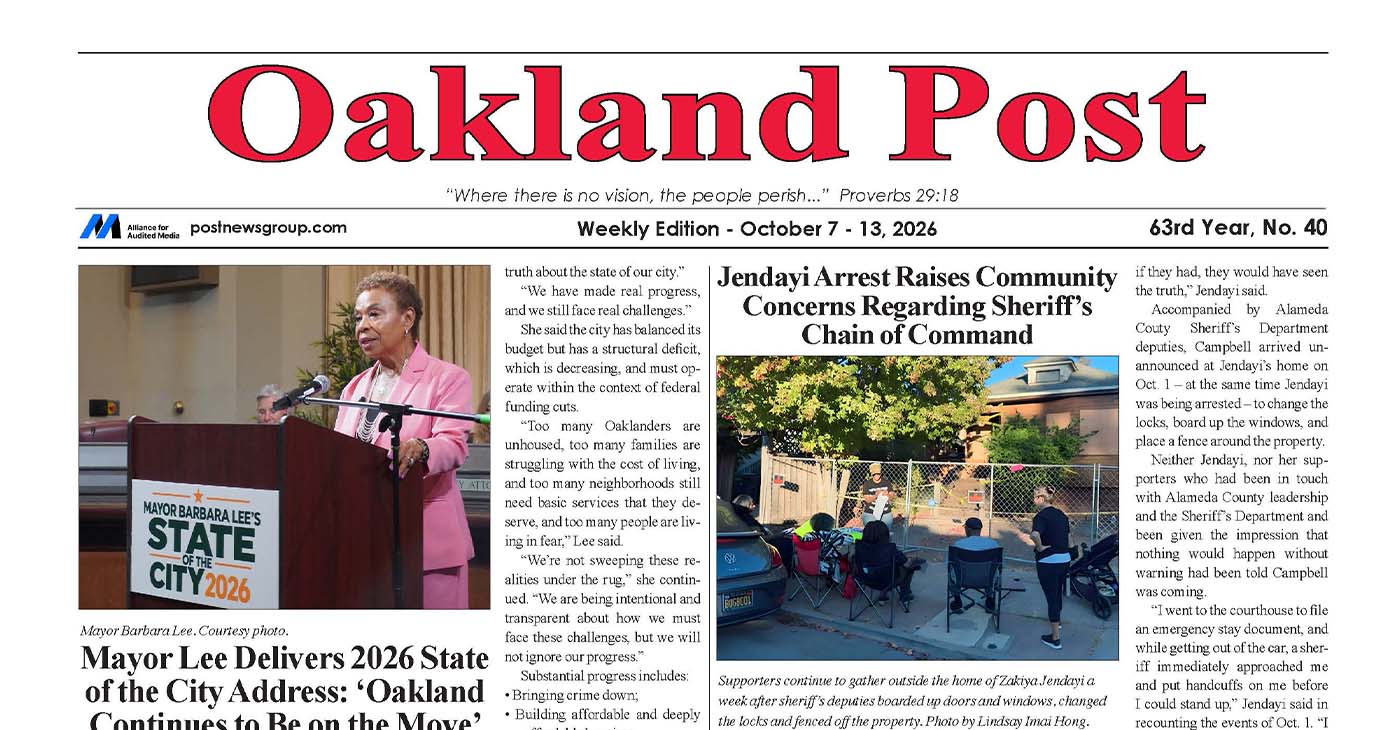
To enlarge your view of this issue, use the slider, magnifying glass icon or full page icon in the lower right corner of the browser window.
Activism
Oakland Post: Week of September 30 – October 6, 2026
The printed Weekly Edition of the Oakland Post: Week of September 30 – October 6, 2026

To enlarge your view of this issue, use the slider, magnifying glass icon or full page icon in the lower right corner of the browser window.



Mayor Barbara Lee Holds Special State of the City Address in Deep East Oakland

Practitioners of African Traditional Spirituality Offer Ancestral Reverence Ritual Oct. 31

It’s Time to Lose Weight Before the Holidays

Trader Vic’s Returns to Its Oakland Roots

Oakland Coal Terminal Backed by Trump Would Be Bigger, Dirtier Than Promised, Says Report

Opponents Smear Effective African American Transit Director as Election Nears

Oakland Post: Week of October 14 – 20, 2026

OP-ED: The Black Church Writes AI’s Next Chapter

OP-ED: The Black Church Writes AI’s Next Chapter

WCCUSD Joins Statewide Organic School Food Purchasing Cooperative

Democrats, Community Groups Back Measure EE to Change How Oakland Is Governed

Four Tips to Help You Plan a Holiday “Staycation”

Veterans Housing Project Proposed for South Richmond
PRESS ROOM: Transformative Justice Coalition 2026 Voting Rights Champion Awards Reception ‘Yesterday Is Today: The Battle For Voting Rights

Mayor Lee Delivers 2026 State of the City Address: ‘Oakland Continues to Be on the Move’

Misnamed ‘Parent’ PAC Seeks to Influence Oakland School Board Elections

Poll: Becerra Widens His Lead Over Hilton; Californians Split on Wealth Tax

Listening as a Lifeline: A Doula’s Witness to Black Maternal Health

Oakland Post: Week of September 9 – 15, 2026

County Office of Education Says OUSD Finances Are Getting Healthier, Materially Stronger

Richmond Tiny House Village Farm & Garden Set to Open Gates on Sept. 26

Mayor Lee Announces $1 Million Kaiser Permanente Grant for Pilot Program to Address Homelessness, Clean Up Public Spaces throughout Oakland

Latest Massacre in Haiti Reveals Cruelty U.S. Deportations

Zakiya Jendayi Arrested, Locked Out of Home by Sheriff’s Deputies

OPINION: Nolan Wells’ Death One of Several Signifying Racial Terror Lives on in U.S. South

BLACspace Cooperative Invites Bay Area to Experience Oakland’s Black Cultural Ecosystem Through a BLAC Map Tour + Party

Doulas Are Helping Black California Moms Navigate Pregnancy–Even as High Mortality Rates Persist

Oakland Post: Week of September 16 – 22, 2026

Oakland People’s Arms Embargo Coalition Demands End to Military Shipments Thru Oakland

Democratic Clubs Interview Candidates for Oakland School Board

The Conversation With Al McFarlane 6/23/26

Media Monday 6/22/26

LIVE! ASK ALMA! — TUES. 6.23.26 7PM EST

Car Buying Secrets: 4 Hidden Checks Before You Sign!

Is This 550 HP Charger Worth YOUR Money? AutoNetwork Review

Celebrating Juneteenth – Frederick Douglass on education and resistance

LIVE! — ASK ALMA! — TUES. 6.19.26 7PM EST

Hyundai Ioniq 5 Parking, Safety, and 360 View #shorts

2025 Ioniq 5 New Wiper & Powerful Performance! #shorts

Electric SUV Range: Is 259 Miles Enough? #shorts

EV Charging: How Fast Can You Charge an Electric Vehicle? #shorts

Biometric Cooling… Messaging Seats…Come on! 2025 Infiniti QX80 Autograph 4WD

Charged Up: Witness the Magic of a Fully Electric Car! #shorts

Range Rover Sport PHEV Included…: See What’s Inside This Luxury SUV! #shorts

Invisible Hood View: Perfect Parking with X-Ray Vision! #shorts
-
 Economy4 weeks ago
Poll: Becerra Widens His Lead Over Hilton; Californians Split on Wealth Tax
-
 Black History3 weeks ago
Listening as a Lifeline: A Doula’s Witness to Black Maternal Health
-
 Business4 weeks ago
County Office of Education Says OUSD Finances Are Getting Healthier, Materially Stronger
-
 Lead Story3 weeks ago
Zakiya Jendayi Arrested, Locked Out of Home by Sheriff’s Deputies
-
 Art4 weeks ago
BLACspace Cooperative Invites Bay Area to Experience Oakland’s Black Cultural Ecosystem Through a BLAC Map Tour + Party
-
 Black History4 weeks ago
Doulas Are Helping Black California Moms Navigate Pregnancy–Even as High Mortality Rates Persist
-
 Business4 weeks ago
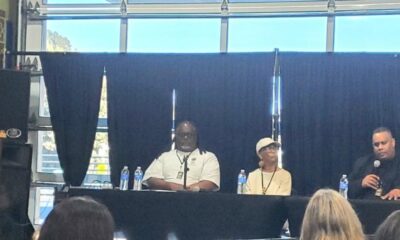
From Historic Memories to New Possibilities: Oakland Celebrates Coliseum 60
-
 Community4 weeks ago
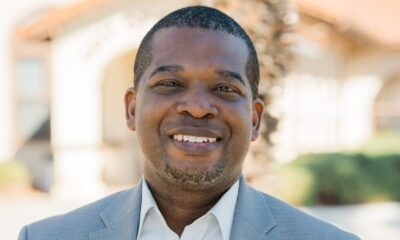
Asm. Corey Jackson Announces Launch of 24-Hour Childcare in His District
