
Activism
Healing Domestic Violence: “It has to be Heart Stuff’
Black people must learn to “leverage our allies in support of our goals,” even if those allies aren’t Black. She explained that others could and are willing to give resources, but she is an advocate for Black people setting their own agenda.


Charlene Muhammad | Special to the Oakland Post
Wilhelmenia “Mina” Wilson, executive director of Healthy Black Families, Inc., in Berkeley grew in a nuclear family in the Bay Area.
Her parents met in college and were each other’s first love. Still, there was trauma.
As Ms. Wilson grew older, she went through her own traumatic experiences. As a young woman, she, too, became a victim to domestic violence.
“The only way I was able to save myself was to remove myself. And not only did I leave the environment, but he knew where I worked. I left my job. I left and created a new life for myself,” she said. “And in removing myself, what I had to do also was stay by myself until I could heal myself. And that took some years.”
To overcome her trauma, Wilson employed some of the techniques she now shares with others as the executive director of Healthy Black Families, Inc.
“I had to learn myself. I had to unpack my trauma. I had to learn to love myself again. And then that allowed me to navigate relationships in a different way,” she said. “So, I’m not really talking from what I think. I’m really talking from what I know, from my own personal experience, and I’d love to try this and see if it works successfully at a macro level as it did for me on a micro one.”
In an interview with Post News Group, Ms. Wilson provided her views on the root causes of domestic violence and proposed several viable solutions.
“When you subject people to lack of human dignity, when people don’t have their basic needs met, that begets a lot of different types of negative behaviors,” she said.
She attributed the causes of domestic violence to how the capitalist system sometimes devalues Black people, and Black women in particular — both of which, from her view, are rooted in slavery. Black women were a commodity, and Black men were vulnerable because they could not protect Black women and were slaughtered when they attempted to, she said.
Fast forward to 2022 and the “same type of socioeconomic structure exists today as it did then. Black poverty is high. Black unemployment is high. Black folks still are fewer as far as home ownership,” she added.
With that month-to-month struggle for sustenance paired with the lack of options to support people’s needs, “people tend to implode upon each other,” Wilson said.
She said when she thinks about solutions to domestic violence, she thinks about how to detach from the system that wants to manipulate and capitalize on Black people, how to gain deeper knowledge of self and how to create new pathways of life and livelihood.
Some solutions she offered included: tackling poverty and the socioeconomic structure by creating an economy within the Black community and buying Black; supporting underfunded grassroots organizations that are grounded in the community; establishing programs and vocational training for children and the community; getting into agriculture and urban farming; and building infrastructure and offering support services.
Related to the solution on economics, she said Black people must learn to “leverage our allies in support of our goals,” even if those allies aren’t Black. She explained that others could and are willing to give resources, but she is an advocate for Black people setting their own agenda.
Wilson especially noted the importance of mastering self, bringing up Biblical figures like Jesus as examples.
“They had done self-mastery, and they had learned universal law. And they knew how to walk in the world so they could be creative energies,” she said.
She recalled a course she took offered by Dr. Ishmael Tetteh, a spiritual teacher from Ghana, on “soul processing.” Students were asked to make a timeline of their entire lives. Tetteh labeled the painful parts of their lives as “cud,” which is partly digested food that a cow continues to chew on.
“Those painful experiences are like cud in our spirit, and we continue to chew on them. And he said, the goal of this life soul processing is to break apart those cud patches and then redefine them in a way that serves you,” Wilson said.
She said as Black people in America, “all of us have trauma” that need to be unpacked.
Another solution she proposed was creating spaces that are culturally authentic where Black people can heal together. But she said the first step is unpacking the pain that fuels the violence.
“Oftentimes that means you have to move people away from each other so that they can do their own healing,” she said, because “it’s hard to heal with people who have harmed you.”
Necessary infrastructure for her includes safe houses and community-based intervention.
“If it’s a mom and kids, where do we put them while we work out the situation, and with the man who’s doing it, how do we get them into a situation where they can do some anger management rather than criminalize everything?” she questioned.
When Wilson experienced domestic violence, a woman she had been close to helped her out.
“She talked to me, and she was the person who made space for my healing. She let me stay with her for a while. And so, fast forward, years go by, I get my act together. And I think about her, and I go back to her and I’m like, ‘I don’t know how to thank you for what you did for me,’” Wilson recalled.
“And she was like, ‘Girl, what you don’t get is that it’s not even about me.’ She’s like, ‘The only reason that I am here to do this for you is because there was some woman who did it for me.’ And she said, ‘So you don’t owe me anything.’” She said, “‘What you owe is you got to step up and do it for someone else when you see a need.’”
Wilson says she lives her life trying to hold true to that advice.
“And I think we have to proceed with that kind of heart in order to really heal people. It can’t just be tactical stuff. It has to be human stuff. It has to be heart stuff,” she said.









Activism
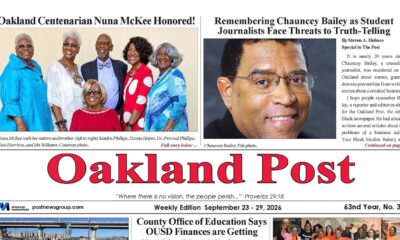
Oakland Post: Week of September 23 – 29, 2026
The printed Weekly Edition of the Oakland Post: Week of September 23 – 29, 2026

To enlarge your view of this issue, use the slider, magnifying glass icon or full page icon in the lower right corner of the browser window.
Activism
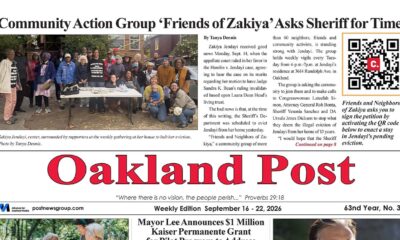
Oakland Post: Week of September 16 – 22, 2026
The printed Weekly Edition of the Oakland Post: Week of September 16 – 22, 2026

To enlarge your view of this issue, use the slider, magnifying glass icon or full page icon in the lower right corner of the browser window.
Activism
Oakland Post: Week of September 9 – 15, 2026
The printed Weekly Edition of the Oakland Post: Week of September 9 – 15, 2026
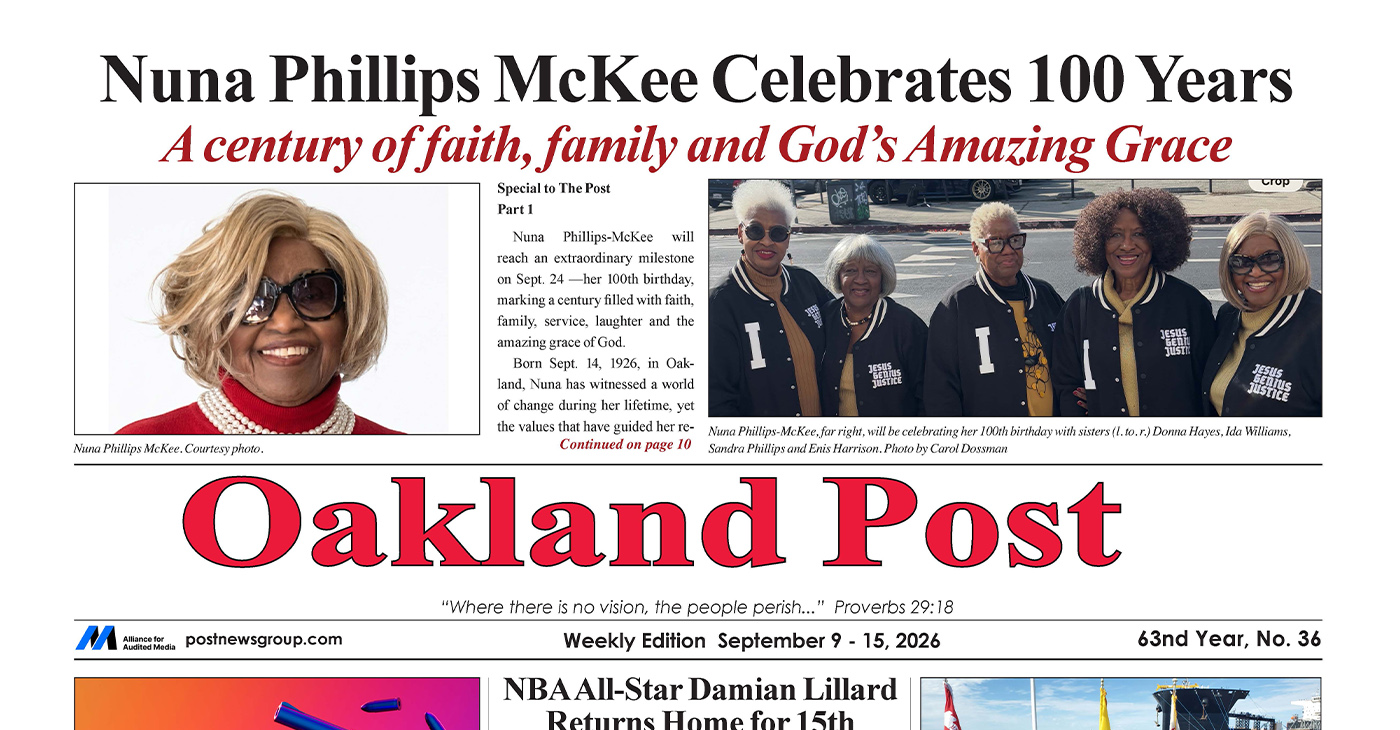
To enlarge your view of this issue, use the slider, magnifying glass icon or full page icon in the lower right corner of the browser window.



Asm. Corey Jackson Announces Launch of 24-Hour Childcare in His District

IN MEMORIAM: The Rev. Leon “Sonny” Clark, Longtime Orange County Pastor and Community Leader, Dies at 72

Poll: Becerra Widens His Lead Over Hilton; Californians Split on Wealth Tax

From Historic Memories to New Possibilities: Oakland Celebrates Coliseum 60

County Office of Education Says OUSD Finances Are Getting Healthier, Materially Stronger

LIVE FREE Sunday Dinner Brings Faith, Fellowship and Civic Conversation to Oakland

Remembering Chauncey Bailey as Student Journalists Face Threats to Truth-Telling

BLACspace Cooperative Invites Bay Area to Experience Oakland’s Black Cultural Ecosystem Through a BLAC Map Tour + Party

In Wake of Death on Doorstep, Williams Chapel Baptist Church Calls for Better Care, Funding for Unhoused

Oakland Centenarian Nuna McKee Honored!

Caribbean Nations Produce Action Plan Calling for UK Reparations Over Slavery

Oakland Post: Week of September 23 – 29, 2026

Doulas Are Helping Black California Moms Navigate Pregnancy–Even as High Mortality Rates Persist

Newsom Signs Addictive Social Media Law to Protect Kids

On Your November Ballot: Prop 38 Would Allocate $8.4 Billion to Immunology and Immunotherapy Funding

Less Affluent School Districts, Including Sacramento City, Face Threat of State Takeover

ESSAY: California Can Close Its Colorectal Cancer Gap

California Hispanic Chambers of Commerce Unveils: ‘Powering the Future’ Theme for 47th Annual Statewide Convention

Four Candidates, Including Incumbent Barbara Lee, Qualify for Oakland Mayor’s Race

Oakland Post: Week of August 12 – 18, 2026

From Blueprint to Breakthrough: Tackling Affordable Housing in Oakland

Oakland Observes Black August with Block Parties, Film Showings, Workshops

COMMENTARY: Why Local School Tax Measure G1 Will Not Be on the November Ballot

Standoff for Justice: Our Homes Are Worth Fighting For

Returning to Its Roots, the Oakland Black-Eyed Pea Festival Partners with the Freedom Farmers Market Sept. 12

Oakland Post: Week of August 26 – September 1, 2026

NPRC Scores First Advocacy Victory: David Shaw Finally Gets His Wish to ‘Go Home’

Frontier Airlines’ Return to Oakland Airport Brings Flights, Jobs and Opportunity

Gubernatorial Candidate Steve Hilton Blasts California New Tire Rules; Newsom Hits Back

Chef Sharon Lee Blends Culinary Excellence, Education and Empowerment

The Conversation With Al McFarlane 6/23/26

Media Monday 6/22/26

LIVE! ASK ALMA! — TUES. 6.23.26 7PM EST

Car Buying Secrets: 4 Hidden Checks Before You Sign!

Is This 550 HP Charger Worth YOUR Money? AutoNetwork Review

Celebrating Juneteenth – Frederick Douglass on education and resistance

LIVE! — ASK ALMA! — TUES. 6.19.26 7PM EST

Hyundai Ioniq 5 Parking, Safety, and 360 View #shorts

2025 Ioniq 5 New Wiper & Powerful Performance! #shorts

Electric SUV Range: Is 259 Miles Enough? #shorts

EV Charging: How Fast Can You Charge an Electric Vehicle? #shorts

Biometric Cooling… Messaging Seats…Come on! 2025 Infiniti QX80 Autograph 4WD

Charged Up: Witness the Magic of a Fully Electric Car! #shorts

Range Rover Sport PHEV Included…: See What’s Inside This Luxury SUV! #shorts

Invisible Hood View: Perfect Parking with X-Ray Vision! #shorts
-
 Business4 weeks ago
Frontier Airlines’ Return to Oakland Airport Brings Flights, Jobs and Opportunity
-
 Business4 weeks ago
Gubernatorial Candidate Steve Hilton Blasts California New Tire Rules; Newsom Hits Back
-
 Business4 weeks ago
Chef Sharon Lee Blends Culinary Excellence, Education and Empowerment
-
 Black History4 weeks ago
Jackie Wright Champions Bay Area Stories, Filmmakers and Cultural Institutions
-

 Community4 weeks ago
Big City Mayors Ask for “Yes” Vote on Housing Bond Measure; Conservatives Say “No”
-

 Education4 weeks ago
Gov. Newsom’s Latest Appointees Include Sacramento Advocate for Formerly Incarcerated Students; State’s New Tech Chief
-

 Business4 weeks ago
Oakland Coliseum Project Opens Door for Small Businesses to Build Bigger
-

 Community2 weeks ago
Misnamed ‘Parent’ PAC Seeks to Influence Oakland School Board Elections
