
Activism
White House Praises California Model; Says Equity Is Critical in COVID Fight
California was among the first states to start tracking racial data to determine why the disease, based on early infection patterns, was disproportionately impacting Blacks, Latinos and Native Americans. Although the rate of infections by race narrowed over time, the Centers for Disease Control and Prevention (CDC) and California Department of Health data still show higher COVID-19 death rates for African Americans than the general population.


By Aldon Thomas Stiles | California Black Media

Last week, Dr. Cameron Webb, the White House COVID-19 Response Team’s Senior Policy Advisor for Equity, discussed with California Black Media (CBM) the importance of fairness in the country’s fight against COVID. He complimented California’s pandemic response model.
“There has been a great model in California, which has always been a leader in some of these equitable initiatives,” Webb said.
He praised the work of Dr. Rohan C. Radhakrishna, deputy director for the California Department of Public Heath’s (CDPH) Office of Health Equity.
“Some of the work they’ve been doing on data collection in California had them tracking [COVID-19] across demographics in preparing to respond to the need. Without having the data, without knowing what the problems are, you can’t find the solution,” Webb said.
California was among the first states to start tracking racial data to determine why the disease, based on early infection patterns, was disproportionately impacting Blacks, Latinos and Native Americans.
Although the rate of infections by race narrowed over time, the Centers for Disease Control and Prevention (CDC) and California Department of Health data still show higher COVID-19 death rates for African Americans than the general population.
The COVID-19 death rate is 15% higher for Black Californians than the statewide average. Nationally African Americans account for 12% of the country’s population, but they make up about 14% of COVID-19 related deaths.
According to Webb, inequity in health care is one of the many challenges that need to be addressed as the country pushes to end the pandemic.
“Just to address it head on, we have an inequitable health care system,” Webb told CBM. “We have a health care system that does not serve all communities in a way that’s fair and that is rooted in systemic and structural dynamics that are themselves inequitable. We have inequitable risk factors, social risk, within communities.”
Webb said that the racial disparities that Americans have been struggling with during the COVID-19 pandemic continues to expose deeper systemic problems.
“COVID-19 really just highlights those inherent inequities and it makes it much more urgent, I would say, for some folks to find a strategy and solution,” Webb said.
During our interview, Webb provided an update on the state of the Black community during this pandemic.
“If you go back to 2021, back in late August, you actually saw that the rate of cases in the Black community was lower than the rate of cases in the white community,” Webb said.
“And that was all through September, all through October, and through most of November until the very end of November when Omicron started to surge. That’s when we saw the case rate jump up again in Black communities to be where it is now which is at 1.6 times the white case rate,” he pointed out.
Webb said that vaccination rates in the Black community are improving.
“In the earliest days of the vaccination effort, we saw pretty wide gaps emerge between white adults and Black adults. But by September of 2021, those rates were equivalent,” he said.
Webb pointed out that his team found that local communities around the country are taking steps to address racial disparities, too. However, challenges remain.
“We still see some gaps in who has been boosted,” he said. “We see some gaps in pediatric vaccination rates. We need to apply the same strategies that got our adult vaccination rates up to get kids vaccinated, and also to get more folks boosted.”
Webb said that they were seeing communities take the lead on that. “We are being as supportive as we can from the federal side because we know that it works.”
According to Webb, income inequality, housing instability, food insecurity, and educational inequity all correlate with health outcomes.
All of those factors, he said, contributed to communities of color facing disproportionate challenges during the pandemic.
“They leave a significantly higher burden of chronic illness in communities of color which leads to higher risk of poor outcomes with COVID-19,” Webb said.
Lastly, Webb described the White House’s approach to inequity in health care.
“We can’t solve all of the challenges that have developed in our society, in terms of structural inequity since 1619,” Webb said.
But in the short term, he said, there are acute issues that can be addressed, including:
- Creating workarounds to get more resources to the Black community and other hardest-hit communities;
- Medium-term fixes that can make sure these communities are more protected;
- Change to the system so that five or 10 years from now, children are not saying we have an inequitable health care system.
California Black Media’s coverage of COVID-19 is supported by the California Health Care Foundation.












To enlarge your view of this issue, use the slider, magnifying glass icon or full page icon in the lower right corner of the browser window.
Activism
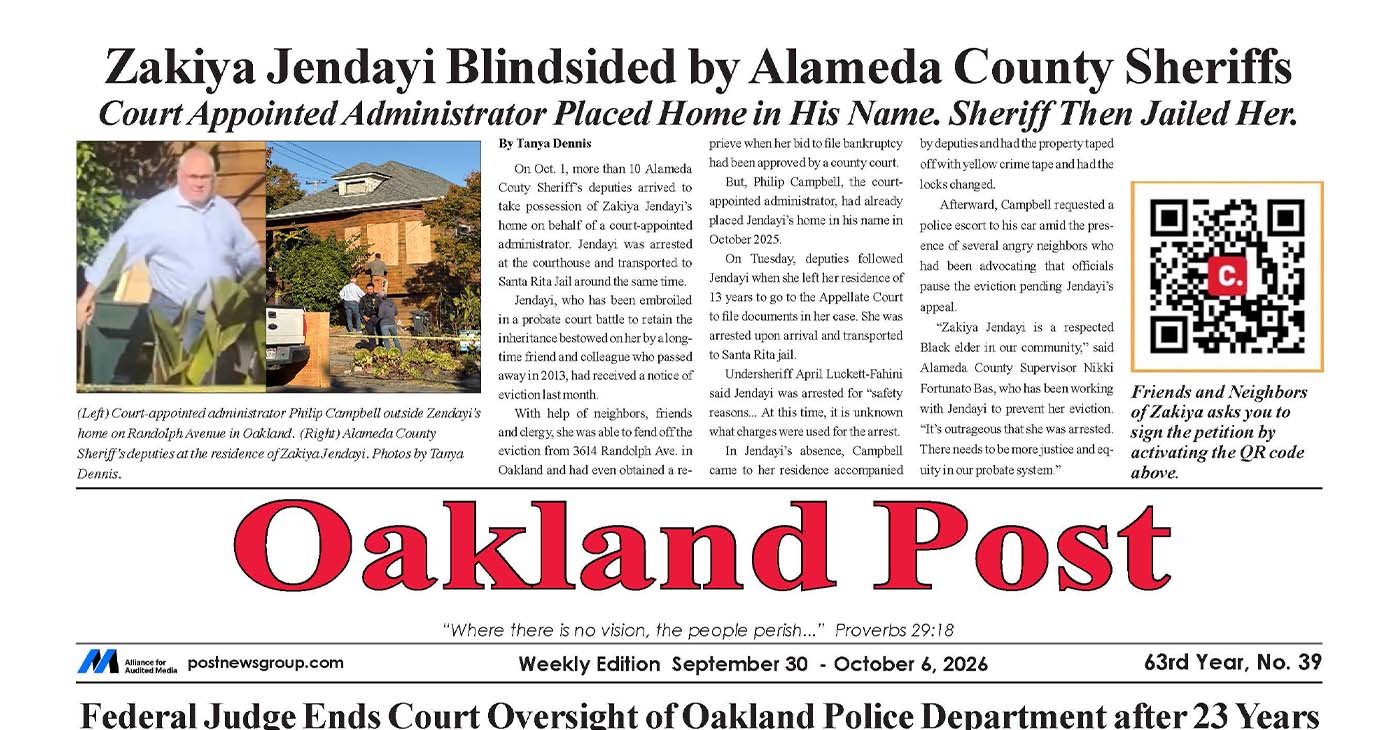
Oakland Post: Week of September 30 – October 6, 2026
The printed Weekly Edition of the Oakland Post: Week of September 30 – October 6, 2026
To enlarge your view of this issue, use the slider, magnifying glass icon or full page icon in the lower right corner of the browser window.
Activism
Oakland Post: Week of September 23 – 29, 2026
The printed Weekly Edition of the Oakland Post: Week of September 23 – 29, 2026
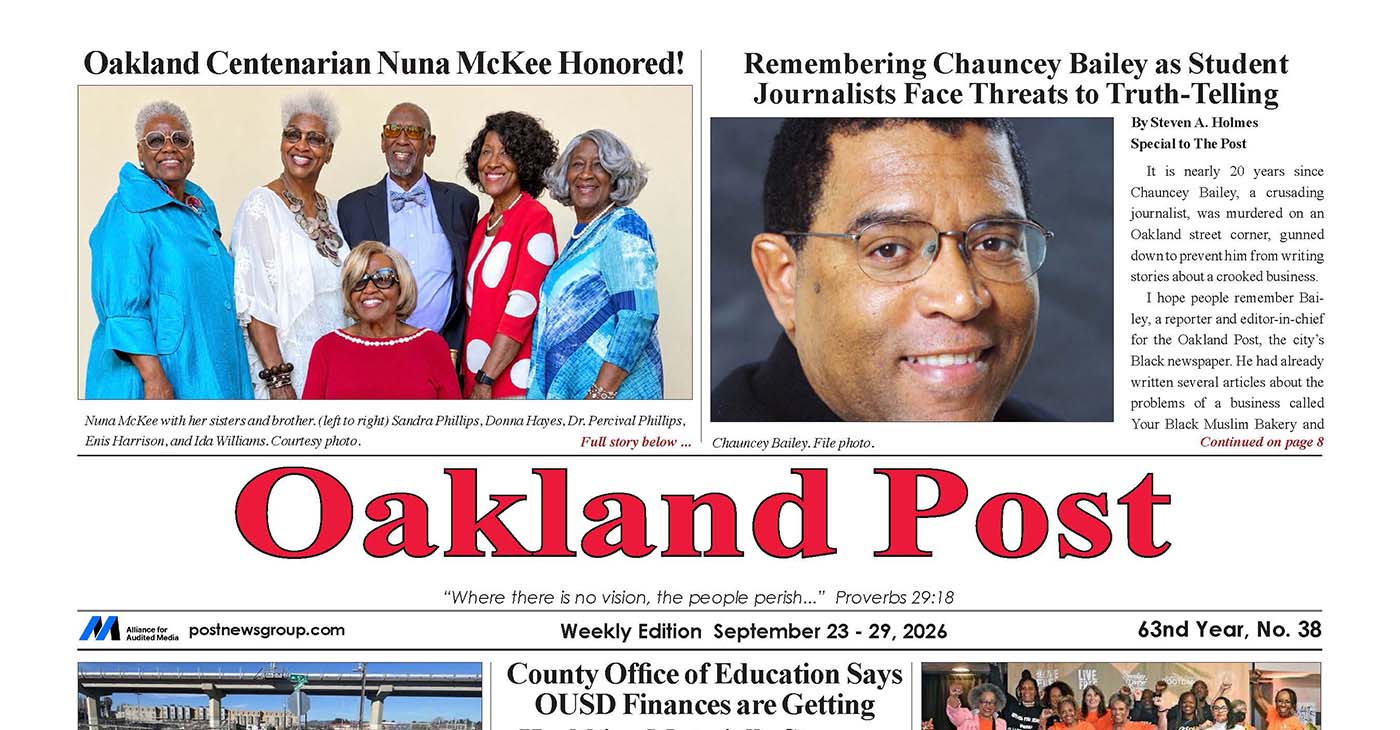
To enlarge your view of this issue, use the slider, magnifying glass icon or full page icon in the lower right corner of the browser window.



WCCUSD Joins Statewide Organic School Food Purchasing Cooperative

Democrats, Community Groups Back Measure EE to Change How Oakland Is Governed

Four Tips to Help You Plan a Holiday “Staycation”

Veterans Housing Project Proposed for South Richmond
PRESS ROOM: Transformative Justice Coalition 2026 Voting Rights Champion Awards Reception ‘Yesterday Is Today: The Battle For Voting Rights

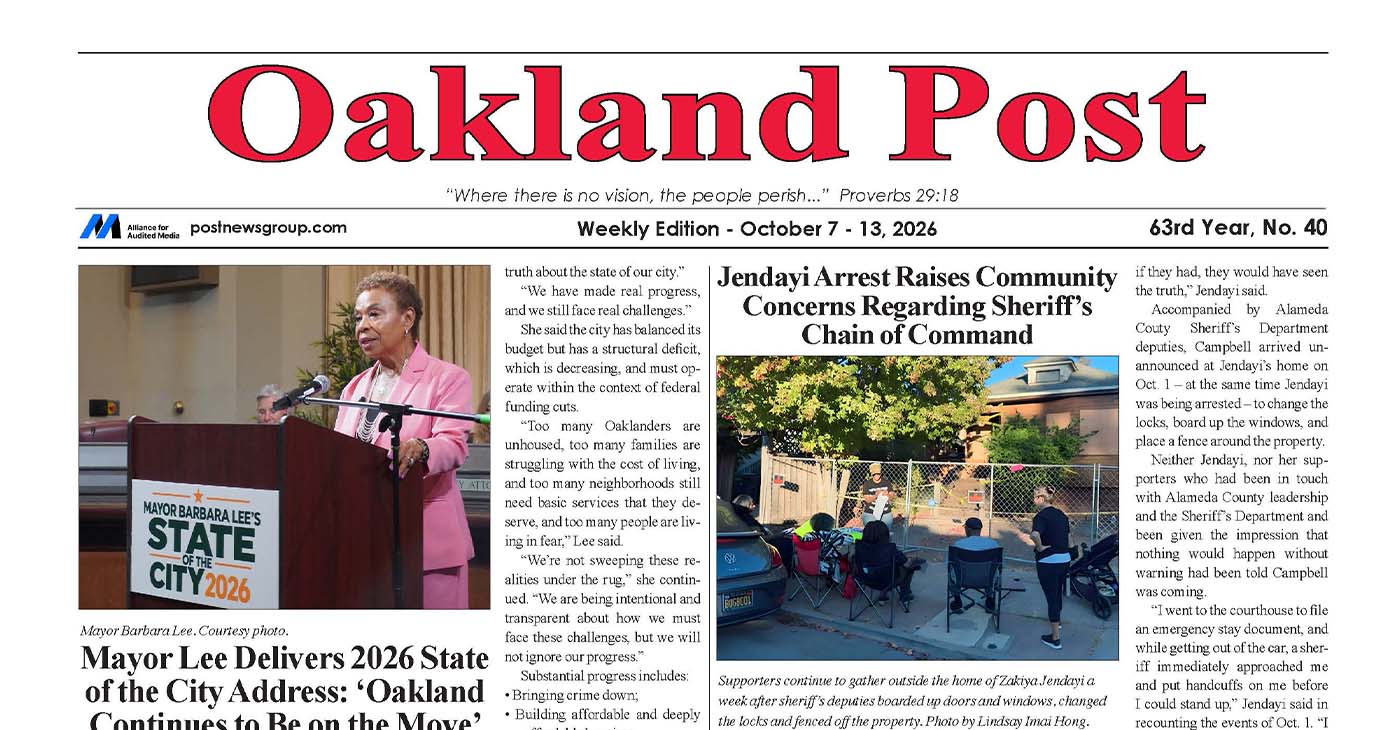
Mayor Lee Delivers 2026 State of the City Address: ‘Oakland Continues to Be on the Move’

Oakland Awarded More than $14 Million in State Funding

Jendayi Arrest Raises Community Concerns Regarding Sheriff’s Chain of Command

Marin County Supes Expand Small Business Options with Home Kitchen Pilot Program

Allen Temple Baptist Church Hosts Free Prostate Cancer Screenings on Oct. 17

AC Transit Labor Unions Back Director Joel Young

Locals Can Get Locally Grown Produce Delivered Through Urban Tilth

‘ICE-Free Marin’ Supporters Press Supervisors as County Drafts Enforcement Restrictions

Oakland Post: Week of October 7 – 13, 2026

Ghana’s Ministry of Foreign Affairs Publishes Global Circle’s Vatican Reparations Call in Special Edition Alongside Heads of State

Frontier Airlines’ Return to Oakland Airport Brings Flights, Jobs and Opportunity

Jackie Wright Champions Bay Area Stories, Filmmakers and Cultural Institutions

Chef Sharon Lee Blends Culinary Excellence, Education and Empowerment

Gubernatorial Candidate Steve Hilton Blasts California New Tire Rules; Newsom Hits Back

Misnamed ‘Parent’ PAC Seeks to Influence Oakland School Board Elections

Oakland Coliseum Project Opens Door for Small Businesses to Build Bigger

Big City Mayors Ask for “Yes” Vote on Housing Bond Measure; Conservatives Say “No”

Gov. Newsom’s Latest Appointees Include Sacramento Advocate for Formerly Incarcerated Students; State’s New Tech Chief

Oakland Post: Week of September 2 – 8, 2026

Longtime BWOPA Member Brendalyn Goodall Appointed to California Workforce Development Board

Gov. Newsom Signs Law Shielding Immigration Aid Workers From Doxing Threats

Secretary of State Shirley N. Weber Urges Californians to Vote Early as Voter ID Battle Intensifies

Oakland Post: Week of September 9 – 15, 2026

Richmond Tiny House Village Farm & Garden Set to Open Gates on Sept. 26

Madeline M. Turner: The Inventor Who Made Juicing Easier

The Conversation With Al McFarlane 6/23/26

Media Monday 6/22/26

LIVE! ASK ALMA! — TUES. 6.23.26 7PM EST

Car Buying Secrets: 4 Hidden Checks Before You Sign!

Is This 550 HP Charger Worth YOUR Money? AutoNetwork Review

Celebrating Juneteenth – Frederick Douglass on education and resistance

LIVE! — ASK ALMA! — TUES. 6.19.26 7PM EST

Hyundai Ioniq 5 Parking, Safety, and 360 View #shorts

2025 Ioniq 5 New Wiper & Powerful Performance! #shorts

Electric SUV Range: Is 259 Miles Enough? #shorts

EV Charging: How Fast Can You Charge an Electric Vehicle? #shorts

Biometric Cooling… Messaging Seats…Come on! 2025 Infiniti QX80 Autograph 4WD

Charged Up: Witness the Magic of a Fully Electric Car! #shorts

Range Rover Sport PHEV Included…: See What’s Inside This Luxury SUV! #shorts

Invisible Hood View: Perfect Parking with X-Ray Vision! #shorts
-

 Business3 weeks ago
Mayor Lee Announces $1 Million Kaiser Permanente Grant for Pilot Program to Address Homelessness, Clean Up Public Spaces throughout Oakland
-

 Economy2 weeks ago
Poll: Becerra Widens His Lead Over Hilton; Californians Split on Wealth Tax
-

 Business2 weeks ago
County Office of Education Says OUSD Finances Are Getting Healthier, Materially Stronger
-
 Community4 weeks ago
Democratic Clubs Interview Candidates for Oakland School Board
-
 Uncategorized3 weeks ago
Oakland People’s Arms Embargo Coalition Demands End to Military Shipments Thru Oakland
-
 Activism3 weeks ago
Oakland Post: Week of September 16 – 22, 2026
-

 Community3 weeks ago
Two Looming Threats Every Alameda County Elder Should Know About
-

 Art2 weeks ago
BLACspace Cooperative Invites Bay Area to Experience Oakland’s Black Cultural Ecosystem Through a BLAC Map Tour + Party
