
Activism
OP-ED: Lessons in Leadership by Regina Jackson, Outgoing Executive Director of EOYDC
Leadership is not just a position or a title, it is action and example. To effectively lead and make a lasting impact in our communities, we must tap into our passion for service in a way that creates value in the lives of others. This charge begins with one specific attribute of emotional intelligence: self-reflection. As leaders, it is critically important that we know ourselves. We must ask: who am I and what do I stand for?


By Regina Jackson With Phylicia King
President and CEO Regina G. Jackson has set the strategic direction for the East Oakland Youth Development Center (EOYDC) for 27 years. With a platform focused on character-based leadership development, her youth-led initiatives have empowered thousands of young people to achieve academic and career success.
Now, as she prepares to transition from her EOYDC leadership role this month, Regina shares lessons in leadership from her lifelong journey toward fulfilling her life’s purpose. She speaks in her own words below.
For nearly three decades, I have focused my efforts on investing in and helping to nurture the potential of youth across Oakland. Like so many areas across the nation, East Oakland is a vibrant community brimming with possibility that is often overshadowed by the very real impact of higher poverty and crime rates.
In a community where many families struggle to meet basic needs, the kinds of enrichment activities that can inspire kids to explore, discover and develop their gifts and talents are often financially out of reach.
And that’s why, now more than ever, the efforts of community-based organizations are so important. They are not only a conduit for developing the social and leadership capacities of our youth, but they also provide safe spaces that uplift them as they navigate life circumstances that can be overwhelming to face without meaningful support.
As I approach the end of my time leading EOYDC, I wanted to share some important lessons that can benefit nearly any organization seeking to improve its community. Given the challenges we’re facing, there is no more important time to understand how we can act in the lives of young people and set them up to thrive.
Know Who You Are and What Drives You
Leadership is not just a position or a title, it is action and example. To effectively lead and make a lasting impact in our communities, we must tap into our passion for service in a way that creates value in the lives of others. This charge begins with one specific attribute of emotional intelligence: self-reflection. As leaders, it is critically important that we know ourselves. We must ask: who am I and what do I stand for?
Thinking back, my passion for service began in my early years as a Brownie in the Girls Scouts. Earning my first merit badge lit a fire in me to continue to serve and, in doing so, I developed a strong sense of accountability and responsibility that remains at the core of who I am today. As a spiritually grounded, purpose-driven leader, knowing who I am and what I stand for upholds me on this path I’ve been called to walk. I accepted my role at EOYDC because I felt aligned with the center’s mission, fueled by passion and sustained by a work ethic that allowed me to face challenges with determination, lead with integrity and inspire others to join me along the way.
As leaders, what we discover about ourselves creates the foundation of our character, purpose and authenticity — all vital keys to our success in leadership. We must take time to reflect and assess who we are, what we value and how we show up in the world in order to truly make a difference. When we’ve done this important internal work, we can effectively lead others toward a common vision or goal.
Challenge the Notion of What’s Possible
There is power in possibility. Leaders who aspire to break barriers look at their surroundings, circumstances and the people they lead through the lens of possibility and set expectations based on that perspective in order to shape the future.
I meet every student I mentor where they are mentally, physically and emotionally — and I walk beside them on the path to endless possibility. Through EOYDC’s summer program, we place young people in positions to lead through exposure and opportunity.
Youth as young as 13 design curriculum, teach classes and manage people. We put the power in their hands and offer positive reinforcement to guide them along the way. As a result, students gain independence and self-confidence — and that is exactly what a successful leader should aim to influence.
As leaders, when we set expectations for the people we lead and challenge them to stretch and grow to meet them, we help unlock their potential and change how they view themselves. This process is not without discomfort, but we must encourage those we lead to embrace discomfort as a byproduct of growth and remain focused on the goal at hand.
Leave a Legacy
A leader’s legacy is only as strong as the foundation they leave behind that allows others to continue to advance. True leadership is not about the role, it is about the goal — and with service as a goal, our work is never done.
At EOYDC, we guide youth into new opportunities by exposing them to new concepts and practice areas and helping them develop the skills they need to succeed. Many of the students I’ve mentored who have gone on to work in prominent positions in the public and private sector point to the supervisory experience they received at EOYDC as critical to their subsequent success as working professionals. I’ve seen kids sit up straighter, walk into rooms with more confidence, and continue to serve because we helped them realize possibilities.
When it is all said and done, leaders raise up other leaders. This is our legacy. One of the things I’m most proud of is the fact that the majority of current EOYDC leaders are EOYDC alumni — and as I move on to the next chapter in my journey, I feel confident that I am entrusting my work to the next generation of leaders who will carry the mission forward.
To follow the next phase of Regina’s leadership journey, reginagjackson.com. To learn more about the East Oakland Development Center’s programs and initiatives, visit www.eoydc.org.
** Phylicia King is an associate with SMJ Communications.












Activism
Oakland Post: Week of September 23 – 29, 2026
The printed Weekly Edition of the Oakland Post: Week of September 23 – 29, 2026
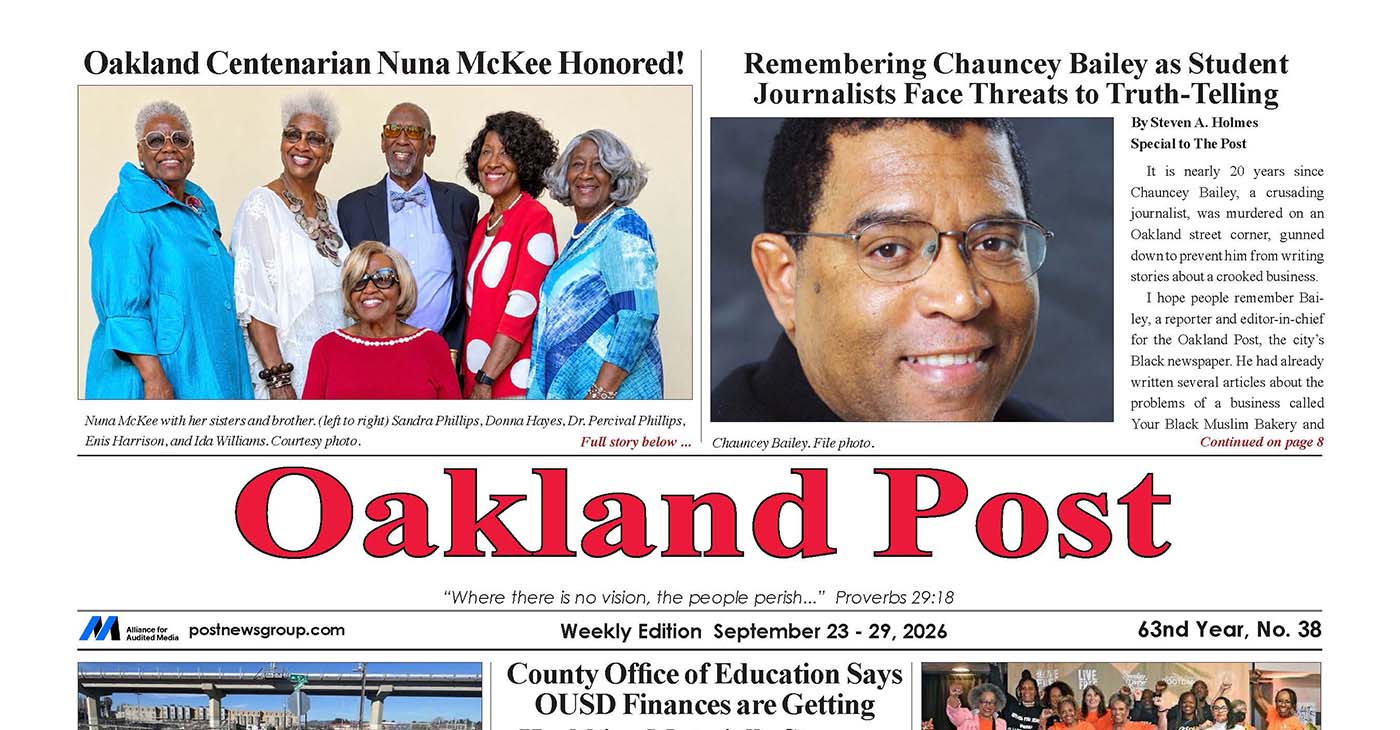
To enlarge your view of this issue, use the slider, magnifying glass icon or full page icon in the lower right corner of the browser window.
Activism
Oakland Post: Week of September 16 – 22, 2026
The printed Weekly Edition of the Oakland Post: Week of September 16 – 22, 2026

To enlarge your view of this issue, use the slider, magnifying glass icon or full page icon in the lower right corner of the browser window.
Activism
Oakland Post: Week of September 9 – 15, 2026
The printed Weekly Edition of the Oakland Post: Week of September 9 – 15, 2026

To enlarge your view of this issue, use the slider, magnifying glass icon or full page icon in the lower right corner of the browser window.



Asm. Corey Jackson Announces Launch of 24-Hour Childcare in His District

IN MEMORIAM: The Rev. Leon “Sonny” Clark, Longtime Orange County Pastor and Community Leader, Dies at 72

Poll: Becerra Widens His Lead Over Hilton; Californians Split on Wealth Tax

From Historic Memories to New Possibilities: Oakland Celebrates Coliseum 60

County Office of Education Says OUSD Finances Are Getting Healthier, Materially Stronger

LIVE FREE Sunday Dinner Brings Faith, Fellowship and Civic Conversation to Oakland

Remembering Chauncey Bailey as Student Journalists Face Threats to Truth-Telling

BLACspace Cooperative Invites Bay Area to Experience Oakland’s Black Cultural Ecosystem Through a BLAC Map Tour + Party

In Wake of Death on Doorstep, Williams Chapel Baptist Church Calls for Better Care, Funding for Unhoused

Oakland Centenarian Nuna McKee Honored!

Caribbean Nations Produce Action Plan Calling for UK Reparations Over Slavery

Oakland Post: Week of September 23 – 29, 2026

Doulas Are Helping Black California Moms Navigate Pregnancy–Even as High Mortality Rates Persist

Newsom Signs Addictive Social Media Law to Protect Kids

On Your November Ballot: Prop 38 Would Allocate $8.4 Billion to Immunology and Immunotherapy Funding

Standoff for Justice: Our Homes Are Worth Fighting For

Oakland Post: Week of August 26 – September 1, 2026

Frontier Airlines’ Return to Oakland Airport Brings Flights, Jobs and Opportunity

Gubernatorial Candidate Steve Hilton Blasts California New Tire Rules; Newsom Hits Back

Chef Sharon Lee Blends Culinary Excellence, Education and Empowerment

Jackie Wright Champions Bay Area Stories, Filmmakers and Cultural Institutions

Big City Mayors Ask for “Yes” Vote on Housing Bond Measure; Conservatives Say “No”

Oakland Coliseum Project Opens Door for Small Businesses to Build Bigger

Gov. Newsom’s Latest Appointees Include Sacramento Advocate for Formerly Incarcerated Students; State’s New Tech Chief

Misnamed ‘Parent’ PAC Seeks to Influence Oakland School Board Elections

Longtime BWOPA Member Brendalyn Goodall Appointed to California Workforce Development Board

Gov. Newsom Signs Law Shielding Immigration Aid Workers From Doxing Threats

Secretary of State Shirley N. Weber Urges Californians to Vote Early as Voter ID Battle Intensifies

From Palestine to Oakland: Seeds for Liberation Examines Shared Struggles for Freedom

IN MEMORIAM: Dolly Parton Dead at 80 — How She Built a Legacy of Love and Earned Her Place in Black Culture

The Conversation With Al McFarlane 6/23/26

Media Monday 6/22/26

LIVE! ASK ALMA! — TUES. 6.23.26 7PM EST

Car Buying Secrets: 4 Hidden Checks Before You Sign!

Is This 550 HP Charger Worth YOUR Money? AutoNetwork Review

Celebrating Juneteenth – Frederick Douglass on education and resistance

LIVE! — ASK ALMA! — TUES. 6.19.26 7PM EST

Hyundai Ioniq 5 Parking, Safety, and 360 View #shorts

2025 Ioniq 5 New Wiper & Powerful Performance! #shorts

Electric SUV Range: Is 259 Miles Enough? #shorts

EV Charging: How Fast Can You Charge an Electric Vehicle? #shorts

Biometric Cooling… Messaging Seats…Come on! 2025 Infiniti QX80 Autograph 4WD

Charged Up: Witness the Magic of a Fully Electric Car! #shorts

Range Rover Sport PHEV Included…: See What’s Inside This Luxury SUV! #shorts

Invisible Hood View: Perfect Parking with X-Ray Vision! #shorts
-
 Community2 weeks ago
Misnamed ‘Parent’ PAC Seeks to Influence Oakland School Board Elections
-

 Activism3 weeks ago
Oakland Post: Week of September 2 – 8, 2026
-

 Community2 weeks ago
Richmond Tiny House Village Farm & Garden Set to Open Gates on Sept. 26
-

 Black History2 weeks ago
Latest Massacre in Haiti Reveals Cruelty U.S. Deportations
-

 Black History2 weeks ago
OPINION: Nolan Wells’ Death One of Several Signifying Racial Terror Lives on in U.S. South
-

 Activism2 weeks ago
Oakland Post: Week of September 9 – 15, 2026
-

 Community2 weeks ago
Democratic Clubs Interview Candidates for Oakland School Board
-

 Featured2 weeks ago
‘Ready to See These Bills Become Law’: Sen. Weber’s Package of 15 Bills Advance to Gov. Newsom’s Desk
