
City Government
The Next First 100 Days
Building a Healthier Future for Oakland


In 2022, the voters of Oakland will have an opportunity to elect the next Mayor for our city. The Mayor of Oakland is the head of the executive branch, in charge of implementing actions and laws that have been passed by City Council and community.
The Mayor also selects and hires the City Administrator, appoints members of key Boards and Commissions, and sets the direction for the Administrative branch of government, thus having a major impact on what actions get taken.
In recent years, the City Council has adopted numerous laws and funded positions and projects – many of which have not been implemented, such as providing gun tracing and cracking down on illegal guns, civilianizing special events, providing pro-active illegal dumping remediation, a public lands policy to prioritize affordable housing, direction to provide healthier alternative locations to respond to homelessness, and many more.
In order to ensure that we build a safer and healthier future for Oakland, is it vitally important to ensure that we elect leadership for the executive branch with the dedication and commitment to take the actions needed to fulfill the needs of our communities.
With serious struggles facing our communities, it is vital that the next mayor take immediate action in their first 100 days – and so, I am undertaking to provide proposals regarding what the next mayor can, and should, do in their first 100 days in office.

These efforts will need to include recruitment and retention for the workforce; effective relationships with County government and neighboring cities to solve common problems; working with stakeholders including to expand equitable economic development and housing for all income levels; presenting and passing proposals at Council and bringing in and properly stewarding the finances needed.
Even within the first 100 days, a mayor can accomplish a great deal – including taking action to implement vitally needed services that already have Council authorization, and thus, can be brought about more quickly.
This is the first installment, a listing of some of the first items that the next mayor can, and should, do to build a healthier Oakland, and which should be factors in our decision-making in the year ahead.
- Ensure implementation of the directive to prioritize stopping the flow of illegal guns and stopping gun violence, including implementing gun tracing, tracking and shutting down sources of illegal guns, and providing immediate response to shooting notifications.
- Remove blight and illegal dumping, implement pro-active removal of blight rather than waiting for complaints, incorporate blight removal throughout city efforts (rewards program, summer jobs program, etc), to clear up backlog and establish a new normal that it is not OK to dump in Oakland.
- Provide healthier alternatives for homeless solutions, including safe parking/managed RV sites, and sanitation/dump sites, to reduce public health risks, including by partnering with the County and others.
- Implement previously approved Council direction to switch to the use of civilians (rather than sworn police) to manage parades and special events. Help ensure community and cultural events can go forward without excess costs undermining them, strengthen the arts and economy and equity of event permitting system, and ensure that expensive police resources are directed where they are needed, rather than wasted on watching parades.
- Implement previously approved public lands policy to ensure using public lands for public needs, with a priority for affordable housing.
- Make it easier for local residents and small businesses to grow, build, and expand by providing coherent and simplified permitting, and by implementing the Council-funded direction to provide evening and weekend hours and easy online access to allow people to do projects like adding Accessory Dwelling Units (ADUs) and make other renovations and construction projects more timely.
- Work with stakeholders and community to advance effective and equitable revitalization of the large public properties at and around the Oakland Coliseum, including with housing for all income levels, jobs and business development, sports and entertainment, convention and hotels and more.
- Work to speed up vacancies in needed city staff positions, and improve recruitment and retention, and local hiring, to help provide vitally needed services, including for cleanup, parks upkeep, gun tracing, and other community needs.
- Fire prevention and climate resiliency. Our region is facing growing dangers from climate change and fire risk, and we must take action to reduce and remedy risk and protect our communities with a more resilient future, including by planning for and starting fire prevention and brush remediation activities earlier in the year, improving brush removal on public land as well as private, fully staffing the fire department, and improving public infrastructure to protect cleaner air and reduce risks.
- Job training and pathways. Some industries face challenges finding enough prepared workers while many in our community also need access to quality jobs. Support and connect job training programs and quality job policies with growing sectors, and ensure that Oaklanders are prepared for vital openings in needed jobs while allowing our community to thrive.
The Oakland Post’s coverage of local news in Alameda County is supported by the Ethnic Media Sustainability Initiative, a program created by California Black Media and Ethnic Media Services to support community newspapers across California.













Activism
Oakland Post: Week of September 16 – 22, 2026
The printed Weekly Edition of the Oakland Post: Week of September 16 – 22, 2026


To enlarge your view of this issue, use the slider, magnifying glass icon or full page icon in the lower right corner of the browser window.

Activism
Oakland Post: Week of September 9 – 15, 2026
The printed Weekly Edition of the Oakland Post: Week of September 9 – 15, 2026

To enlarge your view of this issue, use the slider, magnifying glass icon or full page icon in the lower right corner of the browser window.
Activism
Oakland Post: Week of September 2 – 8, 2026
The printed Weekly Edition of the Oakland Post: Week of September 2 – 8, 2026
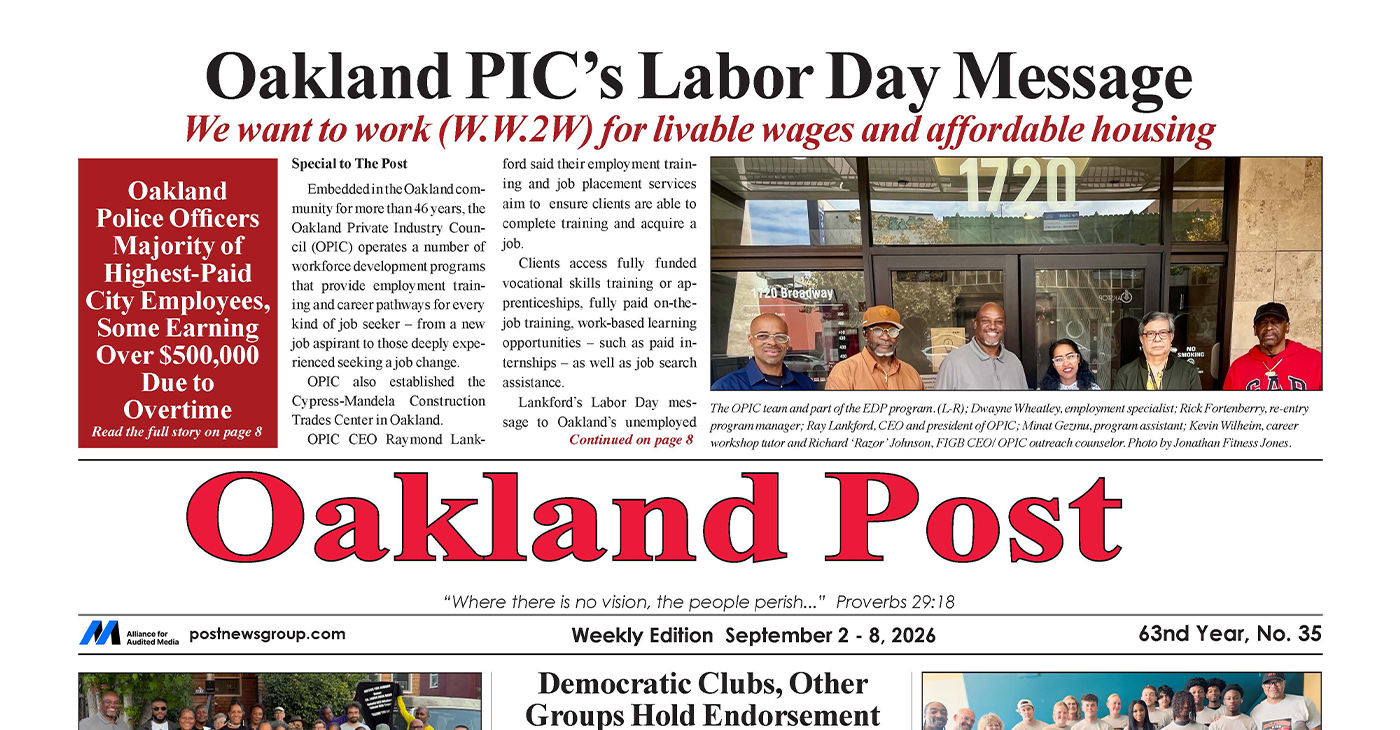
To enlarge your view of this issue, use the slider, magnifying glass icon or full page icon in the lower right corner of the browser window.



Doulas Are Helping Black California Moms Navigate Pregnancy–Even as High Mortality Rates Persist

Newsom Signs Addictive Social Media Law to Protect Kids

On Your November Ballot: Prop 38 Would Allocate $8.4 Billion to Immunology and Immunotherapy Funding

Ask California: Golden State Releases New AI Chatbot

Asm. Isaac Bryan’s Bill Banning California Police From ICE Side Jobs Reaches Newsom’s Desk

Assemblymember LaShae Sharp-Collins’s Bill Would Pause Law Enforcement’s Use of Shock Gloves Pending Study

BOOK REVIEW: ‘Laws of Solomon’ Reveals Tender Heart of Former Child Soldier

OPINION: The New American Fear – From 9-11 to AI

Passing for White, Fighting for Black America: The Courage of Walter White

Oakland People’s Arms Embargo Coalition Demands End to Military Shipments Thru Oakland

Barbara Lee Mourns Gloria Steinem, Remembers a Friendship Rooted in Equality

Event Preview: ‘Fashion v. Fascism’ – A Runway Revolution Is Coming to the Bay Area

Two Looming Threats Every Alameda County Elder Should Know About

Oakland Mayor Reads to Children at Bookout Block Party at Marcus Books Store

Tradition Comes to the Streets in 11th Annual Black-Eyed Pea Festival at the Freedom Farmers Market

Less Affluent School Districts, Including Sacramento City, Face Threat of State Takeover

ESSAY: California Can Close Its Colorectal Cancer Gap

California Hispanic Chambers of Commerce Unveils: ‘Powering the Future’ Theme for 47th Annual Statewide Convention

Four Candidates, Including Incumbent Barbara Lee, Qualify for Oakland Mayor’s Race

Oakland Post: Week of August 12 – 18, 2026

From Blueprint to Breakthrough: Tackling Affordable Housing in Oakland

Oakland Observes Black August with Block Parties, Film Showings, Workshops

COMMENTARY: Why Local School Tax Measure G1 Will Not Be on the November Ballot

Standoff for Justice: Our Homes Are Worth Fighting For

Returning to Its Roots, the Oakland Black-Eyed Pea Festival Partners with the Freedom Farmers Market Sept. 12

NPRC Scores First Advocacy Victory: David Shaw Finally Gets His Wish to ‘Go Home’

Oakland Post: Week of August 26 – September 1, 2026

Frontier Airlines’ Return to Oakland Airport Brings Flights, Jobs and Opportunity

Gubernatorial Candidate Steve Hilton Blasts California New Tire Rules; Newsom Hits Back

Chef Sharon Lee Blends Culinary Excellence, Education and Empowerment

The Conversation With Al McFarlane 6/23/26

Media Monday 6/22/26

LIVE! ASK ALMA! — TUES. 6.23.26 7PM EST

Car Buying Secrets: 4 Hidden Checks Before You Sign!

Is This 550 HP Charger Worth YOUR Money? AutoNetwork Review

Celebrating Juneteenth – Frederick Douglass on education and resistance

LIVE! — ASK ALMA! — TUES. 6.19.26 7PM EST

Hyundai Ioniq 5 Parking, Safety, and 360 View #shorts

2025 Ioniq 5 New Wiper & Powerful Performance! #shorts

Electric SUV Range: Is 259 Miles Enough? #shorts

EV Charging: How Fast Can You Charge an Electric Vehicle? #shorts

Biometric Cooling… Messaging Seats…Come on! 2025 Infiniti QX80 Autograph 4WD

Charged Up: Witness the Magic of a Fully Electric Car! #shorts

Range Rover Sport PHEV Included…: See What’s Inside This Luxury SUV! #shorts

Invisible Hood View: Perfect Parking with X-Ray Vision! #shorts
-
 Commentary4 weeks ago
Standoff for Justice: Our Homes Are Worth Fighting For
-
 Activism4 weeks ago
Oakland Post: Week of August 26 – September 1, 2026
-
 Business4 weeks ago
Frontier Airlines’ Return to Oakland Airport Brings Flights, Jobs and Opportunity
-
 Business4 weeks ago
Gubernatorial Candidate Steve Hilton Blasts California New Tire Rules; Newsom Hits Back
-
 Business4 weeks ago
Chef Sharon Lee Blends Culinary Excellence, Education and Empowerment
-

 Education4 weeks ago
Gov. Newsom’s Latest Appointees Include Sacramento Advocate for Formerly Incarcerated Students; State’s New Tech Chief
-

 Community4 weeks ago
Big City Mayors Ask for “Yes” Vote on Housing Bond Measure; Conservatives Say “No”
-

 Business4 weeks ago
Oakland Coliseum Project Opens Door for Small Businesses to Build Bigger
