
Activism
It Takes a Community: Oakland Group Puts People First in Domestic Violence Fight
Located in Oakland, the Family Violence Law Center (FVLC) served 2,673 survivors and provided legal support to 1,186 survivors across Alameda County during its last fiscal year, July 2019-June 2020.

Firmly believing that those closest to the problem are also closest to the solution, Carolyn Russell, executive director of A Safe Place homeless shelter in Oakland, says she was guided to an idea that she is confident will contribute to addressing domestic violence in her city: a community-led coalition.
Inspired by faith-based leaders, community members, business owners, violence survivors and, significantly third- and fourth- generation Oaklanders, Russell set out to re-establish the charge of a subgroup within the Oakland Violence Prevention Coalition.
“All of the statistics – the calls we get on our hotline, the number of requests for restraining orders – are proof beyond measure that the City of Oakland should be creating a coalition,” Russell said.
Domestic violence statistics in Oakland are startling and alarming, she says.
Located in Oakland, the Family Violence Law Center (FVLC) served 2,673 survivors and provided legal support to 1,186 survivors across Alameda County during its last fiscal year, July 2019-June 2020. This year has shown further increases in incidents as well as a significant upswing in the severity of violence reported by survivors.
“During the month of June alone, we received 76 new requests for emergency civil legal assistance from survivors and in all of May, we received only 35 new requests. So, we are definitely seeing a surge in level of need as things reopen,” said Marissa Seko, an intervention unit manager for FVLC.
At the behest of the community, the City of Oakland formed a Department of Violence Prevention (DVP) in 2017.
While are a number of non-profit advocates and organizations that address domestic violence, Russell felt a particular voice was missing – those who are directly impacted by the violence.
She was inspired by other Bay Area cities like San Francisco and Berkeley where community coalitions are working to address domestic violence.
So, she is utilizing her resources to start the new Domestic Violence Coalition for Oakland (DVCO) dedicated to serving as an advocacy group. Their work is centered on the voices of members of the community.
They are meeting monthly via Zoom since early 2021, discussing the intersection of gun violence, community violence and domestic violence.
“We talk about it all, because as one member said, ‘pain is pain,’” Russell said.
When she first started working at A Safe Place as director in the 1970s, Russell observed that what could be characterized as the ‘sledgehammer’ approach wasn’t working for Black people. She was referring to the custom of criminalizing perpetrators and primarily relying on law enforcement, the criminal justice system and social service agencies to resolve domestic violence and disputes.
Shel was surprised to learn that most of the victims she encountered did not want to press criminal charges against their abusers and certainly didn’t want them incarcerated.
And, critically, the women didn’t want to leave their children behind.
As she made her journey from director to executive director of A Safe Place, Russell began to incorporate the desires of the survivors into the culture of the shelter. (At that time, boys over 12 years old weren’t allowed to stay at the shelter, a policy she eventually reversed.)
The coalition is also different from other organizations serving survivors it has no obligations to a funder, which means they can do whatever they want.
“No one is telling us what our goals and objectives should be,” Russell said.
Antoine Towers, who co-chairs the coalition with Russell, is a veteran of this community approach. The two of them were part of the advocacy that led to the City of Oakland creating and funding DVP.
Raised by women who were abused by men, as a teenager Towers assaulted one of those abusers. But he found that satisfaction was fleeting.
Once he was an adult himself and had experienced his own problems in relationships, Towers explained, he gained insight into some of the contributing factors to intimate violence in families and how the harm ripples out into the community and is passed from generation to generation.
“There are so many components that lead to abuse in all aspects,” he said. There is a tendency, he says, to look at harm narrowly, but “All triggers are important.”
Towers, who is a barber, coaxes customers and bystanders into conversations that help them illuminate their own circumstances and experiences with domestic violence. One theme he noticed was how misunderstanding escalates to disagreement and sometimes to what he calls “the point of no return,” referring to domestic violence.
Intimate one-on-one conversations like the ones Towers has with his clients is an approach the coalition also uses.
“We need to learn proper ways of hearing each other,” Towers said, observing that the Black community has “a bunch of people who lost a lot of people over the years.”
“How do we get ourselves heard? How do we learn what we really want and then get the resources to support it?” He asked.
DVCO is deliberately widening its focus to include men and boys. Historically, domestic violence service providers like A Safe Place have focused on intimate partner abuse mainly involving women. DVCO recognizes that there are all kinds of family violence that don’t get voiced.
“My issue with my (service provider) partners is that they only serve women and girls,” Russell said. “They don’t focus on men.”
The prospect of bringing men and boys to the center of the conversation is one of the things that DVCO member Rev. Harold Mayberry finds exciting.
Now presiding elder of the Oakland/San Joaquin region of the African Methodist Episcopal Church Fifth District, Mayberry spent 48 years as pastor of First A.M.E Church in Oakland where, from the pulpit, he encouraged people who had survived abuse to seek help. He also counseled them in private.
Although he knew some who had suffered domestic violence, no men ever came forward, he said. He wants the new coalition to change that.
“We’ve got to reach people who would not normally come forward,” Mayberry said. “Carolyn wants to include men who are the concealed victims of domestic violence because we are taught to be macho and not show pain.”
DVCO member Patanisha Ali heard a lot of painful accounts when she was helping to document the impact of violence on Oakland citizens in the prelude to the formation of Oakland’s DVP. That experience taught her that people in the community are often unaware of civic and non-profit organizations that are supposed to provide relief – and how their voices may influence policy.
“What is missing is an authentic relationship with the people impacted,” she said. “Those impacted don’t get involved in politics, but they need to. How do we make that happen?”
While several organizations – including A Safe Place – hold workshops for young people on preventing domestic violence, DVCO intends to get more young people involved.
To that end, and at this point in its development, DVCO will use social media as a primary tool to educate the community.
But DVCO members will not be the only ones providing that education. There is wisdom in the experience of the community that is essential and useful. “We know there are people who were assaulted when they were children,” Russell said. “In their survival, they learned valuable lessons to heal themselves that can be shared.”
Ali observes that although there is a lot of current brokenness and historic pain in the Black community, there is still hope. “Another aspect is that people coming to (DVCO’s) table are healers and creatives and survivors,” she said.
Towers is looking forward to creating spaces to document the wisdom in community dialogue. He recounts getting his neighbor to a place of liberation from the cycle of misunderstanding and a sense of woundedness he felt when interacting with his spouse.
“It’s not wrong what she said,” Towers advised the man. “You are not hearing what she needs you to understand.”
With mediation, he said, we may begin to respect each other more. “I think moments like that are needed in our community,” Towers said. “We all grow up in it, but we don’t want to keep those same outcomes.”
“We don’t want to do the ‘same ol’ same ol,’” Russell said.
“We are excited to bring the voices of the ‘hood to the table,” said Ali, who is hoping that with those voices the community can experience a shift.
“Peace can happen here,” she added.











Activism
Oakland Post: Week of September 23 – 29, 2026
The printed Weekly Edition of the Oakland Post: Week of September 23 – 29, 2026


To enlarge your view of this issue, use the slider, magnifying glass icon or full page icon in the lower right corner of the browser window.

Activism
Oakland Post: Week of September 16 – 22, 2026
The printed Weekly Edition of the Oakland Post: Week of September 16 – 22, 2026

To enlarge your view of this issue, use the slider, magnifying glass icon or full page icon in the lower right corner of the browser window.
Activism
Oakland Post: Week of September 9 – 15, 2026
The printed Weekly Edition of the Oakland Post: Week of September 9 – 15, 2026
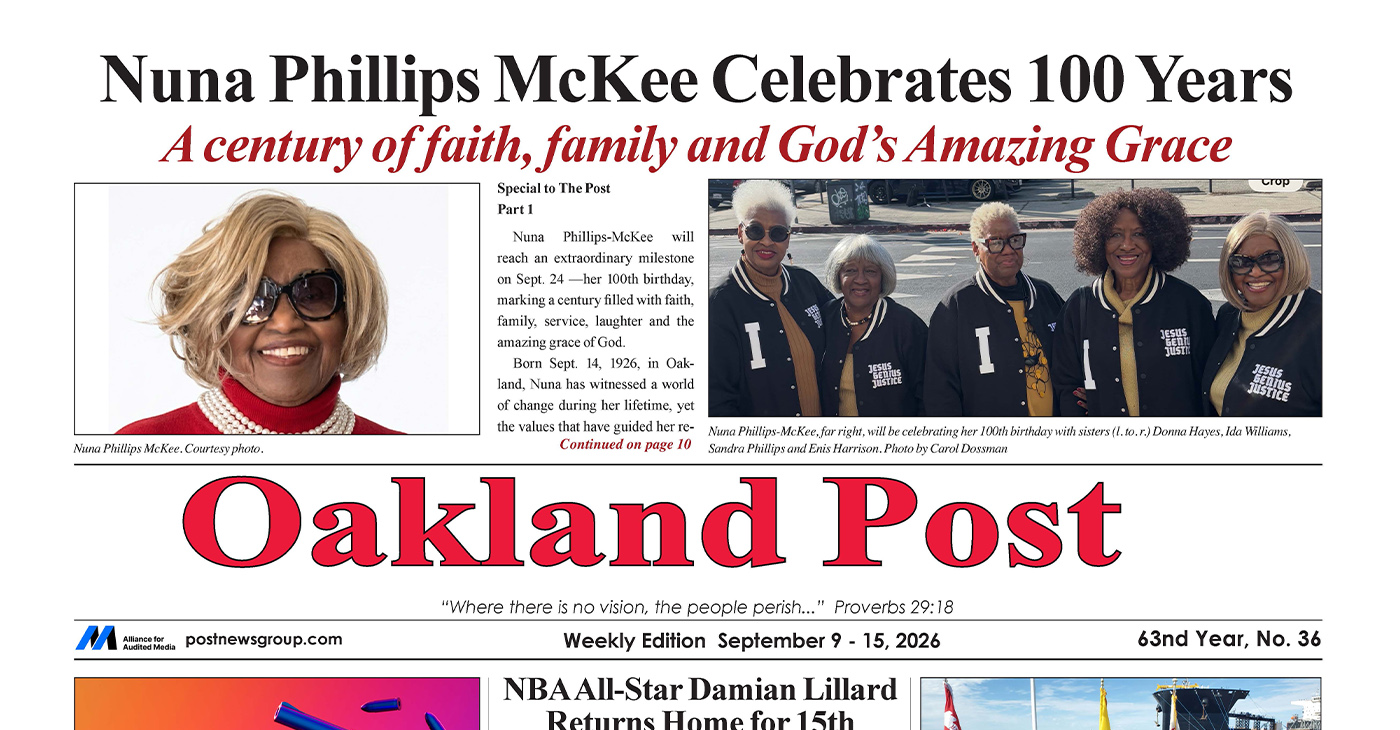
To enlarge your view of this issue, use the slider, magnifying glass icon or full page icon in the lower right corner of the browser window.


Asm. Corey Jackson Announces Launch of 24-Hour Childcare in His District

IN MEMORIAM: The Rev. Leon “Sonny” Clark, Longtime Orange County Pastor and Community Leader, Dies at 72

Poll: Becerra Widens His Lead Over Hilton; Californians Split on Wealth Tax

From Historic Memories to New Possibilities: Oakland Celebrates Coliseum 60

County Office of Education Says OUSD Finances Are Getting Healthier, Materially Stronger

LIVE FREE Sunday Dinner Brings Faith, Fellowship and Civic Conversation to Oakland

Remembering Chauncey Bailey as Student Journalists Face Threats to Truth-Telling

BLACspace Cooperative Invites Bay Area to Experience Oakland’s Black Cultural Ecosystem Through a BLAC Map Tour + Party

In Wake of Death on Doorstep, Williams Chapel Baptist Church Calls for Better Care, Funding for Unhoused

Oakland Centenarian Nuna McKee Honored!

Caribbean Nations Produce Action Plan Calling for UK Reparations Over Slavery

Oakland Post: Week of September 23 – 29, 2026

Doulas Are Helping Black California Moms Navigate Pregnancy–Even as High Mortality Rates Persist

Newsom Signs Addictive Social Media Law to Protect Kids

On Your November Ballot: Prop 38 Would Allocate $8.4 Billion to Immunology and Immunotherapy Funding

Standoff for Justice: Our Homes Are Worth Fighting For

Oakland Post: Week of August 26 – September 1, 2026

Frontier Airlines’ Return to Oakland Airport Brings Flights, Jobs and Opportunity

Gubernatorial Candidate Steve Hilton Blasts California New Tire Rules; Newsom Hits Back

Chef Sharon Lee Blends Culinary Excellence, Education and Empowerment

Jackie Wright Champions Bay Area Stories, Filmmakers and Cultural Institutions

Big City Mayors Ask for “Yes” Vote on Housing Bond Measure; Conservatives Say “No”

Oakland Coliseum Project Opens Door for Small Businesses to Build Bigger

Gov. Newsom’s Latest Appointees Include Sacramento Advocate for Formerly Incarcerated Students; State’s New Tech Chief

Misnamed ‘Parent’ PAC Seeks to Influence Oakland School Board Elections

Longtime BWOPA Member Brendalyn Goodall Appointed to California Workforce Development Board

Gov. Newsom Signs Law Shielding Immigration Aid Workers From Doxing Threats

Secretary of State Shirley N. Weber Urges Californians to Vote Early as Voter ID Battle Intensifies

Oakland Post: Week of September 2 – 8, 2026

IN MEMORIAM: Dolly Parton Dead at 80 — How She Built a Legacy of Love and Earned Her Place in Black Culture

The Conversation With Al McFarlane 6/23/26

Media Monday 6/22/26

LIVE! ASK ALMA! — TUES. 6.23.26 7PM EST

Car Buying Secrets: 4 Hidden Checks Before You Sign!

Is This 550 HP Charger Worth YOUR Money? AutoNetwork Review

Celebrating Juneteenth – Frederick Douglass on education and resistance

LIVE! — ASK ALMA! — TUES. 6.19.26 7PM EST

Hyundai Ioniq 5 Parking, Safety, and 360 View #shorts

2025 Ioniq 5 New Wiper & Powerful Performance! #shorts

Electric SUV Range: Is 259 Miles Enough? #shorts

EV Charging: How Fast Can You Charge an Electric Vehicle? #shorts

Biometric Cooling… Messaging Seats…Come on! 2025 Infiniti QX80 Autograph 4WD

Charged Up: Witness the Magic of a Fully Electric Car! #shorts

Range Rover Sport PHEV Included…: See What’s Inside This Luxury SUV! #shorts

Invisible Hood View: Perfect Parking with X-Ray Vision! #shorts
-
 Community3 weeks ago
Misnamed ‘Parent’ PAC Seeks to Influence Oakland School Board Elections
-
 Activism4 weeks ago
Oakland Post: Week of September 2 – 8, 2026
-

 Community3 weeks ago
Richmond Tiny House Village Farm & Garden Set to Open Gates on Sept. 26
-

 Activism3 weeks ago
Oakland Post: Week of September 9 – 15, 2026
-

 Black History3 weeks ago
Latest Massacre in Haiti Reveals Cruelty U.S. Deportations
-

 Black History3 weeks ago
OPINION: Nolan Wells’ Death One of Several Signifying Racial Terror Lives on in U.S. South
-

 Community3 weeks ago
Democratic Clubs Interview Candidates for Oakland School Board
-

 Business2 weeks ago
Mayor Lee Announces $1 Million Kaiser Permanente Grant for Pilot Program to Address Homelessness, Clean Up Public Spaces throughout Oakland
