
Bay Area
Post News Group Exclusive Interview with California Governor Gavin Newsom
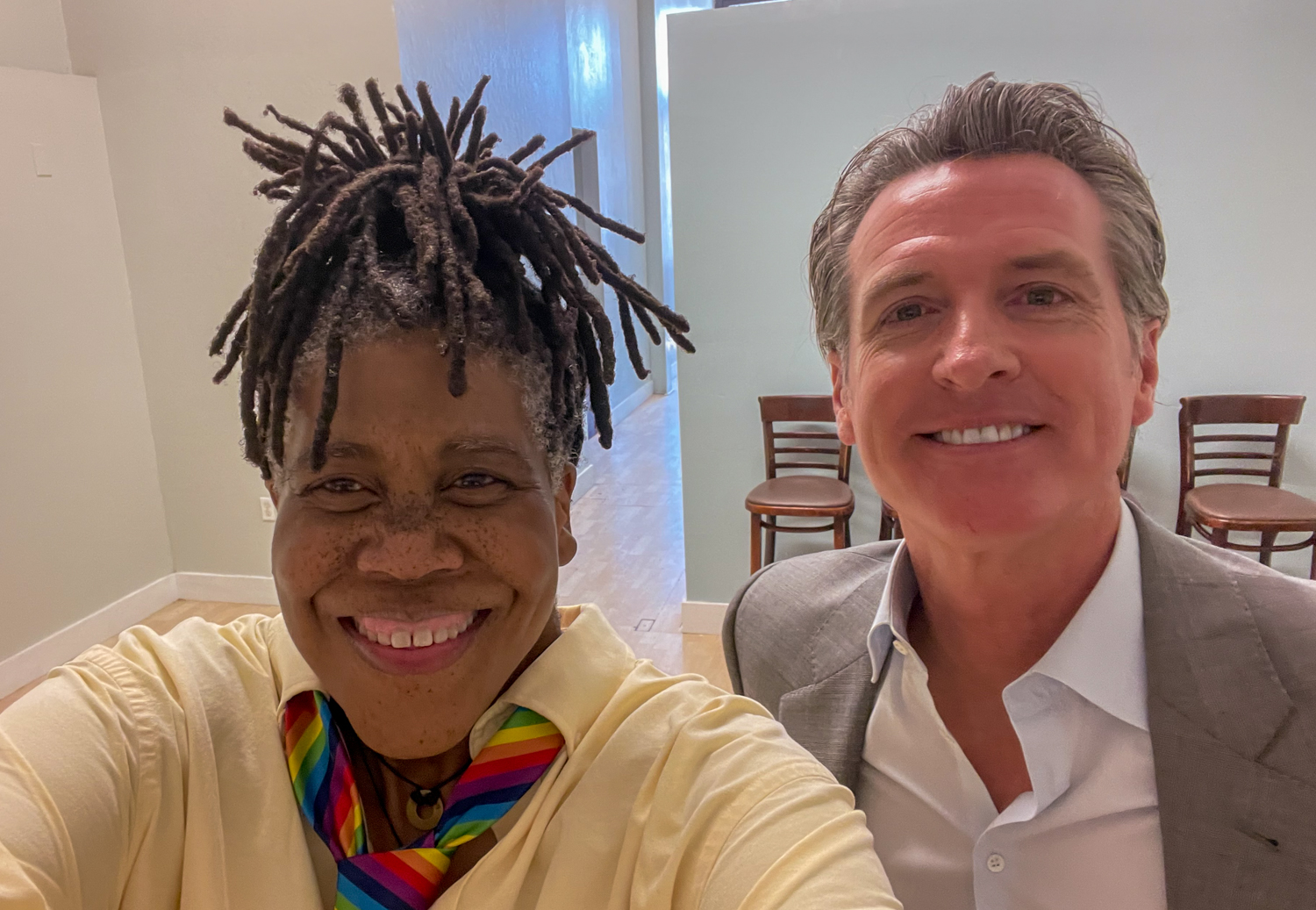
Newsom toured Beastmode Barbershop and Graffiti Pizza, both Black-owned businesses and held a press gaggle with the business owners, local politicians and community business leaders.

Editor’s note: This article was edited for brevity and clarity.
On Thursday, June 18, Gov. Gavin Newsom came to Oakland to talk about small businesses and the “largest small business relief program in the nation.” Dubbed California Roars Back, it’s the governor’s $100 billion “comeback plan”.
Newsom toured Beastmode Barbershop and Graffiti Pizza, both Black-owned businesses and held a press gaggle with the business owners, local politicians and community business leaders.
The Post News Group was granted an exclusive one-on-one sit down interview with Newsom.
Post: “Thank you for your time. Why was it important for you to come to Oakland to talk about the comeback plan?”
Newsom: “ Oakland has been described by some of my San Francisco friends as what San Francisco used to be. It’s a compliment(since) many aspects of San Francisco have been lost to sort of a universal same-ism in certain neighborhoods where you see the same eight nine chains, and the neighborhoods begin to lose their sense of community.
“You come to Oakland, and you see this thriving small business network, just remarkable diverse creative artists who happen to be entrepreneurs, literally in some cases, not just figuratively.
“And so for me it’s really .. the manifestation of a vibrant small business community. It’s also a manifestation of what we want to highlight, which is, while the economy in the macro is recovering from a GDP perspective in the aggregate, we don’t live in the aggregate. There are people who have been disproportionately impacted.
“I want to make a point that we have your back, we want to be there for you when the lights turn off (and) the cameras go away. When we turn the page (on the pandemic), we want to make sure we’re there for the medium- and long-term so everyone’s back on their feet.”
Post: “ I heard you speak earlier about not only helping the businesses that have been struggling, but what about the businesses that have gone out of business. What are your plans for them now that we have reopened?”
Newsom: “We’re working on the final proposal of a billion dollars in grants that allow people to utilize the training dollars to make entrepreneurial investments, meaning to actually use the money in a way where they can start up their business again.
“We’re trying to be very creative. . .. I read this case study about a model, … tripartite agreements of labor, business, and the Singapore government, and there’s these portable accounts that they created, tax free accounts that can be used across the spectrum.
“They also have partnerships with business and small business loans and credit enhancements, and people are able to leverage (them) on the basis of their own skills and where they are in terms of their own workforce development.
“We took a version of that idea. And that’s now currently in the final phases of negotiation with the Legislature. In addition, we’re waiving fees for new startups. We are providing opportunities in terms of loans and grants and credits.
“We have a new credit capacity of close to a billion dollars…. We’re doing micro loans, not grants, for those that have no access to credit or traditional banking institutions. We call it the California Dream fund, emphasis on ‘dream,’ because it also doesn’t regard your immigration status.
“We’re writing these micro loans and grants across the spectrum for that subset of our entrepreneur population. We’re trying across all these spectrums to create more support.
“We have all these regional Small Business Centers, 86 of them that are fully staffed, fully functional, more engaged, more dynamic than ever. . . and supporting a lot of the Black chambers.”
Post: “I understand why (you picked) Oakland. Thank you for taking time to speak exclusively with the Black press. But why was that important to you to specifically speak to the Black press and reach out to Black businesses in particular?”
Newsom: “I think, one of the things that kind of ticked me off a little bit – I don’t know if that’s not gubernatorial language, but it’s more personal – I’m sick of the picture that’s painted on some of the networks around the BLM Movement, around the Black community generally, the exploitation, and it doesn’t tell any story. It’s not even interested in telling a story. It connects to manufactured reality.
“And so for me, this is also an opportunity to counter that (artificial) reality and talk about the entrepreneurial spirit. Yes. talk about creativity, talk about just the culture identity and the competency. What makes life worth living is that diversity of expression, output and insight and meeting needs that you didn’t even know existed.
“I think it’s just incredibly important we talk about Black entrepreneurs. Democrats need to do that. I say, I’m a small business guy. We have such a divided country It’s not just do the right thing for Black-owned businesses in Oakland because, you know, we have a disproportionate number of Black-owned businesses in the Bay Area, but it’s also part of a larger national trust.
“I’m just sick and tired of what I’m watching on the national news. And I want to highlight what I think is really one of the most under-expressed and under-communicated stories in America, like innovation, like entrepreneurship.
“Black excellence (exists) across all spectrums, it’s not just about criminal justice reform, it’s not just about police. There are other things we need to include in that conversation without neglecting our responsibilities to solve those issues. “
Post: “And what importance does the Black press have in all that?”
Newsom: “I’ve been so inspired by how Black press perseveres. Talk about resiliency. We have gone to great lengths in the pandemic to support Black press in terms of our COVID efforts, testing efforts or vaccination efforts.
“(We have) partnerships in terms of trusted messengers and outreach. But we can always do more. I know right now, particularly in the Black press, there’s some anxiety that we’re moving from the investments we made in partnership with the federal government, CDC, because of the pandemic. And how are we going to be there now post-pandemic, and so we’re trying to work that through as well.”









Activism
Oakland Post: Week of September 23 – 29, 2026
The printed Weekly Edition of the Oakland Post: Week of September 23 – 29, 2026


To enlarge your view of this issue, use the slider, magnifying glass icon or full page icon in the lower right corner of the browser window.

Activism
Oakland Post: Week of September 16 – 22, 2026
The printed Weekly Edition of the Oakland Post: Week of September 16 – 22, 2026

To enlarge your view of this issue, use the slider, magnifying glass icon or full page icon in the lower right corner of the browser window.
Activism
Oakland Post: Week of September 9 – 15, 2026
The printed Weekly Edition of the Oakland Post: Week of September 9 – 15, 2026
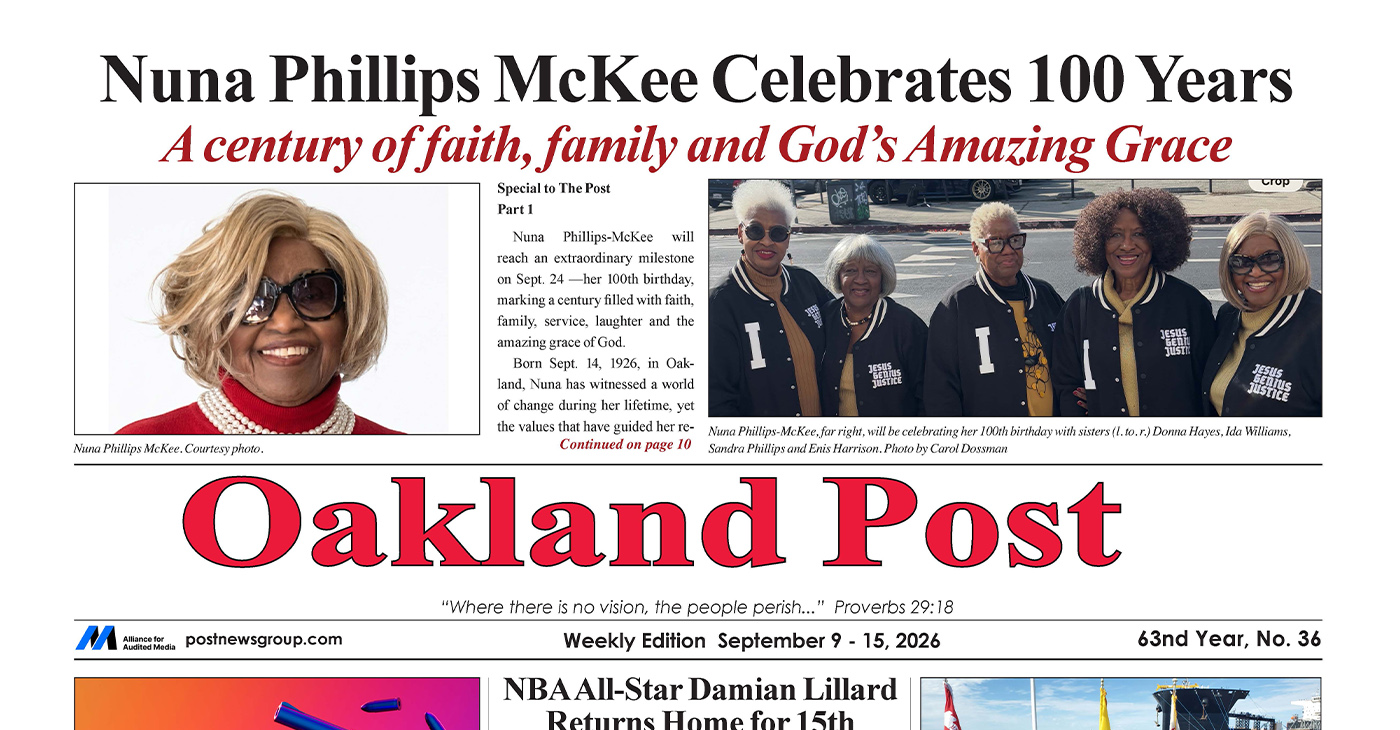
To enlarge your view of this issue, use the slider, magnifying glass icon or full page icon in the lower right corner of the browser window.



Asm. Corey Jackson Announces Launch of 24-Hour Childcare in His District

IN MEMORIAM: The Rev. Leon “Sonny” Clark, Longtime Orange County Pastor and Community Leader, Dies at 72

Poll: Becerra Widens His Lead Over Hilton; Californians Split on Wealth Tax

From Historic Memories to New Possibilities: Oakland Celebrates Coliseum 60

County Office of Education Says OUSD Finances Are Getting Healthier, Materially Stronger

LIVE FREE Sunday Dinner Brings Faith, Fellowship and Civic Conversation to Oakland

Remembering Chauncey Bailey as Student Journalists Face Threats to Truth-Telling

BLACspace Cooperative Invites Bay Area to Experience Oakland’s Black Cultural Ecosystem Through a BLAC Map Tour + Party

In Wake of Death on Doorstep, Williams Chapel Baptist Church Calls for Better Care, Funding for Unhoused

Oakland Centenarian Nuna McKee Honored!

Caribbean Nations Produce Action Plan Calling for UK Reparations Over Slavery

Oakland Post: Week of September 23 – 29, 2026

Doulas Are Helping Black California Moms Navigate Pregnancy–Even as High Mortality Rates Persist

Newsom Signs Addictive Social Media Law to Protect Kids

On Your November Ballot: Prop 38 Would Allocate $8.4 Billion to Immunology and Immunotherapy Funding

Less Affluent School Districts, Including Sacramento City, Face Threat of State Takeover

ESSAY: California Can Close Its Colorectal Cancer Gap

California Hispanic Chambers of Commerce Unveils: ‘Powering the Future’ Theme for 47th Annual Statewide Convention

Four Candidates, Including Incumbent Barbara Lee, Qualify for Oakland Mayor’s Race

Oakland Post: Week of August 12 – 18, 2026

From Blueprint to Breakthrough: Tackling Affordable Housing in Oakland

Oakland Observes Black August with Block Parties, Film Showings, Workshops

COMMENTARY: Why Local School Tax Measure G1 Will Not Be on the November Ballot

Standoff for Justice: Our Homes Are Worth Fighting For

Returning to Its Roots, the Oakland Black-Eyed Pea Festival Partners with the Freedom Farmers Market Sept. 12

Oakland Post: Week of August 26 – September 1, 2026

NPRC Scores First Advocacy Victory: David Shaw Finally Gets His Wish to ‘Go Home’

Frontier Airlines’ Return to Oakland Airport Brings Flights, Jobs and Opportunity

Gubernatorial Candidate Steve Hilton Blasts California New Tire Rules; Newsom Hits Back

Chef Sharon Lee Blends Culinary Excellence, Education and Empowerment

The Conversation With Al McFarlane 6/23/26

Media Monday 6/22/26

LIVE! ASK ALMA! — TUES. 6.23.26 7PM EST

Car Buying Secrets: 4 Hidden Checks Before You Sign!

Is This 550 HP Charger Worth YOUR Money? AutoNetwork Review

Celebrating Juneteenth – Frederick Douglass on education and resistance

LIVE! — ASK ALMA! — TUES. 6.19.26 7PM EST

Hyundai Ioniq 5 Parking, Safety, and 360 View #shorts

2025 Ioniq 5 New Wiper & Powerful Performance! #shorts

Electric SUV Range: Is 259 Miles Enough? #shorts

EV Charging: How Fast Can You Charge an Electric Vehicle? #shorts

Biometric Cooling… Messaging Seats…Come on! 2025 Infiniti QX80 Autograph 4WD

Charged Up: Witness the Magic of a Fully Electric Car! #shorts

Range Rover Sport PHEV Included…: See What’s Inside This Luxury SUV! #shorts

Invisible Hood View: Perfect Parking with X-Ray Vision! #shorts
-
 Commentary4 weeks ago
Standoff for Justice: Our Homes Are Worth Fighting For
-
 Activism4 weeks ago
Oakland Post: Week of August 26 – September 1, 2026
-
 Business4 weeks ago
Frontier Airlines’ Return to Oakland Airport Brings Flights, Jobs and Opportunity
-
 Business4 weeks ago
Gubernatorial Candidate Steve Hilton Blasts California New Tire Rules; Newsom Hits Back
-
 Business4 weeks ago
Chef Sharon Lee Blends Culinary Excellence, Education and Empowerment
-

 Community4 weeks ago
Big City Mayors Ask for “Yes” Vote on Housing Bond Measure; Conservatives Say “No”
-
 Black History4 weeks ago
Jackie Wright Champions Bay Area Stories, Filmmakers and Cultural Institutions
-

 Education4 weeks ago
Gov. Newsom’s Latest Appointees Include Sacramento Advocate for Formerly Incarcerated Students; State’s New Tech Chief
