
Activism
Black Rage is Justified – Statement from the Brotherhood of Elders Network

“To be a Negro in this country and to be relatively conscious, is to be in a rage almost all the time.” James Baldwin
“We revolt simply because, for many reasons, we can no longer breathe” Franz Fanon
We embrace the rage. The knee on George Floyd’s neck symbolizes the historic weight on the neck of the black community for our entire history in this land. It must be lifted, or we all perish. We feel the pain expressed across the nation given our lived experiences of racism, economic disinvestment, failed health care systems, joblessness, disparate impacts of covid-19, and disparate impacts of the criminal justice system. We express our outrage at the blatant racism and act of murder and other violence against Black people by law enforcement. We condemn the federal, state and local officials who, through their silence and inaction, condone these acts of terror against our community. It is time for immediate and substantial action to shift away from the current culture of policing to meaningful, community-based safety and well-being strategies.
Police in Minneapolis murdered George Floyd just for being black and denied him human dignity. The same is true for Breonna Taylor in Louisville, Tony McDade in Tallahassee, and Ahmaud Arbery in Brunswick, Georgia; as well as countless others. Too many of us, no matter our race, gender, or unique identity, struggle everyday with the violence of our society that serves the rich and privileged at the expense of the struggling workers.

The violence generated by the economic, political, social and cultural institutional racism against our community caused the reactions in the streets. We fully support our activist family and friends who are waging a principled demonstration of the pent-up anger we all feel. In the Spirit of John Brown, we applaud the solidarity of antiracist white people in our struggle. We stand with all who fight for change. While we do not seek to promote the violence, looting and other activities that can undermine the message that Black Lives really do Matter, We are committed to the belief that if there is no Justice, there will be no Peace. Our demand is for justice—true justice – justice for George Floyd and all victims of police violence, health and economic justice, educational equity and economic and housing justice. We commit a renewed energy and resources to demand accountability and to the removal of obstacles to change policies, institutions, or change individuals.
To our young people, we understand your distrust of government and law enforcement. We stand with you to change this system of unequal justice. We know that judges represent as much a part of the inequities in the justice system as District Attorneys, City Attorneys, law enforcement and lawyers. Systemic change is required.
As an intergenerational network of men of African descent, we are working hard to bring the world we want to see into being. We have organized a response to the COVID pandemic in Oakland over the last month and created a fund to provide resources to our most vulnerable family members. We have partnered with City officials to support the creation of an effective Department of Violence Prevention.
Lastly, a major tool in this transformation is the Oakland Police Commission which finds itself at a crossroads. We have engaged the debate and won’t give up until this vehicle for accountability is working at its highest level for us. To be successful in their duties, it requires the trust of the Oakland Community; the appropriate number of qualified trained staff; and complete autonomy from Oakland’s elected officials, administration and Police Department. The current debate on making changes to the Commission are critical to their mission of overseeing the policies and practices to meet the national standards of constitutional policing. We are determined to create a humane “use of force” policy and practice for the Oakland Police Department; to eliminate biased policing in the Oakland Police department and the Sheriff’s Department, to strengthen the Citizen Police Review Agency, and elect a District Attorney that prosecutes police violations of citizens’ rights, and elect a sheriff that protects the rights of our community.
Join us in our work. Join us in this fight. Join us in the larger movement for Black lives.
The Brotherhood of Elders Network is an intergenerational network of men of African descent based in Oakland California whose mission is to foster environments where Black males are empowered to flourish.
www.brotherhoodofelders.net




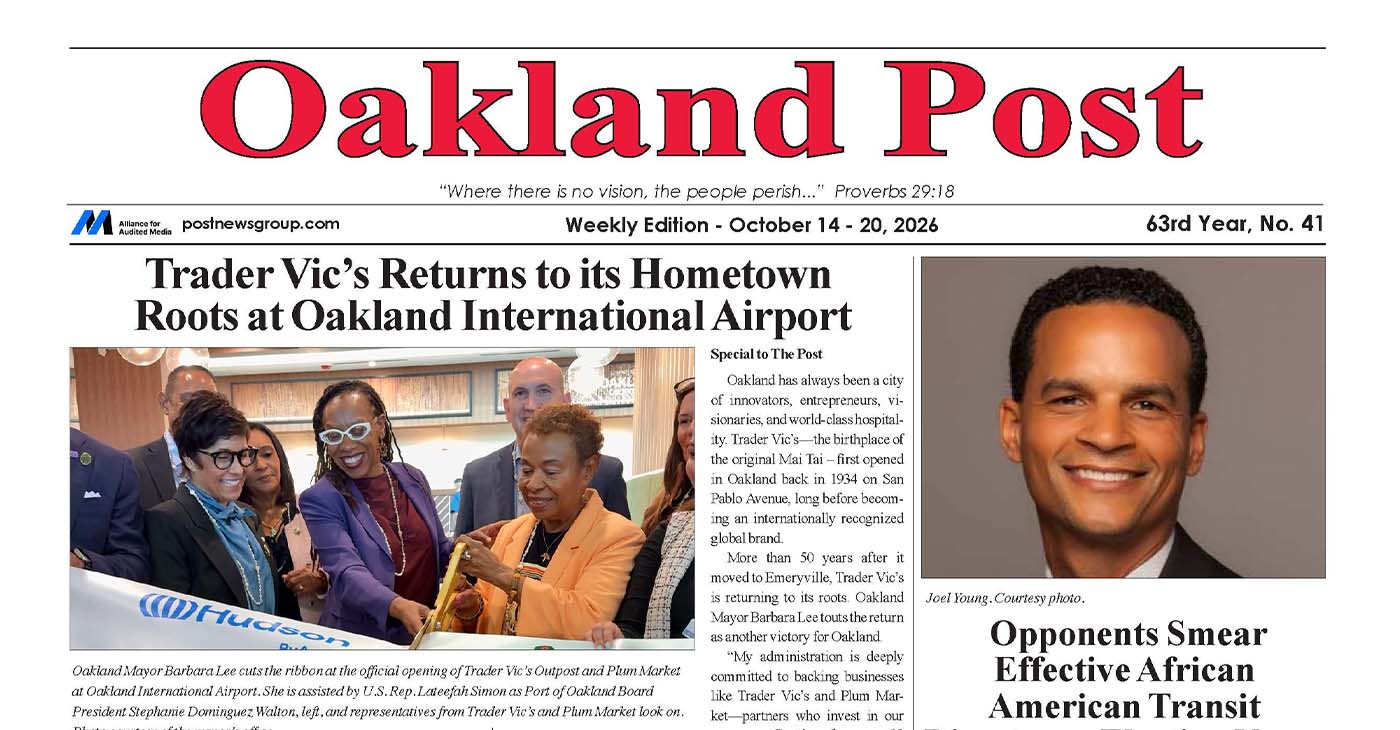
To enlarge your view of this issue, use the slider, magnifying glass icon or full page icon in the lower right corner of the browser window.

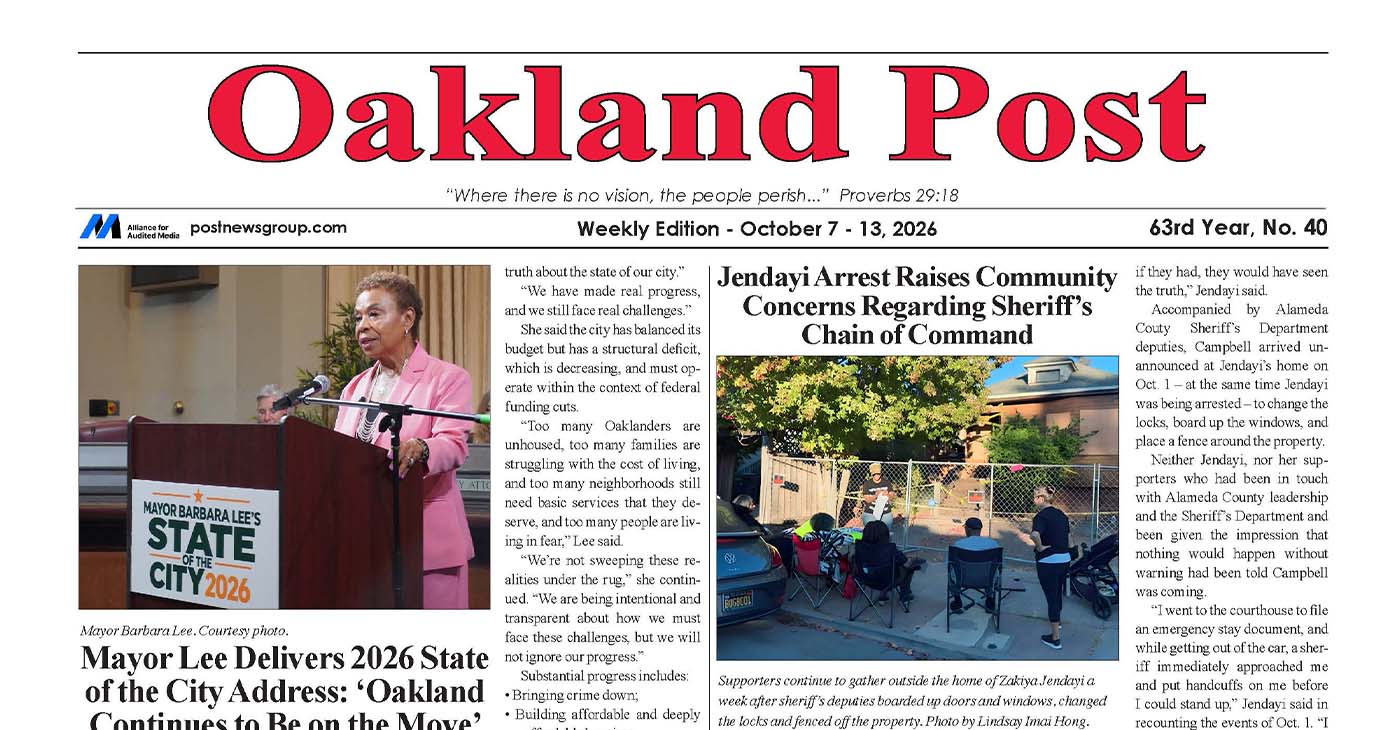
To enlarge your view of this issue, use the slider, magnifying glass icon or full page icon in the lower right corner of the browser window.

Activism
Oakland Post: Week of September 30 – October 6, 2026
The printed Weekly Edition of the Oakland Post: Week of September 30 – October 6, 2026

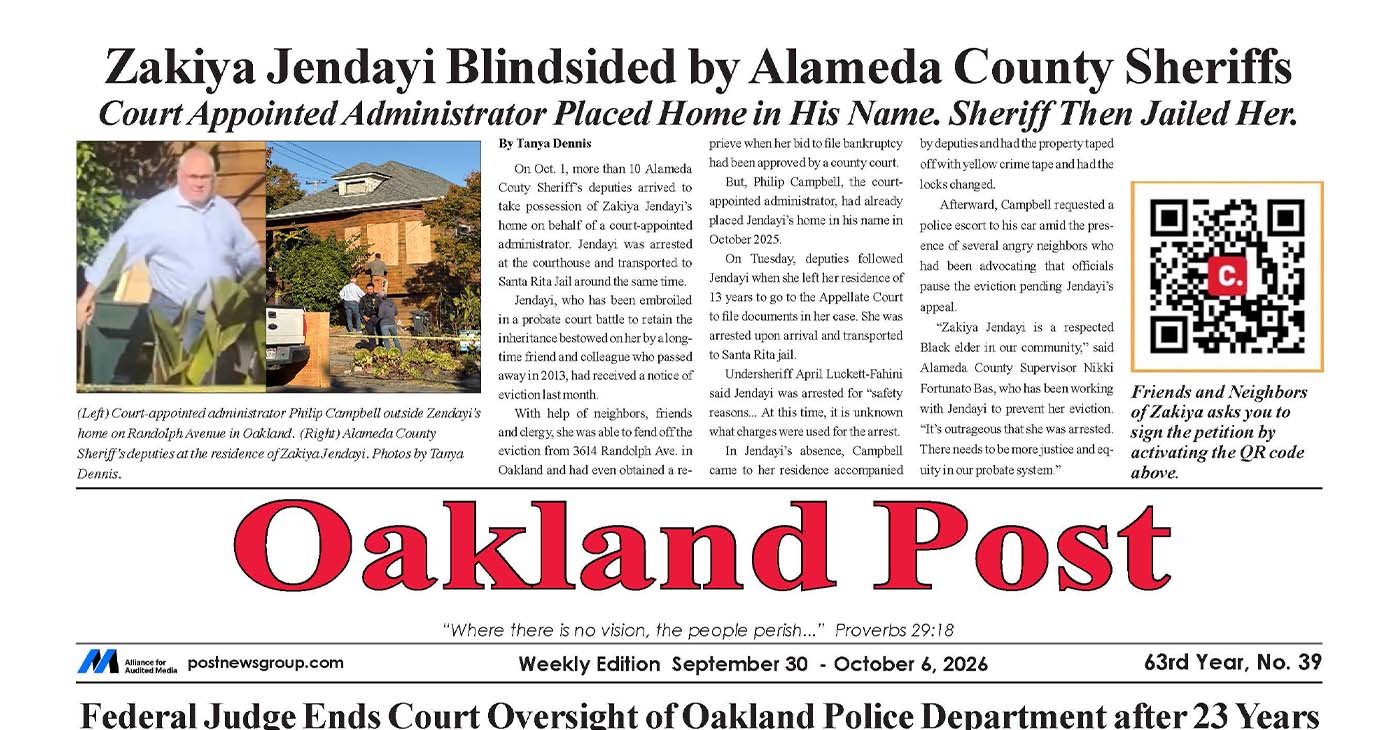
To enlarge your view of this issue, use the slider, magnifying glass icon or full page icon in the lower right corner of the browser window.


Mayor Barbara Lee Holds Special State of the City Address in Deep East Oakland

Practitioners of African Traditional Spirituality Offer Ancestral Reverence Ritual Oct. 31

It’s Time to Lose Weight Before the Holidays

Trader Vic’s Returns to Its Oakland Roots

Oakland Coal Terminal Backed by Trump Would Be Bigger, Dirtier Than Promised, Says Report

Opponents Smear Effective African American Transit Director as Election Nears

Oakland Post: Week of October 14 – 20, 2026

OP-ED: The Black Church Writes AI’s Next Chapter

OP-ED: The Black Church Writes AI’s Next Chapter

WCCUSD Joins Statewide Organic School Food Purchasing Cooperative

Democrats, Community Groups Back Measure EE to Change How Oakland Is Governed

Four Tips to Help You Plan a Holiday “Staycation”

Veterans Housing Project Proposed for South Richmond
PRESS ROOM: Transformative Justice Coalition 2026 Voting Rights Champion Awards Reception ‘Yesterday Is Today: The Battle For Voting Rights

Mayor Lee Delivers 2026 State of the City Address: ‘Oakland Continues to Be on the Move’

Misnamed ‘Parent’ PAC Seeks to Influence Oakland School Board Elections

Poll: Becerra Widens His Lead Over Hilton; Californians Split on Wealth Tax

Listening as a Lifeline: A Doula’s Witness to Black Maternal Health

Oakland Post: Week of September 9 – 15, 2026

County Office of Education Says OUSD Finances Are Getting Healthier, Materially Stronger

Richmond Tiny House Village Farm & Garden Set to Open Gates on Sept. 26

Mayor Lee Announces $1 Million Kaiser Permanente Grant for Pilot Program to Address Homelessness, Clean Up Public Spaces throughout Oakland

Latest Massacre in Haiti Reveals Cruelty U.S. Deportations

Zakiya Jendayi Arrested, Locked Out of Home by Sheriff’s Deputies

OPINION: Nolan Wells’ Death One of Several Signifying Racial Terror Lives on in U.S. South

Doulas Are Helping Black California Moms Navigate Pregnancy–Even as High Mortality Rates Persist

BLACspace Cooperative Invites Bay Area to Experience Oakland’s Black Cultural Ecosystem Through a BLAC Map Tour + Party

Oakland Post: Week of September 16 – 22, 2026

Democratic Clubs Interview Candidates for Oakland School Board

Oakland People’s Arms Embargo Coalition Demands End to Military Shipments Thru Oakland

The Conversation With Al McFarlane 6/23/26

Media Monday 6/22/26

LIVE! ASK ALMA! — TUES. 6.23.26 7PM EST

Car Buying Secrets: 4 Hidden Checks Before You Sign!

Is This 550 HP Charger Worth YOUR Money? AutoNetwork Review

Celebrating Juneteenth – Frederick Douglass on education and resistance

LIVE! — ASK ALMA! — TUES. 6.19.26 7PM EST

Hyundai Ioniq 5 Parking, Safety, and 360 View #shorts

2025 Ioniq 5 New Wiper & Powerful Performance! #shorts

Electric SUV Range: Is 259 Miles Enough? #shorts

EV Charging: How Fast Can You Charge an Electric Vehicle? #shorts

Biometric Cooling… Messaging Seats…Come on! 2025 Infiniti QX80 Autograph 4WD

Charged Up: Witness the Magic of a Fully Electric Car! #shorts

Range Rover Sport PHEV Included…: See What’s Inside This Luxury SUV! #shorts

Invisible Hood View: Perfect Parking with X-Ray Vision! #shorts
-
 Economy4 weeks ago
Poll: Becerra Widens His Lead Over Hilton; Californians Split on Wealth Tax
-
 Black History3 weeks ago
Listening as a Lifeline: A Doula’s Witness to Black Maternal Health
-
 Business4 weeks ago
County Office of Education Says OUSD Finances Are Getting Healthier, Materially Stronger
-
 Lead Story3 weeks ago
Zakiya Jendayi Arrested, Locked Out of Home by Sheriff’s Deputies
-
 Black History4 weeks ago
Doulas Are Helping Black California Moms Navigate Pregnancy–Even as High Mortality Rates Persist
-
 Art4 weeks ago
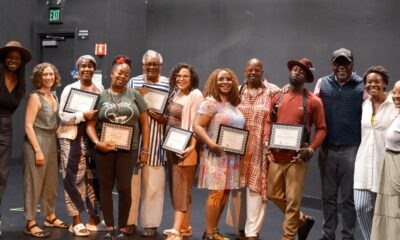
BLACspace Cooperative Invites Bay Area to Experience Oakland’s Black Cultural Ecosystem Through a BLAC Map Tour + Party
-
 Business4 weeks ago
From Historic Memories to New Possibilities: Oakland Celebrates Coliseum 60
-
 Community4 weeks ago
Asm. Corey Jackson Announces Launch of 24-Hour Childcare in His District
