
Economics
The 2020 Census: Why It’s Important


Editor’s Note: The POST Newspaper Group, in partnership with the U.S. Census Bureau, will publish a series of articles on the upcoming 2020 census. Readers can look forward to future articles that will provide more specific information on the census.
Tired of dealing with the potholes in your community? Wondering why there are not enough social services available in your neighborhood?
It may be because of an inaccurate census count due to hundreds of individuals who didn’t participate, and your city received less federal funding for much-needed services than it should have.
The U.S. Census Bureau conducts a census count in thousands of cities, towns and communities across the nation affecting millions of people from all walks of life. The U.S. has counted its population every 10 years since 1790. The purpose of the census is three-fold:
• Accurate census counts help determine how billions of dollars in federal funding flow into states and communities each year.
• The results determine how many seats in Congress each state gets.
• It’s mandated by the U. S. Constitution in Article 1, Section 2.
Norman Brown, who currently works in Alameda County’s Census Office, has participated in every census since 1960, and has held a wide range of positions with the agency, ranging from a clerk to managing all field operations, a post which is second in command at every census office.

“When you respond to the census, your answers are kept anonymous,” said Brown. “They are used only to produce statistics. The U.S Census Bureau is bound by law to protect your answers and keep them strictly confidential. The law ensures that your private information is never published and that your answers cannot be used against you by any government agency or court. The raw data and personal information will not be released to the public for 72 years, or in 2092. Confidentiality is a very important in census taking.”
The 2020 United States Census will be the nation’s twenty-fourth census. National Census Day, the reference used for the census, will be April 1, 2020. It will be the first U.S. census to offer options to respond online or by phone, in addition to the option to respond on a paper form as with previous census. In 2020, the United States population is expected to be 333,546,000, an 8.03 percent increase from the 2010 Census.
Brown says that participating in the census is not only vitally important for neighborhoods, it also provides good, temporary, part-time work for hundreds of thousands of people,
“The Bureau will be recruiting and making job offers to thousands of potential employees during January and February 2020,” said Brown. “Census employees working throughout Alameda County can expect to receive a minimum of $20.00 per hour.”
To be eligible for a 2020 Census job, you must:
• Be at least 18 years of age.
• Have a valid social security number.
• Be a U.S. citizen.
• Have a valid email address.
• Complete an application and answer assessment questions.
• Be registered with the Selective Service System or have a qualifying exemption, if you are a male born after Dec. 31, 1959.
• Pass a census-performed criminal background check and a review of criminal records, including fingerprinting.
• Commit to complete training.
• Be available to work flexible hours, which can include days, evenings, and/or weekends.













Activism
Oakland Post: Week of August 12 – 18, 2026
The printed Weekly Edition of the Oakland Post: Week of August 12 – 18, 2026


To enlarge your view of this issue, use the slider, magnifying glass icon or full page icon in the lower right corner of the browser window.

Activism
Oakland Post: Week of August 5 – 11, 2026
The printed Weekly Edition of the Oakland Post: Week of August 5 – 11, 2026
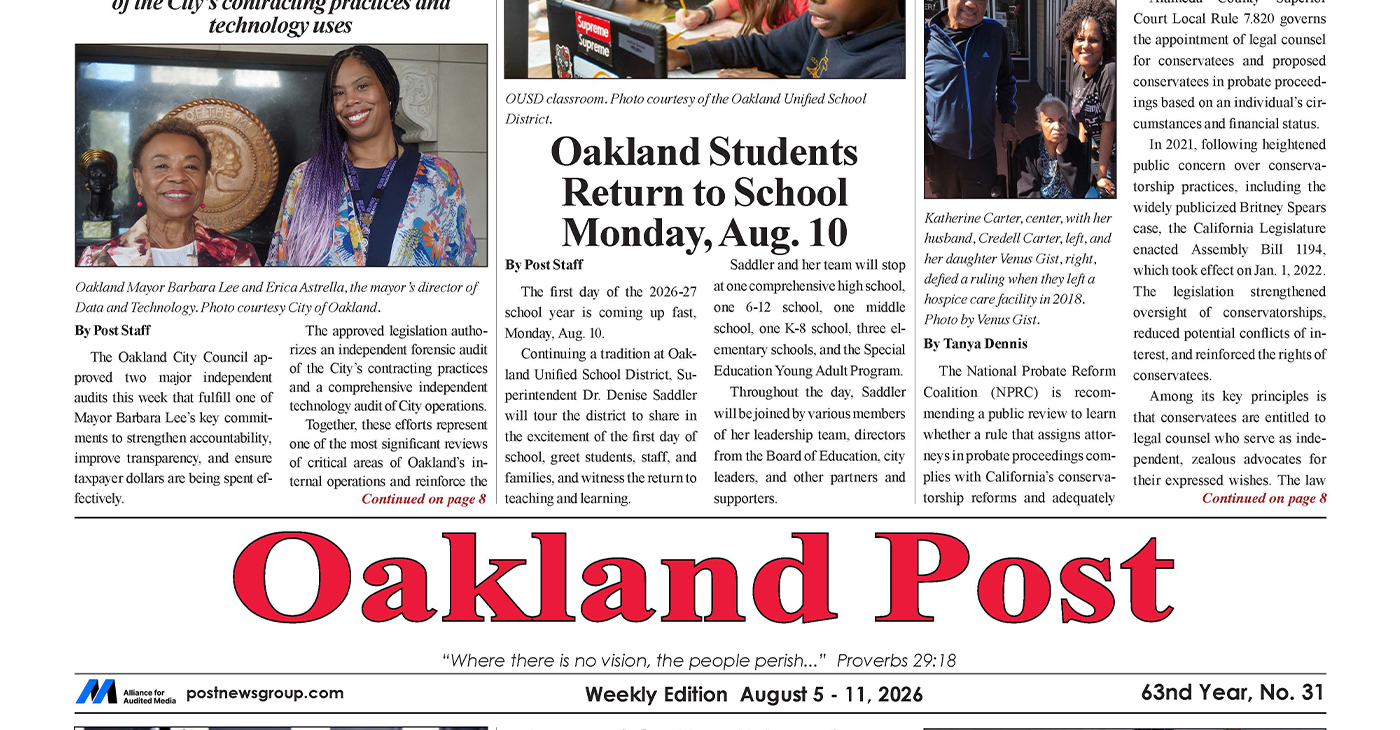
To enlarge your view of this issue, use the slider, magnifying glass icon or full page icon in the lower right corner of the browser window.
Activism
Oakland Post: Week of July 29 – August 4, 2026
The printed Weekly Edition of the Oakland Post: Week of July 29 – August 4, 2026

To enlarge your view of this issue, use the slider, magnifying glass icon or full page icon in the lower right corner of the browser window.

WORK FROM HOME
Home-based business with potential monthly income of $10K+ per month. A proven training system and website provided to maximize business effectiveness. Perfect job to earn side and primary income. Contact Lynne for more details: Lynne4npusa@gmail.com 800-334-0540


OPINION: 57,000 Empty Apartments and Not a Word of Apology – City Limits

Oakland Protesters Rally to Defend Haitian Immigrants and TPS

First 5 Alameda County Celebrates First Year of Measure C’s Implementation

From Palestine to Oakland: Seeds for Liberation Examines Shared Struggles for Freedom

NABJ Convention Brings Black Journalists, Civic Leaders Together in Atlanta

At Sacramento Summit, Becerra Discusses Policy; Uses “Family” Metaphor to Frame Case for National Political Unity

$5 Billion Coliseum Vision Puts Oakland Jobs, Businesses at Center

Gov. Newsom Nominates 3 Black Women Judges to Serve on State Courts of Appeal

Oakland Observes Black August with Block Parties, Film Showings, Workshops

NPRC Elder Justice Symposium Invites Community to Join Effort to Protect Alameda County Elders
Episode 4: Grow Stronger After 50
Episode 4: Grow Stronger After 50

Four Candidates, Including Incumbent Barbara Lee, Qualify for Oakland Mayor’s Race

Oakland Observes Black August with Block Parties, Film Showings, Workshops

Oakland Post: Week of August 12 – 18, 2026

Department of Homeland Security Demands California Secretary of State Shirley N. Weber Scrub Voter Rolls

New Judge Could Decide if Karmelo Anthony Gets a New Trial

Oakland Children’s Hospital Workers and Patients Rally for Pediatric Medical Care

“The Power to See Threats Sooner”: Gov. Newsom, Safety Officials Showcase California’s Investments in Hi-Tech Wildfire Prevention

Alpha Kappa Alpha Sorority, Inc. Celebrates New North Atlantic Regional Director

Surveillance Pricing Fight: State Senate Debates Bill Banning Retailers from Using AI to Set Prices Based on a Buyer’s Profile

Mount Zion MBC, Church of Jesus Christ of Latter-day Saints Partner to Bring 29,000 Meals to Alameda County

California Sen. Padilla Joins Colleagues to Introduce Bill Imposing Term Limits on Supreme Court Justices

Less Affluent School Districts, Including Sacramento City, Face Threat of State Takeover

Car Wash Workers Cope with Lingering Impacts of ICE Raids

Starting This Summer, California Car Buyers Can Get an Instant $3500 Off the Cost of Electric Vehicles

COMMENTARY: You Are Already Paying for the AI Boom

California Bill Would Let Abuse Victims Use Trauma as Legal Defense for Violent Crime

Fed Court to Decide Landmark First Amendment Case

Gov. Gavin Newsom Signs Law Streamlining Affordable Housing Rules

The Conversation With Al McFarlane 6/23/26

Media Monday 6/22/26

LIVE! ASK ALMA! — TUES. 6.23.26 7PM EST

Car Buying Secrets: 4 Hidden Checks Before You Sign!

Is This 550 HP Charger Worth YOUR Money? AutoNetwork Review

Celebrating Juneteenth – Frederick Douglass on education and resistance

LIVE! — ASK ALMA! — TUES. 6.19.26 7PM EST

Hyundai Ioniq 5 Parking, Safety, and 360 View #shorts

2025 Ioniq 5 New Wiper & Powerful Performance! #shorts

Electric SUV Range: Is 259 Miles Enough? #shorts

EV Charging: How Fast Can You Charge an Electric Vehicle? #shorts

Biometric Cooling… Messaging Seats…Come on! 2025 Infiniti QX80 Autograph 4WD

Charged Up: Witness the Magic of a Fully Electric Car! #shorts

Range Rover Sport PHEV Included…: See What’s Inside This Luxury SUV! #shorts

Invisible Hood View: Perfect Parking with X-Ray Vision! #shorts
-
 Featured2 weeks ago
Department of Homeland Security Demands California Secretary of State Shirley N. Weber Scrub Voter Rolls
-
 #NNPA BlackPress3 weeks ago
New Judge Could Decide if Karmelo Anthony Gets a New Trial
-
 Business4 weeks ago
Oakland Children’s Hospital Workers and Patients Rally for Pediatric Medical Care
-
 Environment2 weeks ago
“The Power to See Threats Sooner”: Gov. Newsom, Safety Officials Showcase California’s Investments in Hi-Tech Wildfire Prevention
-
 Black History3 weeks ago
Alpha Kappa Alpha Sorority, Inc. Celebrates New North Atlantic Regional Director
-
 Business4 weeks ago
Surveillance Pricing Fight: State Senate Debates Bill Banning Retailers from Using AI to Set Prices Based on a Buyer’s Profile
-
 Business4 weeks ago
Mount Zion MBC, Church of Jesus Christ of Latter-day Saints Partner to Bring 29,000 Meals to Alameda County
-
 Featured2 weeks ago
California Sen. Padilla Joins Colleagues to Introduce Bill Imposing Term Limits on Supreme Court Justices
