
City Government
City Examines Ways to Reduce Racial Disparities in Construction Projects

The City of Oakland is holding a series of three community engagement meetings to examine ways to mitigate inequities in a potential Project Labor Agreement (PLA), backed by local building trades unions and their supporters, that would require developers to hire only union labor and contactors for projects that are built on city-owned land and or involve city funding.
Under a PLA, also called a Community Workforce Agreement (CWA), contractors and sub-contractors on city projects exceeding a certain dollar amount would use only union labor or pay prevailing wages. “All workers on the projects covered by PLA/CWA will be referred to contactors through the various unions’ dispatch process, (and) all workers must either join the union or pay union dues /fees,” according to a city factsheet.
While a traditional PLA could benefit the over 30 unions that belong to the Construction Trades Council of Alameda County, the concern of the African American construction workers and contractors and many in the city is that such an agreement could solidify the long-term racial disparities that have marginalized Black contractors in the industry and limited the job prospects of African American construction workers, most of whom have only been able to find jobs working for African American non-union contractors.

Many of the building trades unions, which send workers to construction sites from their hiring halls, have been historically segregated, admitting almost no Black workers. The unions, so far, have been unwilling to release data on their racial composition, though there are indications that they may be willing in coming months to respond to the city’s request for information.
The City Council, which has been considering a PLA for a while, currently has no proposed agreement on the table. Instead, the council has directed staff to hold community meetings to “identify barriers to training, employment and retention in construction-related jobs/careers and opportunities for small contactors and offer suggestions how existing equity policies can be strengthened and/or expanded through a community workforce agreement ordinance.”
In addition to mandating community outreach meetings, the council has also asked the city’s Department of Race and Equity to look at the disparate impacts and make suggestions to reduce inequities.
“When we do racial equity work, we always look at disparities…to work toward closing those disparities,” in order to reduce the high level of unemployment among African Americans and underemployment among Latinos, said Darlene Flynn, director of the Department of Race and Equity in an interview with the Oakland Post.
Underscoring the importance of the community engagement meetings, Flynn said that “in evaluating how an agreement might be written to produce more equitable outcomes, we need to look at the barriers, and it’s best to talk to those who are closest to the challenges.”
“This kind of community conversation helps us to not make assumptions about what the problems are,” but to proceed based on facts and data, she said.
“These are questions that need to be asked and answered,” said Flynn.
Agreeing, City of Oakland Employment Services Supervisor Jonothan Dumas said, “In these meetings, we are trying to find out who has been affected, what their experiences have been, who might benefit and whether they ran into barriers that have resulted in the disparities that we see, looking at how we can incorporate ways to offset these barriers.”
Some of the questions the city wants to address:
- Should a defined percentage of the hours on city projects go to local workers (such as 50 percent)?
- Should there be a requirement to hire the formerly incarcerated?
- Should some of the jobs be reserved for people who live in certain Oakland zip codes?
- What should be the requirements for hiring local apprentices?
- Should there be funding for training and removing barriers to employment?
About 100 people, including African American contractors and construction workers, attended the first outreach meeting last Thursday in East Oakland. Many were concerned that a PLA would exclude them from job opportunities on city projects.
Speaking at the meeting, African American contractor Eddie Dillard said, “A Project Labor Agreements benefits white contractors. Ninety percent of Black contractors are non-union.”
Union training programs are not located in Oakland but in outlying areas, like Benicia and San Jose, he said. “We have been asking the unions for 10 years how many African American members they have, but they have refused” to release the data, he said.
Most of those locals “have zero Blacks in them,” he said.
The next community engagement meeting will be held Saturday, Aug. 10, 10 a.m. to noon, at the West Oakland Youth Center, 3233 Market St. in Oakland.

Activism
Oakland Post: Week of September 30 – October 6, 2026
The printed Weekly Edition of the Oakland Post: Week of September 30 – October 6, 2026

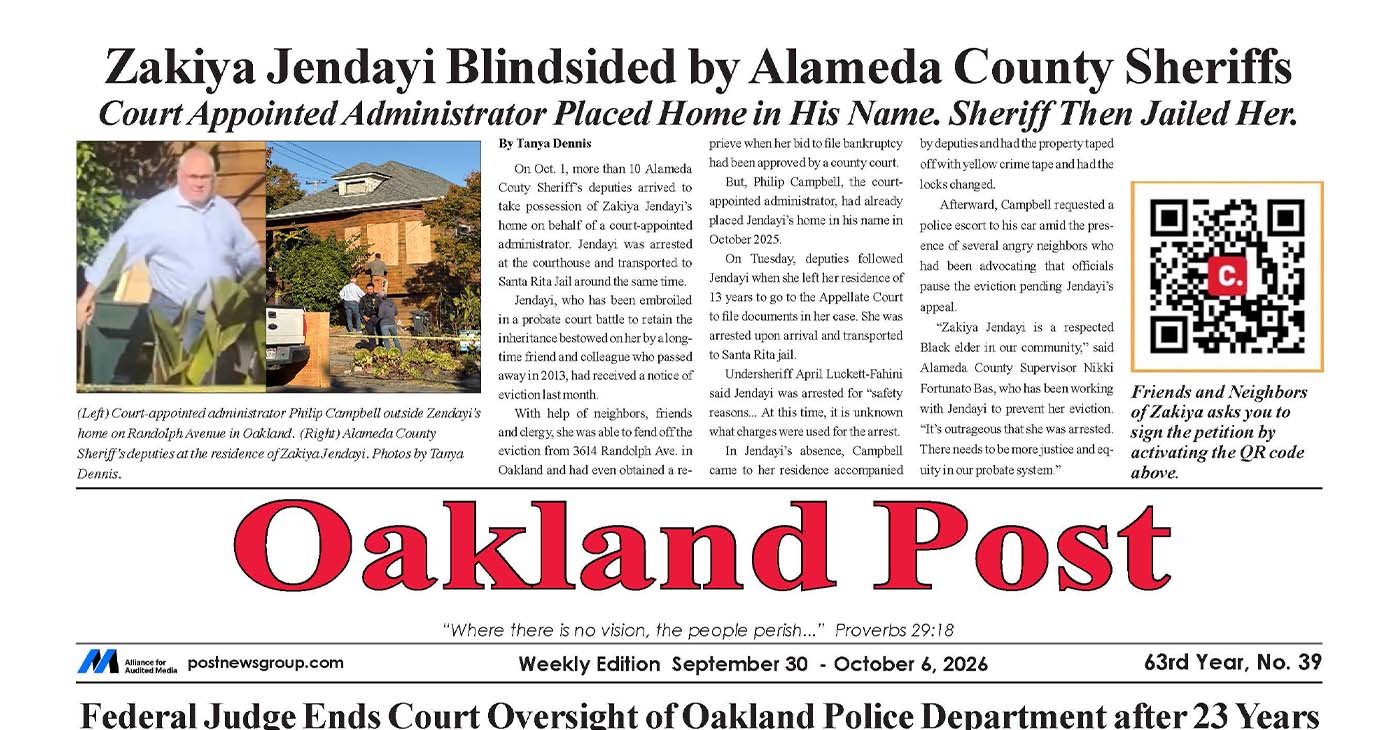
To enlarge your view of this issue, use the slider, magnifying glass icon or full page icon in the lower right corner of the browser window.


Activism
Oakland Post: Week of September 23 – 29, 2026
The printed Weekly Edition of the Oakland Post: Week of September 23 – 29, 2026
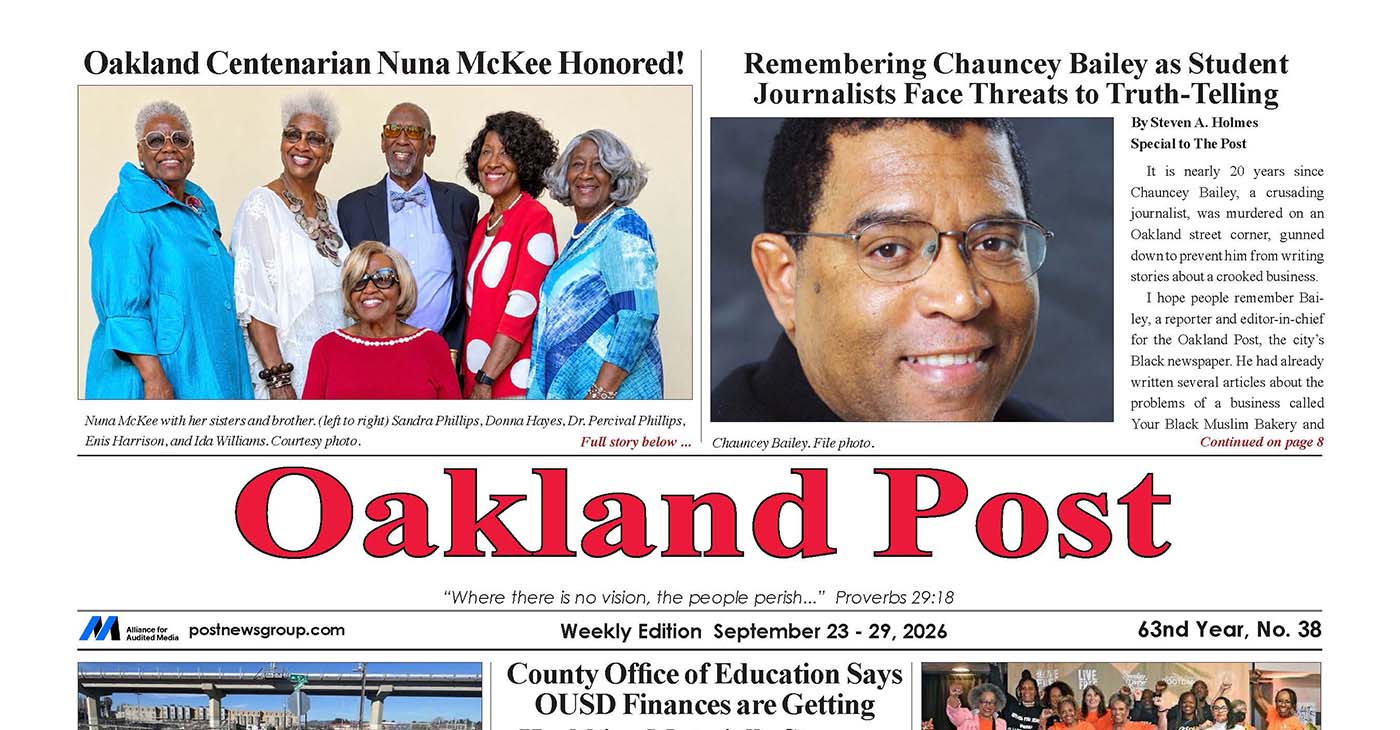
To enlarge your view of this issue, use the slider, magnifying glass icon or full page icon in the lower right corner of the browser window.
Activism
Oakland Post: Week of September 16 – 22, 2026
The printed Weekly Edition of the Oakland Post: Week of September 16 – 22, 2026
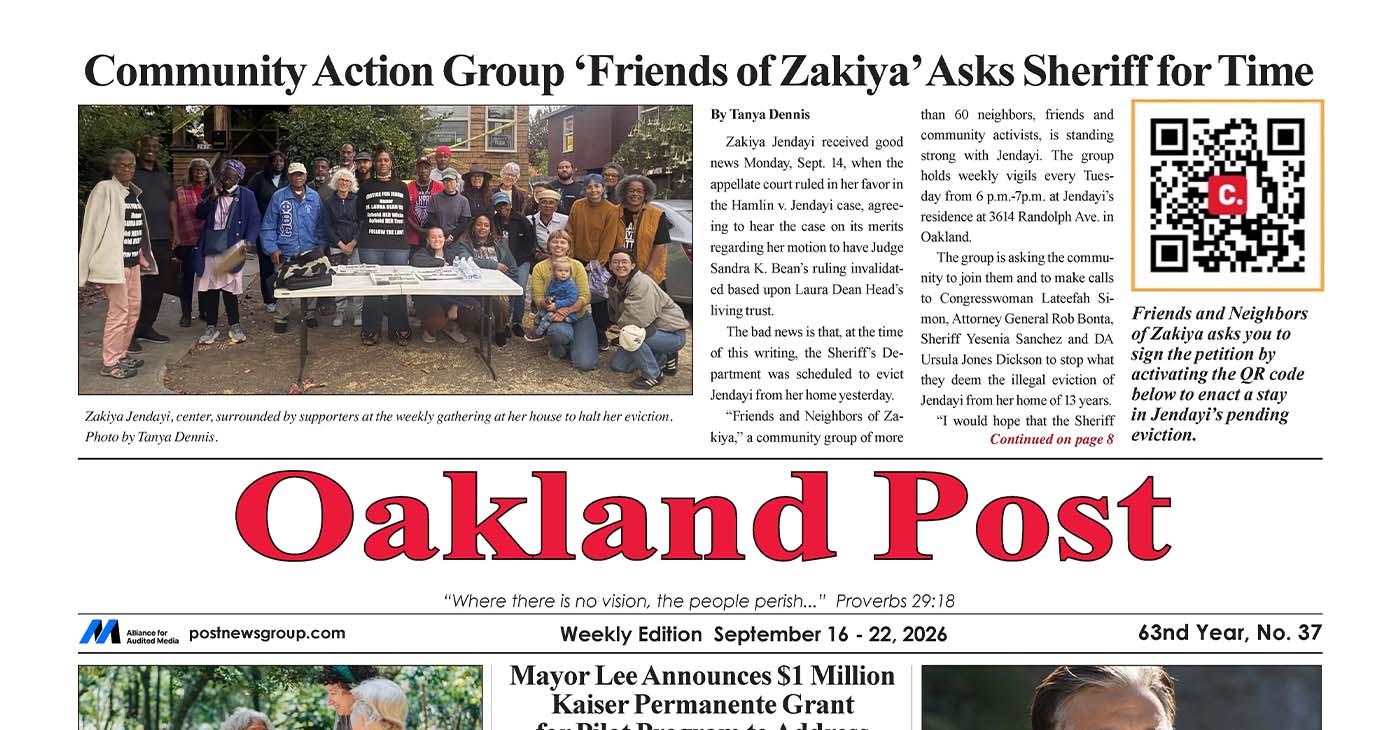
To enlarge your view of this issue, use the slider, magnifying glass icon or full page icon in the lower right corner of the browser window.


OP-ED: Proposition 44 Would Put a Price on Trust

OP-ED: Proposition 40: It’s Time to Play Chess, Not Checkers

Listening as a Lifeline: A Doula’s Witness to Black Maternal Health

New Protections for Ticket Buyers: Gov. Newsom Signs Assemblymember Isaac Bryan’s Bill

‘We Don’t Talk Trash — We Pick Up Trash!’

Zakiya Jendayi Arrested, Locked Out of Home by Sheriff’s Deputies

Oakland Post: Week of September 30 – October 6, 2026

Asm. Corey Jackson Announces Launch of 24-Hour Childcare in His District

IN MEMORIAM: The Rev. Leon “Sonny” Clark, Longtime Orange County Pastor and Community Leader, Dies at 72

Poll: Becerra Widens His Lead Over Hilton; Californians Split on Wealth Tax

From Historic Memories to New Possibilities: Oakland Celebrates Coliseum 60

County Office of Education Says OUSD Finances Are Getting Healthier, Materially Stronger

LIVE FREE Sunday Dinner Brings Faith, Fellowship and Civic Conversation to Oakland

Remembering Chauncey Bailey as Student Journalists Face Threats to Truth-Telling

BLACspace Cooperative Invites Bay Area to Experience Oakland’s Black Cultural Ecosystem Through a BLAC Map Tour + Party

Standoff for Justice: Our Homes Are Worth Fighting For

Oakland Post: Week of August 26 – September 1, 2026

Frontier Airlines’ Return to Oakland Airport Brings Flights, Jobs and Opportunity

Gubernatorial Candidate Steve Hilton Blasts California New Tire Rules; Newsom Hits Back

Jackie Wright Champions Bay Area Stories, Filmmakers and Cultural Institutions

Chef Sharon Lee Blends Culinary Excellence, Education and Empowerment

Misnamed ‘Parent’ PAC Seeks to Influence Oakland School Board Elections

Oakland Coliseum Project Opens Door for Small Businesses to Build Bigger

Gov. Newsom’s Latest Appointees Include Sacramento Advocate for Formerly Incarcerated Students; State’s New Tech Chief

Big City Mayors Ask for “Yes” Vote on Housing Bond Measure; Conservatives Say “No”

Longtime BWOPA Member Brendalyn Goodall Appointed to California Workforce Development Board

Oakland Post: Week of September 2 – 8, 2026

Gov. Newsom Signs Law Shielding Immigration Aid Workers From Doxing Threats

Secretary of State Shirley N. Weber Urges Californians to Vote Early as Voter ID Battle Intensifies

IN MEMORIAM: Dolly Parton Dead at 80 — How She Built a Legacy of Love and Earned Her Place in Black Culture

The Conversation With Al McFarlane 6/23/26

Media Monday 6/22/26

LIVE! ASK ALMA! — TUES. 6.23.26 7PM EST

Car Buying Secrets: 4 Hidden Checks Before You Sign!

Is This 550 HP Charger Worth YOUR Money? AutoNetwork Review

Celebrating Juneteenth – Frederick Douglass on education and resistance

LIVE! — ASK ALMA! — TUES. 6.19.26 7PM EST

Hyundai Ioniq 5 Parking, Safety, and 360 View #shorts

2025 Ioniq 5 New Wiper & Powerful Performance! #shorts

Electric SUV Range: Is 259 Miles Enough? #shorts

EV Charging: How Fast Can You Charge an Electric Vehicle? #shorts

Biometric Cooling… Messaging Seats…Come on! 2025 Infiniti QX80 Autograph 4WD

Charged Up: Witness the Magic of a Fully Electric Car! #shorts

Range Rover Sport PHEV Included…: See What’s Inside This Luxury SUV! #shorts

Invisible Hood View: Perfect Parking with X-Ray Vision! #shorts
-
 Community4 weeks ago
Misnamed ‘Parent’ PAC Seeks to Influence Oakland School Board Elections
-

 Activism4 weeks ago
Oakland Post: Week of September 9 – 15, 2026
-

 Community4 weeks ago
Richmond Tiny House Village Farm & Garden Set to Open Gates on Sept. 26
-

 Black History4 weeks ago
Latest Massacre in Haiti Reveals Cruelty U.S. Deportations
-

 Black History4 weeks ago
OPINION: Nolan Wells’ Death One of Several Signifying Racial Terror Lives on in U.S. South
-

 Business3 weeks ago
Mayor Lee Announces $1 Million Kaiser Permanente Grant for Pilot Program to Address Homelessness, Clean Up Public Spaces throughout Oakland
-

 Community4 weeks ago
Democratic Clubs Interview Candidates for Oakland School Board
-
 Uncategorized3 weeks ago
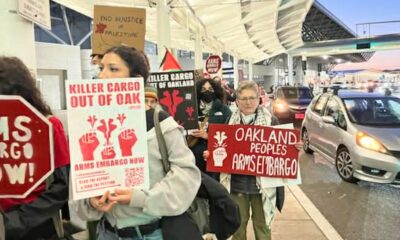
Oakland People’s Arms Embargo Coalition Demands End to Military Shipments Thru Oakland
